


Dominion Strategy: Engine vs. Big Money (and When Each Wins)
Here’s the dirty secret that humbles every new Dominion player: a deck of nothing but Silver, Gold, and one Smithy beats most beginner engines. It’s called Big Money, it takes zero skill, and until you can beat it, you don’t have a strategy — you have a pile of fun cards.
Every Dominion game is a choice between two archetypes. Learn what they are, when each wins, and how to pivot between them, and you’ll beat 90% of casual tables.
Some links below are Amazon affiliate links — as an Amazon Associate, King Panda Games earns from qualifying purchases at no extra cost to you. Full disclosure.
When you’re ready to add to the base game, see the best Dominion expansions — Prosperity is the one we’d buy first, since Platinum and Colony raise the ceiling and make every turn feel like the late game.
Big Money: The Strategy You Must Beat
Big Money is brutally simple: buy the best Treasure you can afford every turn — Silver at 3–5 coins, Gold at 6–7, Province at 8. Add one draw card, usually a Smithy, and nothing else. That’s the whole strategy.
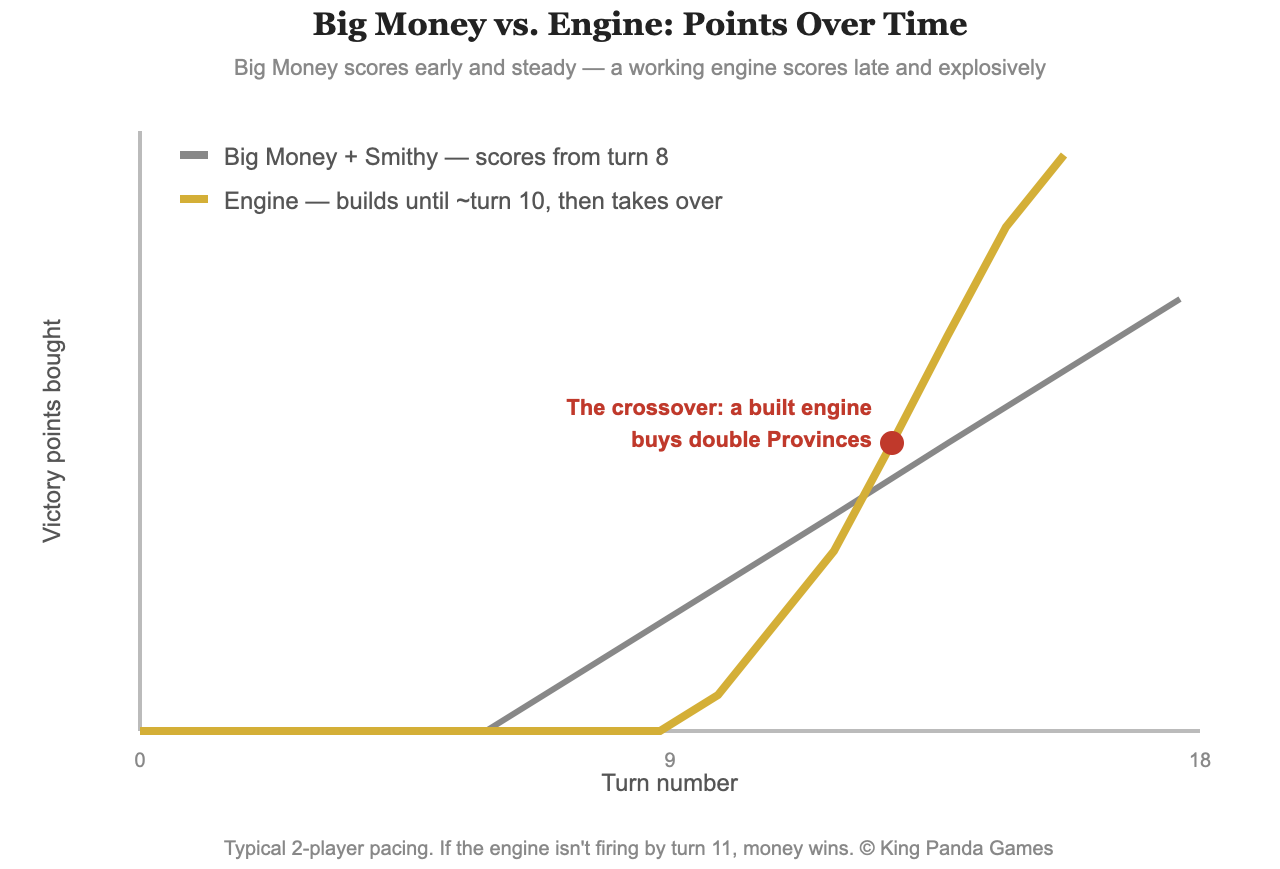
It works because Dominion is a race. Big Money wastes no turns, hits Gold by turn five, and starts buying Provinces around turn eight while engine players are still assembling combo pieces. A pure Big Money deck finishes a typical 2-player game in 15–18 turns.
The rule: Big Money is the benchmark, not the goal. Before buying any Action card, ask — does this beat a Silver right now? If you can’t answer yes, buy the Silver.
Engines: Where the Real Game Lives
“If Big Money is so efficient, why doesn’t everyone just play it?”
Because a working engine beats Big Money — and it isn’t close. An engine deck uses +Action cards (Village, Festival) and +Card draw (Smithy, Laboratory, Council Room) to chain plays until you’ve drawn most of your deck, generating 10+ coins and multiple Buys in a single turn. While Big Money buys one Province, a firing engine buys two.
The catch is time. Engines spend the first six or seven turns buying parts instead of points, and every part has to be drawn together to matter. An engine that “goes off” turn nine wins; an engine still stuttering on turn twelve loses to the player who just bought Silver like a farmer.
The engine checklist, in buy order:
- Trashing first — Chapel or Remodel to remove Coppers and Estates. A thin deck draws its combo pieces reliably; a fat one doesn’t.
- Draw second — Smithy, Laboratory, Council Room. You need to see your whole deck.
- Actions third — Village and Festival, but only as many as your draw cards demand. Villages with nothing to chain into are dead cards.
- Payload last — Gold, Market, and only then Provinces.
Reading the Kingdom: Which Archetype Does This Board Want?
The ten piles hit the table: Smithy, Militia, Moat, Workshop, Bureaucrat, Gardens, Cellar, Chapel, Mine, Moneylender. Look closely — there are no +2 Action cards anywhere. You literally cannot chain Actions on this board. An engine is impossible, so this game is Big Money plus Smithy, and the player who realizes it in turn one beats the player who realizes it in turn six.
That pre-game read is the highest-skill moment in Dominion. Three questions decide it: Is there trashing (Chapel/Remodel)? Is there a Village effect (+2 Actions)? Is there strong draw (Smithy/Laboratory)? Yes to all three: build the engine — it will dominate. Missing the Villages or the draw: lean Big Money and steal cheap improvements. Missing only trashing: a slower “money engine” hybrid usually wins.
Attack cards shift the read too. A Witch on the board almost demands you buy one — every Curse she deals is a dead card in someone’s deck, and the player who skips Witch on a Witch board is playing with a handicap. Our best kingdom cards ranking covers which attacks are worth the slot.
The Pivot: When to Stop Building and Start Scoring
What most players do: keep improving the engine because it finally feels amazing — one more Laboratory, one more Gold, then points.
What actually works: pivoting the moment your deck can reliably produce 8 coins. The first Province you buy starts a clock; from then on, every non-scoring turn is a gift to your opponent. In a 2-player game, when four Provinces are gone, Duchies stop being embarrassing and start being correct.
Endgame math wins more games than opening theory. Track two numbers out loud in your head every turn: Provinces remaining, and the point gap. If you’re ahead, buy points and speed the game toward its end — empty piles on your terms. If you’re behind, you need one more engine turn than feels safe, because tying the leader’s pace loses; you have to out-buy them.
And remember Dominion’s tiebreaker of the heart: the game ends instantly when the third pile empties. Skilled players win losing positions by emptying cheap piles — three Estates and a Copper on your last turn can slam the door while you’re one point ahead. If you’re still deciding whether this level of play sounds like fun or homework, our full Dominion review gives you the honest picture.
Check Dominion: Prosperity price on Amazon →
Looking for another deck-builder? See our best deck-building games list, which compares nine against Dominion and says what each one changes.
Frequently Asked Questions
What is the best strategy in Dominion?
Build an engine when the kingdom supports it — trashing, +Actions, and draw — and default to Big Money with one Smithy when it doesn’t. The best players aren’t loyal to either archetype; they read the ten piles before turn one and pick the one this board rewards.
What is the Big Money strategy in Dominion?
Buy the best Treasure available every turn (Silver, then Gold), add a single Smithy, and buy Provinces the moment you hit 8 coins. It’s the simplest competitive strategy in the game and the benchmark every fancier plan has to beat.
How many Action cards should I buy in Dominion?
Fewer than you want to. A useful test: never own more Action cards than you can play in a typical turn. For a money deck that’s one or two; for a full engine it might be ten — but only because Villages provide the Actions to chain them.
When should I start buying Provinces?
The first turn your deck reliably produces 8 coins — reliably, not luckily. Buying your first Province starts the endgame clock, so make sure your deck can keep scoring afterward rather than producing one great turn and collapsing.
Should I ever buy Copper in Dominion?
Almost never — Copper dilutes every future hand. The rare exceptions are Gardens strategies, where deck size itself scores points, and desperate endgame pile-emptying. If neither applies, a free Copper is usually worse than buying nothing.
How do I beat someone who always plays Big Money?
Build a thin, fast engine on any board that offers trashing, draw, and +Actions — a working engine buys double Provinces and outpaces money decks decisively. On boards without those pieces, don’t fight it: play better Big Money, using attack cards like Militia to slow their good hands.
Next game, try the read before turn one: name the archetype the board wants out loud. Being wrong out loud teaches faster than being quiet and confused.