

Carcassonne Expansions Ranked: Which One Should You Buy First?
Carcassonne has been expanded relentlessly since it launched in 2000. There are currently over a dozen official expansions, plus mini-expansions, promos, and standalone variants. Most of them are fine. A few are genuinely excellent. Two should probably be avoided unless you’re a committed collector.
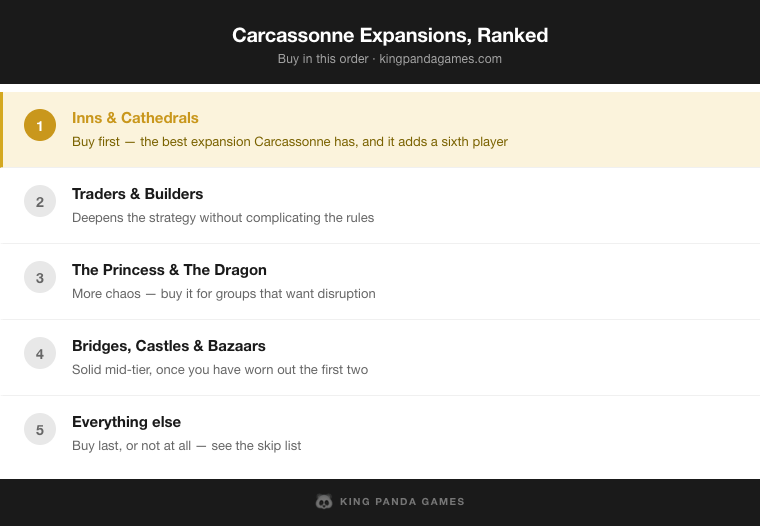
Here’s the ranked breakdown — in the order we’d recommend buying them.
Some links below are Amazon affiliate links — as an Amazon Associate, King Panda Games earns from qualifying purchases at no extra cost to you. Full disclosure.
If you don’t own the base game yet, start with our full Carcassonne review.
First: Inns & Cathedrals (~$20–$25)
Buy this one first. It’s the best expansion Carcassonne has.
Inns & Cathedrals adds two types of special tiles and one extra piece per player. The mechanics are simple:
- Inn tiles sit along road segments and double the value of that road — but only if it completes. If the road is unfinished at game end, inn tiles score zero.
- Cathedral tiles are city tiles placed within a city, and they raise it from 2 points to 3 points per tile and per pennant — but only if the city completes. An unfinished city containing a cathedral scores nothing at all.
- Large meeples (one per player) count as two normal meeples for majority purposes, making them critical in contested features.
Why it works: the inn and cathedral mechanics add real gambling to every placement decision. Do you take the risky road that doubles your points if it finishes, knowing you’ll score zero if it doesn’t? Do you place the cathedral in a city your opponent has a meeple in, making it much harder to complete — and worthless to both of you if it fails? These are tense, meaningful decisions that create drama the base game can’t replicate.
The large meeple adds a powerful tool for settling contested features decisively. Use it correctly once and the impact is immediately obvious.
Inns & Cathedrals also includes tiles for a sixth player. For the price and complexity addition, this is far and away the best value expansion in the Carcassonne line.
Check Inns & Cathedrals price on Amazon →
Second: Traders & Builders (~$20–$25)
Get this second — it deepens the strategic layer without complicating the rules.
Traders & Builders adds two major mechanics:
- Builders: a second follower per player that, when placed in a city or road you already have a meeple in, gives you a bonus turn whenever you extend that feature. Build your city, trigger your builder, place another tile. The bonus turn snowballs development and rewards players who commit to their features.
- Trade goods: cloth, grain, and barrel tokens are attached to certain city tiles. When a city with trade goods completes, the tokens go to whoever scored the city. At game end, the player with the most of each type scores bonus points.
The builder mechanic fundamentally changes mid-game pacing. Having a builder active in a large city means you can rush it to completion before opponents can react — you’re generating extra turns they don’t have. This is the most strategically interesting addition in the expansion line after Inns & Cathedrals.
Trade goods add a quiet secondary objective that influences city targeting. It’s subtle but meaningful — sometimes the city with the most goods is a better target than the largest city.
Check Traders & Builders price on Amazon →
Third: The Princess & The Dragon (~$20–$25)
An interesting expansion with a higher disruption level — buy it for groups that want more chaos.
The Princess & the Dragon adds fairy tale elements: a dragon that moves across the board eating meeples and a fairy that protects a single meeple from the dragon. When a dragon tile is placed, players take turns moving the dragon (it must move six spaces) and it destroys any meeple it lands on.
This is the most aggressive expansion in the core line. Meeples getting eaten mid-feature — including farmers, including carefully placed pieces — adds a chaotic element that some groups love and some groups hate. The fairy provides protection but only for one piece at a time.
Who should buy it: groups that want higher variance, don’t mind losing meeples unexpectedly, and enjoy a more chaotic experience. It’s divisive for a reason — the dragon can swing games heavily, which feels unfair to players who prefer pure strategy.
Who should skip it: two-player groups (the chaos feels less controlled), players who dislike random disruption to long-term plans, or anyone who found the base game perfectly balanced.
Check The Princess & The Dragon price on Amazon →
Fourth: Bridges, Castles & Bazaars (~$20)
A solid mid-tier expansion — worth it if you’ve exhausted Inns and Traders.
This expansion adds three mechanics:
- Bridges let you extend roads over field gaps, opening new placement options where the tile layout would normally end a road.
- Castles give you a choice whenever you complete a two-tile city: take the four points as normal, or drop a castle on it instead. The castle then scores you whatever the next feature completed inside its six-tile fief is worth — and doubles it if that feature is yours too.
- Bazaars add tile auctions mid-game: tiles are laid out face up and players bid victory points for them, with the winner paying those points to the auctioneer.
Bridges are the most practically useful addition — they open up the map in ways that reduce the dead-end frustration of late-game tile draws. Castles are a clever high-risk mechanism (you’re betting on what your opponent will complete nearby). Bazaars are interesting but can slow games noticeably.
Best for groups that have played the first two expansions extensively and want fresh mechanics without going into full expansion overload.
Check Bridges, Castles & Bazaars price on Amazon →
What to Skip (or Buy Last)
Hills & Sheep: Adds sheep tokens and shepherd meeples that score based on flock size. Competent but introduces a tracking overhead that slows turns without adding dramatic decisions. Fine to own eventually, not essential.
The Tower: Adds tower pieces that can capture opponents’ meeples, holding them hostage until a ransom is paid. Thematically fun, strategically frustrating — the hostage mechanic feels punishing in a way that breaks the game’s otherwise clean flow. Most experienced Carcassonne players don’t recommend it.
Catapult: Physically throws tokens across the table to land on tiles and grant scoring bonuses. It’s a party game grafted onto a strategic one. Avoid unless your group explicitly wants a silly physical challenge mechanic.
Abbey & Mayor: Adds abbeys (monastery variants that fill awkward gaps) and mayors (a special meeple for cities only). Competent and clean. If you want to expand your city options, this works — but it’s not essential over the expansions above.
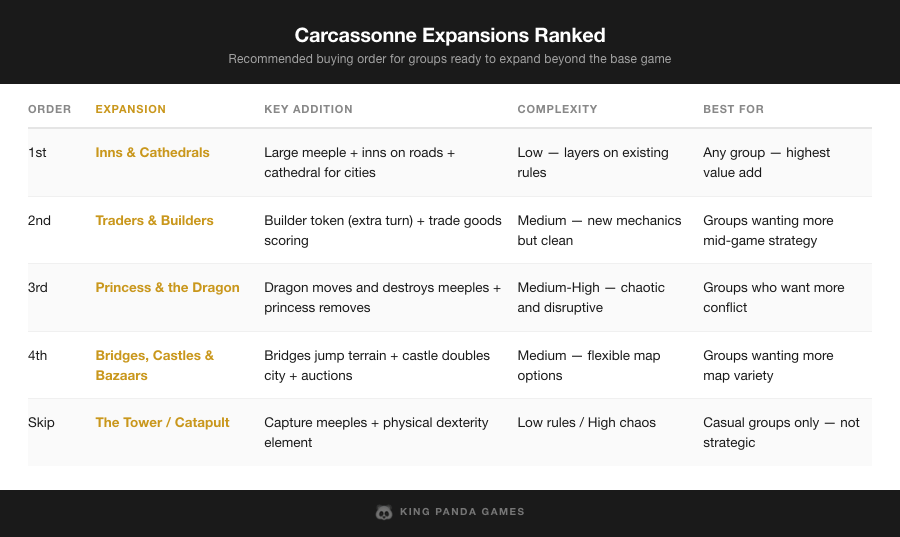
Recommended Buying Order
| Order | Expansion | Why |
|---|---|---|
| 1st | Inns & Cathedrals | High risk/reward decisions, large meeple, best value |
| 2nd | Traders & Builders | Builder mechanic changes mid-game strategy meaningfully |
| 3rd | Princess & The Dragon | For groups that want more chaos and disruption |
| 4th | Bridges, Castles & Bazaars | Opens up map flexibility, auction mechanic |
| Skip/last | Tower, Catapult | Disruptive or gimmicky — not for strategic play |
Start with the base game and play it enough to feel the constraints. Then Inns & Cathedrals. Between those two, you have more Carcassonne than most groups ever need.
Frequently Asked Questions
Which Carcassonne expansion should I buy first?
You absolutely must start with Inns & Cathedrals. It's the best expansion in the entire Carcassonne line, adding crucial strategic depth and player interaction without overcomplicating the game. Its mechanics introduce tense, meaningful decisions that elevate the base game dramatically.
Is Carcassonne Inns & Cathedrals worth it?
Yes, Inns & Cathedrals is unequivocally worth it. For its modest price, it introduces game-changing mechanics like Inns, Cathedrals, and the Large Meeple, which inject exciting risk-reward decisions and powerful tools for contested features. It also expands the player count to six, making it an incredible value.
What does the Inns & Cathedrals expansion add to Carcassonne?
Inns & Cathedrals introduces special Inn and Cathedral tiles, along with a powerful Large Meeple for each player. Inns double road scores if completed, while Cathedrals boost city values, but both score zero if left unfinished, creating thrilling high-stakes plays. The Large Meeple acts as two regular meeples, providing a decisive edge in majority battles.
Does Carcassonne Inns & Cathedrals make the game too complicated?
Not at all; Inns & Cathedrals strikes a perfect balance, enhancing the game's depth without bogging it down with excessive rules. The new mechanics are intuitive and quickly grasped, yet they open up a whole new layer of strategic gambling and player interaction that feels incredibly natural. It truly makes the base game better, not just bigger.
How many Carcassonne expansions are there?
There are currently over a dozen official Carcassonne expansions, not including numerous mini-expansions, promos, and standalone variants. While many are 'fine,' King Panda Games strongly advises focusing on the genuinely excellent ones, starting with Inns & Cathedrals, and avoiding a couple that aren't worth your time unless you're a dedicated collector.
Do all Carcassonne expansions improve the game?
Absolutely not; this is a common misconception among new players. While some expansions, like Inns & Cathedrals, are genuinely excellent and transform the game for the better, many are merely 'fine,' and a couple should be actively avoided unless you're a completionist. It's crucial to choose wisely to enhance your experience, not dilute it.
What is the 'Large Meeple' in Carcassonne Inns & Cathedrals?
The Large Meeple is a powerful new piece included in Inns & Cathedrals, with one provided for each player. It counts as two normal meeples for the purpose of determining majority in contested features like roads, cities, or monasteries. This makes it an incredibly impactful tool for decisively claiming valuable features or challenging opponents' control.