
Sea Salt & Paper vs. Sushi Go: Which Should You Buy?
Both games fit in a jacket pocket, teach in under five minutes, and play in under 30. Both are colorful set-collection card games with art that makes non-gamers stop and ask what you’re playing. Both get recommended in the same breath by every “gateway game” list on the internet.
Some links below are Amazon affiliate links — as an Amazon Associate, King Panda Games earns from qualifying purchases at no extra cost to you. Full disclosure.
They’re not the same game. Buying the wrong one means playing a game that half your group finds either too random or not random enough — and there’s a clear answer for most groups if you know what to look for.
If you’ve already decided on Sea Salt & Paper, check out our full review for the complete breakdown.
How Each Game Actually Works
 Sushi Go comparison table” class=”wp-image”/>
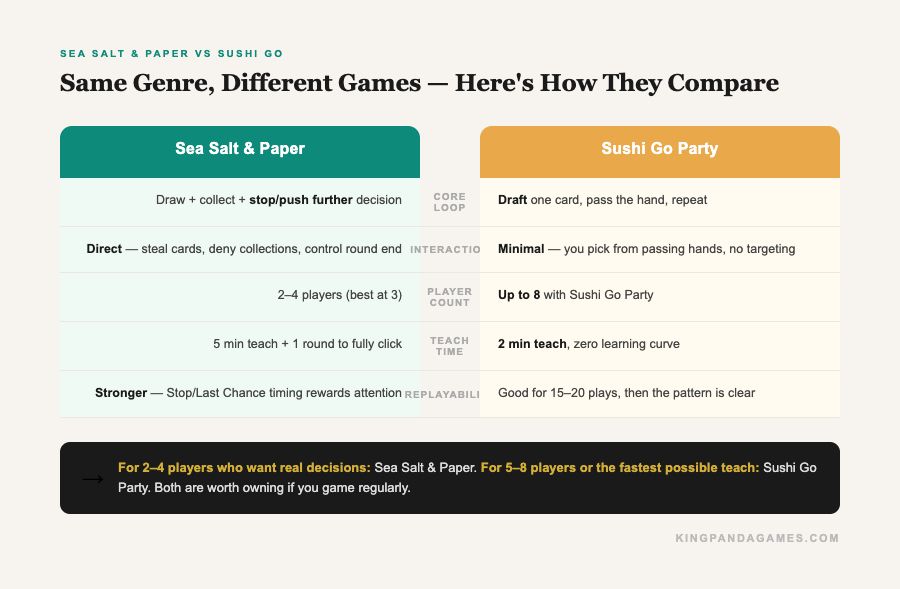
Sushi Go is a drafting game. Everyone starts with a hand of cards, picks one, and passes the rest to the player to their left. You keep picking until all cards are gone. Score the round, deal again, repeat three times. The mechanic is clean and fast — the decisions are entirely about which card to take from the hand you receive.
Sea Salt & Paper is a draw-and-collect game. On your turn, take a card (either the top discard or blind from the deck), optionally play a pair for a point and a power, and manage when to end the round. The interaction happens through card steals, deliberate denials, and the Stop vs Last Chance decision that one player controls and everyone feels.
The difference in feel is immediate. In Sushi Go, you’re mostly reacting to what arrives in your hand. In Sea Salt & Paper, you’re making active choices about what to build, what to deny, and when to cash in.
The Interaction Question
Sushi Go has almost no direct player interaction. You pick cards from a hand that’s moving around the table, so you might take something an opponent wants — but you’re not targeting anyone, and nobody can target you. The game is essentially a simultaneous puzzle everyone is solving with the same rotating pieces.
Sea Salt & Paper has direct interaction baked into the core. The boat pair lets you steal any card from an opponent’s hand. The swimmer + shark pair lets you look at a hand and take one card. The fish pair takes from the discard before anyone else can. And the Stop/Last Chance decision is the most interactive moment in either game — one player unilaterally ends the round and controls whether everyone gets to score their color bonuses.
What Sushi Go does well: Zero conflict. Nobody gets targeted, nobody loses cards they had in hand, and the losing player can’t point to a single opponent decision as the reason they fell behind. This makes Sushi Go genuinely frictionless — perfect for groups where direct competition creates tension at the table.
What Sea Salt & Paper does well: Meaningful agency. Every good play in Sea Salt & Paper is a decision — not just “which card is worth more points” but “which card hurts my opponent more,” “is now the right time to stop,” and “do I build my color group or my collector set this turn.” Players who want to feel like their decisions matter will feel it more in Sea Salt & Paper.
Player Count and Group Size
Sushi Go plays 2–5 players in the base game. Sushi Go Party — the expanded tin version — plays up to 8. If you need to accommodate 6+ players, Sushi Go Party is the only game in this comparison that can handle it.
Sea Salt & Paper plays 2–4. At 4 players, it’s still good, but rounds can end before slower-drawing players have built meaningful hands — the variance is slightly higher at 4 than 3. At 2 and 3, Sea Salt & Paper is arguably better than Sushi Go at both counts.
If your group regularly hits 6+ people, Sushi Go Party is the practical answer and it’s not close. If your group is 2–4 and wants the better game for that count, Sea Salt & Paper wins.
Learning Curve and Teach Time
Both games teach in under 5 minutes. The Sushi Go rules are slightly simpler to verbalize: “pick a card, pass the hand, repeat.” Sea Salt & Paper requires explaining the Stop vs Last Chance mechanic, which takes an extra two minutes and one demonstration round to fully click.
Teaching Sushi Go for the first time: “Take one card, pass the rest. Score at the end. Three rounds.” Done. Teaching Sea Salt & Paper for the first time: “Draw a card, optionally play a pair, and if you have enough points you can end the round — but you have to decide whether you want just your bonus or to let everyone score theirs.” The first person to call Last Chance for the first time will always ask a follow-up question. One demonstration turn usually answers it. By round 2, everyone has it.
For groups that are skeptical of new games or have limited patience for rules explanations, Sushi Go is marginally easier to get on the table. Once they’re playing, Sea Salt & Paper is more engaging — but you have to get there first.
Replayability
Sushi Go is less replayable than Sea Salt & Paper. The drafting mechanic is elegant but shallow — after 15–20 plays, experienced players have internalized most of the card values and the game’s strategic ceiling becomes visible. The Party version helps by offering different card combinations, but the core loop stays the same.
Sea Salt & Paper varies round to round based on how collectors appear, who’s building what, and when rounds get called. The strategic depth is also modest, but the Stop/Last Chance timing keeps producing new situations — you can play 30+ sessions and still hit a moment where you genuinely don’t know whether to call Stop or ride it out.
Which Should You Buy?
Buy Sea Salt & Paper if:
– Your group is 2–4 players most of the time
– You want decisions that feel meaningful, not just pattern-matching
– You like the idea of a game where timing and reading opponents matters
– You want something that rewards a few plays without requiring dozens
Check Sea Salt & Paper price on Amazon →
Buy Sushi Go Party if:
– You regularly play with 6+ people
– You want zero conflict and no direct targeting
– You need the fastest possible teach time with zero learning curve
– You want to play three rounds and move on to something else
Check Sushi Go Party price on Amazon →
Buy both if:
– You game regularly and want different tools for different group sizes and moods
– You want a low-conflict option for one audience and an interactive option for another
The honest answer for most groups: Sea Salt & Paper is the better game. Sushi Go Party is the more practical game for large groups. They’re not competing for the same occasion — which is why the choice usually comes down to how many people you’re regularly playing with, not which game is technically superior.
See also: our picks for the best card games for adults if you’re still exploring the genre.
Frequently Asked Questions
Is Sea Salt & Paper better than Sushi Go?
Sea Salt & Paper gives players more meaningful decisions — particularly the Stop vs Last Chance call and the active card denial through steals. Sushi Go is simpler and plays larger groups (up to 5 in the base game, 8 in the Party edition). If you want genuine strategic tension, Sea Salt & Paper is the better game. If you need to accommodate 6+ players, Sushi Go Party has the edge.
What is the main difference between Sea Salt & Paper and Sushi Go?
The core mechanical difference is interaction. Sushi Go is a drafting game — you pass hands and pick one card, so player interaction is minimal. Sea Salt & Paper has direct interaction through card steals and the Stop/Last Chance decision. Sea Salt & Paper rewards reading opponents; Sushi Go rewards pattern recognition across the card set.
Which is better for families, Sea Salt & Paper or Sushi Go?
Both work well for families. Sushi Go is slightly easier to teach and plays more players without an expansion. Sea Salt & Paper has more interesting decisions and is better for families with older kids (10+) who can track what opponents are building. For younger kids or large family gatherings, Sushi Go Party is the more practical choice.
Can you own both Sea Salt & Paper and Sushi Go?
Yes — they serve different occasions. Sea Salt & Paper is better for focused 2–3 player sessions where you want real decisions. Sushi Go Party is better for larger groups or when you need something you can explain in 90 seconds. They’re distinct enough that owning both makes sense if you game regularly.