

Ghost Stories vs Pandemic: Which Cooperative Board Game Should You Buy?
If you’ve decided you want a cooperative board game, you’ve probably landed on two names: Ghost Stories and Pandemic. They’re the most talked-about games in the category. They’re both highly rated. They’re both genuinely good.
Some links below are Amazon affiliate links — as an Amazon Associate, King Panda Games earns from qualifying purchases at no extra cost to you. Full disclosure.
They are not, however, the same kind of game — and which one you’ll enjoy more depends entirely on what your group is looking for.
This is our honest comparison. We’ve played both extensively. We’re going to give you a real answer, not “it depends on your preferences.”
Before diving in: if you want the full breakdown on Ghost Stories specifically, read our Ghost Stories review. This guide assumes you’re familiar with how both games work at a basic level.
The Short Answer
Buy Pandemic if: You’re new to cooperative games, you want something you can learn in one session, or you prefer strategic planning over reactive survival.
Buy Ghost Stories if: You already like co-ops and want a harder challenge, you enjoy learning a game over multiple sessions, or your group communicates well under pressure.
Buy both if: You play cooperative games regularly and want different experiences depending on the mood. They fill different roles in a collection.
How the Games Feel Different
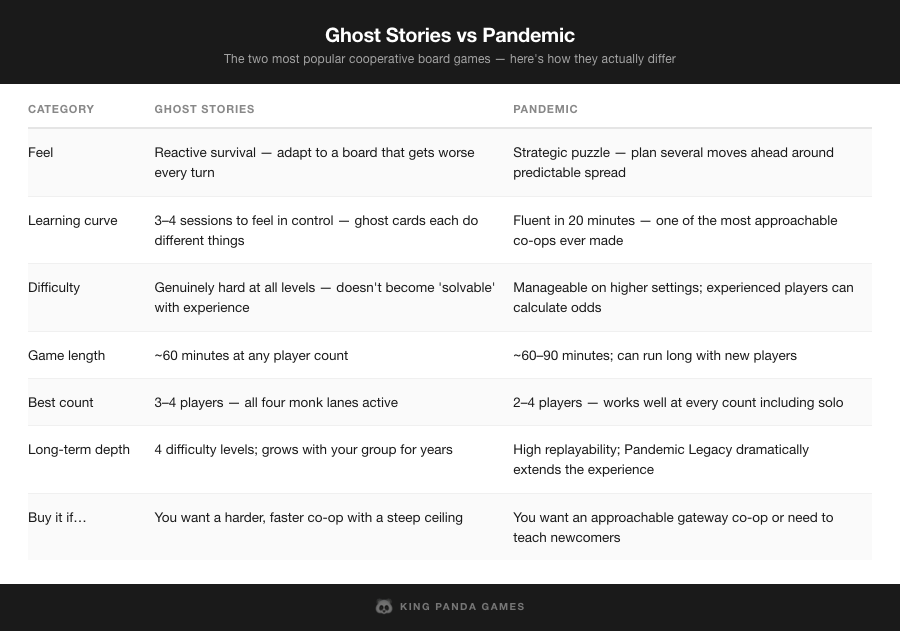
Pandemic feels like a puzzle. You’re looking at a world map, tracking disease spread, and making calculated decisions about the most efficient use of your actions. Experienced Pandemic players think several turns ahead. The randomness — where disease outbreaks happen — is manageable enough that you can plan around it. Wins come from executing a well-reasoned plan. Losses usually come from being out-resourced or making a miscalculation.
Ghost Stories feels like survival. You’re reacting to a board that gets worse every single turn, making the best decisions you can with limited information. The ghost deck has genuine chaos in it — bad draws stack fast and you can’t fully plan around them. Wins come from adapting quickly, coordinating your monk powers, and getting a little lucky at the right moment. Losses often feel like being overwhelmed by forces you couldn’t stop even with good decisions.
Neither of these is better. They’re different games that satisfy different moods.
Learning Curve
Pandemic is one of the most approachable gateway cooperative games ever designed. The turn structure is simple, the mechanics are intuitive, and most groups are playing fluently within the first twenty minutes of their first session. There’s a reason Pandemic is one of the best-selling board games of the past twenty years — it’s genuinely easy to teach.
Ghost Stories is harder to learn. Not because the turn structure is complicated — it’s actually similar in length and logic to Pandemic’s — but because the ghost cards each do different things, the monk powers require coordination to use well, and the game punishes misplays quickly. Most new groups need three or four sessions before they feel like they understand what’s actually happening.
If you need a game your group can pick up and enjoy on the first play, Pandemic wins this category decisively.
Difficulty
Pandemic has difficulty levels (number of epidemic cards), and on higher settings it’s genuinely hard. But here’s the honest truth: once a group has played Pandemic twenty or thirty times and understands the system, the game becomes solvable. Experienced Pandemic players can look at a board state and calculate the odds of a win. The randomness gets predictable enough to manage.
Ghost Stories doesn’t get solvable in the same way. It has four difficulty levels — Initiate through Master — and even Initiate punishes groups that aren’t paying attention. Veteran is hard for players who have dozens of plays. Master is genuinely punishing for anyone.
If your group is looking for a long-term challenge that stays difficult as you get better, Ghost Stories has significantly more ceiling.
Player Count
Pandemic plays 2–4, works well at every count, and has an excellent solo mode that doesn’t change the mechanics.
Ghost Stories plays 1–4 and works best at 3–4. At 3–4, all four monk lanes are active and the full coordination game is in play. At 2, you run two monks each and lose some of the lane-coverage dynamics. Solo has you running all four monks simultaneously, which is a legitimate experience but a fundamentally different one — more of a solo puzzle than a team game.
If you mostly play with 2 or play solo, Pandemic is the more consistent experience.
Replayability
Pandemic is highly replayable because the disease spread creates different board states every game. The roles (character special abilities) add variation. Expansions like Pandemic Legacy dramatically extend the game’s life.
Ghost Stories is highly replayable for different reasons — the ghost deck creates genuinely different situations, the monk combinations create different coordination puzzles, and the difficulty system means the game can grow with your group for years. There are also expansions (White Moon adds helpful mechanics; Black Secret adds a hidden traitor mode) that substantially change the experience.
Both games are strong on replayability. This category is a tie.
Price and Value
Both games are in the $40–$50 range at most retailers. Both give you a complete game for that price. Neither requires expansions to be enjoyable, though expansions exist for both. Be careful shopping for Pandemic’s, though — only three of the many boxes carrying its name actually expand the base game, which we sort out in Pandemic expansions ranked.
On raw hours-per-dollar: Ghost Stories runs about 60 minutes per session. Pandemic runs 45–60 minutes per session. Both are good value.
The Honest Verdict
Most people should buy Pandemic first. It’s easier to teach, works at more player counts, and is satisfying from the very first game. It’s genuinely one of the best cooperative games ever designed at the accessible end of the spectrum.
Ghost Stories is what you buy after Pandemic if Pandemic starts feeling comfortable. It’s not a better game — it’s a harder game. The distinction matters. Pandemic at its best is elegant and satisfying. Ghost Stories at its best is brutal and exhilarating. Both of those things are worth experiencing.
If your group has already played Pandemic twenty times and is looking for the next challenge: buy Ghost Stories. Start on Initiate, check out our difficulty guide before your first session, and prepare to lose a lot before you start winning.
It’s worth it.
Check Pandemic price on Amazon →
Check Ghost Stories price on Amazon →
Frequently Asked Questions
Which cooperative game is better for new players, Ghost Stories or Pandemic?
Pandemic is undeniably the superior choice for newcomers to cooperative board games. Its rules are easier to grasp in a single session, and its strategic puzzle-solving offers a more forgiving introduction compared to Ghost Stories' brutal, reactive challenge.
How different is the difficulty between Ghost Stories and Pandemic?
Ghost Stories is significantly harder than Pandemic, offering a much steeper challenge. While Pandemic requires strategic planning around manageable randomness, Ghost Stories demands constant adaptation to genuine chaos and unforgiving draws, making wins feel like a hard-earned survival.
Should I buy both Ghost Stories and Pandemic for my game collection?
If you regularly play cooperative board games, buying both Ghost Stories and Pandemic is highly recommended. They fill different roles: Pandemic for accessible strategic planning and Ghost Stories for intense, reactive survival, ensuring a diverse cooperative experience.