


Some links below are Amazon affiliate links — as an Amazon Associate, King Panda Games earns from qualifying purchases at no extra cost to you. Full disclosure.
Bunco is one of the easiest games you’ll ever learn. If you can roll three dice and spot which ones match a number, you can play. There are no decisions and no strategy, so nobody at the table has an edge over a first-timer. It gets our top score for ease, 5/5 Bamboo from Eric, who has played it.
This guide covers both sides of a first Bunco night: playing it, in the order it happens from the door to the prizes, and hosting it, from the invitations to handing out prizes. Each half has a free one-page printable. For every rule and variation, see how to play Bunco.
If You’re Playing
Print this cheat sheet and bring it along, or keep it open on your phone.
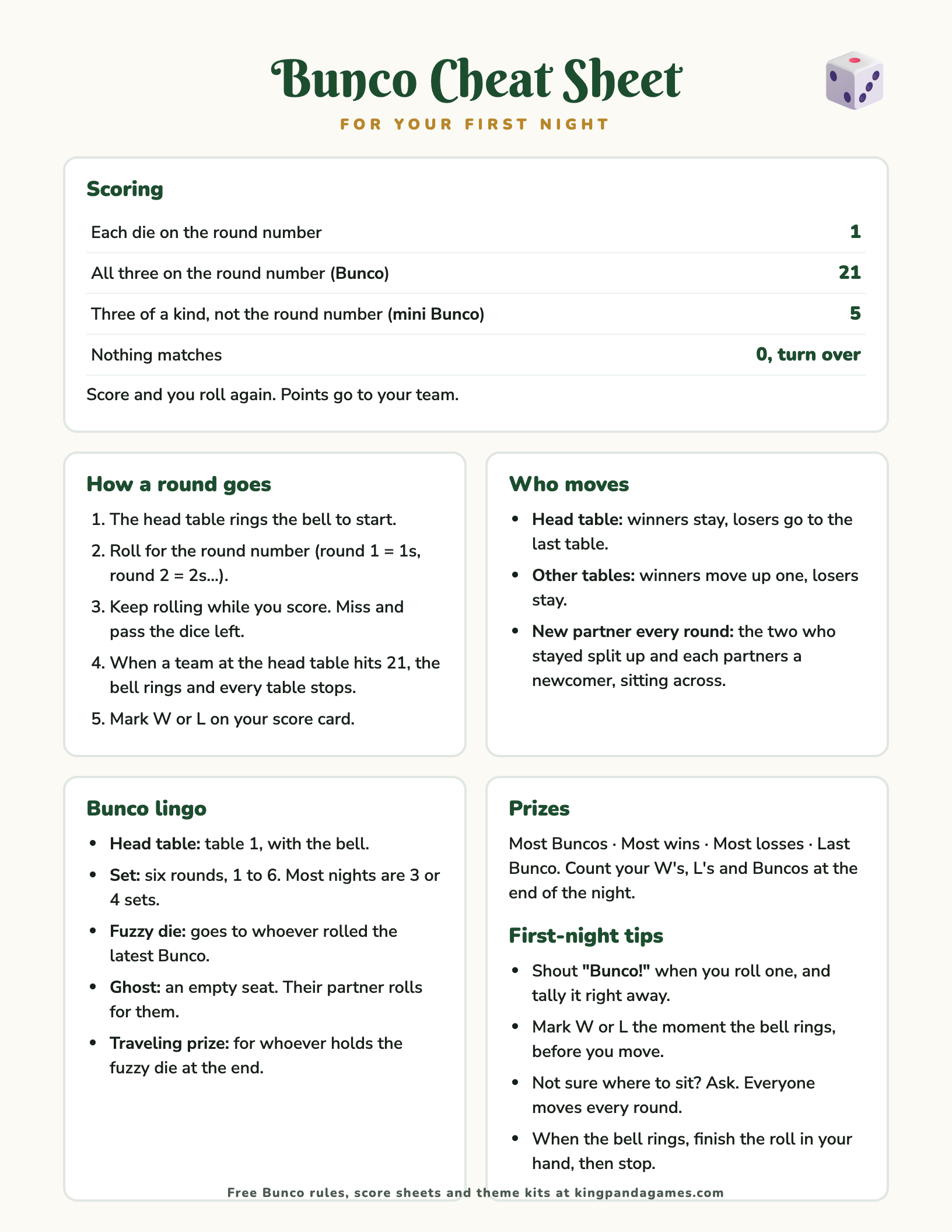
Download the cheat sheet (PDF)
Before You Go
- Bring the buy-in. Most groups collect a few dollars a person for prizes, often $5, as in the groups the Seattle Times and Honolulu Advertiser wrote about. Cash is easiest.
- Ask if it’s potluck. Many groups share food, so check whether you should bring a dish.
- Check for a theme. Some groups dress up for the month. Our Bunco themes page shows the kinds of things people do.
- Leave the dice at home. The host has them.
When You Arrive
You’ll get a score card with your name on it. Keep it with you all night, because you’ll carry it from table to table.
There are usually three tables of four, the standard setup described in Wikipedia’s Bunco entry. Table 1 is the head table, and it has a bell. The person across from you is your partner for the round, and the two people beside you are the other team. For the first round, sit wherever the host points you.
Your First Round, Step by Step
- The head table rings the bell. Everyone starts at once.
- Check the round number. Round 1, you want 1s. Round 2, you want 2s. And so on up to 6.
- Roll all three dice. You get a point for every die showing the round number.
- Keep rolling while you score. Roll nothing useful and your turn is over. Pass the dice to your left.
- Your points go to your team. You and your partner add together. Someone at the table keeps a running tally.
- Listen for the bell. When a team at the head table hits 21, it rings and every table stops. Finish the roll in your hand, then stop.
- Mark your card. W if your team had more points at your table, L if it didn’t.
Here’s what one turn looks like:

In words, it’s round 3, so you want 3s:
- You roll 3, 5, 1. One 3, so 1 point. You scored, so roll again.
- You roll 3, 3, 6. Two 3s, so 2 more points. Roll again.
- You roll 2, 2, 2. Three of a kind that isn’t 3s is a mini Bunco: 5 points. Roll again.
- You roll 4, 6, 1. No 3s. Your turn ends with 8 points for your team, and the dice go to the player on your left.
The two big rolls: three dice all on the round number is a Bunco, worth 21 points. Shout “Bunco!” and mark it on your card, because Buncos usually win a prize. Three of a kind that isn’t the round number is a mini Bunco, worth 5. A Bunco is rare, about 1 roll in 216, so it’s a big moment when it happens.
Then Everyone Moves
After every round, people change tables:
- At the head table, the winners stay and the losers go to the last table.
- At every other table, the winners move up one table and the losers stay put.
Then each table forms new teams, so you get a new partner every round. If you’re unsure where to go, just ask. The full rotation rules have a diagram.
The Rest of the Night
After round 6, a set is over and the next one starts back at round 1. Most groups play three or four sets, with a break for food in the middle. A night usually runs two to three hours. The four-set, 24-round format is the one a 2007 Pleasanton Weekly story credits to the World Bunco Association.
At the end, everyone counts their wins, losses and Buncos. The usual prizes are for the most Buncos, the most wins, the most losses and the last Bunco of the night. Some groups add a door prize drawn by name. Our Bunco prize guide has the full list.
Bunco Lingo
- Head table: table 1, with the bell. It controls when rounds start and end.
- Bunco: all three dice on the round number. 21 points.
- Mini Bunco (or baby Bunco): three of a kind that isn’t the round number. Usually 5 points.
- Set: six rounds, 1 through 6.
- Fuzzy die: a plush die that goes to whoever rolled the latest Bunco.
- Traveling prize: the prize for whoever holds the fuzzy die at the end.
- Ghost: an empty seat when the group is short. The ghost’s partner rolls for them.
Beginner Mistakes to Avoid
- Rolling for the wrong number. The target changes every round. Glance at the round number before your first roll.
- Forgetting to mark your card. Do it the moment the bell rings, before you move. It’s easy to lose track by round 4.
- Rolling after the bell. Finish the roll in your hand, then stop.
- Calling three of a kind a Bunco. It’s only a Bunco if all three show the round number. Otherwise it’s a mini Bunco.
- Staying quiet about a Bunco. Shout it and tally it, so it counts toward the prize.
What Queen Panda Wishes She’d Known
Queen Panda (Eric’s wife), who has played in a monthly Bunco group for three years, started as a sub. What threw her at first:
- Every group plays a little differently. The core game is the same, but some groups score extras, like a straight (1, 2, 3). Ask about house rules before the first roll.
- It’s fast. Rounds go quickly, and keeping track of where you move takes a couple of rounds to get used to.
- The prizes are a bonus. She goes for the social side, and says the prizes have introduced her to things she wouldn’t have bought for herself.
If You’re Hosting
Most Bunco groups take turns hosting, so sooner or later it’s your night. Hosting is mostly logistics: the right number of people, the right supplies on each table, and someone keeping the night moving. Here’s the whole job in order, plus a printable checklist with a space to track RSVPs.
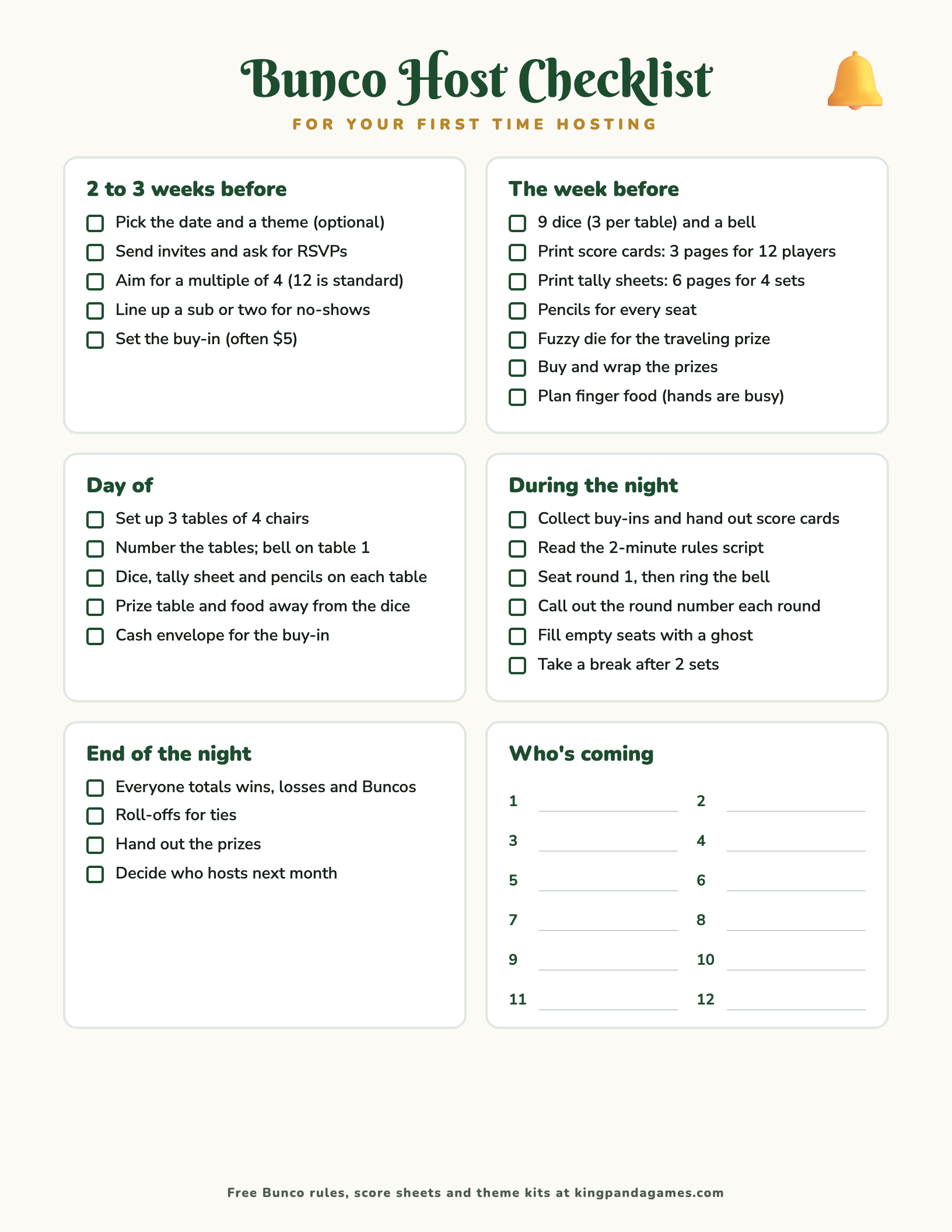
Download the host checklist (PDF)
Two to Three Weeks Before
- Pick a date, and a theme if you like. Themes are optional, but they make food and prizes easy to plan. Our Bunco themes page has 50 ideas by month.
- Send the invitations. Ask for RSVPs by a set date. Our Christmas Bunco kit has an invite you can fill in on your phone and text to the group.
- Get to a multiple of four. Twelve is the standard: three tables of four. Eight works with two tables, and sixteen with four.
- Line up a sub or two. Cancellations happen, and a spare friend saves you from playing with an empty seat.
- Set the buy-in. Most groups use $5 a person and spend all of it on prizes.
The Week Before
- Dice and a bell: three dice per table and one bell for the head table.
- Printables: score cards (one per player) and tally sheets (one per table per set). Our free Bunco score sheets print three pages of cards and six of tally sheets for 12 players and four sets.
- Pencils for every seat, plus a few spares.
- A fuzzy die for the traveling prize.
- Prizes: play to your strengths. When Queen Panda first hosted, a friend told her to pick prizes she knows, so she’s done a gardening theme and a sleepover theme. Buy and wrap them. Our Bunco prize guide has lists for $25, $50 and $100.
- Food: plan finger food. Players’ hands are busy with dice and pencils all night.
Host supplies

Continuum Games Box of Bunco ↗
Three sets of dice, a bell and score pads in one box, which covers a 12-player night.

If your set has no bell, a loud desk bell does the job.

Pink plush dice (Bunco fuzzy die) ↗
For the traveling prize.
Setting Up the Room
- Three tables, four chairs each, with enough room between tables for people to move every round.
- Number the tables. Table 1 is the head table. Put the bell there.
- Use real chairs, not the sofa. The first time Queen Panda hosted, people sat on the sofa at the tables, which made getting up to change tables awkward. Folding or dining chairs at table height work much better.
- On every table: three dice, a tally sheet, pencils, and a dice mat. Her group started using padded mats recently because dice kept sliding off kitchen counters, and every table surface rolls a little differently.
- Keep food and prizes on a separate table, away from the rolling.
- Have an envelope ready for the buy-in money.
The Two-Minute Rules Script
New players learn fastest by hearing it once and then playing. Read this aloud before the first round:
“Here’s all you need to know. There are six rounds, and the round number is what you’re rolling for. In round 1 you want 1s, in round 2 you want 2s. Roll all three dice. Every die showing the round number is a point, and if you score, you keep rolling. When you miss, pass the dice to your left.
Three of a kind that isn’t the round number is a mini Bunco, worth 5. All three on the round number is a Bunco, worth 21. Yell it and mark it on your card, because Buncos win prizes.
Your partner sits across from you, and your points go together. When a team at the head table reaches 21, I ring the bell and everyone stops. Mark a W or an L on your card. Winners move up a table, head-table losers go to the last table, and you get a new partner every round. Let’s roll.”
Running the Night
- Call the round number when you ring the bell to start each round. It’s an easy thing for new players to lose track of.
- If someone doesn’t show, fill the seat with a ghost: the ghost’s partner rolls for both. Try to keep it to one ghost. If you’re short two or more people, call a sub.
- If someone arrives late, they can take the ghost’s seat at the start of the next round.
- Take a break after two sets for food and drinks. Most nights run three or four sets, about two to three hours in all.
- Expect the social part to take time. In Queen Panda’s group, people arrive between 8 and 8:30 for food and catching up, play starts around 9, the game wraps up by about 10:15, and then come prizes and more chatting.
- Keep the pace up. The bell ends a round for everyone, so don’t wait for slow tables to finish their turns.
Ending the Night
- Everyone totals their score card: wins, losses, Buncos and mini Buncos.
- Settle ties with a roll-off. One simple way: each tied player rolls three dice, and the highest total wins.
- Hand out the prizes: most Buncos, most wins, most losses, and last Bunco (whoever holds the fuzzy die). Add a door prize if your budget allows.
- Decide who hosts next month before anyone leaves.
Frequently Asked Questions
What should I wear to Bunco?
Whatever you'd wear to a friend's house for dinner, unless the group has a theme that month. Then expect costumes, team colors or ugly sweaters, and it's fine to ask the host how far people go.
How much does it cost to host Bunco?
Less than you'd think. The buy-in usually pays for the prizes, so the host's costs are food and, the first time, supplies: dice, a bell and a fuzzy die, which one boxed set covers. Score sheets and tally sheets you can print free.
Can kids play Bunco?
Yes. The only skill is spotting which dice match a number from 1 to 6, so kids who can count can play. It works well as a family game night.