Your $3,000 bid is about to cost you $2,000 for the worst card on the table. This guide works through what each decision in For Sale actually costs, using the card counts in our Eagle-Gryphon box and plain arithmetic.
Some links below are Amazon affiliate links — as an Amazon Associate, King Panda Games earns from qualifying purchases at no extra cost to you. Full disclosure.
Want the box first? Eagle-Gryphon’s For Sale page has the details, and Board Game Arena lets you try it free. New to the game? Start with how to play For Sale, or our full For Sale review if you’re still deciding whether to buy it.
Your Coins Are Worth Less Than You Think
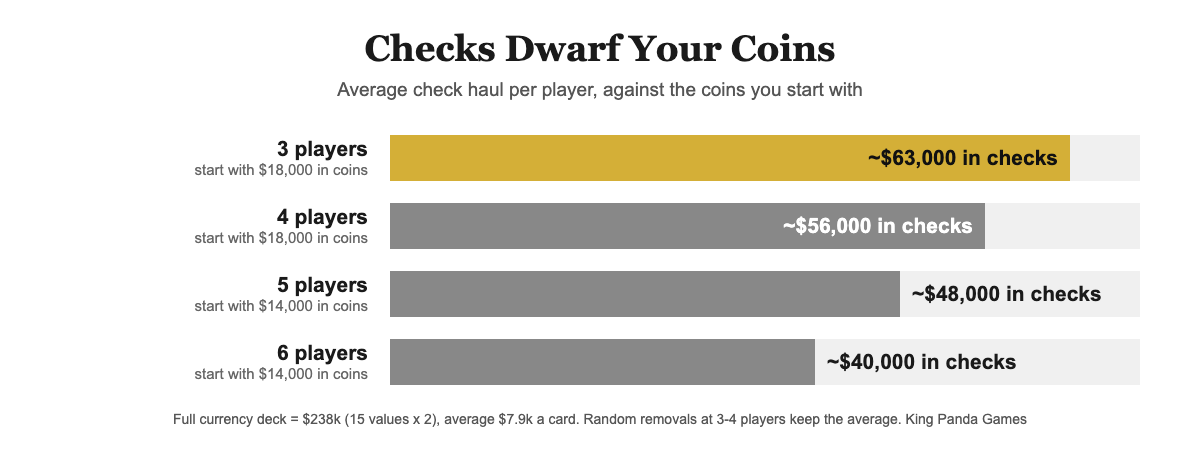
Checks decide For Sale, not coins. The 30 currency cards add up to $238,000, an average of about $7,900 each. Every player ends up with one check per property they bought, so the average player’s check haul is several times their starting money.
| Players | Starting coins | Properties each | Average checks each |
|---|---|---|---|
| 3 | $18,000 | 8 | about $63,000 |
| 4 | $18,000 | 7 | about $56,000 |
| 5 | $14,000 | 6 | about $48,000 |
| 6 | $14,000 | 5 | about $40,000 |
At three players, you start with $18,000 and the average player collects about $63,000 in checks. At six, it’s $14,000 against about $40,000. Removing cards at 3 and 4 players doesn’t change those averages, because the removed cards are random.
The rule: spend coins to get properties that win you checks. A coin saved only matters if it wins you a tie or keeps you from buying a property that will lose every sale.
That doesn’t make coins worthless. Leftover coins count at face value, and a tie goes to the player with more of them. But a player who hoards coins and ends up with a hand of 2s and 5s will lose to someone who spent freely on 20s.
What a Pass Really Costs
Four cards are up: the 27, 19, 11 and 3. You opened at $1,000 and someone raised. If you pass now, you lose your whole $1,000, because half of $1,000 rounds down to zero, and you get the 3.
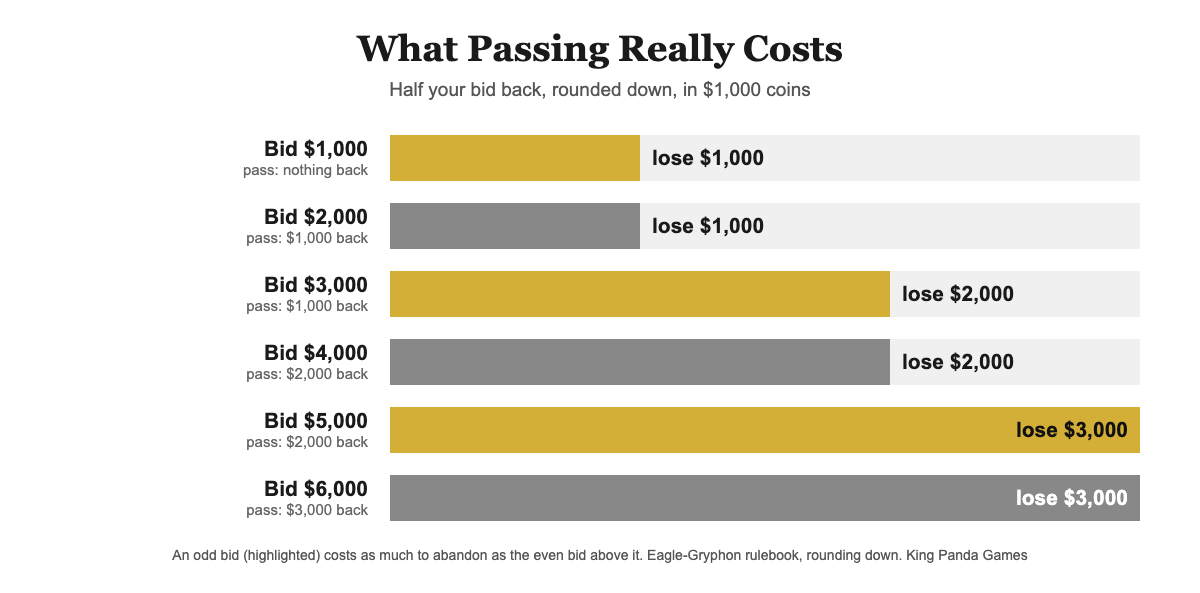
The refund is half your bid rounded down, and coins come in $1,000 units, so the cost of dropping out jumps around. Here’s what you lose by passing at each bid:
| Your bid | Back when you pass | You lose |
|---|---|---|
| $1,000 | nothing | $1,000 |
| $2,000 | $1,000 | $1,000 |
| $3,000 | $1,000 | $2,000 |
| $4,000 | $2,000 | $2,000 |
| $5,000 | $2,000 | $3,000 |
| $6,000 | $3,000 | $3,000 |
Two things follow from that table. First, a $1,000 opening bid is a bad bluff: it costs the same as a $2,000 bid if you fold, but it tells the table less. Second, every odd bid costs as much to abandon as the even bid above it. If you’re bidding to push someone else’s price up and plan to drop out, stop on an even number.
Free Cards Are Part of the Plan
Passing before you bid anything costs nothing and still gets you the lowest property on the table. It feels like giving up, but the selling half needs low cards too.
Each selling round has one check per player, and the lowest property takes the lowest check. If you play a 2 into a round where the lowest check is $0, you lose very little. If you play your 17 there because you have nothing lower, you’ve wasted a good card.
The tempting play: Fight for a mid-value card in every round, so you never come away with a bad property.
What actually works: Take two or three free low cards over the first half and spend the coins you saved on the rounds with a 25 or higher on the table. Your hand ends up with a few sure winners and a few cards to dump on bad rounds.
Track What’s Out There
Every property goes up for auction face up, so by the second half everyone has seen every card that’s in the game. At 5 and 6 players, nothing is removed, so you can know exactly which numbers each opponent holds if you pay attention.
That matters most for your middle cards. Say you hold the 20 and you know the 21 through 30 are all gone except one card in a player’s hand. Your 20 is then the second-best card left, and you can plan for it to win the second-highest check.
At 3 and 4 players, some cards were removed unseen, so you can only be sure about the cards that were auctioned. Treat the gaps as uncertain, not as cards someone is hiding.
When to Play Your Best Property
In the second half, only the order of the properties matters. A property doesn’t earn more for winning by a lot.
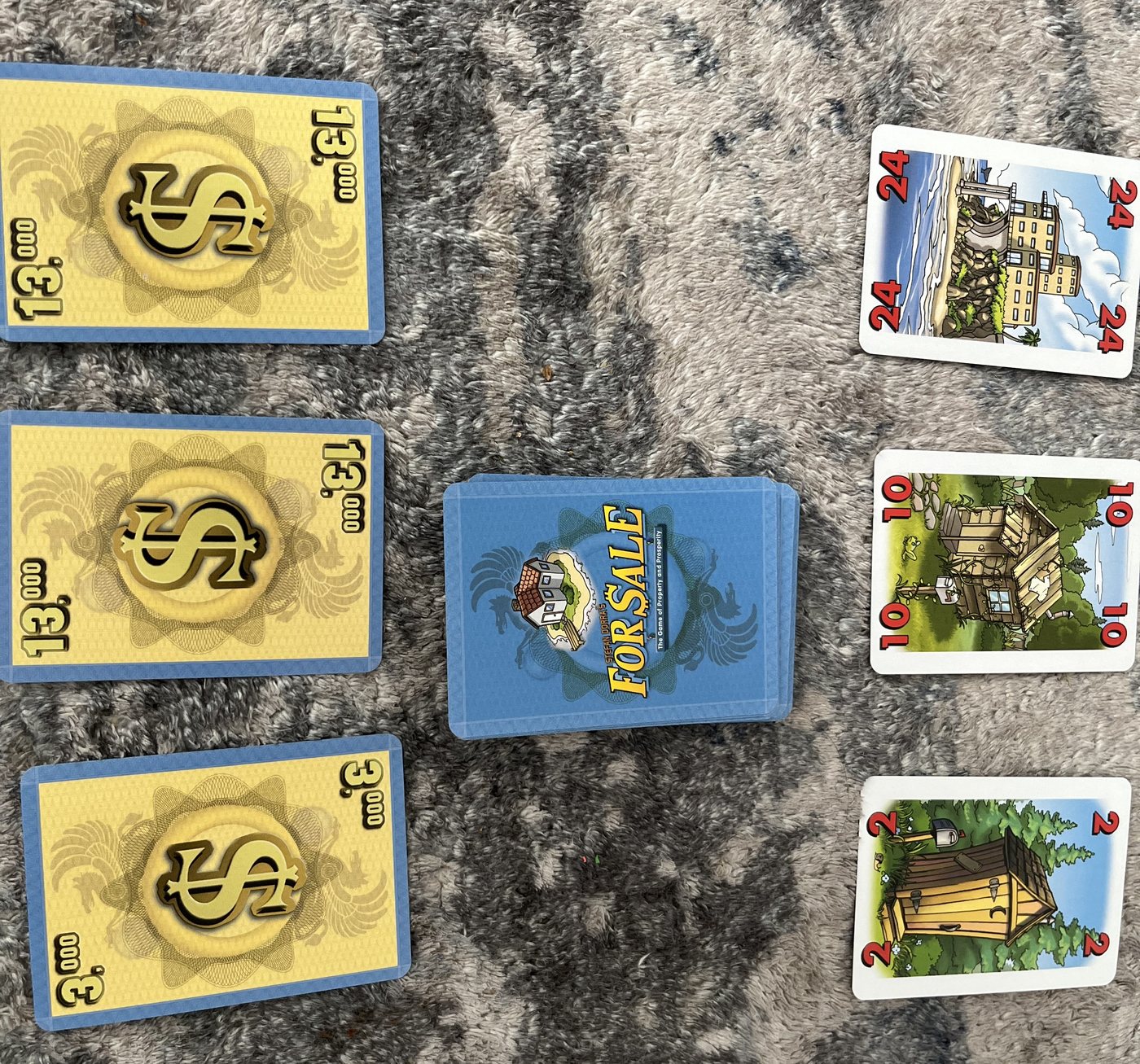
Look at the gap between the top two checks before you choose. If the top check is $15,000 and the next is $14,000, the round is worth almost the same to first and second place, so your second-best card is enough to do well. Save your best card for a round where the top check is far ahead, like $14,000 against $6,000.
The same works at the bottom. When a round has a $0 check in it, that’s the round to dump your lowest card. When every check in the round is high, even your weakest card earns something, so it’s a safe round to keep a strong card back.
Putting It Together
If you don’t own a copy yet, start with the standard For Sale from Eagle-Gryphon. If your group likes this kind of reveal, 6 nimmt! runs on the same simultaneous play. Spend coins on the high cards, take free low cards when the round is weak, stop odd bids before you pass, and remember every property that goes up. In the selling half, match your best card to the biggest gap between checks, not the biggest check.
Check For Sale price on Amazon →
For a deeper look at how other players think about the game, BoardGameGeek’s For Sale page has a long-running strategy forum.
Frequently Asked Questions
Should you ever bid on the first card in For Sale?
Only if you want one of the top cards on the table. Bidding just to look involved costs money: a $1,000 bid you later abandon is lost in full, because half of $1,000 rounds down to zero.
How many coins should you save for the end of For Sale?
Enough to avoid buying properties you don’t want, and no more. Leftover coins count at face value and break ties, but the average player’s checks are worth several times their starting coins, so properties matter more.
Is it better to go high or low in the first round of For Sale?
It depends on the cards up, not the round number. If the round has a 27 or higher, it’s worth competing for. If the best card is in the teens, passing early for a free low card usually costs less than the difference between the cards.
What’s the best property card in For Sale?
The 30 wins the top check in any round you play it, because no other property can beat it. At 3 and 4 players it may have been removed at setup, so check whether it came up during the auctions.
When should you play your lowest property in For Sale?
In a selling round that includes a $0 or $2,000 check. Your lowest card will probably take the lowest check anyway, so it’s the round where it costs you least.
Where do the coins go when you lose an auction in For Sale?
Out of the game. When you pass, you keep half your bid, rounded down, and the rest goes back to the bank for good. The winner of the auction pays their whole bid to the bank too, so coins only ever leave play.