

Bottom Line
Skip-Bo is best for couples, families and travelers who want an easy card game that works just as well with two players as with four. Skip it if your group hates luck or wants a game with a theme and a story. Its biggest strength is the race: everyone is trying to empty a stock pile, and every card you play can help or block someone else. Its biggest weakness is that the order of your stock pile is pure luck, and a bad one can cost you the game.
Skip-Bo gets 4/5 Bamboo Plants and 5/5 Pandas from us. It’s easy to learn and it’s fun, and Skip-Bo is worth buying for almost any household that plays cards.
The Bamboo is a 4 because the turn itself is simple: draw up to five cards, play numbers in order, discard one. It isn’t a 5 because there are four kinds of piles on the table, and each one has its own rule to learn. The Pandas are a 5 because it’s fun, it works with just two people, and it fits in a bag.
Some links below are Amazon affiliate links — as an Amazon Associate, King Panda Games earns from qualifying purchases at no extra cost to you. Full disclosure.
Check Skip-Bo price on Amazon →
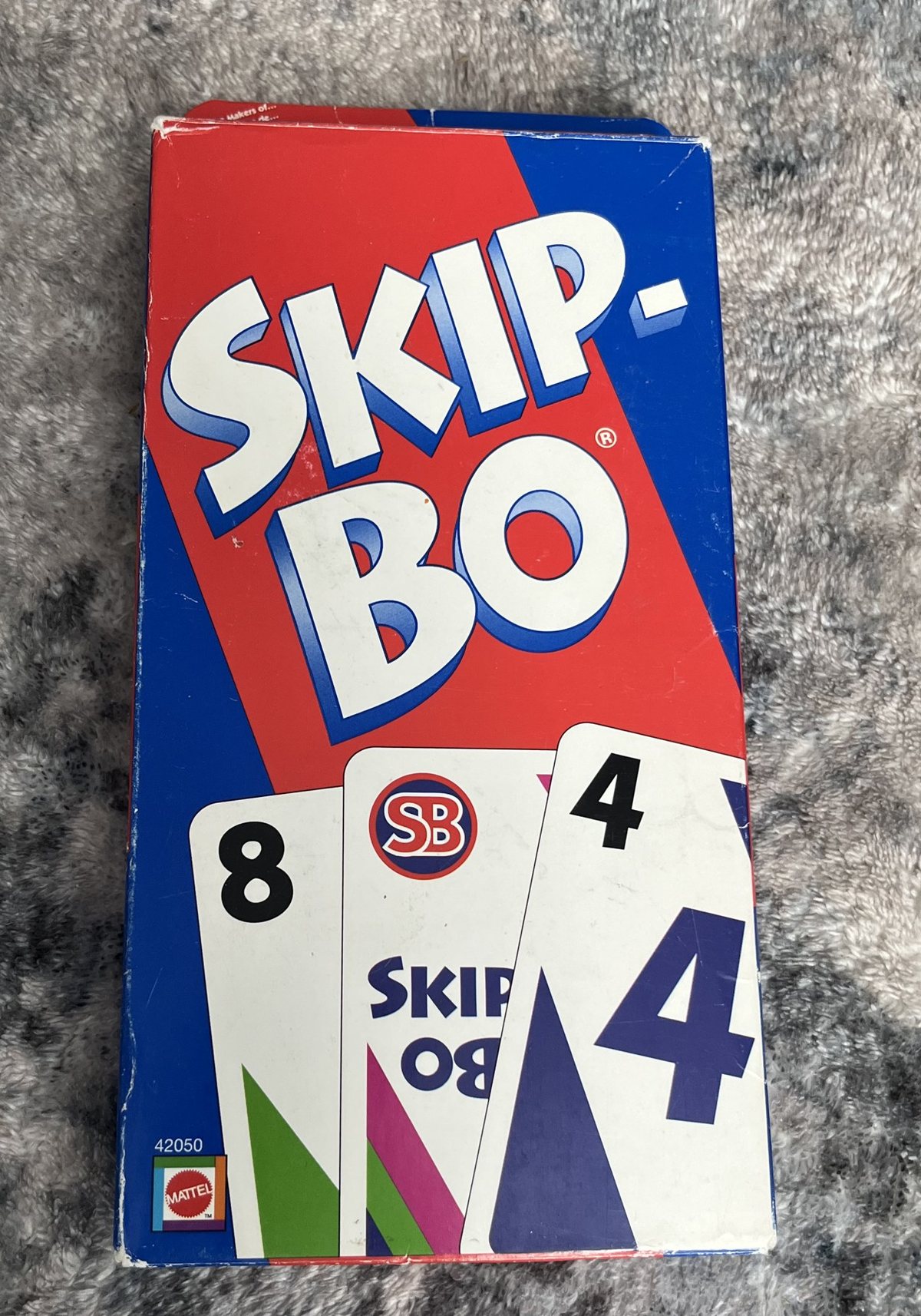
This review is based on playing our own copy, which is the one in the photos, and on Mattel’s rule sheet for the exact counts and rules. We haven’t kept a play count, so we don’t quote one.
Skip-Bo is a sequencing card game where each player tries to be the first to play every card in their own stock pile onto shared piles that count up from 1 to 12.
| Detail | Info |
|---|---|
| Players | 2–6 |
| Best Player Count | 4 — more stock piles to watch and block, and still great at 2 |
| Age | 7+ |
| Play time | 20 min on BoardGameGeek; a full 30-card game can run longer |
| Complexity | Light |
| Solo Mode | No |
| Designer | Hazel “Skip” Bowman |
| Publisher | Mattel |
| Popular Upgrades | No |
| Bamboo Plants | 4/5 — easy turns, four kinds of piles to learn |
| Pandas | 5/5 — great at two, easy to take anywhere |
| Official site | Mattel’s Skip-Bo page |
How Skip-Bo Works
You win by emptying your stock pile. Everything else on the table exists to help you do that.
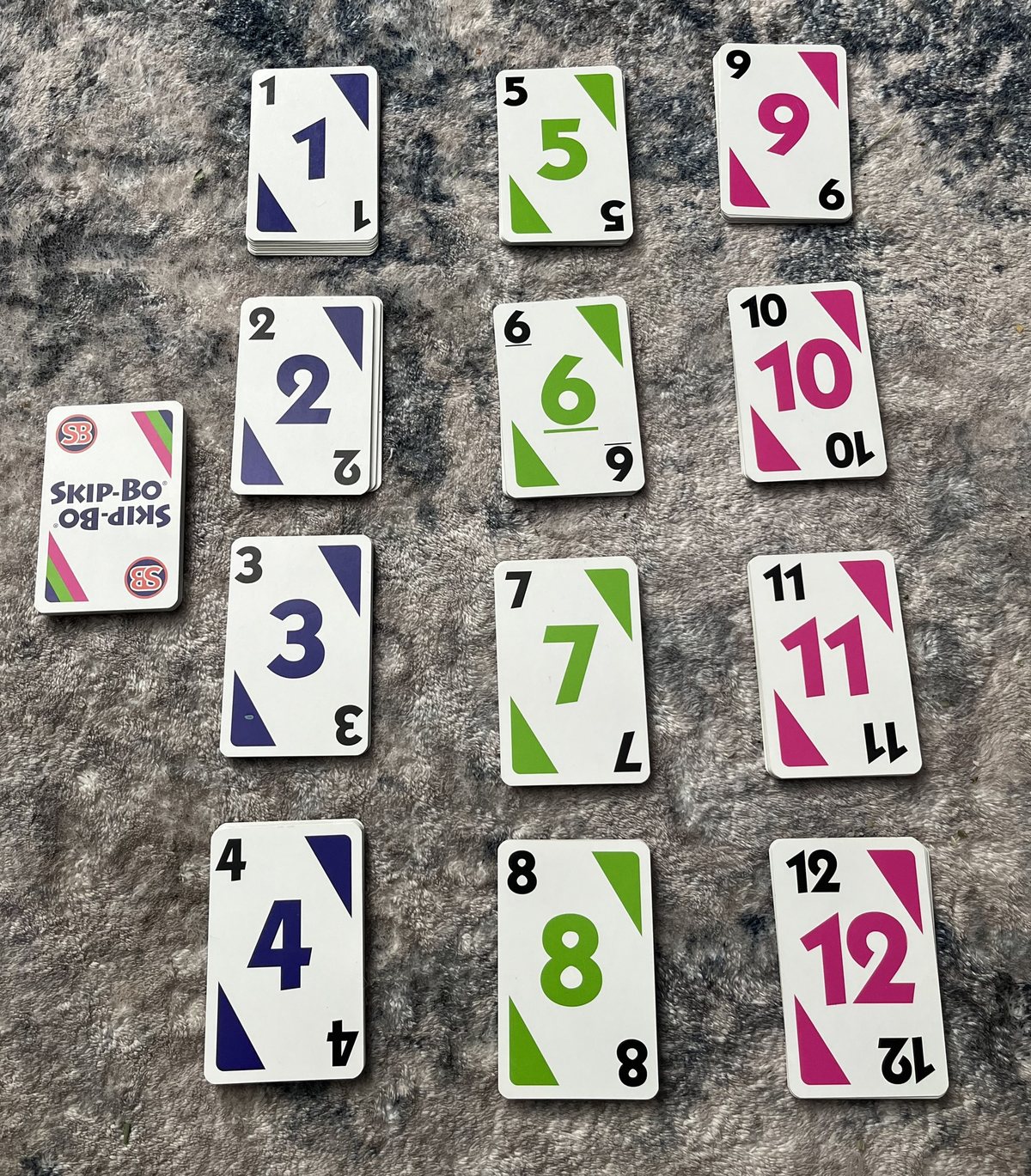
The deck has 162 cards: 144 numbered 1 through 12, plus 18 Skip-Bo cards, which are wild. Those counts come from Mattel’s official rule sheet. With two to four players, each player is dealt a face-down stock pile of 30 cards and flips the top one face up. With five or six, the stock piles are 20 cards.
There are four kinds of piles:
- Your stock pile. Only the top card is face up. This is the pile you’re trying to get rid of.
- The draw pile. Everyone draws from it.
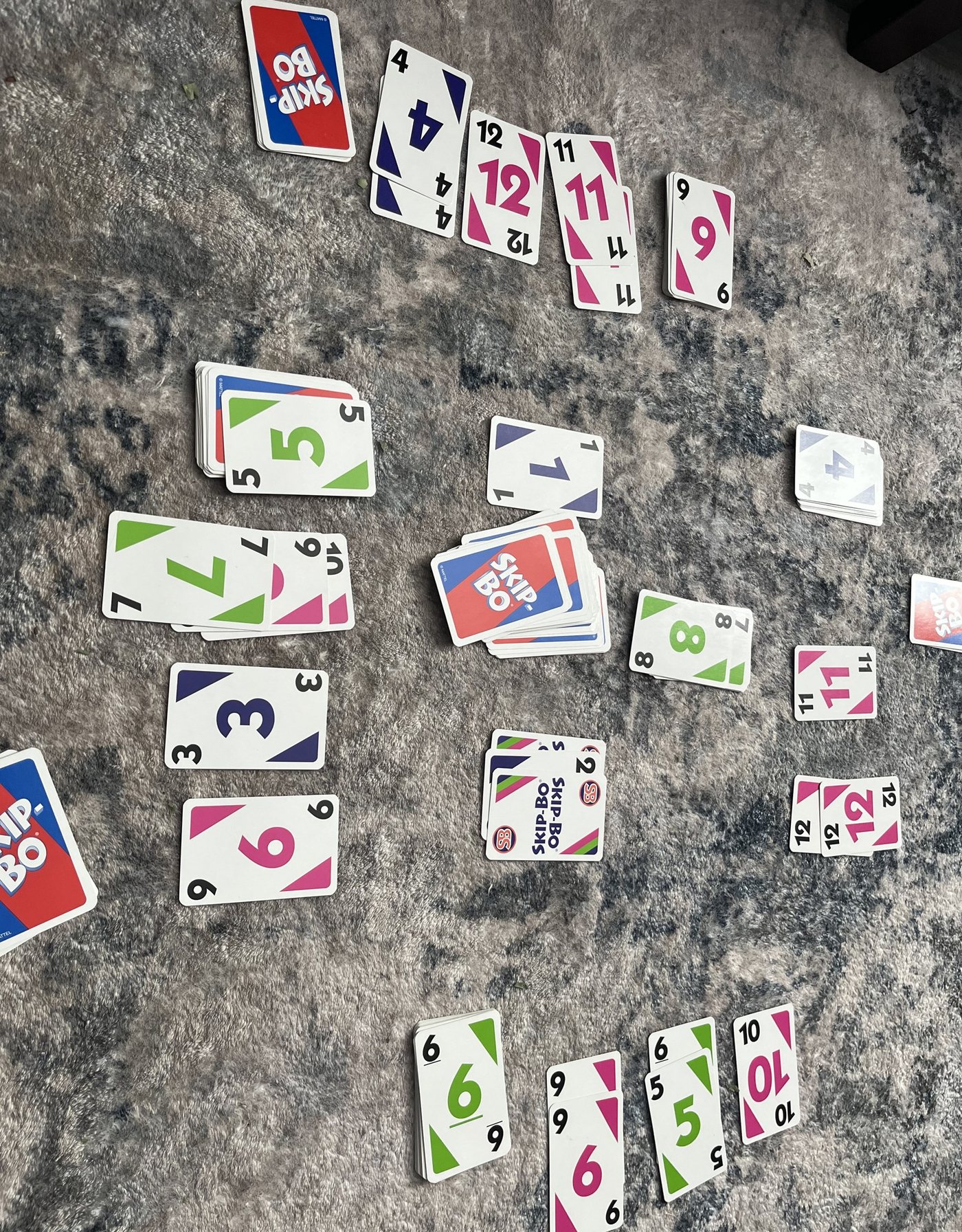
- Building piles. Up to four in the middle, shared by everyone. Each one starts with a 1 and counts up to 12, then gets cleared away.
- Your discard piles. Up to four in front of you. You end every turn by putting one card from your hand on one of them.
On your turn you draw until you hold five cards. Then you play as many cards as you can onto the building piles, in number order. You can play from your hand, from the top of your stock pile, or from the top of any of your discard piles. When you’re done, you discard one card and the next player goes.
The top of your stock pile is a 6. One building pile is sitting on a 3. Your hand has a 4 and a Skip-Bo card. You play the 4, play the Skip-Bo as a 5, then play the 6 off your stock pile. A new stock card flips up. That’s one card closer to winning, and it took three cards to do it.
If you’d rather watch than read, Gather Together Games has a Skip-Bo video tutorial. Our own Skip-Bo rules guide covers setup, scoring and the partnership variant.
What We Liked
It works with two. A lot of family card games need three or four people to come alive. Skip-Bo doesn’t. With two players there’s no waiting, and every card you play either helps you or blocks the one person you’re racing. It’s our pick for a cheap date night: get some ice cream and play Skip-Bo.
It travels. The whole game is a deck of cards in a small box, with no board and no pieces. It’s small and easy to pack, and it’s the game we’d pull out while waiting for a flight at the airport.
The shared piles create real interaction. The building piles belong to everybody. Play a 7 and you may have just handed the next player the spot for the 8 on top of their stock pile. You can see that 8, because stock cards sit face up, so the choice is yours.
Your discard piles are a puzzle you build yourself. You can only play the top card of each one. Where you put each discard decides which cards you can reach three turns from now.
What We Disliked
The stock pile order is luck. Your 30 cards are shuffled and face down, and you have to play them in the order they come. Nothing you do changes that order.
A full game can run long. Thirty cards each is a lot to get through. Mattel’s own rule sheet includes a short game with 10-card stock piles, and that’s the version to start with.
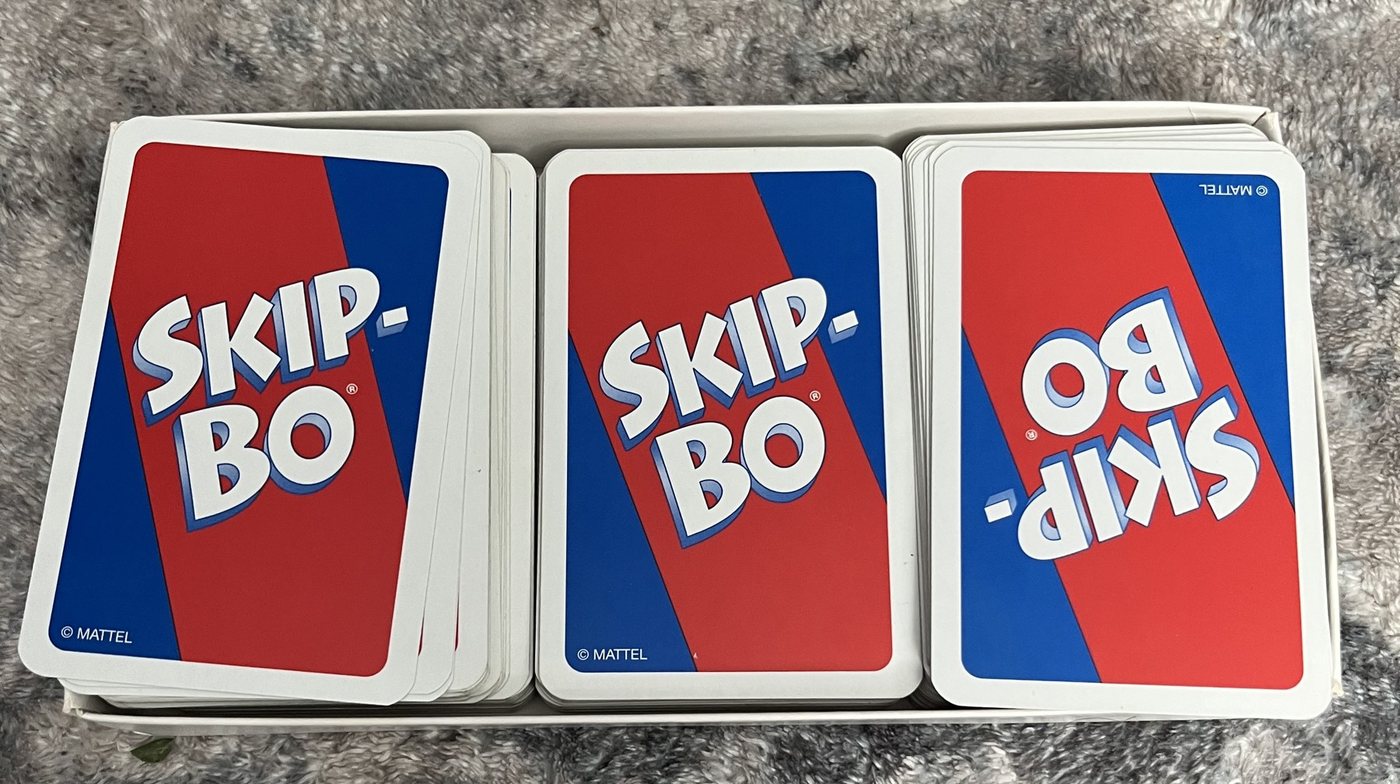
- 162 cards is a big deck to shuffle. And you shuffle it again every game.
- It needs table space. Each player has a stock pile and up to four discard piles, plus the shared piles in the middle.
Who It’s For
Skip-Bo is for couples, families with kids of 7 and up, and anyone who wants one card game that works with two players or a full table. The box says ages 7 and up. If a child can count to 12, they can play.
It’s a strong pick for travel, for the same reason Phase 10 is: a deck and a flat surface are all you need. It also sits comfortably next to the games on our best board games for families list.
Who should skip this game:
– Players who want skill to decide every game. The stock pile is shuffled luck.
– Groups that want a theme, art or a story. Skip-Bo is numbers on cards.
– Anyone looking for a party game for seven or more. It stops at six.
Who Should Buy This?
Buy Skip-Bo if you want a low-cost card game for two that also works when the family joins in. Mattel’s list price was $8.49 when we checked on October 4, 2026.
At that price it’s a low-risk purchase, and you don’t need to try it first. It’s a core collection game for couples and families, and a situational one for hobby gamers. If you mostly play as a pair, also look at our best 2-player games list.
Our copy is an older Mattel printing, with a box dated 2003. Mattel’s current listing uses the same item number, 42050, and the same 162 cards, and notes that colors and decorations may vary. For most people, the standard Skip-Bo card game is the one to get.
Check Skip-Bo price on Amazon →
Best Player Count
Skip-Bo is best with 4 players, and it’s still a great two-person game. The box says 2 to 6, and it plays at every count in that range.
With four, there are three other stock cards to watch, so a card you play onto a building pile can help or block more than one person. Four is also the largest count that keeps the full 30-card stock piles. With two, your turn comes straight back around, you only have one opponent’s stock card to watch, and the stock pile is still 30 cards each.
BoardGameGeek’s community poll also rates it best with four. Two still works well, and our Skip-Bo 2-player guide explains why.
At five and six, the stock piles drop to 20 cards and there’s more waiting between turns. The rule sheet’s partnership variant is the better way to play with a big group.
Replayability
Skip-Bo holds up because no two stock piles come out in the same order. The rules never change from game to game.
What changes is the puzzle. The top of your stock pile, the four building piles and your own discard piles are different every turn. The same hand can be a five-card run one turn and nothing the next.
The limit is that there’s only one way to play. If your group wants variety, the rule sheet gives you three options: the 10-card short game, partnerships, and scoring across several games to 500 points.
Awards
Skip-Bo has no major game awards that we could verify. It has been in print since 1967, when Hazel “Skip” Bowman of Brownfield, Texas began selling it, according to Wikipedia’s history of the game. International Games bought it in 1980, and Mattel bought International Games in 1992.
Similar Games
If you like Phase 10, try Skip-Bo — both are Mattel number-card games for 2 to 6, but Phase 10 is rummy and Skip-Bo is a race to empty a pile. Our Skip-Bo vs Phase 10 vs Uno comparison picks between them.
If you like Uno, try Skip-Bo — Uno gives you one pile to match. Skip-Bo gives you four shared piles and four of your own to manage. Our Uno review explains why we rate Uno lower for fun.
If you like Spite and Malice, you already know Skip-Bo. Skip-Bo is a commercial version of that game, which is played with regular playing cards. Pagat’s Spite and Malice rules are the reference if you want to try the original.
Tips & Tricks
Play from your stock pile first. It’s the only pile that wins the game. Mattel’s rule sheet says the same thing: use the playable cards from that pile before anything else.
Stack your discard piles counting down. Put a 9 on a 10, then an 8 on the 9. When a building pile reaches 7, you can play the 8, 9 and 10 off that one pile in a row.
The tempting play: use a Skip-Bo card the moment it lets you play something from your hand.
The better play: hold it until it gets a card off your stock pile. There are only 18 wilds in 162 cards, which is one card in nine.
Look at the other stock piles before you play. Every stock pile’s top card is face up. If the next player is showing a 6, don’t leave a building pile sitting on a 5 unless it gets one of your own stock cards out.
Empty your hand when you can. If you play all five cards, you draw five more and keep going. Our Skip-Bo strategy guide goes deeper on all of this.
Frequently Asked Questions
Is Skip-Bo worth buying?
Yes, for couples and families. We rate it 4/5 Bamboo and 5/5 Pandas. It’s inexpensive, easy to learn, good with two players and small enough to travel with. Skip it if your group dislikes luck.
How long does a game of Skip-Bo take?
BoardGameGeek lists 20 minutes. A full game with 30-card stock piles can run longer, and Mattel’s rule sheet offers a short game with 10-card stock piles for a quicker match.
Is Skip-Bo good for two players?
Yes. We think Skip-Bo is best with four, and it’s still a great two-person game. Each player still gets a 30-card stock pile, there’s no waiting between turns, and you only have one opponent to block.
Is Skip-Bo luck or strategy?
Both. The order of your stock pile and the cards you draw are luck. How you arrange your discard piles, when you spend wild cards and whether you block the next player are decisions that add up over a game.
What age is Skip-Bo for?
Mattel rates Skip-Bo for ages 7 and up. The only skill a player needs is counting from 1 to 12 in order.
How many cards are in a Skip-Bo deck?
There are 162 cards: 144 numbered 1 through 12, and 18 Skip-Bo wild cards. That’s twelve of each number.
Is Skip-Bo the same as Spite and Malice?
Skip-Bo is a commercial version of Spite and Malice. The main difference is the deck: Skip-Bo uses its own numbered cards and wilds, and Spite and Malice uses regular playing cards.
Is Skip-Bo like Uno?
They’re both Mattel card games, but they play differently. In Uno you match one pile by color or number. In Skip-Bo you build piles in number order to empty your own stock pile.
Want to go deeper?
- How to Play Skip-Bo — setup, a full turn, scoring and the partnership variant. Read it here
- Skip-Bo Strategy — discard piles, wild cards and blocking, with the odds worked out. Read it here
- Skip-Bo With 2 Players — the rules at two and why it’s still a great two-person game. Read it here
- Skip-Bo vs Phase 10 vs Uno — which of Mattel’s three card games to buy. Read it here
Verdict
Buy it if you want an easy card game for two that also works for the whole family, or something small to pack for a trip. Skip it if your group can’t stand losing to a bad shuffle. Try the short game first if you’re worried about length: deal 10-card stock piles.
Skip-Bo official site: Mattel’s Skip-Bo product page