

The best Skip-Bo strategy is to judge every play by one question: does it get a card off my stock pile? Your stock pile is the only pile that wins the game. Your hand, your discard piles and the building piles are tools for emptying it.
Some links below are Amazon affiliate links — as an Amazon Associate, King Panda Games earns from qualifying purchases at no extra cost to you. Full disclosure.
The advice below comes from the deck itself and from Mattel’s official rule sheet. The numbers are ones we worked out from the 162-card deck. If you’re new to the game, start with our Skip-Bo rules guide.
Play Your Stock Pile First
Every turn starts with the same check: can I reach the card on top of my stock pile? If the answer is yes, do that before anything else.
The rule sheet says so directly. It tells players it’s best to always use the playable cards from the stock pile first, because the winner is the player who empties it.
A hand card you play is replaced next turn when you draw back up to five. A stock card you play is gone for good, and it’s one fewer between you and the win.
Know the Odds of Drawing What You Need
Any single number is easier to find than it looks. The deck has 12 copies of each number and 18 Skip-Bo wilds, so 30 of the 162 cards can stand in for the number you need.
| Fresh cards you draw | Chance at least one works as the number you need |
|---|---|
| 1 | 18.5% |
| 2 | 33.7% |
| 3 | 46.1% |
| 4 | 56.3% |
| 5 | 64.6% |
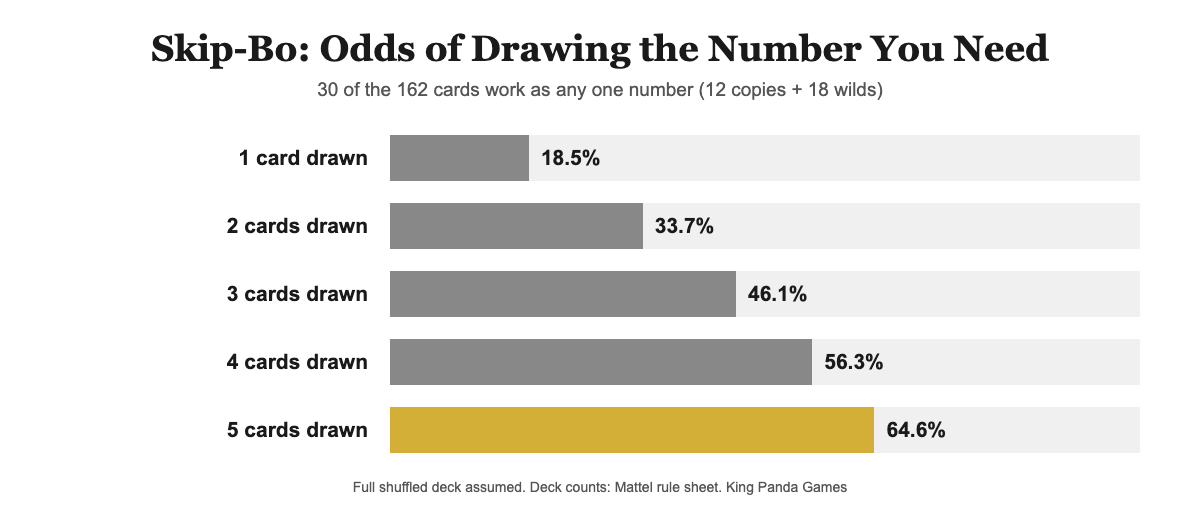
These figures assume a full, shuffled deck, so treat them as a guide. In a real game the cards already on the table shift them a little.
The rule: the more cards you play from your hand, the more you draw next turn, and a full five-card draw finds any one number about two times in three.
That’s the case for emptying your hand. If you play all five cards, you draw five more at once and keep going.
Stack Your Discard Piles Counting Down
Your four discard piles are the part of the game you control. Skip-Bo is a commercial version of Spite and Malice, and the same discard habits work in both. You can stack as many cards as you like on each one, but you can only play the top card.
The easy habit: drop the discard on whichever pile is closest. A 3 ends up buried under an 11, and it stays there.
What actually works: build each pile counting down. Put a 9 on a 10, then an 8 on the 9. When a building pile reaches 7, the 8, 9 and 10 come off that one pile in a row.
Two more habits help:
- Keep one pile for duplicates. A second 5 goes on top of the first 5, so neither blocks a different number.
- Leave a pile empty as long as you can. An empty pile is where you put the card that doesn’t fit anywhere.
Spend Skip-Bo Cards on Your Stock Pile
“When should you play a Skip-Bo card?” When it gets a stock card out, and rarely before.
There are 18 wilds in 162 cards. That’s one card in nine. You won’t see many in a game, so each one should buy something that matters.
Your stock pile shows a 9. A building pile is on a 7. You hold a Skip-Bo card and no 8. Play the wild as the 8, then play the 9 off your stock. Compare that with using the wild as a 4 so you can play a 5 from your hand: you’ve spent your best card and your stock pile hasn’t moved.
The exception is a wild that lets you empty your whole hand. Playing all five cards gets you five new ones, and that can be worth more than holding it.
Block the Next Player When It’s Free
Every stock pile’s top card is face up. That means you always know what the next player needs.
If the player after you is showing a 6, a building pile sitting on a 5 is a gift. Either don’t build a pile up to 5, or push it past 6 yourself if you hold the cards.
Don’t block at any cost. If building a pile to 5 is what gets your own stock card out, do it. Getting your card out matters more than stopping theirs.
Worth knowing: finishing a building pile is a block too. When a pile reaches 12 it’s cleared away, and nobody can play on that spot until someone starts it again with a 1 or a wild.
Blocking is simplest with two players, because there’s only one stock card to watch. Our Skip-Bo 2-player guide covers that game.
Is Skip-Bo Strategy or Luck?
Skip-Bo is mostly luck with a real layer of skill on top. BoardGameGeek users rate its complexity at about 1.2 out of 5, which is as light as card games get. The order of your stock pile is shuffled, and nothing you do changes it.
What you control is everything around it: how you stack discards, when you spend wilds, and whether you hand the next player the card they need. Those choices won’t rescue a terrible stock pile, but over several games they add up.
If you don’t own a copy yet, the standard Skip-Bo deck is all you need, and our Skip-Bo review covers who it’s for.
Check Skip-Bo price on Amazon →
Frequently Asked Questions
What is the best strategy for Skip-Bo?
Play from your stock pile before anything else, stack your discard piles counting down so the tops come off in order, and save Skip-Bo wild cards for plays that get a stock card out.
How should you use your discard piles in Skip-Bo?
Build each one in descending order, such as a 9 on a 10 and an 8 on the 9. Keep duplicates together on one pile, and leave a pile empty for as long as you can.
Should you save Skip-Bo cards?
Yes, usually. Only 18 of the 162 cards are wild. Spend one when it lets you play the top card of your stock pile, or when it lets you empty your hand and draw five new cards.
Is Skip-Bo luck or strategy?
Mostly luck, with some skill. The order of your stock pile is random. Discard pile management, wild card timing and blocking are the decisions that improve your results over many games.
Can you block other players in Skip-Bo?
Yes. Each player’s top stock card is face up, so you can avoid building a pile to one below the number they need, or build past it yourself.
What are the odds of drawing the card you need in Skip-Bo?
From a full deck, 30 of the 162 cards work as any one number: 12 copies of it plus 18 wilds. One card has an 18.5% chance of being one, and a five-card draw has about a 65% chance of including one.