

Most board game collections are stored the one way the people who make the games advise against.
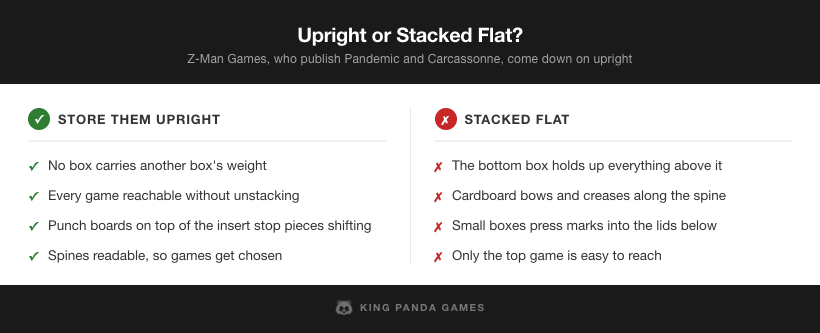
Open any photo of a games cupboard and you will see a tower: boxes laid flat, stacked eight or ten high, the big ones at the bottom and the small ones balanced on top. It looks tidy. It is also the arrangement that does the damage — the box at the bottom is carrying the weight of everything above it, and cardboard under sustained load bows, creases along the spine, and leaves the imprint of whatever is sitting on it.
The fix is free and takes an afternoon. Here is what to change, which shelf actually fits a board game, and what is worth buying once the shelving is sorted.
How this was put together. Publisher guidance on storage, IKEA’s own dimensions for the shelving most collections end up on, and the specifications of the insert makers named below — not a photograph of our own games room.
Some links below are Amazon affiliate links — as an Amazon Associate, King Panda Games earns from qualifying purchases at no extra cost to you. Full disclosure.
Store Them Upright, Like Books
This is the whole article in one line, and it is not our opinion. Z-Man Games — who publish Pandemic and Carcassonne — address the vertical-versus-horizontal argument directly and come down on vertical, for the obvious reason: games are heavy, and a box at the bottom of a stack is holding up weight it was never built to hold.
Stacking also makes every game except the top one annoying to reach, which is the quiet reason collections stop getting played. A game you have to unstack four boxes to get at is a game you suggest less often.
The objection, and the fix. The reason people stack flat is that turning a box on its side lets the contents slide, and nobody wants to open a game to find the tokens redistributed across the board and the cards fanned into the lid.
The answer costs nothing: keep the punch boards. Those cardboard frames left over after you punch out the tokens are usually binned. Lay them on top of the insert before you close the lid and they press everything flush against the lid, so nothing can move when the box goes on its edge. This is Z-Man’s own suggestion, and it is the single most useful thing in this article.
For games where the punch boards have long since gone, a folded tea towel or a sheet of craft foam does the same job.
The Shelf Nearly Everyone Ends Up With
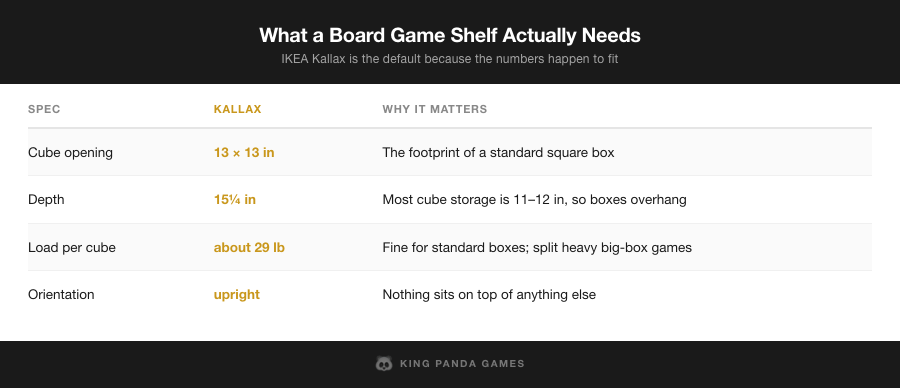
There is a reason the same shelving unit appears behind every board game photo on the internet. IKEA’s Kallax has a cube opening of roughly 13 by 13 inches and about 15 inches deep, and that is almost exactly the footprint of a standard square board game box — Catan, Ticket to Ride, Azul, Wingspan. It is not that Kallax was designed for games. It is that 13 inches is the number, and most other cube shelving is built shallower.
Two things worth knowing before you buy one.
The depth matters more than the width. Plenty of cube storage is 11 or 12 inches deep, which leaves a standard box overhanging the front edge by an inch. It works, it looks wrong, and the protruding edges are the ones that get knocked.
Each cube is rated to around 29 lb. That is generous for standard boxes, but a column of big-box games with a lot of plastic in them gets heavy faster than you would expect. Spread those across compartments rather than loading one.
If you want the same geometry without the IKEA trip, cube shelving in the same dimensions is widely available.
Check cube storage shelf price on Amazon →
Inserts Buy Back Setup Time, Not Shelf Space
This is the most misunderstood purchase in the hobby. A fitted insert does not usually let you fit more games on a shelf — the box is the same size either way. What it buys is setup and teardown time, and on a game with a lot of components that is the difference between playing and not bothering.
The established makers each work differently:
- Folded Space — flat-pack EVA foam trays you assemble yourself. The cheapest route, and the one most of our reviews end up recommending.
- The Broken Token — laser-cut plywood. More expensive, considerably more satisfying, and heavier.
- Laserox — similar laser-cut approach with a strong range for the bigger campaign games.
- Game Trayz — moulded plastic, and increasingly the trays that ship inside premium games rather than something you buy separately.
Where an insert earns its money is on the games you actually play. Our Scythe review calls a fitted insert close to non-optional, Heat and Everdell both benefit heavily, and Dominion is the clearest case of all — a game that is mostly card storage, where an organizer transforms the shuffle-and-sort between games.
Check board game insert price on Amazon →
For Everything Loose Inside the Box
Before you buy an insert, the cheap version solves most of the problem. Z-Man’s own advice is simply small plastic bags — one per component type — and for a lot of games that is genuinely enough.
Where bags fall short is games with many small, visually similar components, which is where small lidded bins are worth it. King of Tokyo and Wingspan are both games where sorting time comes down sharply once the tokens live in something with compartments.
Check component storage price on Amazon →
Where Not to Put Them
Three places ruin collections, and two of them are where people put the overflow.
The garage and the loft. Cardboard takes on moisture and warps, and an uninsulated space swings through a far wider temperature range than any room in the house. More collections are damaged by being stored somewhere cold and damp than by anything that happens at the table.
Direct sunlight. Box art and card faces fade, and the fading is uneven, so it shows. A shelf opposite a south-facing window will visibly age a collection over a few years.
Under anything heavy. This is the stacking problem again in another costume — a games shelf that also holds books, or a box with a speaker on it.
Games That Will Not Fit
Every collection has a few that defeat a 13-inch cube: the oversized boxes, legacy campaign games, and anything with miniatures in a deep tray.
Put those flat, on the bottom shelf, with nothing on top of them. Big-box games are the one category where lying flat is genuinely the safer option — they are heavy enough that standing on edge puts real strain on the box corners, and sitting at the bottom means nothing is pressing down on them.
If a lot of your collection is in that category, games with miniatures explains why those boxes are so deep, and a playmat is the other accessory worth having once the shelving is solved — it is what the game sits on when it comes back off the shelf.
Frequently Asked Questions
Should board games be stored flat or on their side?
On their side. Z-Man Games, who publish Pandemic and Carcassonne, state plainly that vertical storage is preferable, because games are heavy and a box at the bottom of a stack is carrying weight it was never designed to hold. Stacking flat is the more common habit and the more damaging one.
How do you stop pieces sliding around in a game stored on its side?
Keep the punch boards — the cardboard frames left over after you punch out the tokens — and lay them on top of the insert before closing the lid. They press the contents flush against the lid so nothing can shift when the box is turned on its edge. This is Z-Man’s own recommendation and it costs nothing.
What size shelf do board games need?
A cube opening of roughly 13 by 13 inches, around 15 inches deep. That is the IKEA Kallax dimension, and it is the practical minimum for a standard square box like Catan, Ticket to Ride or Azul. Shallower shelving leaves boxes overhanging the front edge.
How much weight can a Kallax cube hold?
IKEA rates each Kallax compartment at about 29 lb. A cube packed with standard-size games sits comfortably inside that, but a column of heavy big-box games is worth splitting across more than one compartment rather than filling a single one.
Are board game inserts worth buying?
For games you play often, yes — the time saving is in setup and teardown rather than storage. A fitted insert turns a twenty-minute pack-down into five. For a game played once a year it is money better spent on another game.
Can you store board games in the garage or loft?
It is the worst place for them. Cardboard absorbs moisture and warps, and the temperature swings in an uninsulated space are harder on boxes and boards than anything that happens during play. Interior rooms at stable temperature are the only places worth putting a collection you care about.
What do you do with games too big for a standard shelf?
Store the oversized boxes flat on a bottom shelf and everything else upright above them. Big-box games are the only ones heavy enough that lying flat is genuinely safer, and putting them at the bottom means nothing is stacked on them.