

How to Win at Catan: Strategy Guide for Beginners
You’ve lost three games in a row. Someone at the table keeps winning and you can’t figure out why. The dice seem to hate you. The robber always lands on your best hex.
Some links below are Amazon affiliate links — as an Amazon Associate, King Panda Games earns from qualifying purchases at no extra cost to you. Full disclosure.
Here’s the thing: some of that is luck. But most of it isn’t.
A board game fan simulated 36,000 games of Catan and found that conventional wisdom about the game is partially wrong — the “obvious” starting spots aren’t always the best ones, and the most common beginner strategies actively hurt your chances of winning. This guide covers the five principles that actually move the needle, based on how the game mathematically works and what separates consistent winners from consistent losers.
Not read our full Catan review yet? Start there if you’re still deciding whether Catan is worth learning.
Principle 1: Chase Numbers, Not Resources
The single most common mistake beginners make is optimizing for resource diversity. They want wood, brick, ore, wheat, and sheep — so they place settlements near as many different resources as possible.
Experienced players optimize for probability instead.
Here’s the math: in Catan, dice probability determines everything.
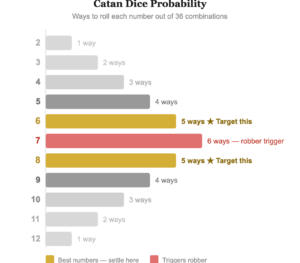
The number 7 is rolled most often (6 ways to roll it out of 36). Then 6 and 8 (5 ways each). Then 5 and 9 (4 ways each). Then 4 and 10 (3 ways each). Then 3 and 11 (2 ways each). Then 2 and 12 (1 way each).
A settlement on a single hex with an 8 will produce resources roughly five times every 36 rolls. A settlement on a single hex with a 3 will produce resources roughly twice every 36 rolls. That’s a 2.5× difference in productivity from the same settlement slot — and most beginners never think about it.
The rule: prioritize 6s and 8s above everything else. A settlement adjacent to a 6-wheat and an 8-ore is better than a settlement adjacent to two different resources on 4 and 10, regardless of what resources you think you need.

Principle 2: Your Second Settlement Is More Important Than Your First
Most players pick their first settlement carefully and their second settlement reactively — wherever’s left after three other players have placed. This is backwards.
Before you place your first settlement, identify the single best second settlement spot on the board. Then place your first settlement in a position that gives you a clean road path to that second spot before anyone else can claim it.
The best second spot is usually the highest-probability hex intersection that offers resources you can’t get from your first settlement. If your first settlement covers wheat, ore, and wood, your second settlement should prioritize brick and sheep — ideally on high-probability numbers.
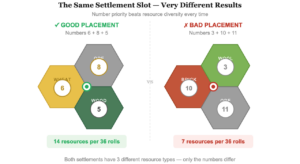
Players who nail both placements in the first two turns often have a resource engine that runs all game. Players who get stuck with one bad settlement spend the whole game trading just to stay competitive.
For a complete breakdown of opening positions, see our Catan best starting placement guide.
Principle 3: Roads Win Games, Not Settlements
New players think victory points win Catan. Experienced players know that board position wins Catan.
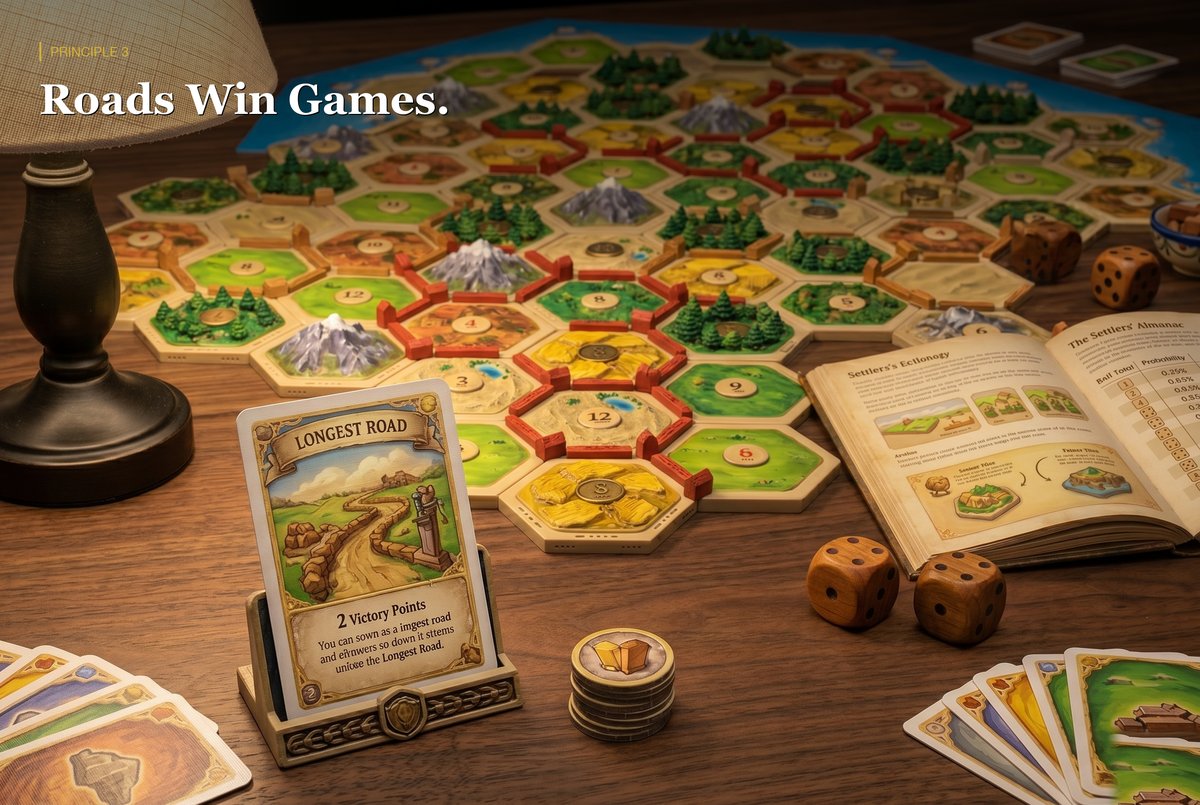
Roads are cheap (one wood, one brick) and they do two things: they lock in settlement spots before opponents can reach them, and they generate the Longest Road bonus (2 points) if you build 5+ consecutive road segments first.
The Longest Road is more valuable than it looks. Two free points that don’t require any resource investment beyond what you’re already spending on expansion is an enormous edge. The player who wins the Longest Road race usually wins the game more often than not — because they’re also expanding their board position while doing it.
The rule: build roads aggressively in the first half of the game. Stop only when you’ve secured your expansion path and blocked your most threatening opponent’s expansion. Then switch to cities.
Once you have board position locked in, the robber becomes your next strategic lever — see Catan robber strategy: where to place it and when to move it.
Principle 4: Cities Before Settlements After Turn 10
Once you’ve placed your second settlement, your development priority should shift to upgrading existing settlements to cities rather than building new settlements.
Cities cost two wheat and three ore, but they double the resource production of a settlement. A city on a 6-ore hex produces two ore every time a 6 is rolled. A third settlement on that same hex would still only produce one ore.
The math is stark: a city upgrade gives you more total resource production than a new settlement in most cases, at a lower opportunity cost (you don’t need to build roads to a new location first).
The exception: if there’s an excellent expansion spot that an opponent is about to reach, securing it first with a new settlement is worth the delay. But in the absence of urgency, city upgrades compound your production in a way that new settlements don’t.
Principle 5: The Longest Army Card Is Almost Always Worth It
The Largest Army card — earned by playing three or more knight development cards before anyone else — grants 2 victory points. It can also be stolen if an opponent later plays more knights than you.
Beginners often ignore development cards in favor of visible construction. This is a mistake. Development cards do three things: knights (which move the robber and protect you from being robbed), progress cards (road building, year of plenty, monopoly — all extremely powerful), and victory point cards (hidden points that win games without anyone seeing them coming).
The Largest Army is one of the most reliable 2-point sources in the game precisely because most players undervalue it. If you buy one development card per turn whenever you have the resources, you’ll often claim Largest Army before anyone realizes the race is happening.
The rule: buy development cards consistently. Don’t hoard resources waiting for a city upgrade if you have the ore and wheat to buy a development card this turn. The cards compound over time.
Putting It Together
Win a Catan game by doing all five at once: you placed on high-probability numbers, your second settlement location was planned before your first was placed, you built roads aggressively to secure board position, you upgraded to cities rather than expanding unnecessarily, and you quietly accumulated development cards while everyone else was focused on building.
The luck is still real. The dice will still betray you sometimes. But players who apply these principles win more often — not every game, but measurably more often over a full session.
Play a few games applying just Principle 1 (number priority over resource diversity) and watch how it changes your resource production. Everything else builds on that foundation.
Once these habits feel natural, the next step is usually a new expansion — our full Catan expansions ranking covers exactly which one to buy first.
Check Catan: Seafarers price on Amazon →
Frequently Asked Questions
Is Catan mostly luck or strategy?
While dice rolls introduce an element of chance, Catan is far more strategic than many beginners realize. Consistent winners understand the underlying math and employ principles that minimize the impact of bad luck, proving that skill significantly outweighs pure chance in the long run.
What is the biggest mistake beginners make in Catan?
The single most common mistake beginners make is optimizing for resource diversity rather than production probability. They often spread their settlements thin trying to get one of every resource, which leads to inefficient production and slow development.
Which numbers should I prioritize when placing settlements in Catan?
Always prioritize hexes with 6s and 8s above everything else when placing your settlements. These numbers have the highest probability of being rolled (after 7), ensuring a much more consistent and higher flow of resources compared to less probable numbers like 3s or 11s.
Are the 'obvious' starting spots always the best in Catan?
No, the article reveals that conventional wisdom about 'obvious' starting spots is often misleading. Experienced players look beyond surface-level resource availability, focusing instead on the mathematical probability of resource generation from specific number combinations, especially 6s and 8s.
Should I try to get all five resources early in Catan?
Absolutely not; this is a common trap for new players. Instead of chasing resource diversity, focus on securing high-probability production (6s and 8s) for a few key resources, then trade strategically for what you lack. Efficient production trumps diverse but low-yield spots every time.
What's the core principle for winning consistently in Catan?
The core principle for consistent wins is to optimize for dice probability, not just resource type. Prioritizing settlements on high-probability numbers like 6s and 8s ensures a steady stream of resources, which is far more crucial than simply having access to every resource type.
How important is my second settlement placement in Catan?
While only briefly mentioned, your second settlement is critically important for establishing a strong resource engine. It should strategically complement your first settlement by securing additional high-probability numbers or crucial resources you might be missing from your initial placement, setting you up for rapid expansion.