

Bottom Line
Phase 10 is best for families and mixed-age groups who want an easy card game they can play anywhere. Skip it if your group gets frustrated by bad luck or wants a game that ends in 20 minutes. Its biggest strength is the ten-step ladder: everyone always knows what they need and how far ahead the leader is. Its biggest weakness is that a cold run of cards can leave one player stuck on the same phase for several rounds.
Phase 10 gets 5/5 Bamboo Plants and 4/5 Pandas from us. We’ve played it more than 100 times, and it’s a staple when we go camping. Phase 10 is worth buying for most families.
The Bamboo is a 5 because a turn is three steps: draw a card, lay down your phase if you can, discard a card. The ten phases are printed on a reference card, so nobody has to memorize anything. The Pandas are a 4 because the race up the ladder stays fun after a lot of plays. It loses a point for how long a full game runs and for how badly it treats a player who falls behind.
Some links below are Amazon affiliate links — as an Amazon Associate, King Panda Games earns from qualifying purchases at no extra cost to you. Full disclosure.
Check Phase 10 price on Amazon →
Phase 10 is a rummy-style card game where each player works through ten set goals, called phases, in order. The first player to finish the tenth phase wins.
| Detail | Info |
|---|---|
| Players | 2–6 |
| Best Player Count | 4 — enough opponents to hit on, short waits between turns |
| Age | 7+ |
| Play time | 45 min on BoardGameGeek; a full ten-phase game can run longer |
| Complexity | Light |
| Solo Mode | No |
| Designer | Kenneth R. Johnson |
| Publisher | Mattel |
| Popular Upgrades | No |
| Bamboo Plants | 5/5 — draw, lay down, discard |
| Pandas | 4/5 — great race, rough when you’re stuck |
| Official site | Mattel’s Phase 10 page |
How Phase 10 Works
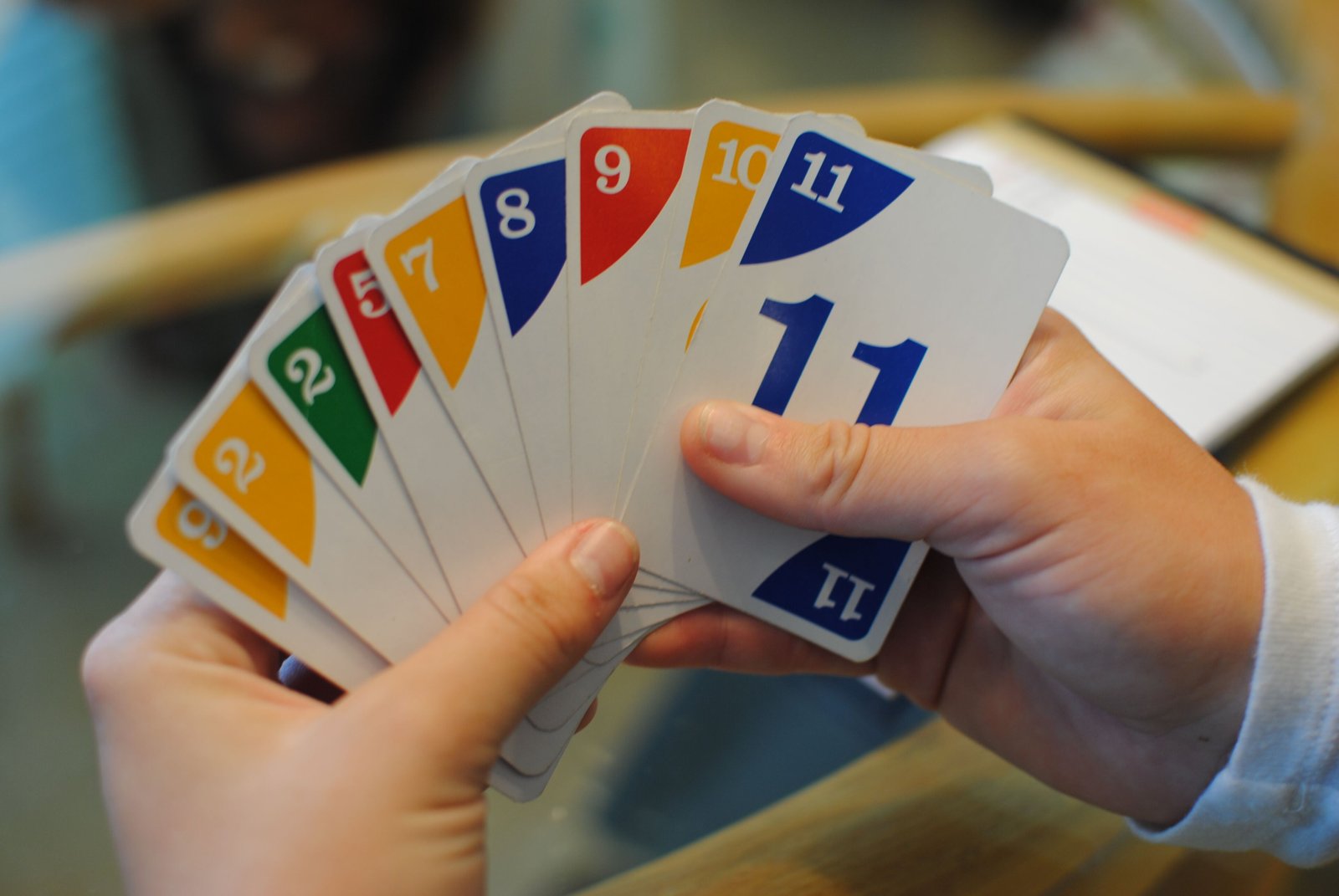
Each round, you try to collect the exact combination your current phase asks for. Everyone is dealt 10 cards. The deck has 108 playing cards: 96 number cards (two each of 1 to 12 in four colors), 8 Wilds and 4 Skips, according to Mattel’s official rules.
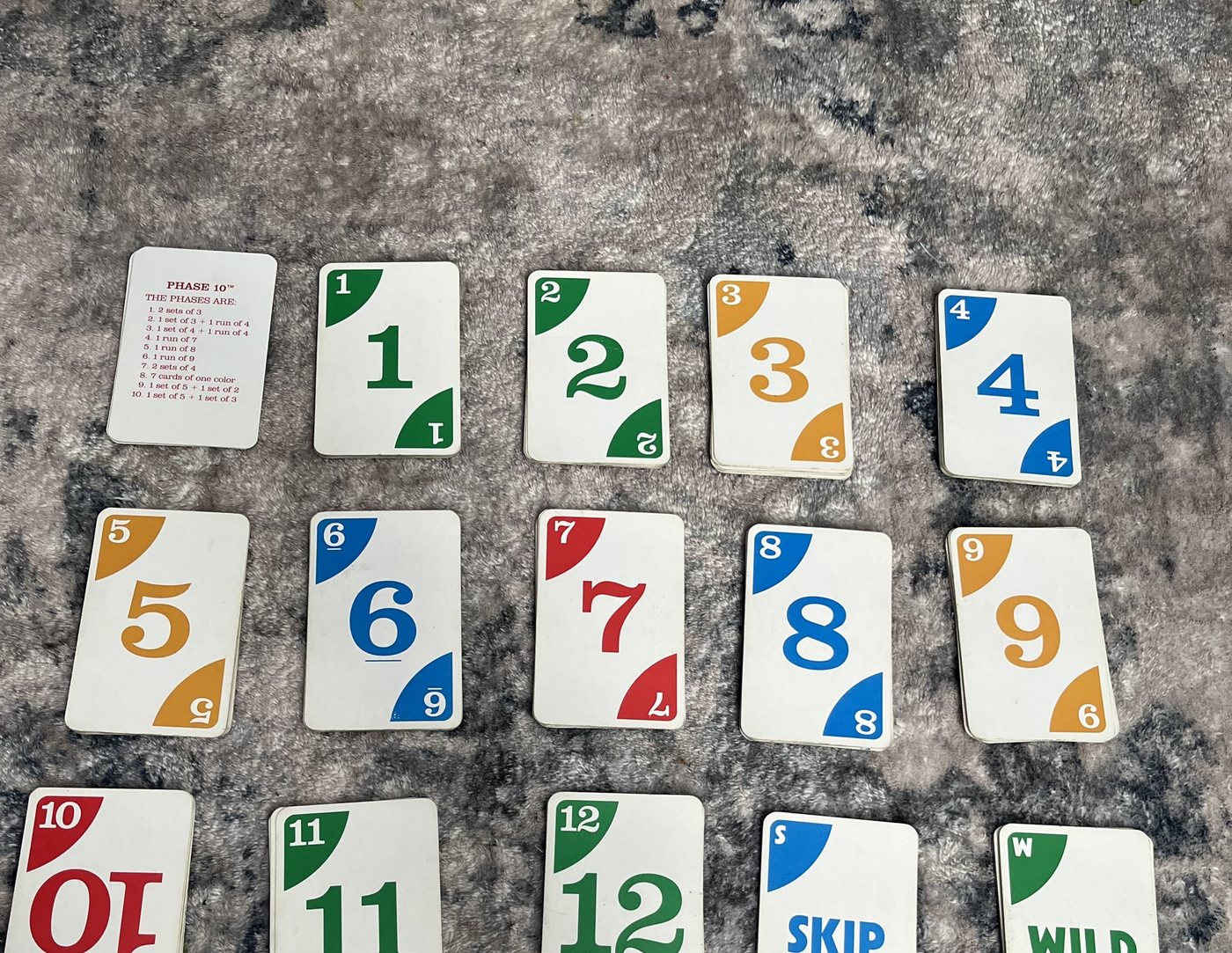
A turn has four steps:
- Draw the top card of the draw pile or the discard pile.
- Lay down your phase, if you have the whole thing in hand.
- “Hit” by adding cards to any phase on the table, once your own phase is down.
- Discard one card.
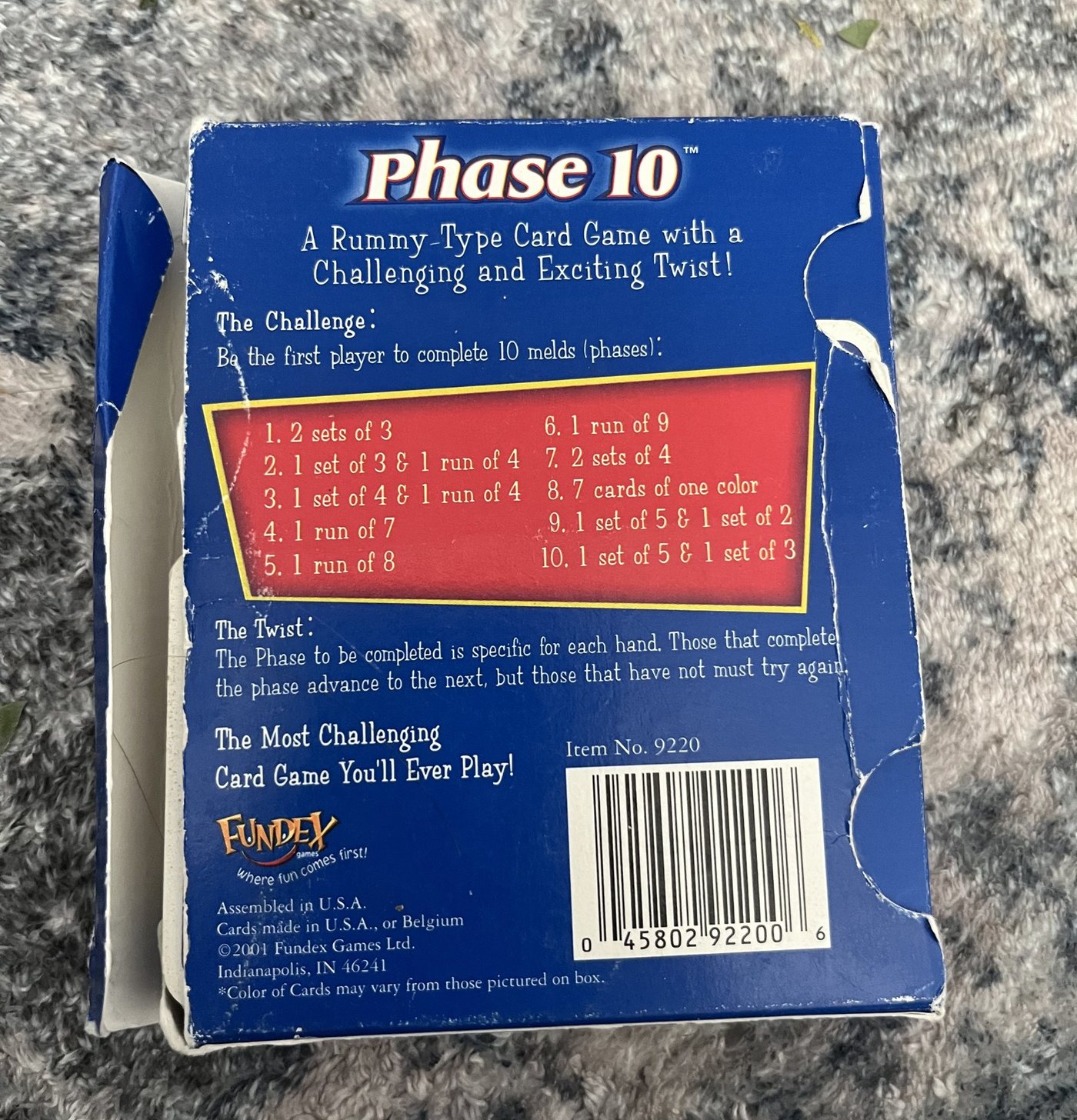
The phases get harder as you go. Phase 1 is two sets of three. Phase 6 is a run of nine. Phase 10 is a set of five plus a set of three. A set is cards of the same number, and a run is cards in number order.
You’re on Phase 4, a run of 7. You hold 3, 4, 5, 6, 8, 9 and a Wild. The Wild can stand in for the 7, so you lay all seven cards down. On your next turns you get rid of your last three cards by hitting on other players’ sets. The moment you play or discard your last card, the round ends and everyone still holding cards scores points against themselves.
When a round ends, every player who laid down their phase moves to the next one. Everyone else repeats the same phase. That is the whole game, and it’s where both the fun and the frustration come from.
If you’d rather watch than read, this how to play Phase 10 video from Triple S Games covers the current rules. Our own Phase 10 rules guide has the full phase list and scoring.
What We Liked
The ladder gives every round a clear goal. Nobody sits there wondering what to do. You need two sets of four, you have one, and you’re hunting the other. New players get it in the first hand.
It travels well. The whole game is a deck of cards in a small box, with no board and no pieces to lose. That fits how we use it: it’s our camping staple.
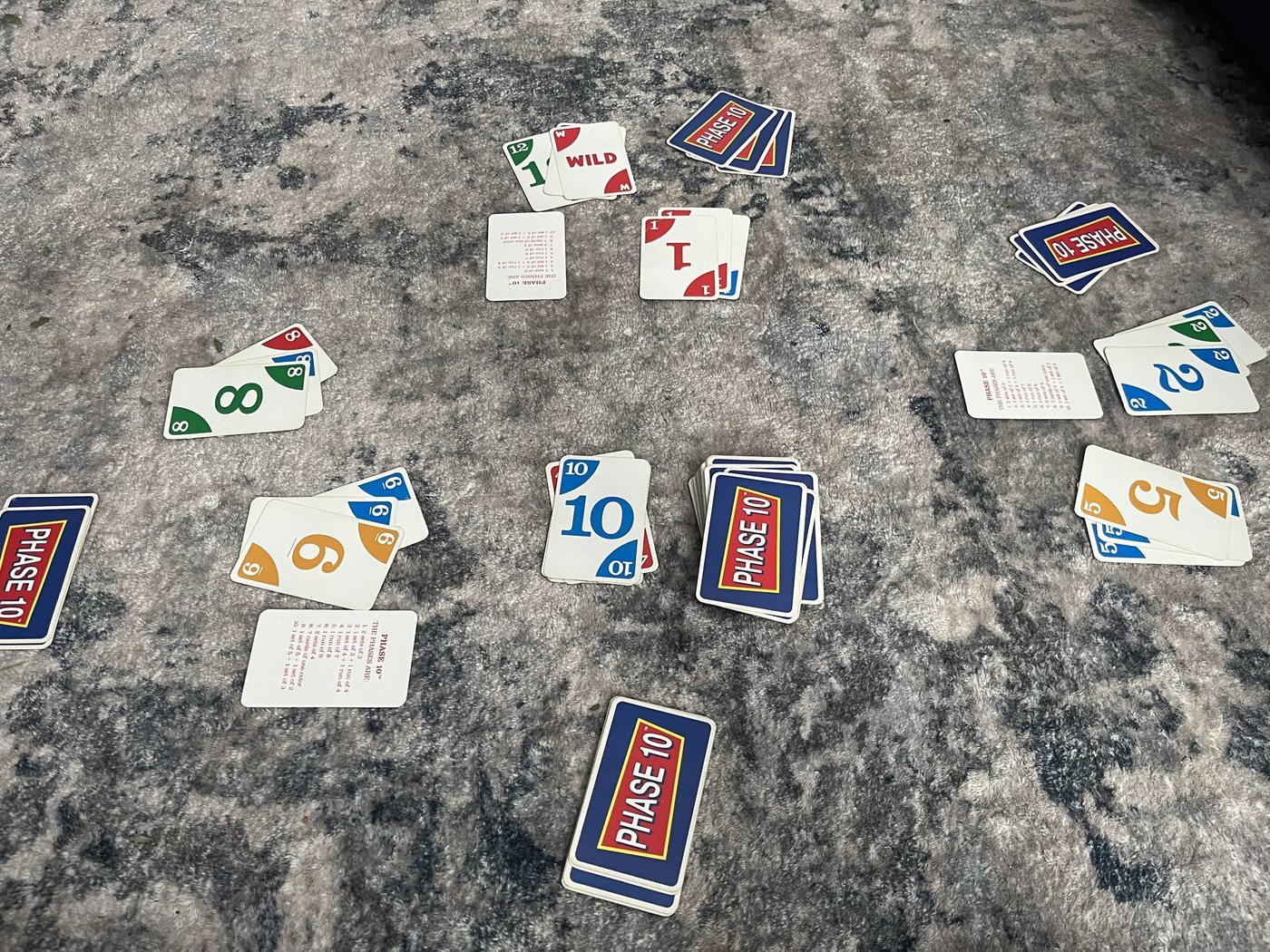
Hitting keeps the end of a round tense. Once your phase is down, you can dump cards onto anyone’s sets and runs. A player who looked stuck with six cards can be out two turns later.
The scoring is more forgiving than it looks. Points only break ties. The winner is the first player to finish Phase 10, so a bad round costs you position on the ladder, and the points rarely matter.
What We Disliked
Getting stuck feels bad. If you miss a phase, you repeat it while other players move on. Two or three misses in a row can put someone far enough behind that they’re playing for second.
A full game is long. Ten phases means at least ten rounds, and more whenever the eventual winner misses one. Mattel doesn’t print a play time, but its own rules offer two shorter variants, which says a lot.
Luck decides a lot of rounds. You can play well and still not draw the eighth card of a run. Players who want skill to win out will prefer something else.
Who It’s For
Phase 10 is for families, grandparents and grandkids, and any group where the players have very different levels of game experience. The box says 7 and up, and the rules really are that simple.
It’s also a strong pick for travel, cabins and campsites, because a deck and a flat surface are all you need. It sits comfortably next to the games on our best board games for families list.
Who should skip this game:
– Groups that want a game finished in 20 to 30 minutes.
– Players who get discouraged when they fall behind and can’t catch up quickly.
– Strategy fans who want their decisions to outweigh the draw.
– Anyone who already owns and loves a similar rummy game and doesn’t want a second one.
Who Should Buy This?
Buy Phase 10 if you want one cheap card game that a seven-year-old and a seventy-year-old can play at the same table. Mattel’s list price is $6.49.
At that price it’s a low-risk purchase. It’s a core collection game for families and a situational one for hobby gamers.
Mattel also sells the same cards in a storage tin. Our Phase 10 versions guide compares the main editions. For most people, the standard Phase 10 deck is the right one.
Check Phase 10 price on Amazon →
Best Player Count
Phase 10 is best with 4 players. The box says 2 to 6, and it works across that whole range, but four is where the pacing is right.
With four, your turn comes around quickly, and there are three other phases on the table to hit on once yours is down. BoardGameGeek’s community poll also rates it best with four.
At six, each round has more waiting, and the game has more chances for someone to miss a phase, so it runs longer. At two, the Skip card loses its bite, because there’s only one player to skip and the rules don’t let you skip the same player two turns in a row.
Replayability
Phase 10 holds up over a lot of plays, and we can say that from more than 100 of them. The phases never change, but the cards you’re dealt do, and the same phase can be easy one night and impossible the next.
The fixed ladder is also the limit. You always play the same ten goals in the same order. If your group wants variety, Mattel sells versions that change the phases, including Phase 10 Masters Classic, where you pick which phase to attempt each round.
The rules include two official shorter variants: play exactly ten rounds with everyone advancing each time, or agree on fewer phases before you start.
Awards
Phase 10 was inducted into the National Toy Hall of Fame in 2024, alongside My Little Pony and Transformers. Kenneth Johnson created it in Detroit in 1982 and sold it to Kmart himself before licensing it, according to The Strong National Museum of Play.
Similar Games
If you like Phase 10, try Five Crowns — you still build sets and runs, but there are no fixed phases to get stuck on, and it plays up to seven. Our Five Crowns vs Phase 10 comparison picks a winner, and the Five Crowns review covers it in full.
If you like Uno, try Phase 10 — it uses the same kind of colored number deck, but you’re building a hand toward a goal instead of emptying it as fast as you can. See Phase 10 vs Uno for how they differ, or our Uno review.
If you mostly play with two, try Skip-Bo — it’s a race to empty a stock pile, not rummy, and it’s still a great two-person game. Our Skip-Bo review covers it, and Skip-Bo vs Phase 10 vs Uno compares all three.
If you like classic rummy, Phase 10 will feel familiar. The card-game reference site Pagat describes it as a commercial version of Contract Rummy with special cards and a different sequence of contracts.
Tips & Tricks
Finish the phase before you worry about points. Points only matter as a tie-breaker when two players complete Phase 10 in the same round. Holding a Wild is worth the 25-point risk if it gets your phase down.
On run phases, never throw away the middle numbers. Every possible run of 9 includes the 4 through the 9. Every run of 8 includes the 5 through the 8. Those are the cards to keep, unless you’re holding a Wild to cover one.
The tempting play: use a Skip as soon as you draw it, on whoever is ahead of you on the ladder.
The better play: save it for the player who has laid down their phase and is down to one or two cards. Skipping them buys the whole table another turn to get a phase down.
Watch the discard pile. You can take the top discard instead of drawing blind, and so can the player after you. If the next player is collecting 8s, don’t feed them one.
Once your phase is down, get rid of high cards first. Tens, elevens and twelves count 10 points each if you’re caught with them, against 5 for a low card. Our Phase 10 strategy guide goes deeper on all of this.
Frequently Asked Questions
Is Phase 10 worth buying?
Yes, for families and casual groups. We rate it 5/5 Bamboo and 4/5 Pandas after more than 100 plays. It’s inexpensive, teaches in a few minutes and travels anywhere. Skip it if your group wants a short game.
How long does a game of Phase 10 take?
BoardGameGeek lists 45 minutes, and a full ten-phase game can run longer because players repeat any phase they miss. Mattel’s rules include two shorter variants for groups that want a quicker game.
Is Phase 10 good for kids?
Yes. Mattel rates it for ages 7 and up. A child who can count to 12 and match colors can play, and the phases are printed on a reference card.
Is Phase 10 more luck or skill?
Mostly luck, with some skill. You can’t control what you draw, but choosing what to discard, when to pick up the discard and who to skip does change your results over many rounds.
Can you play Phase 10 with 2 players?
Yes. The box says 2 to 6 players, and the rules are the same at two. It plays faster, and the Skip card matters less because there’s only one opponent to skip.
Is Phase 10 like Uno?
The decks look alike, but the games play differently. In Uno you race to empty your hand. In Phase 10 you collect sets and runs to complete ten goals in order, which is much closer to rummy.
What happens if you don’t complete your phase?
You stay on the same phase in the next round while players who finished move up. You also score penalty points for the cards left in your hand.
Which version of Phase 10 should I buy?
The standard 108-card deck. It has the lowest list price and it’s the game people mean when they say Phase 10. The tin edition has the same cards in a sturdier case.
Want to go deeper?
- Phase 10 Rules — the ten phases, scoring and every Wild and Skip rule in one place. Read it here
- Phase 10 Strategy — which cards to keep on each phase, with the maths behind it. Read it here
- Phase 10 Versions — standard, Masters Classic, Flip!, Tiles and the rest compared. Read it here
- Phase 10 vs Uno — which of Mattel’s two big card games to buy. Read it here
- Five Crowns vs Phase 10 — the closest rival, compared. Read it here
Verdict
Buy it if you want a simple, cheap card game for a mixed-age group, or something to throw in a bag for a trip. Skip it if your group needs a game that finishes fast or hates falling behind with no quick way back. Try the shorter variant first if you’re worried about length: agree to stop after five phases.
Phase 10 official site: Mattel’s Phase 10 product page