

Phase 10 rules in short: deal 10 cards each. On your turn, draw one card, lay down your current phase if you have all of it, then discard one card. Players who lay down their phase move to the next one. The first player to complete Phase 10 wins.
Some links below are Amazon affiliate links — as an Amazon Associate, King Panda Games earns from qualifying purchases at no extra cost to you. Full disclosure.
This guide follows Mattel’s current official Phase 10 rules for the standard Phase 10 deck. Where older rule sheets say something different, we point it out.
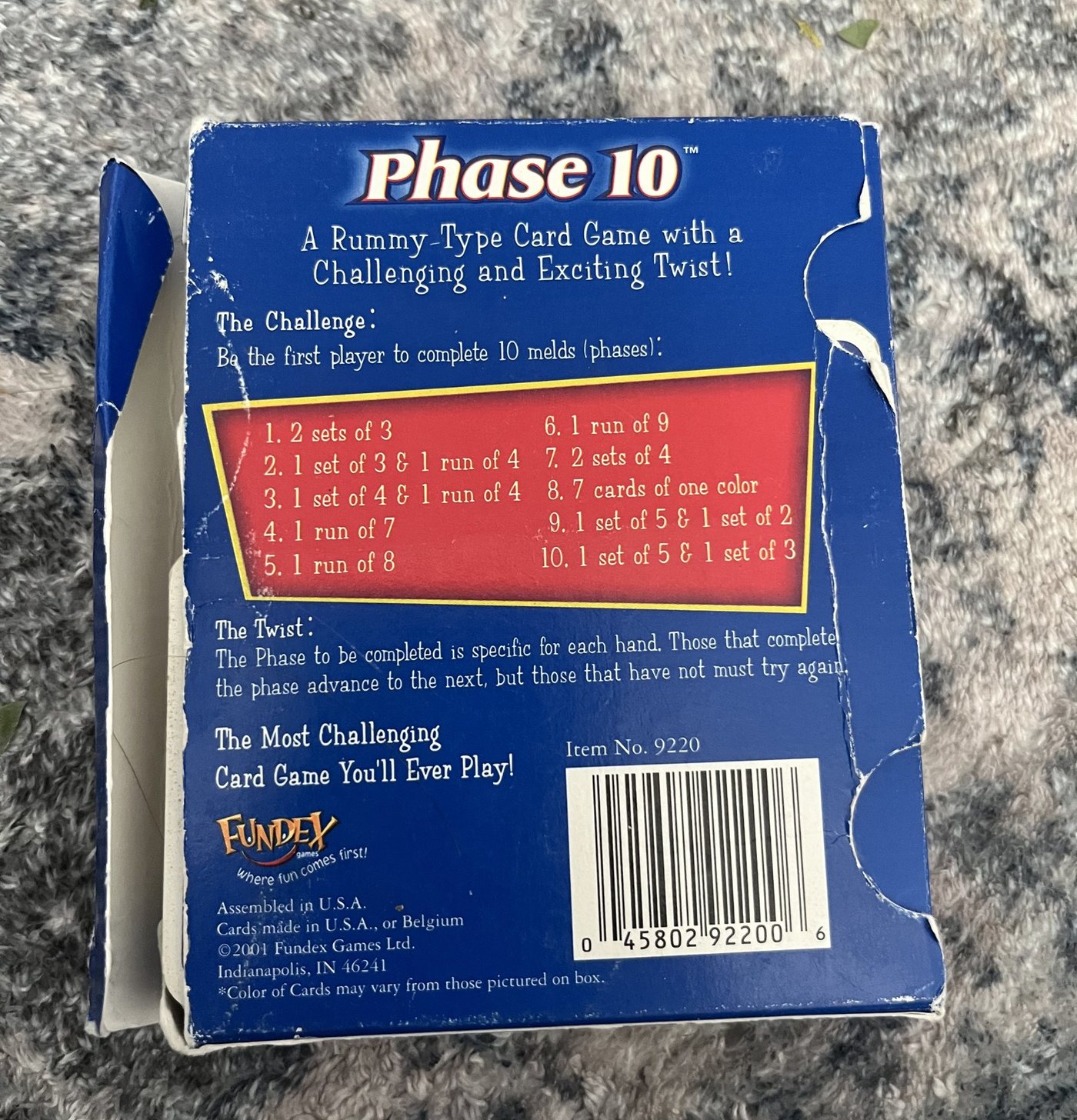
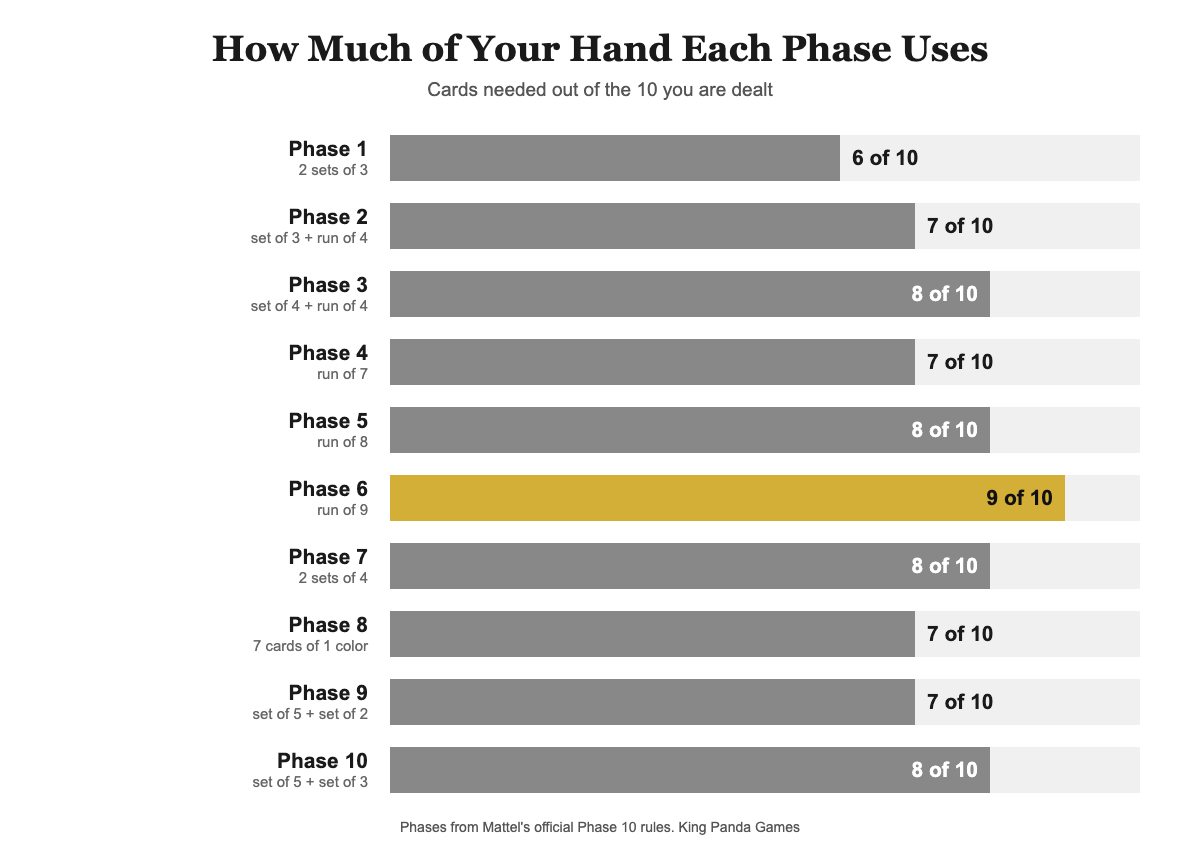
The 10 Phases in Order
| Phase | What you need |
|---|---|
| 1 | 2 sets of 3 |
| 2 | 1 set of 3 + 1 run of 4 |
| 3 | 1 set of 4 + 1 run of 4 |
| 4 | 1 run of 7 |
| 5 | 1 run of 8 |
| 6 | 1 run of 9 |
| 7 | 2 sets of 4 |
| 8 | 7 cards of 1 color |
| 9 | 1 set of 5 + 1 set of 2 |
| 10 | 1 set of 5 + 1 set of 3 |
- A set is cards with the same number, in any colors. Both sets in a phase can be the same number.
- A run is cards in number order, in any colors, like 3-4-5-6.
- One color means all the same color. The numbers don’t matter.
You have to complete the phases in order, one per round. You must hold the whole phase in your hand before you can lay any of it down.
What’s in the Deck
Phase 10 has 108 playing cards:
- 96 number cards: two each of 1 through 12 in red, blue, green and yellow.
- 8 Wild cards.
- 4 Skip cards.
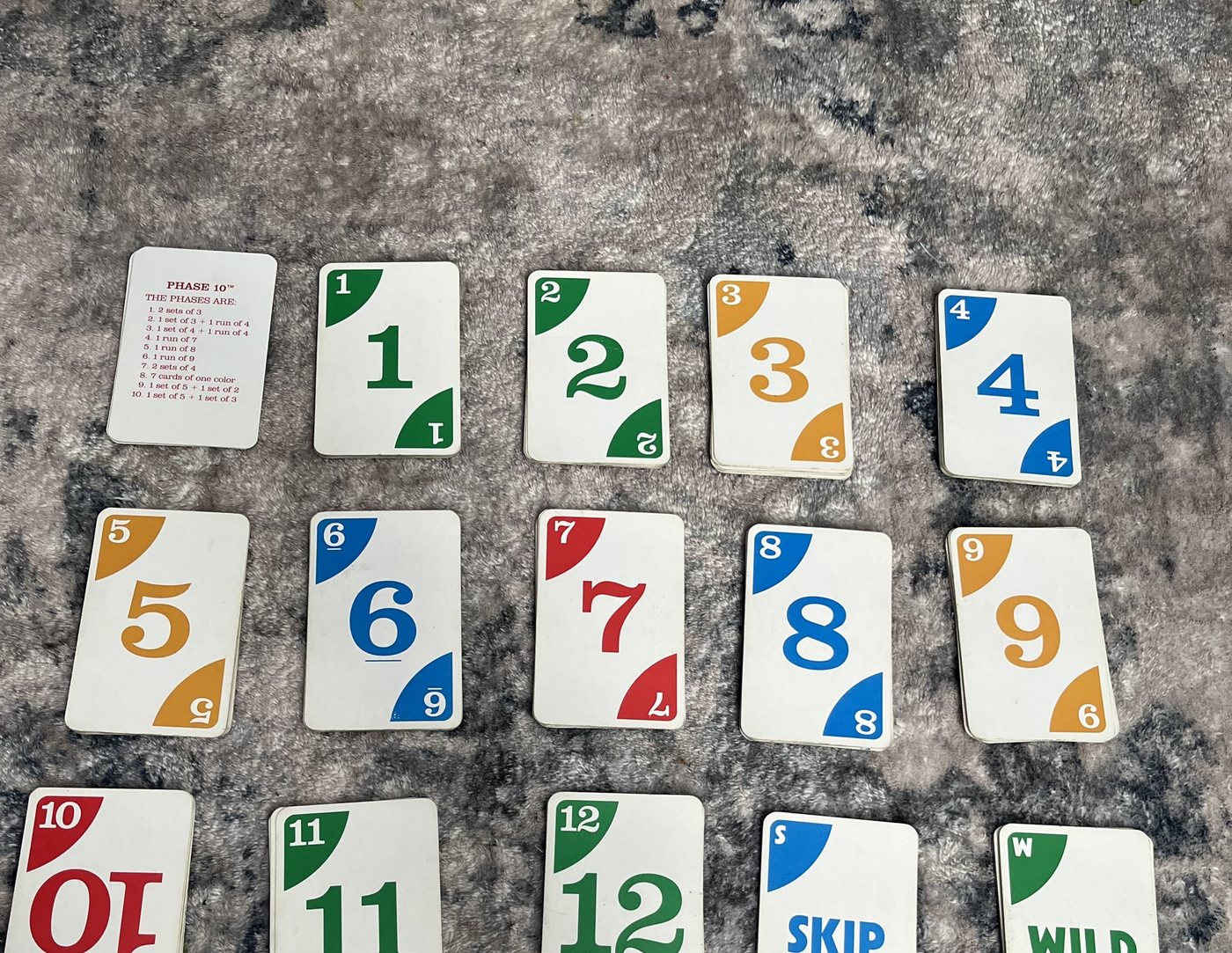
Current boxes also include two phase reference cards. That’s why the rules say 110 cards and some store listings say 108.
The game is for 2 to 6 players, ages 7 and up.
Setup
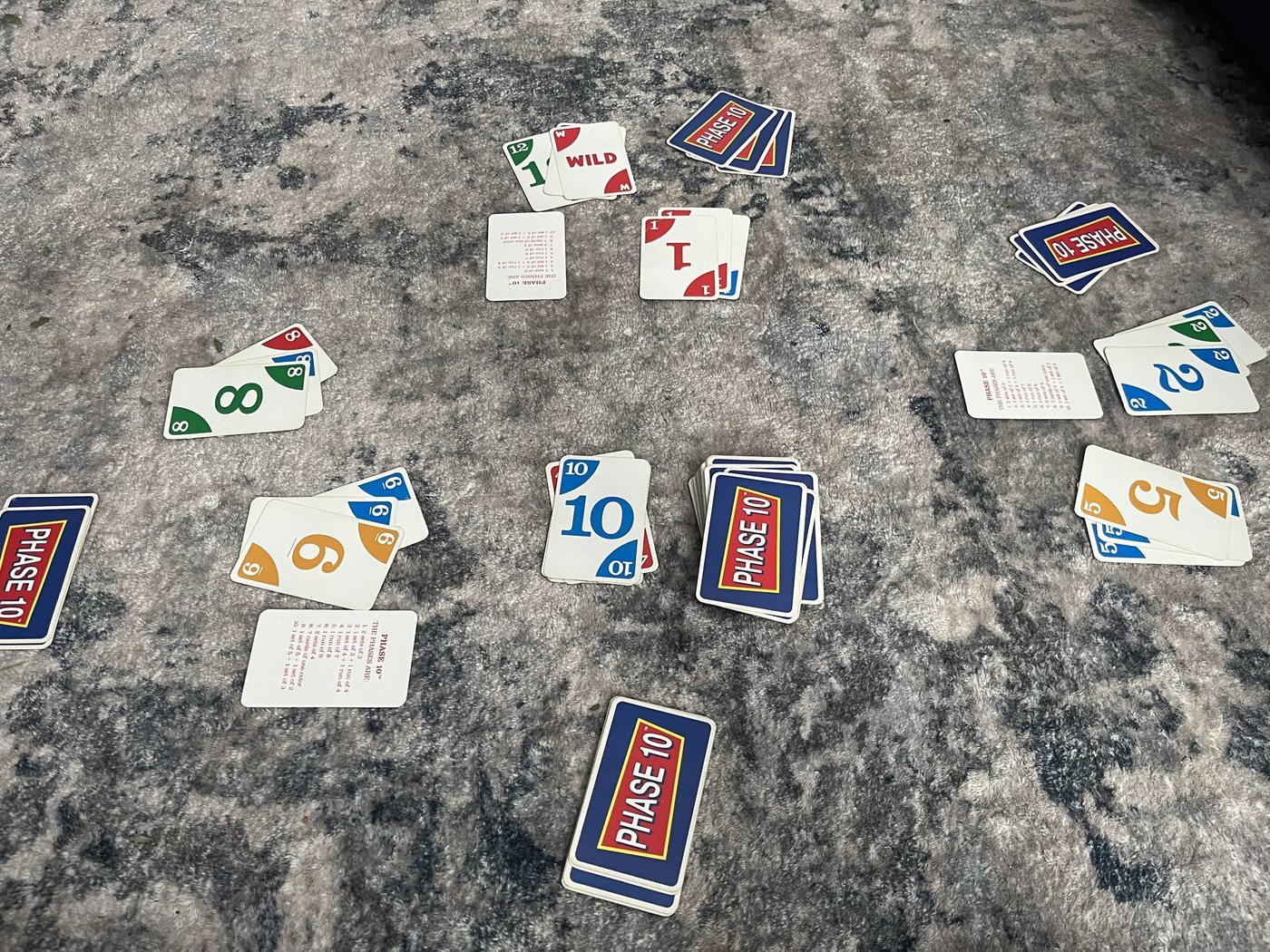
- Pick a dealer. Shuffle and deal 10 cards to each player, face down.
- Put the rest of the deck in the middle as the draw pile.
- Turn the top card over to start the discard pile.
- The player to the dealer’s left goes first, and play moves clockwise.
Everyone starts on Phase 1.
What You Do on Your Turn
Every turn has the same four steps:
- Draw one card, either the top of the draw pile or the top of the discard pile.
- Lay down your phase, if you have the whole thing in hand. This is optional.
- Hit, if your own phase is already down. This is optional too.
- Discard one card to end your turn.
You get credit for a phase the moment you lay it down. You don’t have to go out to keep it.
If you’d rather watch a turn played out, this how to play Phase 10 video from Triple S Games covers the current rules.
Check Phase 10 price on Amazon →
How Hitting Works
“What is hitting in Phase 10?” Hitting means adding cards from your hand to a phase that’s already on the table.
Three rules apply:
- Your own phase must be laid down first.
- You can only hit during your own turn.
- You can hit on your own phase or anyone else’s, as many times as you like, as long as each card fits.
A card fits if it continues the set or run. You can add a fourth 9 to a set of 9s, or a 7 to the end of a 3-4-5-6 run. Wilds can be used to hit.
Wild Card Rules
A Wild can stand in for any number, or for any color in Phase 8.
- You can use as many Wilds as you want in a phase, as long as there’s at least one number card in it. An all-Wild phase isn’t allowed.
- Once a Wild is played in a phase, it can’t be removed for the rest of the round. You can’t swap in the real card and take the Wild back.
- If the dealer turns up a Wild to start the discard pile, the first player may pick it up.
Skip Card Rules
You play a Skip by discarding it, then choosing which player loses their next turn. It counts as your discard for that turn.
- A Skip can never be picked up from the discard pile.
- A Skip can never be used as part of a phase.
- You can’t skip the same player two turns in a row. They have to get a normal turn before they can be skipped again.
- If the dealer turns up a Skip to start the discard pile, the first player’s turn is skipped.
What older rule sheets say: only one Skip can be used against each player per trip around the table.
What the current rules say: a skipped player must be allowed a normal turn before being skipped again. If your family argues about this, you may be using two different rule sheets.
Ending a Round and Scoring
A round ends when one player gets rid of their last card, by hitting or by discarding it. That’s called going out.
Then two things happen. First, everyone who laid down their phase moves on to the next phase. Everyone who didn’t repeats the same phase next round.
Second, players score penalty points for the cards still in their hands. Low scores are good.
| Card left in hand | Points |
|---|---|
| 1 through 9 | 5 each |
| 10, 11 or 12 | 10 each |
| Skip | 15 each |
| Wild | 25 each |
The player who went out scores zero. Cards on the table don’t count. The deal passes to the left and a new round begins.
How You Win
The first player to complete Phase 10 at the end of a round wins.
If two or more players complete Phase 10 in the same round, the one with the fewest total points wins. If they’re still tied, the tied players replay Phase 10, and the first to go out wins.
Worth knowing: points are only a tie-breaker. A player with 300 points who finishes Phase 10 first beats a player with 40 points who is still on Phase 9.
Official Shorter Variants
The current rules include two ways to shorten the game:
- Ten rounds, no repeats. Play exactly ten rounds. Everyone moves up a phase each round whether they completed it or not, and the lowest total score wins.
- Fewer phases. Agree before you start to play only the first five or seven phases.
An older Mattel rule sheet also suggested playing only the even-numbered phases. That variant isn’t in the current rules, but nothing stops you from using it.
Two-Player Phase 10
The rules are the same with two players. The official rule sheet has no separate two-player rules.
The Skip is the one card that works differently in practice. Under the general rule, a Skip makes your only opponent lose their turn, so you play again, and you can’t skip them a second time until they’ve had a normal turn.
Once you know the rules, our Phase 10 strategy guide covers which cards to keep. The Phase 10 review has our ratings, and Phase 10 versions explains how Masters, Flip! and Tiles change these rules. If your rule sheet is missing, a new Phase 10 deck includes the current one.
Frequently Asked Questions
What are the 10 phases in Phase 10?
In order: 2 sets of 3; a set of 3 and a run of 4; a set of 4 and a run of 4; a run of 7; a run of 8; a run of 9; 2 sets of 4; 7 cards of one color; a set of 5 and a set of 2; a set of 5 and a set of 3.
How many cards do you deal in Phase 10?
Ten cards to each player, every round. The rest of the deck becomes the draw pile, and one card is turned over to start the discard pile.
How do you score Phase 10?
Cards left in your hand when someone goes out count against you: 5 points for each 1 to 9, 10 points for each 10 to 12, 15 for a Skip and 25 for a Wild. The lowest score is best.
Can you pick up a Skip card from the discard pile?
No. The official rules say a Skip card may never be picked up from the discard pile. A Skip also can’t be used as part of a phase.
Can a phase be made of all Wild cards?
No. You can use as many Wilds as you like, but every phase needs at least one numbered card.
Do you have to go out to complete a phase?
No. You get credit for the phase as soon as you lay it down. Going out ends the round, but every player whose phase is on the table moves up.
Can you skip the same person twice in Phase 10?
Not two turns in a row. The current rules say a skipped player must have a normal turn before they can be skipped again.
Who wins if two players finish Phase 10 in the same round?
The one with the lowest total score. If the scores are tied, those players replay Phase 10 and the first to go out wins.