

The best Phase 10 strategy is to finish your phase every round and ignore your score until the very end. Points only break ties. The player who completes Phase 10 first wins, so a round where you lay down your phase is a good round, whatever you’re left holding.
One link below is an Amazon affiliate link — as an Amazon Associate, King Panda Games earns from qualifying purchases at no extra cost to you. Full disclosure.
We’ve played Phase 10 more than 100 times. The advice below comes from the deck itself and from Mattel’s official rules, so you can check every number. Phase 10 is a version of Contract Rummy, as the card-game reference site Pagat notes, so most rummy habits carry over.
Know How Much of Your Hand Each Phase Uses
You’re dealt 10 cards, and each phase uses a different share of them. The fewer spare cards a phase leaves you, the harder it is.
| Phase | What you need | Cards needed | Spare cards in a 10-card hand | What to keep |
|---|---|---|---|---|
| 1 | 2 sets of 3 | 6 | 4 | Pairs. Throw single cards first. |
| 2 | 1 set of 3 + 1 run of 4 | 7 | 3 | Your best pair, plus numbers that sit next to each other. |
| 3 | 1 set of 4 + 1 run of 4 | 8 | 2 | Your best pair or triple, plus four neighbors. |
| 4 | 1 run of 7 | 7 | 3 | 6s and 7s. Throw duplicates. |
| 5 | 1 run of 8 | 8 | 2 | 5 through 8. Throw duplicates. |
| 6 | 1 run of 9 | 9 | 1 | 4 through 9. Throw duplicates. |
| 7 | 2 sets of 4 | 8 | 2 | Your two biggest groups. Throw everything else. |
| 8 | 7 cards of 1 color | 7 | 3 | Your longest color. Numbers don’t matter. |
| 9 | 1 set of 5 + 1 set of 2 | 7 | 3 | Your biggest group and any one pair. |
| 10 | 1 set of 5 + 1 set of 3 | 8 | 2 | Your two biggest groups. |
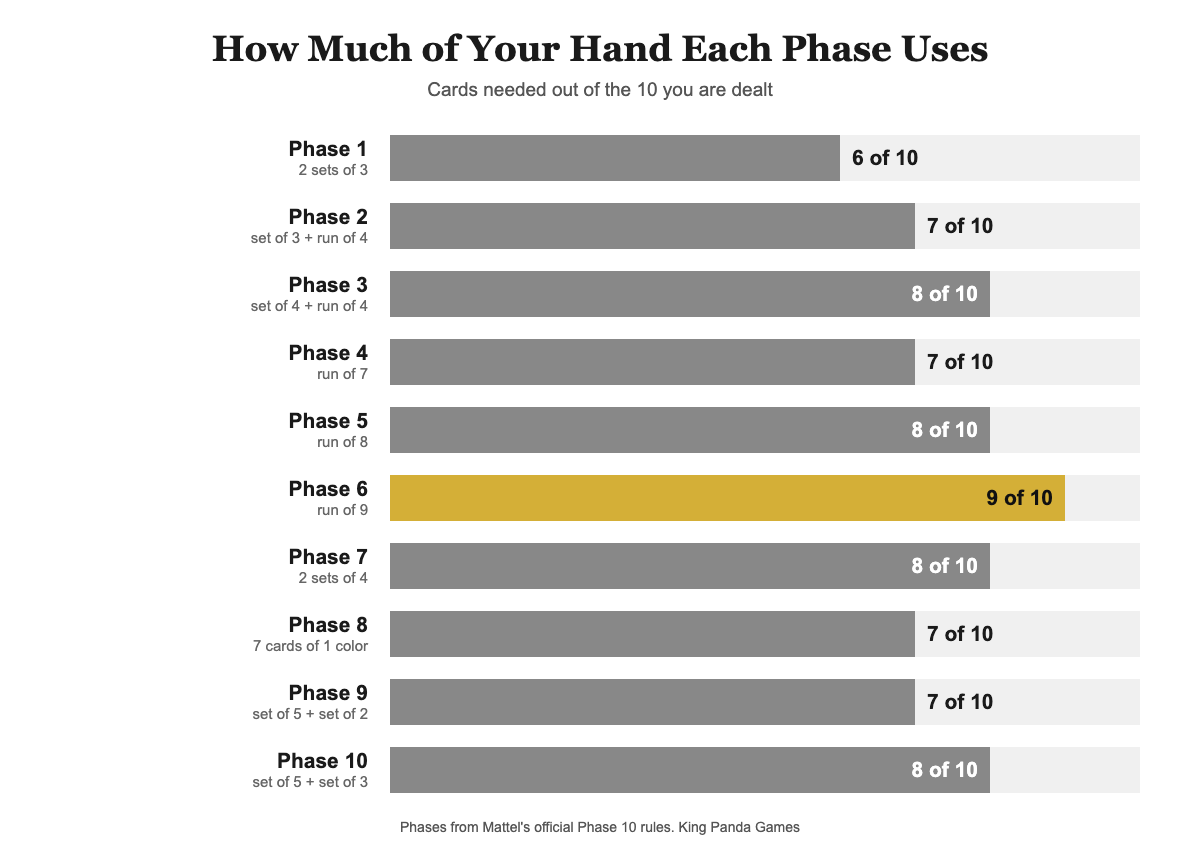
Phase 6 is the tightest phase in the game. A run of 9 uses nine of your ten cards, so almost every card you hold has to be the right one. It’s the phase where a single wrong card hurts most.
On Run Phases, Keep the Middle Numbers
Some numbers are in every possible run. Don’t discard them unless a Wild is covering that spot. This is plain counting.
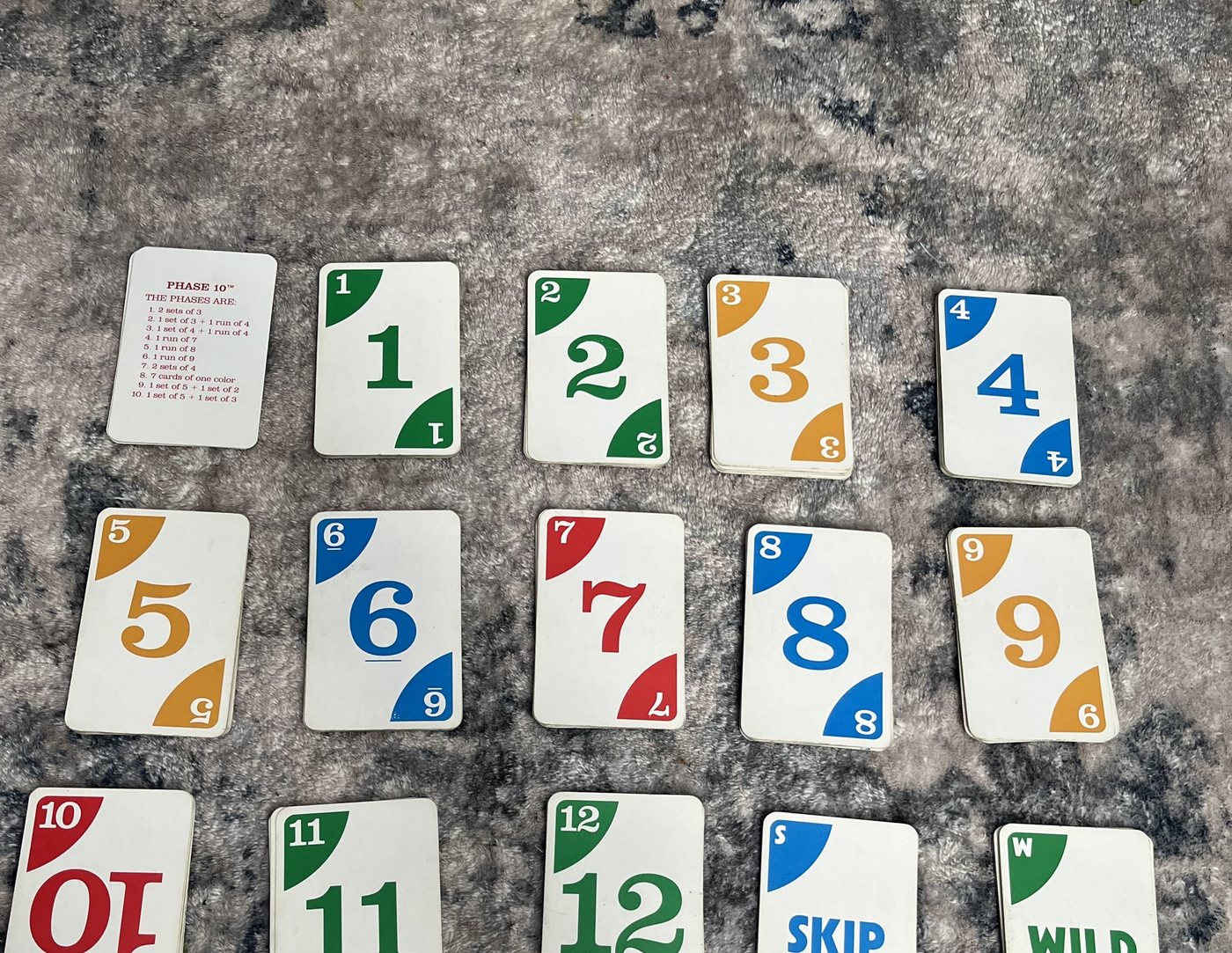
The deck runs from 1 to 12. A run of 9 can only be 1–9, 2–10, 3–11 or 4–12. Every one of those four runs contains the 4, 5, 6, 7, 8 and 9.
| Phase | Run length | Possible runs | Numbers that are in every one |
|---|---|---|---|
| 4 | 7 | 6 | 6 and 7 |
| 5 | 8 | 5 | 5, 6, 7 and 8 |
| 6 | 9 | 4 | 4, 5, 6, 7, 8 and 9 |
The rule: on Phases 4, 5 and 6, hold the middle numbers and discard from the ends. A 1 or a 12 fits only one possible run. A 6 or a 7 fits all of them.
Duplicates are dead weight on run phases. A run needs one of each number, so your second 7 is your first discard.
Hold Your Wilds, and Spend Them Late
“Should you keep Wild cards in Phase 10?” Yes. Keep every Wild until it completes your phase.
There are 8 Wilds in the 108-card deck, about one card in every 13. A Wild left in your hand at the end of a round costs 25 points, the biggest penalty in the game. That penalty is a poor reason to dump them, because points only matter in a tie.
Two rules shape how you use them:
- A phase needs at least one real number card. You can’t lay down all Wilds.
- Once a Wild is on the table, it stays where it is for the rest of the round. You can’t swap the real card in later and reuse the Wild.
So decide what the Wild is standing in for before you lay it down. On a run, use it for the one number you can’t find.
Lay Down the Moment You Can
There is rarely a good reason to hold a finished phase in your hand. You get credit for the phase as soon as it’s on the table, and you can’t hit until your own phase is down.
The tempting play: hold a complete phase for a turn or two, hoping to go out in one move and catch everyone with full hands.
The better play: lay it down right away. If someone else goes out first, a phase still in your hand counts for nothing, and you repeat it next round.
After that, your job changes. Get rid of cards as fast as you can by hitting on any phase on the table, and discard your 10s, 11s and 12s first. They cost 10 points each if you’re caught with them, against 5 for the numbers 1 to 9.
Use Skips on the Player Who’s About to Go Out
A Skip is worth the most late in a round. Play it on the player who has laid down their phase and is down to one or two cards.
Three players have their phases down. You don’t. The player to your left has one card left and will probably go out on their next turn. You draw a Skip. Play it on them now. That gives you, and everyone else, one more full turn to finish a phase before the round ends.
Two rules limit this. You can’t skip the same player two turns in a row, and a Skip can never be picked up from the discard pile. A Skip in your hand at the end of a round costs 15 points, so don’t sit on one once your own phase is down.
Worth knowing: a Skip is also your discard for the turn. On a tight phase like Phase 6, playing a Skip lets you keep every number card you’re holding.
Watch What the Next Player Picks Up
The player after you can take your discard. If they picked up an 8 last turn, they’re collecting 8s or building a run around it, and your spare 8 should stay in your hand a little longer.
It works the other way too. The card the player before you throws away tells you what they don’t need, which hints at what they do.
On set phases, remember there are eight copies of every number in the deck: two in each of four colors. Phases 9 and 10 need a set of five, which is five of those eight copies unless Wilds help. If two players are chasing the same number, there aren’t enough copies for both.
If getting stuck is ruining the game for someone at your table, Phase 10 Masters Classic lets players choose which phase to attempt each round. Our Phase 10 versions guide explains how it works, and the Phase 10 review covers the standard game in full.
For the exact wording of any rule above, see our Phase 10 rules guide.
Check Phase 10 Masters Classic price on Amazon →
Frequently Asked Questions
What is the best strategy for Phase 10?
Complete your phase every round and treat points as an afterthought. The first player to finish Phase 10 wins, and points only break a tie when two players finish it in the same round.
What is the hardest phase in Phase 10?
Phase 6, a run of 9. It uses nine of the ten cards you’re dealt, more than any other phase, so it leaves the least room for cards you don’t need.
Should you hold on to Wild cards in Phase 10?
Yes, until one completes your phase. A Wild costs 25 points if you’re caught with it, but points rarely decide the game, and a Wild is the most flexible card in the deck.
When should you play a Skip card in Phase 10?
On a player who has laid down their phase and has only one or two cards left. Skipping them gives everyone else another turn to complete a phase before the round ends.
Which cards should you discard first in Phase 10?
Before your phase is down, discard cards that can’t help it, starting with duplicates on run phases. After it’s down, discard 10s, 11s and 12s first, because they score 10 points each.
Can you lay down more than your phase in Phase 10?
You lay down the phase itself, then add cards by hitting on your own or other players’ phases on the same turn or later ones. You can only hit once your own phase is on the table.
Is Phase 10 mostly luck?
Luck decides a lot of individual rounds, because you can’t control what you draw. Over a full game, good discards, well-timed Skips and smart use of Wilds add up.