

The Best Wonders in 7 Wonders (Base Game), Ranked
Babylon is the best wonder in 7 Wonders, Gizah is the one to hand a beginner, and Rhodes is the one we always pass to whoever showed up late. This is the ranking for the base board game — 3 to 7 players, the one that won the first Kennerspiel des Jahres in 2011. If you’re looking for the 2-player game, that’s a different ranking entirely: our 7 Wonders Duel wonders guide.
Some links below are Amazon affiliate links — as an Amazon Associate, King Panda Games earns from qualifying purchases at no extra cost to you. Full disclosure.
Quick orientation: every board has a simpler day (A) side and a spicier night (B) side. The ranking below weighs both, and calls out where a board’s two sides genuinely differ in strength. Last verified: August 2026.
1. Babylon — The Tempo Cheat
Babylon’s night side breaks the game’s most fundamental constraint: at the end of each Age, you play your final card instead of discarding it. That’s three extra cards of value per game in a game that’s only 18 cards long — call it a 16% bigger game than everyone else is playing.
The day side leans science, granting a wild science symbol that fills whichever of the three symbols your collection is missing. Science scoring rewards completed sets so heavily that a single wildcard routinely swings 7-plus points. Either side, Babylon gives you options the table can’t plan around — the mark of a first-place board.
2. Halicarnassus — The Second Chance Engine
Halicarnassus digs through the discard pile and builds a card from it for free. Everyone at the table has watched a perfect card die in the discards; Halicarnassus is the only board that gets it back.
The strength is partly psychological — you draft differently knowing the discard pile is your personal reserve. Late in an Age you can hate-draft an opponent’s key card with zero cost, because your wonder stage will fish out whatever you actually needed. No other board gives you a second chance at a card the table already threw away.
3. Gizah — The Beginner’s Rock
Gizah pays victory points, full stop — more raw points from stages than any other wonder board. No decisions, no timing, no reading the draft. Build the stages, bank the points, and you’ve got a floor no one can take away from you.
That’s exactly why it’s the right first board: a new player on Gizah stays competitive while learning what everyone else’s cards even do. It ranks third rather than first because a fixed pile of points has a ceiling, and the two boards above it don’t.
4. Alexandria — The Flexible One
Alexandria’s stages produce wild resources — a choice among the raw materials on the day side, broader on the night side. In a game where being short one clay in Age II ruins whole turns, Alexandria simply doesn’t have that problem.
Why isn’t flexibility ranked higher? Because wild resources make every plan slightly better rather than any plan much better. Alexandria has the highest floor of the top four and the lowest ceiling — the board you’re happy to receive and never excited about.
5. Olympia — The Free Lunch, Occasionally
Olympia’s signature lets you construct a card for free — once per Age on the day side. Best case, that’s a monstrous Age III guild built for nothing. Average case, it saves you a few coins on something you could nearly afford anyway.
That gap between best and average case is the ranking. Olympia rewards players who can hold the free build until it’s worth double digits, and punishes everyone else with mild savings. A veteran’s board wearing a beginner’s ability.
6. Ephesos — The Coin Purse
Ephesos mints coins, and coins are quietly fine: three coins convert to a victory point at game end, and never being broke means never missing a resource purchase from a neighbor. Solid, liquid, unexciting.
The trouble is that “never broke” is a problem good drafting solves anyway. Ephesos is the board equivalent of a sensible emergency fund — correct, comfortable, and never the reason you won.
7. Rhodes — The Neighborhood Bully
Rhodes builds military shields from its wonder stages, and military is the base game’s most overrated pursuit. Conflict scoring is capped, you can only ever beat your two neighbors, and at 5–7 players the rest of the table happily ignores your border war while stacking civilian and science points.
Rhodes on the night side, at three players, with neighbors who neglect shields — genuinely strong. Everywhere else it’s a board that wins battles while losing the score sheet. Someone has to be seventh.
The Tier Picture
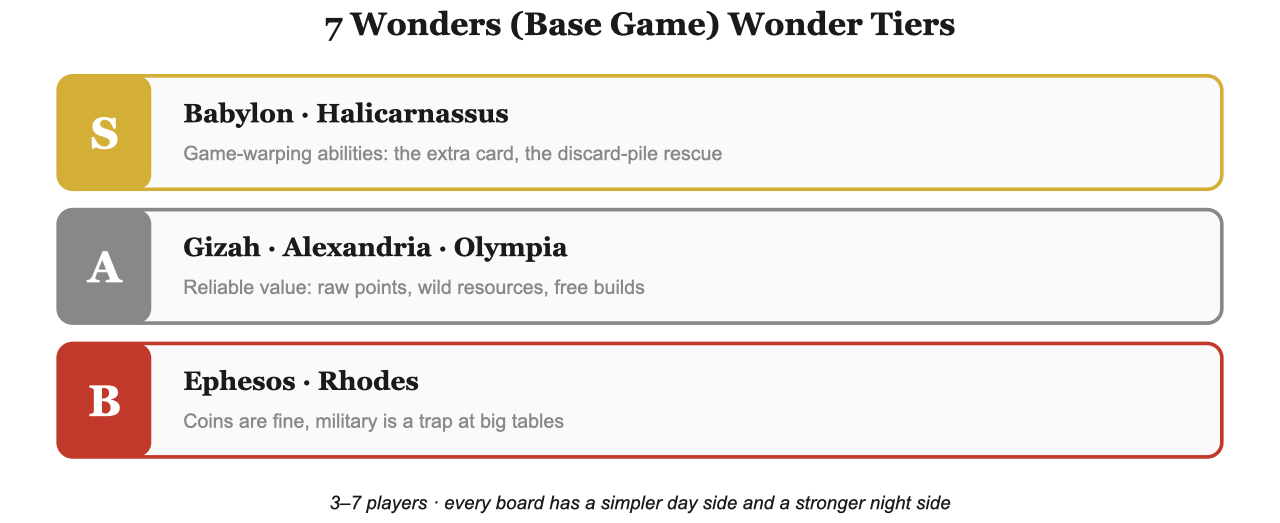
Two boards above the pack (Babylon, Halicarnassus), three solid citizens (Gizah, Alexandria, Olympia), two you play because the box handed them to you (Ephesos, Rhodes). If your table plays random assignment — as the rulebook intends — the ranking matters less than knowing your board’s win condition — and BGG’s 7 Wonders page has stage-by-stage references for every board if you want the exact numbers.
New to the game entirely? Start with our 7 Wonders review. It’s the best 3–7 player opener in the hobby, and the reason we compare so many games to it — Wingspan fans will recognize the “build your engine, mind your neighbors” DNA immediately. Deciding between this and the 2-player version? 7 Wonders Duel vs 7 Wonders settles it.
Once you know your board, our 7 Wonders strategy guide covers what to draft in each Age, and 7 Wonders expansions ranked covers the seven extra Wonder boards the four expansions add.
Frequently Asked Questions
What is the best wonder in 7 Wonders?
Babylon, especially on its night side — playing your final card of each Age instead of discarding it is three extra cards of value per game, and no other board’s benefit compounds like that. Halicarnassus is the close second for its build-from-the-discard-pile ability.
What is the best wonder for beginners in 7 Wonders?
Gizah. It asks for no strategy beyond building its stages, pays out more raw victory points than any other wonder, and never depends on reading the draft or your neighbors. You can play your first game on Gizah and stay competitive.
Is this ranking for 7 Wonders or 7 Wonders Duel?
The base 7 Wonders board game for 3–7 players. Duel is a separate 2-player game with its own wonder cards and a completely different ranking — we cover those in our 7 Wonders Duel best wonders guide.
What do the day and night sides of a wonder mean?
Every wonder board is double-sided: the day (A) side is simpler and cheaper to build, the night (B) side has fewer or stranger stages with stronger effects. New players should start on day sides; experienced tables usually agree on all-night for more variety.
Is Rhodes a bad wonder in 7 Wonders?
It’s the weakest of the seven for most tables. Its military shields only punish your two neighbors, military conflict scoring is capped, and at 5–7 players the rest of the table races ahead on civilian and science points while you win border skirmishes.
Do you need to finish your wonder to win in 7 Wonders?
No — wonder stages are one scoring category among many, and skipping stages to draft better cards is often correct. Strong players regularly win with unfinished wonders, especially on boards whose later stages pay less than a good Age III card.