

You get 18 card plays in a game of 7 Wonders. The rulebook’s own scoring example ends on 55 points, which works out to about 3 points per card. That number is the whole strategy: every pick should either beat 3 points or set up a later pick that does.
Some links below are Amazon affiliate links — as an Amazon Associate, King Panda Games earns from qualifying purchases at no extra cost to you. Full disclosure.
Everything below is worked out from the scoring rules in the official Second Edition rulebook, not from a win-rate database. If you’re still learning the turn structure, read our 7 Wonders rules guide first.
Science Is All or Nothing
Science is the strongest color in 7 Wonders if you take a lot of it, and one of the weakest if you take a little. There is almost no middle.
Green cards score two ways at once. Each symbol scores its count squared, and every set of three different symbols adds 7. The base game has twelve different green buildings, four for each symbol, and you can’t build the same building twice.
Here is the best score you can reach for each number of green cards:
| Green cards | Best mix | Points | Points per card |
|---|---|---|---|
| 1 | 1 / 0 / 0 | 1 | 1.0 |
| 2 | 2 / 0 / 0 | 4 | 2.0 |
| 3 | 1 / 1 / 1 | 10 | 3.3 |
| 4 | 4 / 0 / 0 | 16 | 4.0 |
| 5 | 3 / 1 / 1 | 18 | 3.6 |
| 6 | 2 / 2 / 2 | 26 | 4.3 |
| 7 | 3 / 2 / 2 | 31 | 4.4 |
| 8 | 4 / 2 / 2 | 38 | 4.75 |
| 9 | 3 / 3 / 3 | 48 | 5.3 |
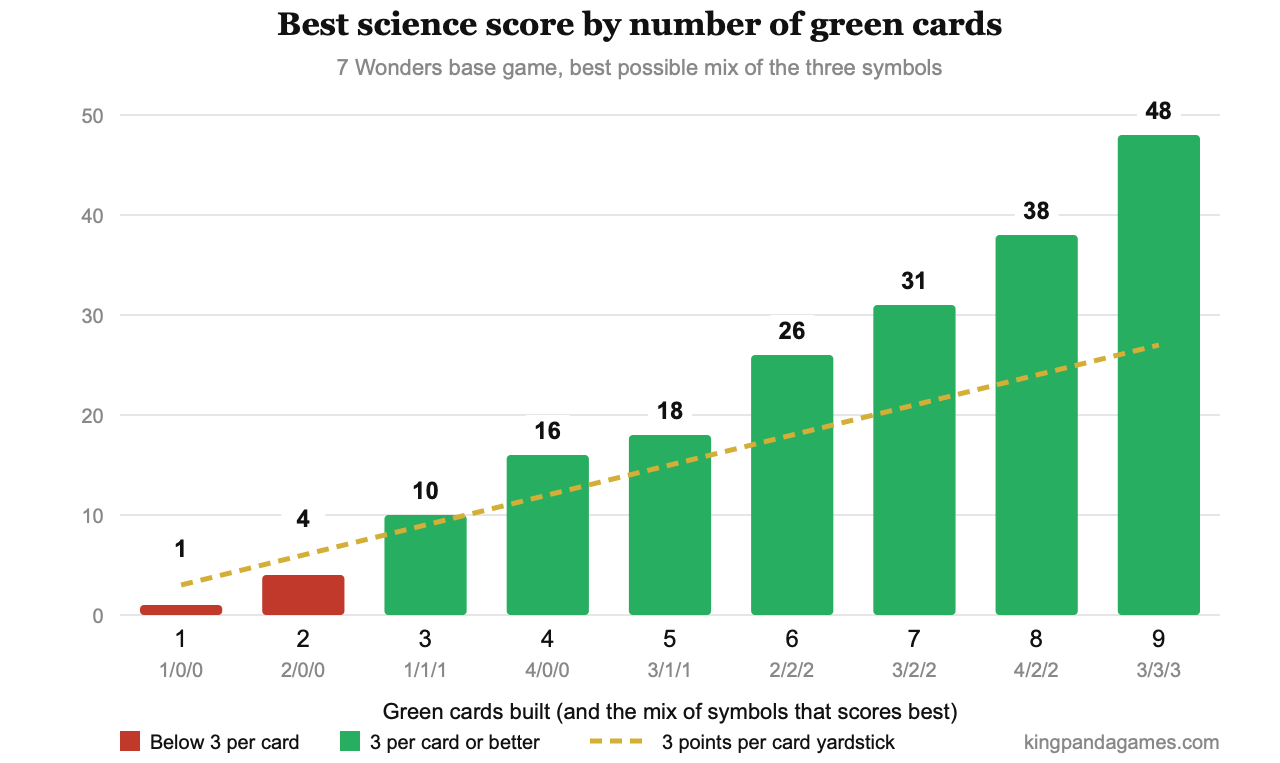
One or two green cards fall well short of the 3-point yardstick. Three or four can clear it, but only if you hold at least one of each symbol, or all four of one kind. Six or more beat it comfortably. So decide by the middle of Age II: either you’re collecting science for the rest of the game, or you stop taking it.
The rule: if you can’t see your way to at least six green cards, don’t build your second one.
Military Only Pays at the End
The tempting play: take a red card in Age I so you don’t fall behind, then keep matching your neighbors shield for shield.
What the scoring rewards: let Age I go, and put your red cards where the points are. A win is worth 1 point in Age I, 3 in Age II and 5 in Age III. A loss is always minus 1.
Winning every fight in the game is worth 18 points. Ten of those 18 come from Age III alone. Losing both Age I fights costs you 2.
The cards follow the same curve. Age I red cards give one shield, Age II cards give two, and Age III cards give three. A single Age III military card gives as many shields as three from Age I.
You also only need to beat each neighbor by one shield. Ties give nothing to either side, and winning by five scores the same as winning by one. Count your neighbors’ shields before the last two turns of Age III and take exactly what you need.
Should You Build Resources or Buy Them?
“Is it better to make my own resources or pay my neighbors?” Build what neither neighbor makes. Buy the rest.
Buying costs 2 coins per resource, paid to the neighbor. Coins are worth a third of a point each at the end, so every purchase costs you two-thirds of a point and gives your neighbor the same. That’s cheap for one card, and expensive as a habit.
A brown or grey card scores nothing by itself. Each one you take is a card play spent on no points, so it has to pay for itself by making later cards free. Three or four across the first two Ages is usually enough if you picked the right ones.
Three trade rules are easy to miss. You can’t spend coins you were paid on the same turn. You can’t buy from a building your neighbor built that same turn. And you can never buy the resources shown on a neighbor’s yellow cards or Wonder stages.
The Card You Bury Matters Too
A Wonder stage lets you turn any card into progress, and that makes it your best blocking tool.
It’s Age III, turn four. You hold four cards. One is a guild that’s worth 2 points to you and 8 to the player on your left, who gets your hand next. Your last Wonder stage is ready to build. You bury the guild under it. You score your stage, and an 8-point card leaves the game.
That only works if you know who receives your hand. Hands pass left in Ages I and III and right in Age II.
Don’t rush your Wonder, though. Stages can be built in any Age, as long as you go left to right. Save them for turns when your hand has nothing you want, or something a neighbor wants badly. Which stages are worth finishing depends on the board, and our ranking of the best wonders covers all seven.
What to Draft in Each Age
- Age I: set up. Take the resources your neighbors don’t make, then cards with chain symbols. A chain lets you build a matching later card for free. The rulebook’s example is the Theater, which makes the Gardens free in Age III.
- Age II: commit. This is where you decide on science. It’s also the last Age with brown and grey cards, so fix any resource gap now.
- Age III: cash in. There are no resource cards left, so every pick is about points. Take the big blue buildings, the guilds that score off your neighbors’ cities, and exactly enough red to win your two borders.
Worth knowing: guilds are drawn at random, two more than the number of players, so you can’t count on a specific one showing up. Look at your neighbors’ cities in Age III and take the guild that scores what they already built.
Yellow Cards and Coins
Yellow cards are support, not a plan. Some make trading cheaper, some pay coins, and the Age III ones score points for cards you already have.
Selling a card for 3 coins is worth exactly 1 point. That’s below the 3-point yardstick, so sell only when the alternative is a card you can’t build and a Wonder stage you can’t pay for. Coins also break ties: if two players finish level, the one with more coins wins.
One limit of the base game is that you can only affect your two neighbors, so a runaway leader across the table is out of reach. If that bothers your group, the Cities expansion adds cards that make every other player lose coins. We compare all four boxes in 7 Wonders expansions ranked.
Check 7 Wonders: Cities price on Amazon →
Frequently Asked Questions
What is the best strategy in 7 Wonders?
Aim for about 3 points per card across your 18 plays. In practice that means building only the resources your neighbors lack in Age I, deciding on science by the middle of Age II, and spending Age III on blue buildings, guilds and just enough military to win both borders.
Is science overpowered in 7 Wonders?
Only when one player is allowed to collect it unchallenged. Six green cards in the right mix score 26 points and nine score 48, but two score just 4. If a neighbor is collecting science, burying one green card under your Wonder can cost them far more than it costs you.
Is military worth it in 7 Wonders?
In Age III, yes. Each Age III win is worth 5 points, so beating both neighbors there is 10 points, often from one or two cards. Age I wins are worth 1 point each and rarely justify a card.
How many points do you need to win 7 Wonders?
There’s no fixed target, because the highest score at the table wins. The rulebook’s scoring example totals 55 points, which is a reasonable benchmark for a solid game with the base cards.
Should you always finish your Wonder in 7 Wonders?
No. Wonder stages are optional. Build a stage when your hand has nothing better, or when it lets you remove a card your neighbor needs. A strong Age III card usually beats a weak final stage.
How many resource cards should you take in 7 Wonders?
Three or four across the first two Ages is usually enough, focused on resources neither neighbor produces. Everything else can be bought for 2 coins each. Brown and grey cards score no points themselves, so each extra one is a play spent on nothing.
Count to three on every pick. If the card in your hand won’t earn 3 points now or set them up later, bury it or pass it on. For the bigger picture on whether the game is right for your group, see our 7 Wonders review. Players comparing notes on specific cards will find plenty of discussion on 7 Wonders’ BoardGameGeek page.