

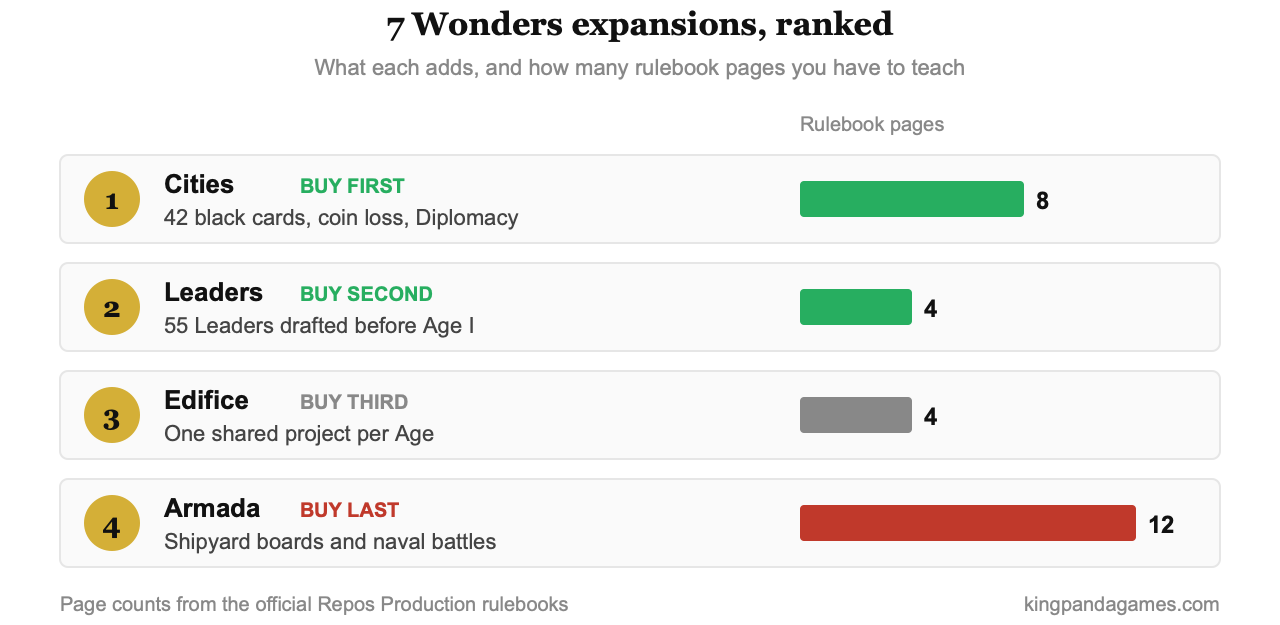
The best 7 Wonders expansion is Cities. Buy Leaders second, Edifice third and Armada last. All four work with the Second Edition base game, all four can be mixed, and none of them is a standalone game.
Some links below are Amazon affiliate links — as an Amazon Associate, King Panda Games earns from qualifying purchases at no extra cost to you. Full disclosure.
A note on how we built this list: we’ve played the base game, and we have not played all four expansions. The contents, rule changes and play times below come from each expansion’s official rulebook on Repos Production’s 7 Wonders pages. The order is our judgement of how much each box adds for how much new teaching it costs.
All 4 Expansions at a Glance
| Rank | Expansion | First released | What’s in the box | What it changes | Rulebook |
|---|---|---|---|---|---|
| 1 | Cities | 2012 | 42 black cards, 2 Wonders, Debt and Diplomacy tokens | One extra card and turn per Age, coin loss, team play | 8 pages |
| 2 | Leaders | 2011 | 55 Leader cards, 2 Wonders | A Leader draft before the game, one Leader hired per Age | 4 pages |
| 3 | Edifice | 2023 | 15 Edifice cards, 2 Wonders, 24 pawns | Shared building projects tied to your Wonder stages | 4 pages |
| 4 | Armada | 2018 | 7 Shipyard boards, 28 Fleet figures, 24 Age cards, 27 Island cards, 1 Wonder | Four naval tracks, naval battles against the whole table | 12 pages |
Every one of them needs the Second Edition base game. If you’re still deciding on that, start with our 7 Wonders review.
1. Cities — Buy This First
Cities is the best first expansion because it fixes the base game’s biggest weakness with the least new teaching. That weakness is how little players affect each other.
It adds 42 black cards, 14 per Age. You shuffle in one per player each Age, so everyone is dealt 8 cards instead of 7 and plays one extra turn. That’s most of the setup.
Some black cards make every other player lose coins. If you can’t or won’t pay, you take a Debt token worth minus 1 point each, and debts can never be paid back. Other cards hand you a Diplomacy token, which pulls you out of that Age’s military fight entirely. Your two neighbors then fight each other instead.
Those two ideas change the table. Coins stop being safe, and a player with no army can dodge a war they were about to lose.
Cities also adds team rules for 4 or 6 players, where partners sit together and can show each other their hands. The box has two new Wonders, Byzantium and Petra. The full rules are in the Cities rulebook, and Repos Production lists play time at 40 minutes.
Check 7 Wonders Cities price on Amazon →
2. Leaders — The Best One for Planners
“Does Leaders change how you play, or just add cards?” It changes how you plan. Leaders gives every player a direction before Age I even starts.
Each player is dealt 4 Leader cards and drafts them, pick one and pass, until everyone has 4. Then, at the start of each Age, you play one Leader: hire them for coins, bury them under a Wonder stage, or sell them for 3 coins. You begin with 6 coins instead of 3 to pay for this.
The box holds 55 Leaders: 34 standard, 15 marked expert, and 6 bonus cards that only work if you also own Cities. The rulebook says to play your first games with the standard set only.
Leaders ranks second because it adds a new phase to explain and some reading before the game starts. For a table that already knows the base cards, that pre-game draft is the appeal. It comes with two Wonders, Roma and Abu Simbel, and the Leaders rulebook runs just 4 pages.
Check 7 Wonders Leaders price on Amazon →
Worth knowing: Cities and Leaders are built to go together. Six of the Leader cards are only used when both expansions are on the table, and each box’s score pad has a line for the other.
3. Edifice — The Smallest and Simplest
Edifice adds one shared project per Age, and almost nothing else. It’s the lightest of the four to add.
At setup you deal one Edifice card for each Age. When you build a stage of your Wonder, you may also pay that Edifice’s participation cost and take a pawn. Once the last pawn is taken, the Edifice is built and everyone holding a pawn gets its reward.
What it looks like: a co-op side project you can ignore.
What it actually is: a threat. If the Edifice isn’t finished by the end of the Age, every player who didn’t chip in suffers its penalty, and anyone who can’t pay takes a Debt token worth minus 2, 3 or 5 points.
Edifice ranks third because it changes less than Cities or Leaders. It gives you a new reason to build Wonder stages and a small standoff each Age, and that’s it. The box includes two Wonders: Ur, and Carthage, which the rulebook says can be used with the base game alone. Repos Production’s Edifice page says it adds no extra play time.
Check 7 Wonders Edifice price on Amazon →
4. Armada — The Biggest Change, So Buy It Last
Armada is the most ambitious expansion and the one we’d buy last. It adds a second board for every player and a second war.
Each player gets a Shipyard with four colored tracks. When you build a red, yellow, blue or green card, you can pay an extra cost to move the matching ship forward. Red ships add naval strength, yellow ships raise taxes on other players, blue ships score points, and green ships explore Island cards with their own effects.
At the end of each Age there’s a naval fight on top of the normal one. This time you’re compared against every player, not just your neighbors. The strongest and second-strongest fleets score, and the weakest loses points.
That is a lot more to track. The Armada rulebook is 12 pages, three times the length of Leaders or Edifice, and it also adds an extra turn per Age and a new option when selling a card. It ranks last because of that weight, not because it’s bad. For a group that has played the base game dozens of times and wants it to feel new, Armada is the box that does the most.
Check 7 Wonders Armada price on Amazon →
Which Expansions Work Together?
All four can be combined, and the rulebooks include specific rules for doing it.
- Cities + Leaders is the natural pair. Six Leaders exist only for this combination.
- Cities + Armada deals 9 cards per Age instead of 7, so games run longer.
- Edifice + Armada forces a choice: when you build a Wonder stage, you can advance a ship or join the Edifice, not both.
Start with one. Add a second only when the first feels normal. Playing with three or four at once is for groups who know the base game cold.
Make sure every box you buy is the new edition. First-edition expansions have different card backs and can’t be shuffled into a Second Edition deck.
Frequently Asked Questions
What is the best 7 Wonders expansion?
Cities. It shuffles a deck of black cards into the game, adds one extra turn per Age, and makes players affect each other through coin loss and Diplomacy. It adds the most interaction for the least new teaching.
How many 7 Wonders expansions are there?
Four are in print for the Second Edition: Leaders, Cities, Armada and Edifice. Older first-edition products such as Babel and the Wonder Pack were not reprinted in the same form, and first-edition boxes don’t mix with the Second Edition.
Do 7 Wonders expansions work with the Second Edition?
Only the new-edition printings do. First-edition expansions have different card backs, so the cards can’t be shuffled together. Check that the box says new edition or shows the Second Edition artwork before you buy.
Can you combine all the 7 Wonders expansions?
Yes. The rulebooks give rules for mixing them, such as dealing 9 cards per Age with both Cities and Armada. Combining everything makes a much longer and heavier game, so add one at a time.
Is 7 Wonders Armada worth it?
It’s worth it for groups that have played the base game many times and want a big change. Armada adds a Shipyard board for each player, four ship tracks and a naval fight against the whole table. It’s too much for a group still learning the base cards.
Do any 7 Wonders expansions add a 2-player mode?
No. The new-edition printings of all four keep the game at 3 to 7 players. Cities and Armada add team rules for 4 or 6 players. For two players, 7 Wonders Duel is a separate game.
Does Leaders or Cities come first?
Leaders was released first, in 2011, and Cities followed in 2012. We’d still buy Cities first, because it changes the game during play, while Leaders mostly changes how you plan before Age I.
Buy Cities, play it five or six times, then decide whether your group wants more planning (Leaders) or just more of the same game with a twist (Edifice). And if you haven’t picked a favorite board yet, the best wonders in 7 Wonders ranks the seven in the base box.