

Catan Robber Rules: Every Question, Answered
Yes — you have to move the robber. That’s the rule most tables argue about, and the official rulebook settles it in one line: “The robber must be moved. You may not choose to leave the robber on the same hex.” Everything else about the robber is nearly as short, and this page covers all of it: the 7, the discards, the stealing, the desert, and the Knight card — straight from the official Catan rulebook, with the exact wording where it matters.
Some links below are Amazon affiliate links — as an Amazon Associate, King Panda Games earns from qualifying purchases at no extra cost to you. Full disclosure.
This is the rules page. If you already know the rules and want to know where to put the thing, that’s our robber strategy guide.
Do You Have to Move the Robber in Catan?
Yes, always. Whenever the robber activates — a rolled 7 or a played Knight — moving it is mandatory, and it must go to a different hex. You cannot leave it where it sits, even if you’d rather not block or rob anybody.
The move is also unrestricted: “the number token of any other terrain hex, or the desert.” There is no rule against targeting the same player twice, no rule protecting the leader, and no rule against putting it right back where it was two turns ago — as long as it moves somewhere else each time it activates.
Worth knowing: if you genuinely don’t want to hurt anyone — early game, family game, fragile alliance — the desert is your legal “pass.” Moving the robber there blocks no production and, if the desert borders no settlements, steals from no one.
What Happens When You Roll a 7?
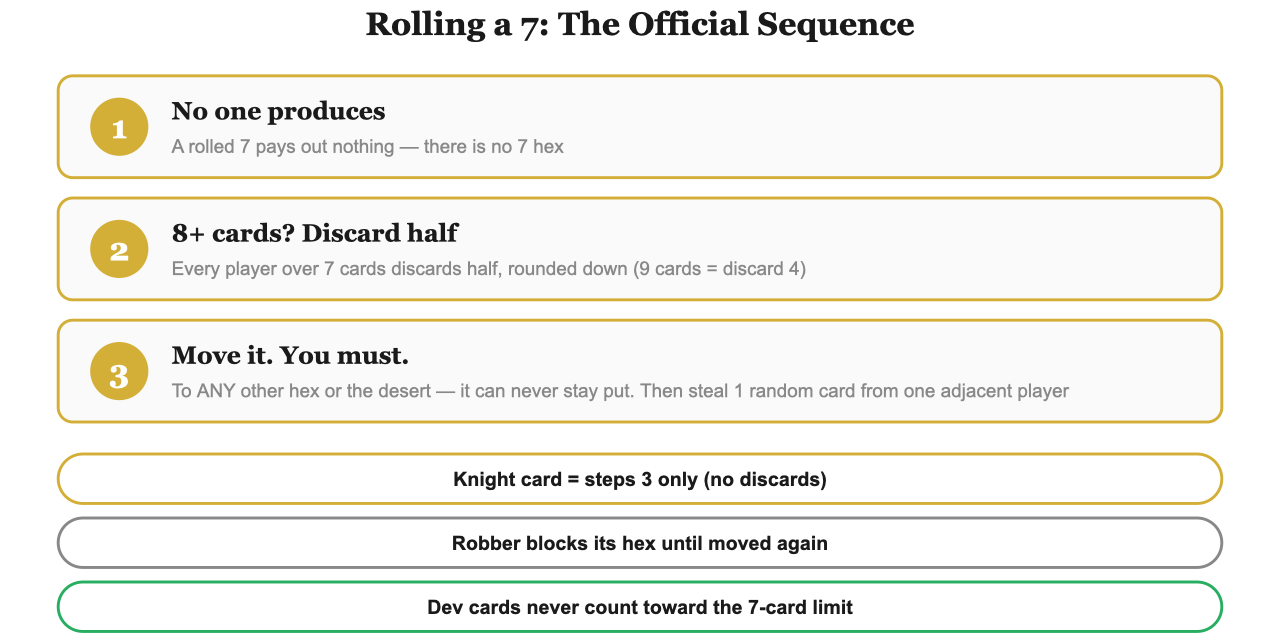
A rolled 7 triggers three things, in this exact order:
- Nobody produces. No hex pays out on a 7 — there is no 7 number token on the board.
- Everyone fat on cards discards. Every player holding more than 7 resource cards chooses half their hand, rounded down, and returns it to the bank. Nine cards? Discard four. Eleven? Discard five. This hits every qualifying player, including the roller.
- The roller moves the robber and steals. Move it to any other hex (or the desert), then take one random resource card from a player with a settlement or city touching the new hex.
The order matters more than people think: discards happen before the steal. Your victim discards down first, and then you rob from what’s left.
Do development cards count toward the 7-card hand limit? No — only resource cards (brick, grain, lumber, ore, wool). Development cards are never counted and never discarded, which is quietly one more reason buying them is a decent 7-proofing move.
How Does the Robber Actually Block Production?
The robber shuts off the hex it sits on, completely and for everyone. While it’s parked there, that hex produces nothing when its number is rolled — every adjacent settlement and city gets skipped, no matter whose they are. The rulebook’s own example: robber on a fields hex with a 4 token means a rolled 4 pays that hex’s owners nothing.
The block lasts until the robber moves again — the next 7, or the next Knight. There is no turn limit and no expiration. We’ve had games where an 8 hex sat robbed for a third of the game because everyone kept aiming 7s at each other’s new targets instead.
The Stealing Rules, Precisely
You steal one random card from one player — not one card from everyone. If the robber’s new hex touches settlements or cities from two or more players, you pick which player to rob, but the card itself is drawn blind from their hand.
What a lot of tables play: the robber steals from everyone on the hex, or steals a card of the robber’s choosing.
The actual rule: one victim, one random card. Hold their hand face-down, pull one. If the hex borders no one’s buildings — or your only victim has zero cards — you simply steal nothing.
One more edge case: cities aren’t special. A city adjacent to the robbed hex makes its owner a legal target exactly like a settlement — it doesn’t lose two cards or change the odds.
How the Knight Card Changes Things
A Knight card is a rolled 7 with two differences. When you play one, you must immediately move the robber and steal exactly as described above — but nobody discards for holding more than 7 cards, and the Knight counts toward Largest Army (three played Knights, 2 victory points, stealable by whoever plays more).
The timing rule most players miss: you may play a development card at any point during your turn — including before you roll the dice. Sitting adjacent to the robber with a big hand? Knight it away first, then roll. That sequencing is legal and it’s the single most useful robber rule that isn’t in most people’s heads.
Don’t own Catan yet? The robber is in every box.
Frequently Asked Questions
Do you have to move the robber in Catan?
Yes. When you roll a 7 or play a Knight card, moving the robber is mandatory — the official rules state you may not choose to leave the robber on the same hex. It must go to a different terrain hex or the desert.
What happens when you roll a 7 in Catan?
Three things, in order: no one collects resources this roll; every player holding more than 7 resource cards discards half of them, rounded down; then the roller must move the robber to a new hex and steal one random card from a player with a settlement or city adjacent to it.
Can you move the robber back to the desert?
Yes. The rules explicitly allow moving the robber to the number token of any other terrain hex or to the desert hex. Parking it in the desert blocks nobody — it’s the peace-keeping move.
Can you leave the robber where it is in Catan?
No. The robber must be moved to a different hex every time it activates — the rulebook states you may not choose to leave it on the same hex, even if you’d rather not block or steal from anyone. If you want a harmless move, put it on the desert.
How many cards can you hold before discarding in Catan?
Seven. When a 7 is rolled, every player holding 8 or more resource cards discards half, rounded down — so 8 cards discard 4, 9 cards discard 4, and 11 cards discard 5. Development cards never count toward the limit and are never discarded.
Do you steal a card when you play a Knight in Catan?
Yes. A Knight card moves the robber exactly like a rolled 7 — move it to a new hex, then steal one random resource card from a player with a settlement or city adjacent to that hex. The only difference is that nobody discards for holding more than 7 cards.
What does the robber do in Catan?
The robber blocks resource production on whatever hex it occupies — when that hex’s number is rolled, adjacent settlements and cities receive nothing. It stays there, blocking, until another 7 or a Knight card moves it.
Can you steal from someone with no cards in Catan?
You can target them, but you steal nothing — there’s nothing to take. The steal is one random card from one adjacent player, so if every adjacent player has an empty hand (or the hex borders no one’s buildings), no steal happens.
Rules settled? The interesting half of the robber is knowing where to put it and when the desert is actually the right play — that’s our Catan robber strategy guide. And if you’re still deciding whether the game deserves a place on your shelf, our full Catan review makes the call.