

Cover Your Assets Review: Is It Worth It?
Bottom Line
Cover Your Assets is best for families and mixed-skill groups who want a game that teaches in ninety seconds and still produces genuine table drama. Skip it if your group hates direct conflict — the entire game is built on taking things from each other. Its biggest strength is the stealing mechanic, which makes every set you own feel simultaneously like a trophy and a target. Its biggest weakness is that at 20–40 minutes with light decisions, it’s a filler, not a main event.
Cover Your Assets earns 5/5 Bamboo Plants and 5/5 Pandas from us, and a spot as an Editor’s Top Pick. The Bamboo score is the easy part: this is one of the fastest teaches in our entire collection, and we’ve never had to explain a rule twice. The Pandas score is the one we argued about — the decisions are light, and on paper that should cost a point — but the table keeps overruling the paper. This game has produced laughter every single time it has come out, from our six-year-old to the adults, and nothing else at this price does that as reliably.
Buy it. At $19.99 it’s one of the best dollar-per-laugh ratios in card games, and it does something most family games don’t: it makes a seven-year-old and a forty-year-old genuinely equal at the table.
Some links below are Amazon affiliate links — as an Amazon Associate, King Panda Games earns from qualifying purchases at no extra cost to you. Full disclosure.
| Detail | Info |
|---|---|
| Players | 2–6 |
| Best Player Count | 4 — enough stacks to create real threat, short enough between turns |
| Age | 7+ |
| Play time | 20–40 min |
| Complexity | Light |
| Solo Mode | No |
| Designer | Tauni Beck, Brent Beck, and Jeff Beck |
| Publisher | Grandpa Beck’s Games |
| Popular Upgrades | No |
| Bamboo Plants | 5/5 — the whole rulebook fits in one breath |
| Pandas | 5/5 — cheerfully mean, reliably hilarious |
| Official site | Grandpa Beck’s Games |
How It Works
You are trying to be the first player to a million dollars, and you get there by collecting matching pairs of assets — Jewels, Classic Autos, Piggy Banks, Cash under the Mattress — and stacking them in front of you. It lands at #1 on our best board games of 2026 list.
The stacking is where the game lives. Each new set goes on top of the last, rotated ninety degrees so the piles stay visually separate. Only the set on top is exposed. Everything underneath is locked away and safe forever.
On your turn you take exactly one action: form a set, discard, or challenge someone. There is no passing. If you can’t do anything useful, you must throw a card away, and that discard becomes ammunition for the player after you.
Your sister has a Jewels set sitting on top of her stack. You hold a matching Jewels card. You slide it across the table — that’s a challenge. She plays a Gold wild to defend. You play your second Jewels. She’s out of answers, and all three cards come to you as a single, fatter set. The set she spent two turns building is now the top of your stack, worth more than it was, and every other player is looking at it.
That escalation is the engine of the whole game. A stolen set doesn’t just change hands — it grows, because every card played into the fight joins it. The richest pile on the table is usually also the one everybody wants.
Two rules keep it from being cruel. The first set you ever build is permanently safe at the bottom of your stack, so nobody gets wiped out. And you must build a set of your own before you’re allowed to steal from anyone, which stops the player who goes first from simply raiding the table.
The rule: only your top set is ever vulnerable. Everything you cover is money in the bank — which is exactly why the title is a pun and a strategy at the same time.
The Advanced Rules Are the Real Game
Most people who own Cover Your Assets have never played it properly. The box ships with Swap, Move, and Penny Jar cards that the classic rules tell you to remove — and the majority of owners remove them once and never look back.
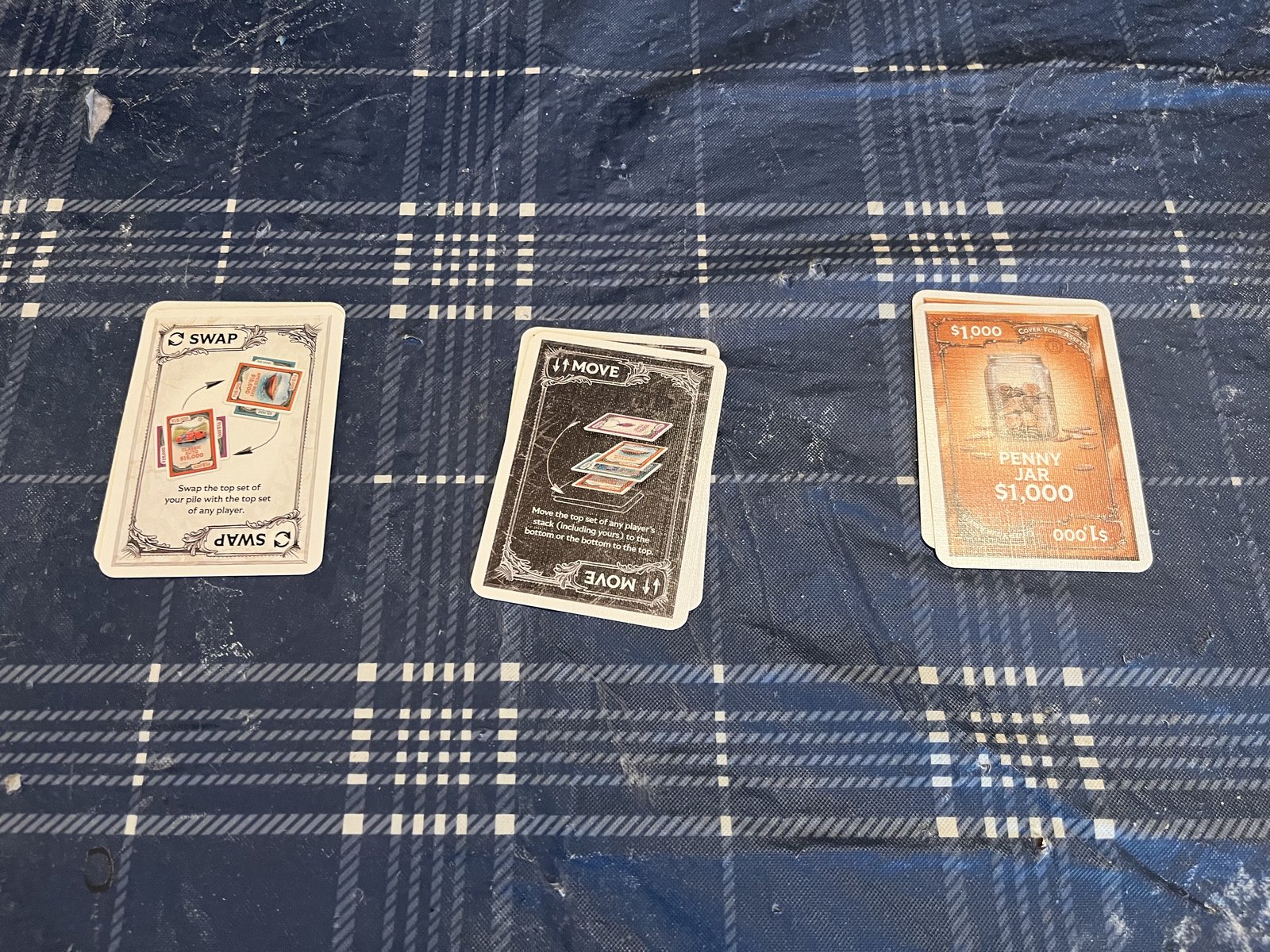
Put them in. The advanced rules change four things: your hand grows to six cards, you take two actions per turn instead of one, you can add a matching asset to your own top set to fatten it, and — the big one — the set second from the top becomes vulnerable.
That last change is what fixes the game’s biggest weakness. Under classic rules, covering a valuable set makes it permanently untouchable, so the optimal play is often just to bury things and wait. When the second set can be challenged too, burying stops being a guaranteed answer and you have to actually think about stack order.
The Penny Jar is the cleverest card in the box. It’s a wild worth only $1,000 — nearly worthless at scoring — but it counts as two cards when challenging or defending. To beat one, an opponent must produce two assets, two wilds, one of each, or their own Penny Jar. It’s a card that’s simultaneously the cheapest and the most powerful thing in your hand, and it creates the best decisions in the game.
What most players do: pull the advanced cards out during setup because the rulebook says the classic game is where to start, then never revisit it.
What actually works: teach the classic game once, then add all the advanced rules from game two onward. The teach cost is about sixty extra seconds and it roughly doubles how long the game stays interesting.
What We Liked
The teach is genuinely ninety seconds. Collect pairs, stack them, top one can be stolen, go. We’ve taught this to people mid-conversation without anyone putting their drink down. Our full rules breakdown exists mostly because the edge cases trip people up — the core game does not.
The theft mechanic produces the specific kind of table noise that good family games run on. Someone always gasps. Someone always says “you had that the whole time?” It’s aggressive without being personal, because the cards do the aggression for you.
It also solves a problem most family card games don’t. A strong player can’t strategize their way past bad cards here, and a seven-year-old holding two Speed Boats has exactly as much power as an adult holding two Speed Boats. That flattening is rare, and it’s why this game keeps coming back out.
And it scales down honestly. Rather than bolting a weak variant onto a 4–6 player game, the 2-player rules replace the discard-driven economy with three face-up draft piles — a real redesign, not a patch.
What We Disliked
Runaway leaders are a genuine problem at 5–6 players. When one player’s top set balloons to four or five cards, everyone else has to spend their turns fighting it, and whoever finally wins that pile inherits the same target. Rounds can bog down into a single repeated argument.
The decision space is thin once you’ve internalized the flow. By your fourth or fifth round, most turns resolve themselves — you can see the correct play immediately, and the game becomes about whether the deck cooperates.
Downtime spikes with six players. There’s no simultaneous action, and a long challenge chain between two other players is pure spectating.
A Round That Explains the Whole Game
We put Cover Your Assets in front of our six-year-old — a full year under the printed age — half-expecting to shelve it after ten minutes. Instead it produced the loudest game of the week: laughing the entire game, start to finish, including the turns where cards were being taken from them. That’s the tell about this design. The stealing isn’t something kids tolerate; it’s the thing they show up for.
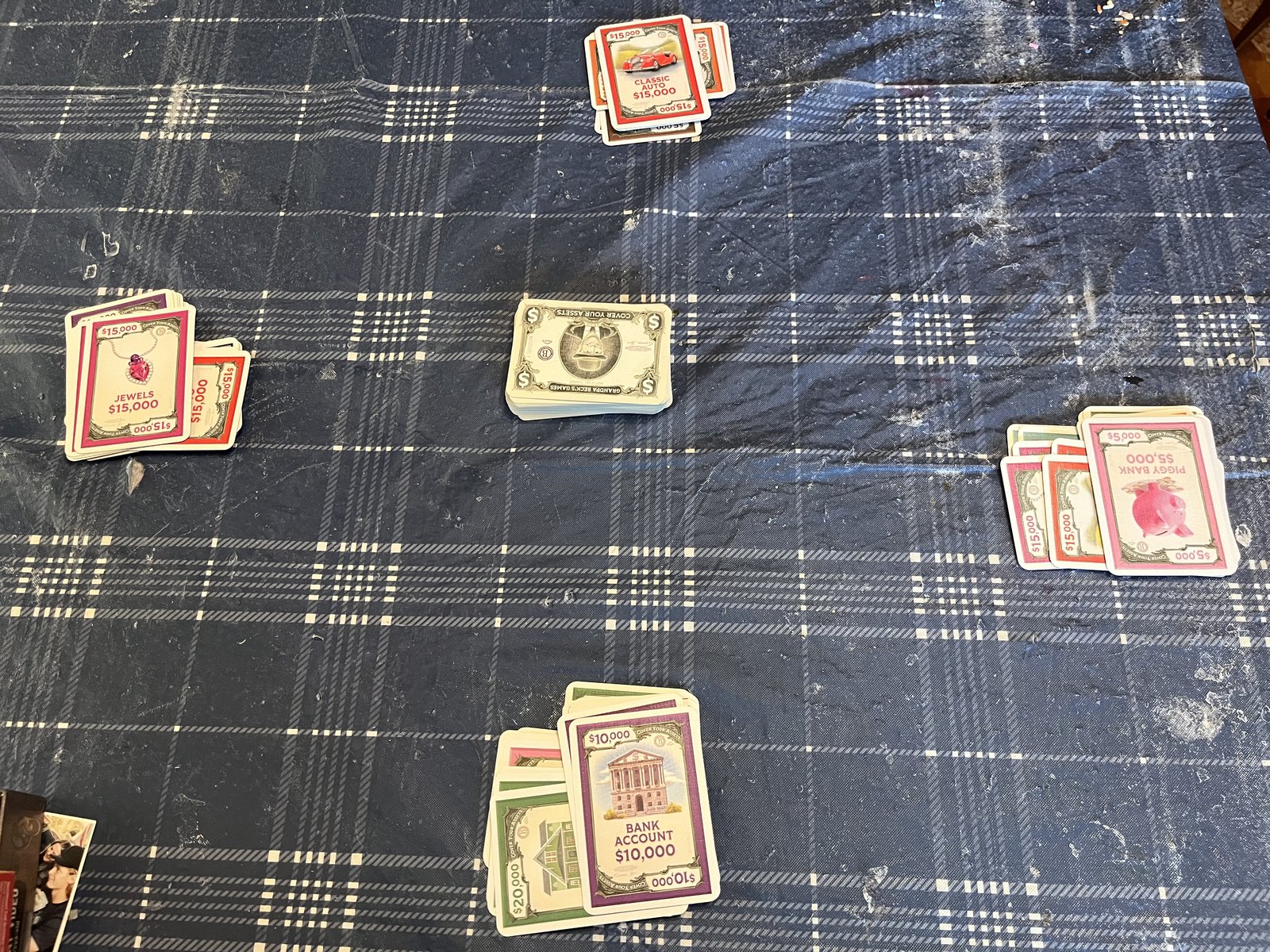
The reason a moment like that lands is structural. Cover Your Assets is one of the few family card games where the thing you’re proudest of is also the thing most likely to be taken from you, and the game makes that trade visible on the table at all times. Your stack is your score and your vulnerability at the same time.
Who It’s For
Cover Your Assets is for families with kids around 6 to 12 — the box says 7+, and our six-year-old clears it comfortably — for groups where card-game experience varies wildly, and for anyone who needs a reliable opener before a heavier game comes out. It sits comfortably next to Five Crowns and Sequence in the “everyone at the table can play this” tier.
It’s also a strong travel and vacation-house game. It’s a small box, it survives a loud room, and it doesn’t punish anyone for missing a turn while they get up to grab something.
Who Should Skip This Game
Skip it if your group dislikes take-that mechanics. There is no way to play Cover Your Assets without repeatedly taking things from specific people, and if that reliably sours someone in your group, nothing about this design will soften it.
Skip it if you want meaningful long-term strategy. This is a tactical game about the five cards in your hand, not a game you plan three turns ahead in.
And skip it if you already own Cover Your Kingdom — the spinoffs are the same engine with more chrome, and owning two is redundant unless you specifically want the extra chaos.
Who Should Buy This?
At $19.99 this is an easy yes for families, and an easy no for strategy gamers. The price is genuinely justified — you’re getting a game that will hit the table dozens of times and never take more than forty minutes.
Buy it now rather than trying it first. There’s very little to test; if the premise sounds fun to you, the execution delivers exactly that, and no amount of playing first will change the verdict.
Treat it as a core collection game if you regularly play with kids or mixed groups, and a situational one if you don’t. It is not competing for the same shelf slot as your heavier games — it’s competing with the twenty minutes before dinner.
Check Cover Your Assets price on Amazon →
Best Player Count
Four. The box says 2–6, and the rulebook itself recommends 4–6 for the classic rules, but four is where this game is genuinely at its best.
At four, there are enough stacks on the table that threats feel real, and the turn cycle is short enough that you’re never watching for long. You can track what everyone is collecting without effort, which makes discarding an actual decision instead of a shrug.
At five and six, the runaway-leader problem sharpens and downtime creeps in. At three, the draft-pile variant works well but the table talk thins out. At two it becomes a genuinely different, more tactical game — good, but not the game most people are buying.
Replayability
Cover Your Assets has strong short-term replayability and a real ceiling.
The uneven deck is doing quiet work here. There are ten Baseball Cards but only eight Homes and four Gold wilds, so the same asset carries different risk depending on how many copies are still unseen. That changes what’s worth defending from round to round without the game ever announcing it.
The four official endings help more than they should. Playing to $1,000,000 is a long session; “highest score after one round” turns it into a fifteen-minute filler; best-of-three and first-to-two-rounds sit in between. Choosing the format is effectively choosing how long you want the night to be.
What it lacks is strategic diversity. Games ten through fifty will feel very similar to games five through ten. That’s fine for what this is — but it’s why the advanced rules matter. Adding the Swap, Move, and Penny Jar cards plus two actions per turn is the single best thing you can do for the game’s lifespan, and most owners never bother.
What’s Actually in the Box
The deck is more deliberate than it looks. There are ten asset types, and they are not evenly distributed: Baseball Cards, Coin Collection, and Piggy Bank have ten copies each; Cash under the Mattress, Bank Account, Stocks, Speed Boat, Jewels, and Classic Auto have nine; Home has only eight.
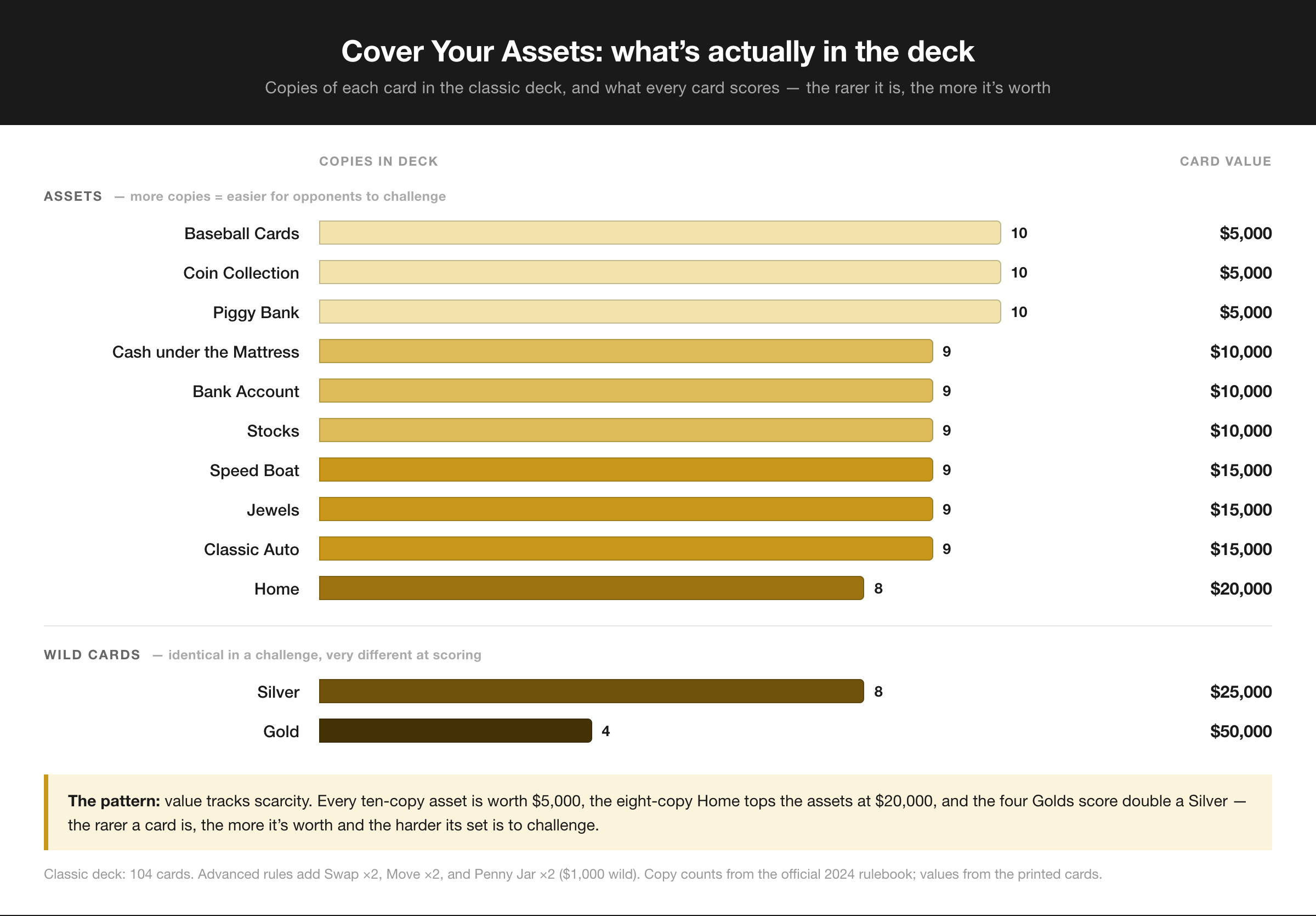
Wilds are split eight Silver and four Gold. Silver and Gold have identical power in a challenge — the difference is purely what they’re worth when you tally scores at the end of the round: $25,000 for a Silver, $50,000 for a Gold.
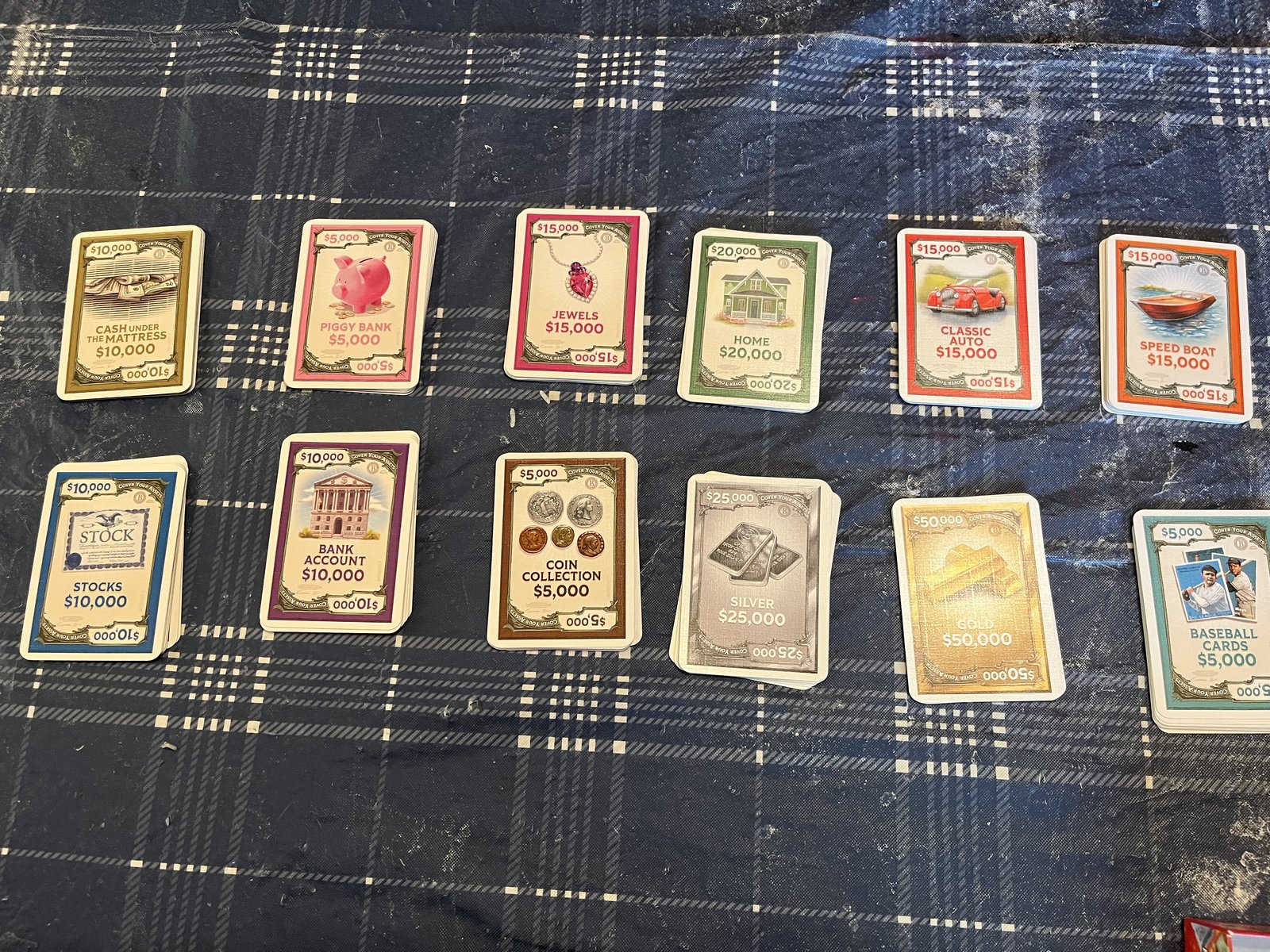
The full value spread is worth having in front of you, because the printed values aren’t listed in the rulebook, on the product page, or anywhere else we could find online:
| Asset | Copies in deck | Value |
|---|---|---|
| Baseball Cards | 10 | $5,000 |
| Coin Collection | 10 | $5,000 |
| Piggy Bank | 10 | $5,000 |
| Cash Under the Mattress | 9 | $10,000 |
| Bank Account | 9 | $10,000 |
| Stocks | 9 | $10,000 |
| Speed Boat | 9 | $15,000 |
| Jewels | 9 | $15,000 |
| Classic Auto | 9 | $15,000 |
| Home | 8 | $20,000 |
| Silver (wild) | 8 | $25,000 |
| Gold (wild) | 4 | $50,000 |
Notice how value tracks scarcity: every ten-copy asset is worth $5,000, the eight-copy Home tops the regular assets at $20,000, and the four Golds are worth double a Silver. The rarer a card is, the more it scores — and the harder its set is for anyone to challenge.
Component quality is fine, not remarkable. These are standard playing cards in a small box, and heavy use will show. Nobody makes premium inserts or upgrade kits for this game and nobody should — there’s nothing to organize. If you play often enough to care, sleeves are the only upgrade worth considering, and even that’s a stretch at this price.
The art, by Apryl Stott, does a lot of quiet work. Each asset is instantly readable across a table, which matters more than it sounds like it should in a game where you’re constantly scanning five other players’ stacks.
Similar Games
If you like Sequence, try Cover Your Assets — both are simple family staples driven by blocking, but Cover Your Assets takes things directly from opponents rather than quietly occupying space they wanted.
If you like Five Crowns, try Cover Your Assets — both are set-collection card games at the same complexity, but Five Crowns is a solitaire-ish race where you optimize your own hand, and Cover Your Assets is constant interference.
If you like Coup, you may find this too gentle — Coup’s conflict is psychological and elimination-based; here the aggression is transparent, no one is knocked out, and nobody has to bluff.
Tips & Tricks
Hold your second copy. The most common beginner error is forming a set the moment you can. If you already have a matching pair in hand and you play both, you’ve announced a target with no defense left. Play one, keep one in reserve to defend it.
Watch the discard pile like it’s a second hand. You can form a set by pairing a card from your hand with the top of the discard pile, which means every card you throw away is a gift to the player on your left. Before discarding, ask what they’ve been collecting.
Worth knowing: assets aren’t equally safe. With ten Baseball Cards in the deck, a Baseball Card set is far easier for someone to challenge than a Home set, where only eight exist and you may be holding two of them.
Get your first set down fast, and make it cheap. Your opening set is permanently safe, so it’s tempting to make it your most valuable. Resist it — you can’t steal from anyone until you’ve built a set, so speed matters more than value on turn one.
Spend your wilds defending, not attacking. Gold and Silver have identical power in a challenge but are worth real money at scoring. Using a Gold to steal a cheap set is how people lose rounds they were winning.
Frequently Asked Questions
Is Cover Your Assets worth buying?
Yes, if you play with families or mixed-skill groups. At $19.99 for a game that teaches in ninety seconds and plays in 20–40 minutes, it earns its shelf space quickly. It’s not worth buying if your group prefers strategy games with long-term planning or dislikes taking cards directly from other players.
Can your first set be stolen in Cover Your Assets?
No. The first set you build sits at the bottom of your stack and is permanently safe for the rest of the round. Only the set currently on top of your stack can ever be challenged, which is why covering a valuable set with a new one is the core defensive move.
Do you have to form a set before stealing?
Yes. You must have built at least one set of your own before you’re allowed to challenge another player. This stops the first player from immediately raiding the table and forces everyone to expose something before they can attack.
How many players is Cover Your Assets best with?
Four. The rulebook recommends 4–6 for the classic rules, but at five and six players the runaway-leader problem gets worse and downtime increases. Two and three players use a completely different draft-pile system that plays well but feels like a different game.
Can you use two wild cards to make a set?
No. A set must be either two matching assets or one asset plus one wild — never two wilds, and never more than two cards when first formed. When you pair an asset with a wild, the wild always goes underneath the asset.
How long does Cover Your Assets take to play?
20–40 minutes, depending on which ending you choose. Playing a single round is the quickest option at roughly 15–20 minutes, while playing all the way to $1,000,000 can run past an hour with a full table.
What’s the difference between Cover Your Assets and Cover Your Kingdom?
They share the same stealing-and-stacking engine, but Cover Your Kingdom adds fantasy factions and special powers that make it louder and more chaotic. Cover Your Assets is the cleaner, faster, more family-friendly version of the idea.
Is Cover Your Assets good for 7-year-olds?
Yes — the box says 7+, and if anything it’s conservative: our own six-year-old plays it happily and spent an entire game laughing. Matching pairs is the only skill required, and because card luck flattens the gap between players, kids compete with adults on genuinely equal footing. Younger kids may need help remembering that only the top set is vulnerable.
Want to go deeper?
- Cover Your Assets Strategy: How to Win — When to hold a pair, when to spend a wild, and the discard habit that quietly loses rounds. Read it here
- Cover Your Assets with 2 Players — The draft piles change the game completely. Here’s how to play the two-player version well. Read it here
- Cover Your Assets Rules: The 5 Everyone Gets Wrong — Wild placement, the safe first set, and the challenge rules that cause the most table arguments. Read it here
- Cover Your Assets vs Cover Your Kingdom vs Cover Your Cookies — Three games, one engine. Which one belongs on your shelf. Read it here
The Verdict
Buy it if you play with kids, mixed groups, or anyone who needs to learn a game in under two minutes. Skip it if your table dislikes direct conflict or wants decisions with long-term consequences. Try the advanced rules early — the Swap, Move, and Penny Jar cards are sitting in the box, and they’re what keeps this game interesting past game ten.
Cover Your Assets is an Editor’s Top Pick and the most cheerfully mean $20 you can spend on a card game. It won’t be the deepest game on your shelf, and it will get played more than the ones that are.
Cover Your Assets official site: grandpabecksgames.com
You can read the full 2024 rulebook straight from the publisher, or watch The Rules Girl explain it in three minutes on The Dice Tower if you’d rather be shown than read. Grandpa Beck’s own how-to-play video covers setup in more detail, and the card art throughout is by illustrator Apryl Stott.