

Cover Your Assets Rules: The 5 Everyone Gets Wrong
Cover Your Assets takes ninety seconds to teach and somehow still produces arguments.
Some links below are Amazon affiliate links — as an Amazon Associate, King Panda Games earns from qualifying purchases at no extra cost to you. Full disclosure.
That’s not a knock on the design — it’s a side effect of how fast people learn it. The core loop is so simple that groups stop reading before they reach the clauses that matter, then hit them mid-game with money on the line. These are the five that cause the most trouble, each settled straight from the official 2024 rulebook. The two- and three-player games layer a draft-pile system on top of all five, and the low-count rules change what counts as safe.
1. Your First Set Can Never Be Stolen
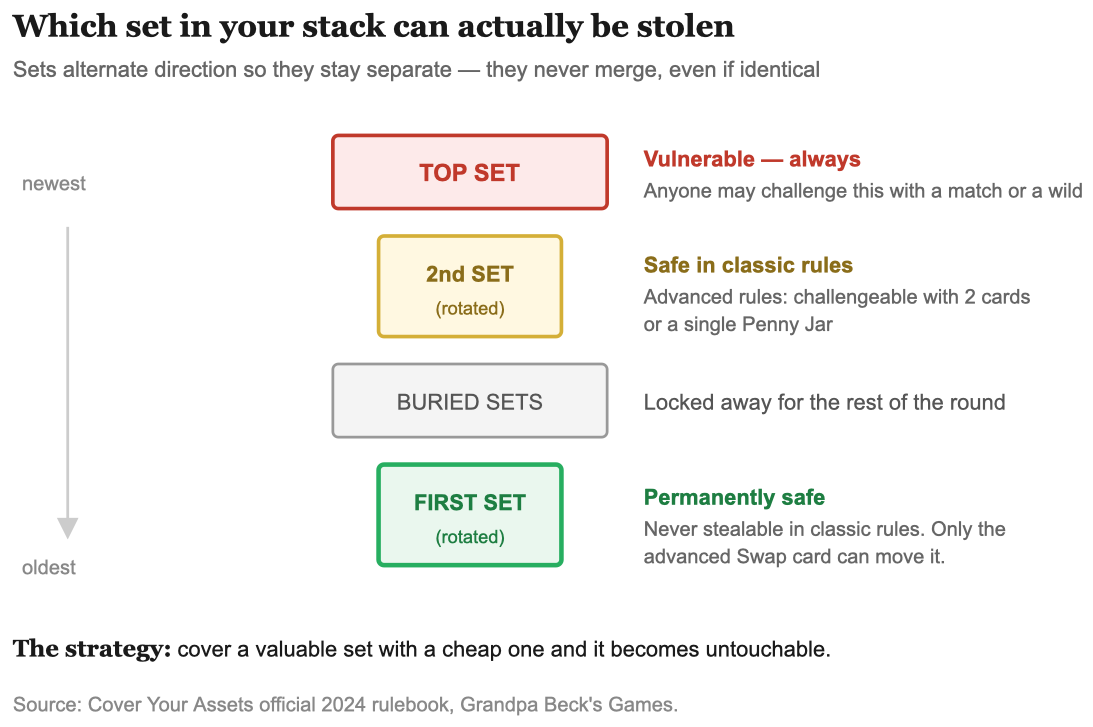
The bottom set in your stack is permanently safe. Not “hard to steal” — safe, for the entire round, with no exceptions in the classic rules.
This is the rule most groups play wrong, usually by assuming everything is fair game if it’s ever exposed. It isn’t. The first set you form is protected the moment you place it, and it stays protected even if every other set above it gets stolen away and it ends up back on top.
That protection is why speed matters more than value when you’re opening. Grab the cheapest legal set fast — you’re buying permanent safety and unlocking your ability to attack at the same time.
2. You Must Build a Set Before You Can Steal
You are not allowed to challenge anyone until you have formed at least one set of your own.
New players routinely miss this and try to open the game by raiding someone. The rule exists to stop the first player from attacking before anyone can build a defense, and it means the opening turns are always constructive rather than destructive.
The rule: no set of your own, no stealing. Building is the price of admission to the aggressive half of the game.
3. Wilds Go Underneath — and Two Wilds Never Make a Set
Two separate rules that trip up the same moment.
When you pair an asset with a Gold or Silver wild, the wild always goes below the asset in the set. This isn’t a fussy formality — it’s how everyone at the table can see what the set actually is at a glance, which matters when six stacks are on the table.
And you cannot form a set from two wilds. A set must be two matching assets, or one asset plus one wild. Never wild-plus-wild.
What most players assume: wilds are universal, so two of them should pair with each other like any matching pair.
What the rules say: a set always needs a real asset to define what it is. Two wilds have nothing to be.
There’s a third clause hiding here that groups also miss: a set is always exactly two cards when first formed. You can’t dump three matching Jewels down at once. Sets only grow past two cards by surviving a challenge — or, under the advanced rules, by being deliberately improved.
4. Sets Never Merge, Even Identical Ones
If you already have a Speed Boat set in your stack and you form a second Speed Boat set later, they stay separate. Always.
That’s what the alternating orientation is for. Each new set goes on top of the previous one rotated ninety degrees, so two identical sets sitting on top of each other remain visually distinct piles rather than blurring into one four-card mass.
People try to combine them constantly, usually reasoning that a bigger set is better. It isn’t available, and it wouldn’t help — only the top set is ever exposed, so merging would just put more value at risk.
5. Passing Is Not an Option
You must take an action every single turn: form a set, discard, or challenge.
If you can’t form a set and don’t want to challenge, you must discard. There is no waiting, no holding your hand intact, no passing to see what happens. This is the rule with the biggest strategic consequence, and it’s the one groups house-rule away without realizing what they’re breaking.
Forced discarding is what keeps the discard pile alive and gives the next player material to work with. Remove it and the game slows to a crawl, because everyone simply sits on their cards.
It matters most at the end of a round. Once the draw deck is depleted, play continues until everyone has emptied their hand — and your sets can still be stolen the whole time. Running out of cards early doesn’t make you safe; it makes you defenseless.
Worth knowing: after your action, you draw back up to five cards. If another player spent cards defending during your turn, they draw back up too — at the same time, not on their own turn. Groups forget this constantly and it quietly starves the defender.
The Advanced Rules Change Three of These
If you’ve added the Swap, Move, and Penny Jar cards, some of the above shifts:
- Hand size goes to six, and you take two actions per turn instead of one.
- The second set from the top becomes challengeable — so “cover it and it’s safe” no longer holds. Initiating that challenge requires two matching assets, two wilds, one of each, or a single Penny Jar.
- You can improve your own set by adding one matching asset to your top set. It must match, and it cannot be a wild.
- A first set can be swapped. The Swap action card ignores the safety rule entirely and can trade a protected bottom set to another player.
That last one surprises everyone. Permanent safety is a classic-rules guarantee, not an advanced-rules one. If the advanced rules stop surprising your table, the spinoffs are the next stop — we put Cover Your Assets, Cover Your Kingdom and Cover Your Cookies head to head.
Don’t own Cover Your Assets yet? It teaches in ninety seconds.
Check Cover Your Assets price on Amazon →
Frequently Asked Questions
Can your first set be stolen in Cover Your Assets?
No. The first set you form sits at the bottom of your stack and is safe for the entire round under the classic rules. The only exception is the advanced Swap action card, which can trade a first set to another player.
Can you make a set with two wild cards?
No. A set must be two matching assets, or one asset plus one wild. Two wilds cannot pair with each other, and a newly formed set is always exactly two cards.
Does the wild go on top or bottom of a set?
Underneath. When pairing an asset with a Gold or Silver wild, the wild is always placed below the asset so the set is identifiable at a glance from across the table.
Can you pass your turn in Cover Your Assets?
No. Every turn you must form a set, discard, or challenge. If you can’t or don’t want to do the other two, you are required to discard a card.
Do matching sets combine into one bigger set?
No. Sets in your stack are never combined, even when they’re the same asset. That’s why each new set is placed rotated ninety degrees from the one below it — to keep them visually separate.
When do you draw cards back up?
At the end of your action, you draw back up to five cards (six under advanced rules). Any player who spent cards defending during your turn also draws back up at that time, rather than waiting for their own turn.
What happens when the draw deck runs out?
Play continues until every player has emptied their hand. You still must take an action each turn, and your exposed sets can still be stolen — so the last few cards you play matter more than most players expect.
For where these rules sit in the wider game — and whether it’s worth buying in the first place — see our full Cover Your Assets review, or the strategy guide for how to exploit rules 1 and 5 specifically. If a rules argument is still live at your table, The Rules Girl’s three-minute explainer on The Dice Tower is the fastest tiebreaker.