

Cover Your Assets with 2 Players: How the Draft Piles Change Everything
Most family card games handle two players by shrugging and letting you play anyway. Cover Your Assets doesn’t — it rebuilds the middle of the game.
Some links below are Amazon affiliate links — as an Amazon Associate, King Panda Games earns from qualifying purchases at no extra cost to you. Full disclosure.
At two players you strip cards out of the deck, lay out three face-up draft piles, and gain an action that doesn’t exist in the full-player game. The result plays noticeably better than the four-player version does at two, and it catches people off guard who expected a watered-down variant.
What Actually Changes at Two Players
Three things, and they compound.
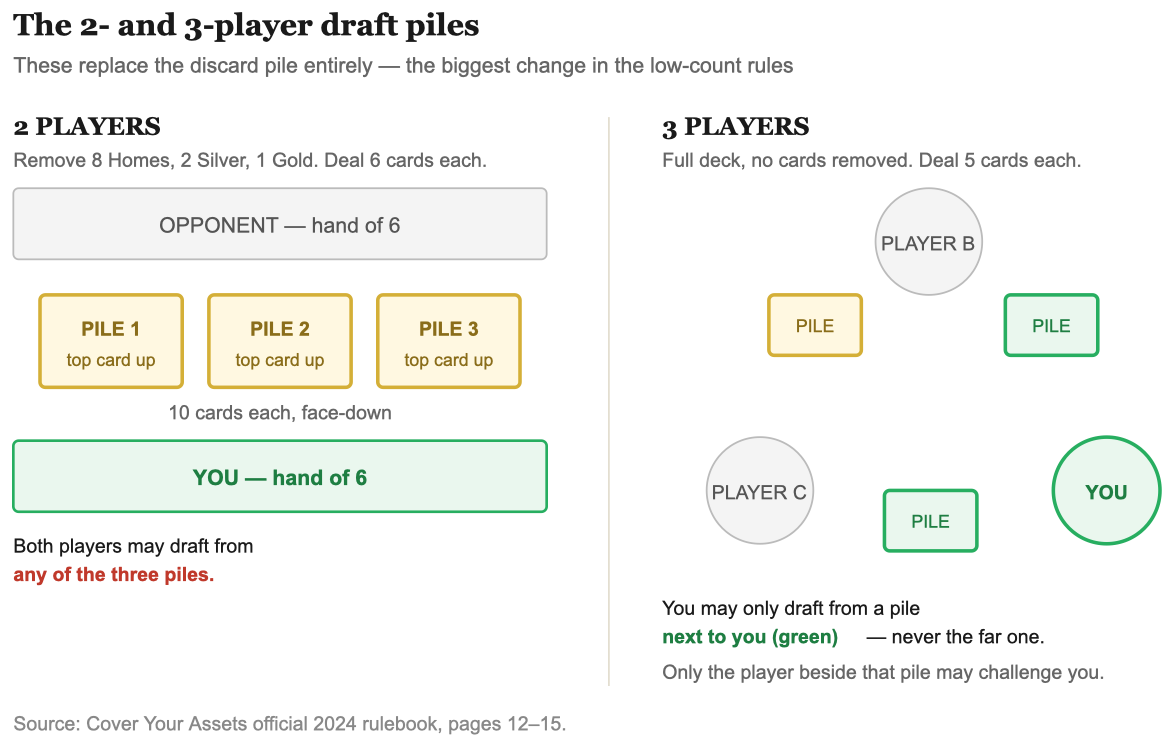
- Remove cards from the deck: all 8 Homes, 2 Silver, and 1 Gold come out before you shuffle. The deck gets smaller and the wild supply tightens.
- Build three draft piles of 10 cards each, face-down, then flip the top card of each one face-up.
- Deal 6 cards to each player instead of 5.
The draft piles are the real change. Instead of a single discard pile that both players feed and fight over, there are three visible cards at all times — a small open market sitting between you.
The Draft Action Is the Whole Game
You get a fourth action at two players: draft a set.
Play one asset or wild from your hand that matches one or more of the face-up draft pile cards, and collect all of them together as a single set. Then flip the next card in each pile you used.
That “or more” is doing enormous work. If two Speed Boats happen to be showing across two different piles, one Speed Boat from your hand takes all three cards as one set. Three-card sets are common at two players and nearly impossible in the classic game without a long challenge.
The piles show Jewels, Gold, and Silver. You play a single Stocks card from your hand — it can’t pair with Jewels, but it can pair with both wilds. You take Stocks + Gold + Silver as one three-card set, having spent exactly one card. Your opponent can still challenge it, but if they can’t, you’ve just built the most valuable set on the table in a single action.
That exact situation appears in the official rulebook as an example, and it’s the play to watch for all game.
Every Draft Is Challengeable
Drafting is not safe. Your opponent can challenge the new set the moment you form it by playing a matching asset or a wild, and the challenge then proceeds exactly like the classic rules — back and forth until someone can’t answer.
If you lose that fight, your opponent takes the set. Including the cards you just drafted.
This is the tension that makes two-player work. A greedy three-card draft is also the most attractive challenge target your opponent will see all game, and you have to weigh grabbing it against whether you can survive the response.
The rule: never make a large draft unless you can also defend it. Taking three cards and immediately losing all three is the fastest way to lose a two-player round.
Why the Removed Cards Matter
Pulling all eight Homes out changes what’s safe.
In the full game, Home is the scarcest asset at eight copies, which makes a Home set unusually difficult to challenge. At two players that entire category is gone, so every remaining asset sits at nine or ten copies. Nothing is naturally safe anymore.
The wild reduction cuts the other way. With 2 Silver and 1 Gold removed, there are only five Silver and three Gold in a smaller deck. Wilds become both scarcer and more decisive, which means a wild in hand is worth holding longer than your instincts from the six-player game will tell you. The full-table version of that habit — spend Silver, hoard Gold — is one of the biggest swings in our Cover Your Assets strategy guide.
Three Players Is a Different Animal Again
Three players uses the draft-pile system too, but with two changes that matter more than they look.
You play with the full deck — no cards removed — and 5-card hands. And the three piles are positioned so that one sits to the left and right of each player.
The positional rule is the twist: you may only draft from a pile adjacent to you, never the one between the other two players. And when you draft, only the opponent sitting next to that pile may challenge you. The third player has to sit and watch.
That creates something the two- and six-player games don’t have — geography. Which pile a card appears in determines who can take it and who can contest it, so the same card is worth different amounts depending on where it lands.
Worth knowing: at three players, pay attention to the pile you can’t touch. Cards accumulating there are effectively a private market for the two players flanking it, and you’ll need to plan around sets you have no ability to contest.
Don’t own Cover Your Assets yet? This guide assumes the base game.
Check Cover Your Assets price on Amazon →
Frequently Asked Questions
Is Cover Your Assets good with 2 players?
Yes, and better than most family card games manage at two. The draft-pile system replaces the discard economy with three face-up cards, which keeps meaningful choices on every turn. It plays faster and more tactically than the full-player game.
Which cards do you remove for a 2-player game?
All 8 Home cards, 2 Silver wilds, and 1 Gold wild. That leaves a smaller deck where no asset is naturally scarce, and wilds are meaningfully harder to come by.
How many cards can you take in one draft?
As many as can be combined into a single set with the one card you play from your hand. If two piles show matching assets and you play a third, you take all three cards as one set. Wilds count, so one asset plus two visible wilds is a legal three-card draft.
Can your opponent challenge a drafted set?
Yes. They can challenge immediately by playing a matching asset or a wild, and the challenge continues back and forth under the normal rules. If you can’t answer, they take the whole set — including the cards you just drafted.
How is the 3-player game different from 2 players?
Three players uses the full deck with no cards removed and 5-card hands. The three draft piles sit between players, and you may only draft from a pile adjacent to you. Only the opponent next to that pile can challenge your draft.
Do the advanced rules work at 2 and 3 players?
Yes, with one addition: action cards revealed in a draft pile trigger immediately rather than being drawn. A revealed Swap makes the two affected players exchange top sets, and a revealed Move lets each decide how their opponent reorders their stack. Action cards revealed before the round starts get shuffled back into the middle of that pile.
If you’re weighing the game for a couple or a two-player household, our full Cover Your Assets review covers whether it earns the shelf space. The complete two- and three-player rules start on page 12 of the official 2024 rulebook, and Grandpa Beck’s own how-to-play video walks through the setup if you’d rather watch it.
Play three rounds before you judge it. The draft piles reward pattern recognition, and the two-player game gets sharper the moment you start reading which piles your opponent is waiting on.