

This article contains affiliate links — if you buy through them, we may earn a small commission at no extra cost to you. Full disclosure.
Progress tokens are earned by collecting a pair of identical scientific symbols. Five of the ten tokens are randomly selected and displayed at the start of each game — a pool Pantheon widens with three more — the other five don’t exist for that session. Knowing what each token does and how much it’s worth determines whether you spend your science pairs chasing the best available token or ignoring the board entirely.
Some links below are Amazon affiliate links — as an Amazon Associate, King Panda Games earns from qualifying purchases at no extra cost to you. Full disclosure.
The Spiel des Jahres jury put 7 Wonders Duel on its recommended list in 2016. See the jury’s entry.
How Progress Tokens Work
Each time you collect a matching pair of identical scientific symbols, you immediately choose one of the five face-up Progress tokens on the board and add it to your city. You keep it for the rest of the game.
The choice is yours — you don’t have to take the “best” token, you take whichever one fits your current game state. Once a token is taken, it’s gone from the board. The five displayed tokens are all that exist for this game.
Important: the Law Progress token itself counts as a scientific symbol. Once you have it, it can form a pair with any matching green card symbol you subsequently collect, triggering another Progress token pick.
All 10 Tokens, Ranked by Baseline Power
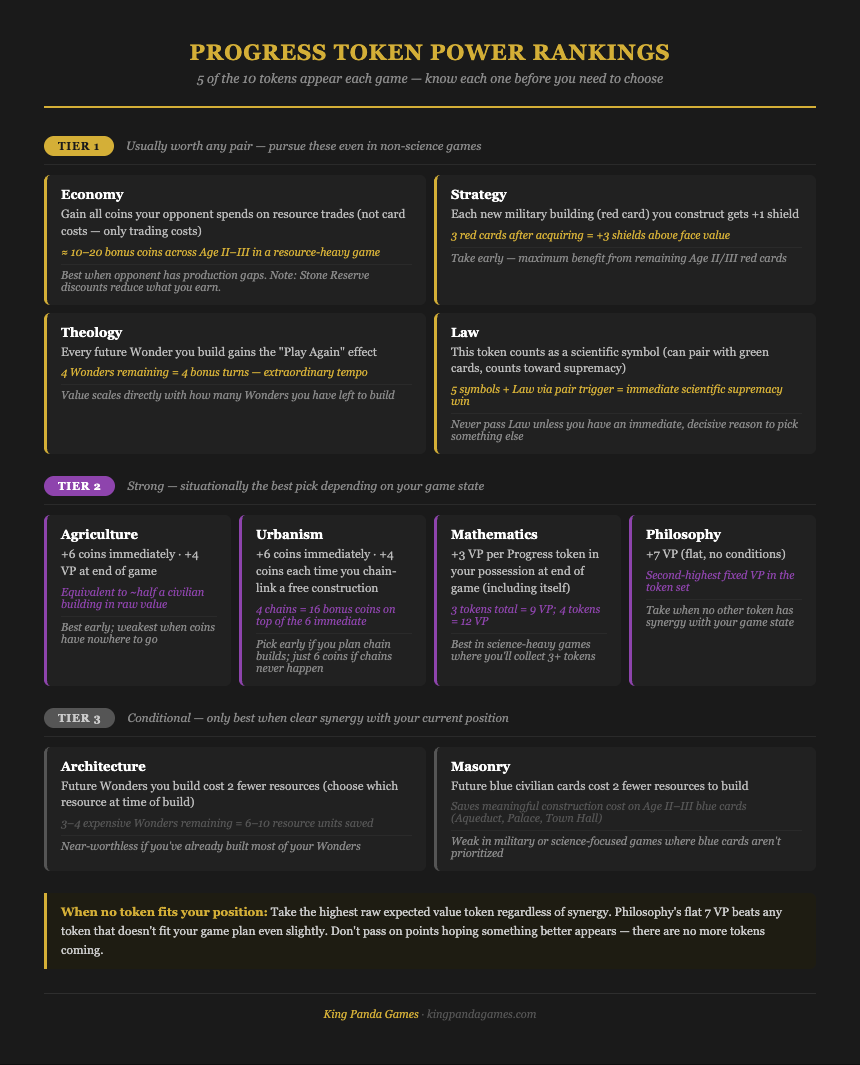
Tier 1: Usually Worth Any Pair
Economy — You gain all coins your opponent spends on trades. Not the coins spent on card costs — only the coins spent purchasing resources they don’t produce. This token turns your opponent’s resource gap into your income. In a resource-heavy game where both players are trading frequently, Economy can generate 10–20 additional coins across Ages II and III. Draft players who also take economy-boosting yellow cards (Stone Reserve, Clay Reserve, Wood Reserve) create a permanent income engine that’s nearly impossible to counter.
Strategy — Each new military building (red card) you build gets +1 shield. A 1-shield red card becomes a 2-shield play; a 2-shield card becomes 3. This compounds immediately. Building three or four red cards after acquiring Strategy can push for military supremacy that would have been out of reach without it. It also benefits from timing — take it early enough that the remaining red cards in the structure all benefit.
Theology — Every future Wonder you build has the “Play Again” effect. If you have three or four Wonders remaining when you acquire Theology, you suddenly string consecutive turns together every time you build one. Four Wonders with Theology means four bonus turns — an extraordinary tempo advantage. Value is strongly correlated with how many Wonders you have left to build.
Law — This token counts as a scientific symbol. If you have five different symbols and acquire Law through a pair trigger, you win the game via scientific supremacy immediately. Even without supremacy, Law counts as a symbol for future pair triggers — a self-referential snowball. Never pass Law unless you have a clear, immediate reason to take something else.
Tier 2: Strong, Situationally Best
Agriculture — You take 6 coins immediately, and the token is worth 4 VP. No conditions, no opponent dependency. 6 coins plus 4 end-game VP is equivalent to about half a civilian building’s value in raw terms. Agriculture is best early when the 6 coins fund an Age II construction push, and weakest late when coins have nowhere productive to go.
Urbanism — You take 6 coins immediately, plus 4 coins each time you construct a building for free via chain linking. Chain builds happen when you have an Age I card with a symbol that grants free construction of a linked Age II or III building. In games with heavy chain use (Baths → Aqueduct, Scriptorium → Library, Tavern → Lighthouse), Urbanism generates 12–20 bonus coins across the game. In games with few chains, it’s just the 6 immediate coins — still decent, but not exceptional.
Mathematics — Worth 3 VP per Progress token in your possession at end of game, including itself. If you end the game with 3 Progress tokens, Mathematics is worth 9 VP. With 4, it’s worth 12. It compounds based on how many other tokens you collect. Best in games where you’re likely to collect three or more tokens (science-heavy builds). Weakest if you only end up with one or two total tokens.
Philosophy — 7 VP, flat, no conditions. The second-highest fixed VP total in the Progress token set. It doesn’t interact with anything else — it’s simply 7 points. Take it when 7 VP closes a game you’re winning on points, or when no other token has direct synergy with your position.
Tier 3: Conditional, Take When Synergy Is Clear
Architecture — Any future Wonder you build costs 2 fewer resources. Choose which resource the discount applies to at time of construction. If you have three or four expensive Wonders left to build, Architecture can save 6–10 resource units — substantial. If you’ve already built all your Wonders or only have cheap ones remaining, Architecture is nearly worthless. Assess your Wonder count before valuing this token.
Masonry — Future blue civilian cards cost 2 fewer resources to build. Same logic as Architecture but for blue cards. Blue cards are plentiful in Ages II and III and often expensive (Aqueduct, Palace, Town Hall, Pantheon all require multiple resources). If you’re building a civilian-point-heavy game, Masonry reduces the construction cost of your most important cards. Weak in military or science-focused games where blue cards aren’t a priority.
The Two Interactions That Break Games
Economy + opponent’s production base: A player with Economy who faces an opponent with a strong raw material production base earns coins every time that opponent builds anything requiring trades. If the opponent builds grey resources (Glass, Papyrus) and the Economy player forces them to trade for raw materials — or vice versa — the coin transfer can be 3–5 coins per opponent turn. Over 20 turns, this is 60–100 coins of economic swing.
Strategy + military red cards: A player who grabs Strategy in Age I and then plays three 2-shield red cards is pushing 9 effective shields toward the enemy capital — enough for military supremacy from a neutral starting position in most games. Opponents must immediately spend turns on their own red cards or the game ends before Age III.
What to Do When No Token Fits
Sometimes you’ll trigger a pair and look at the five available tokens to find none of them clearly suit your position. This happens — the random five displayed can include all three of the VP-specific tokens (Philosophy, Mathematics, Agriculture) when you’re deep in a science or military game.
Take the token with the highest expected value regardless of synergy. Philosophy’s flat 7 VP beats a token that doesn’t fit your game plan even slightly. Don’t pass on points hoping something better appears — there are no more tokens coming.
For the full picture on how Progress tokens fit into your overall game plan, see our 7 Wonders Duel review.
What the critics said about 7 Wonders Duel
We play these games ourselves, but it’s worth knowing where the rest of the hobby lands.
-
“There’s a lot in this game that takes away from the original 7 Wonders, but it is not a watered-down version. It is its own game in its own right.”
— Jay Howitt, The Dice Tower. The strongest one-line case for Duel over the original, and the reason progress tokens matter so much to how it plays.
-
Shut Up & Sit Down — SU&SD’s take on why the two-player-only constraint is a feature.
Going straight to the source: Read the official 7 Wonders Duel rules, plus the background and history.
📕 Grabbing the rules? Grab this too.
The KPG Budget Board Games Guide — 9 games under $30, each with player counts, play time, and who it’s actually for. Free PDF, no email gymnastics.
Check 7 Wonders Duel: Pantheon price on Amazon →
Frequently Asked Questions
How many Progress tokens can you have in a game?
There’s no hard cap on the number of tokens you can collect, but practically you’ll collect 1–4 across a game. Each token requires a pair of identical scientific symbols, and collecting enough pairs to trigger multiple tokens means building heavily in green cards — which competes with other city development. Three tokens is a realistic upper limit in most games without a dedicated science strategy.
What happens if both Progress tokens I want are equally good?
Take the one your opponent would most benefit from if they collect a pair next. Economy matters less if your opponent has no production to trade for. Strategy matters less if they’ve already built all their red cards. Denying the opponent’s highest-value option is sometimes more important than optimizing your own token choice.
Does the Economy token work with the trading discounts from yellow cards?
Yes and no — and this is the most commonly misunderstood Economy interaction. If your opponent has a Stone Reserve card that fixes stone at 1 coin, and they spend that 1 coin buying stone, you gain that 1 coin. The Economy token captures the actual coins spent on resource purchases, not the undiscounted price. Stone Reserves reduce what your opponent pays, which reduces what you earn through Economy. The interaction works but is diminished by opponent discounts.
Is it worth pursuing science symbols just to collect Progress tokens?
Yes, if the available tokens are strong. Economy, Strategy, and Theology are worth building toward even in non-science games. The cost is 2 green cards to collect a pair — that’s usually 2–3 turns of construction depending on card cost. If the token you’d earn is worth 10+ VP equivalent in effect, it’s almost always worth the diversion.
What’s the most underrated Progress token?
Urbanism. Most players evaluate it as “6 coins + a small chain bonus” and deprioritize it. Players who actively plan chain builds (Baths into Aqueduct, multiple Age I-to-II links) find that Urbanism generates 4 coins per chain — and in a game with four successful chains, that’s 16 bonus coins on top of the 6 immediate, comparable to two mid-game commercial buildings. Players who plan chains in Age I and pick up Urbanism in Age I or early Age II see enormous returns.