
Of all the rules in Sequence, jacks generate the most confusion. Can a one-eyed jack remove a chip from a completed sequence? Can you use a two-eyed jack to take a space that already has a chip on it? What actually happens when you play a jack — do you still draw a card afterward?
Some links below are Amazon affiliate links — as an Amazon Associate, King Panda Games earns from qualifying purchases at no extra cost to you. Full disclosure.
Here’s every jack rule, clearly explained.
The quick answer: a standard Sequence game uses 8 jacks — 4 two-eyed (hearts and diamonds) that place your chip on any open space, and 4 one-eyed (spades and clubs) that remove any opponent chip. The rule almost everyone forgets: neither jack can touch a completed sequence. Once five chips connect, they’re locked forever.
The Two Types of Jacks and What They Do
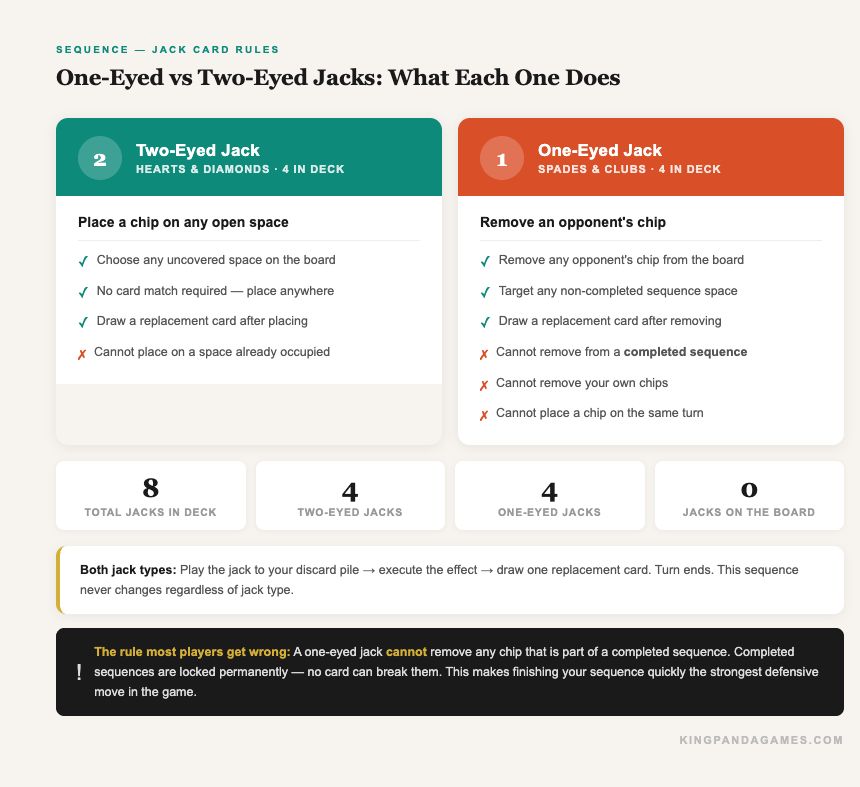
Sequence uses two standard 52-card decks shuffled together, which means 8 jacks total. Four of them are two-eyed jacks; four are one-eyed jacks. They do completely opposite things.
Two-eyed jacks (the jacks of hearts and diamonds in most standard decks) let you place a chip on any open space on the board — no matching card required. Play the card to your discard pile, place your chip anywhere that isn’t already occupied, then draw a replacement. That’s it.
One-eyed jacks (the jacks of spades and clubs) let you remove any opponent’s chip from the board. Play the card, remove one opponent’s chip from any space of your choice, draw a replacement. You do not place your own chip in that space on the same turn.
Neither type of jack appears on the game board itself. Jacks are only in the deck — they’re tools you use to manipulate the board, not spaces you can directly claim by matching a card.
The rule: two-eyed jacks place chips anywhere open; one-eyed jacks remove any opponent’s chip that isn’t part of a completed sequence. You always draw a replacement after playing either type.
The Rule Most Players Get Wrong
One-eyed jacks cannot remove a chip that is part of a completed sequence.
This is the most commonly misunderstood rule in the game, and the one that causes the most disputes at the table. Once a sequence is finished — five chips in a connected row — those chips are locked in place permanently. No jack card, no matter who plays it or when, can break a completed sequence.
This rule has strategic consequences that go beyond the rule itself. Because completed sequences are untouchable, finishing your first sequence as quickly as possible does double duty: you score toward your win condition and you lock those five spaces out of your opponents’ reach forever. Sequences aren’t just progress — they’re permanent board control.
Worth knowing: A one-eyed jack cannot remove your own chip either. It must be used on an opponent’s chip. You also cannot use a one-eyed jack to remove a chip and then place a chip on that space in the same turn — those are two separate actions and one turn only allows one.
When to Use a Two-Eyed Jack
Two-eyed jacks feel like trump cards — and they are, in a limited sense. The temptation is to save them for the final winning chip in a nearly-complete sequence. This works, but it’s rarely the most effective use.
The more valuable play is using a two-eyed jack mid-game to fill a gap your current hand can’t reach. If you have a four-card sequence path with one space missing and no card in hand that matches that space, a two-eyed jack closes the run early — before opponents notice the gap and use a one-eyed jack to remove one of your adjacent chips.
What most players do: Hold the two-eyed jack as a closing move — the guaranteed final chip when a sequence is one space away from completion.
What actually works: Play the two-eyed jack in the middle of a sequence to fill an unreachable gap, then use your remaining hand cards to complete the run naturally. This collapses the window in which opponents can disrupt the sequence before it finishes.
In team play, a two-eyed jack can also bail your teammate out of a blocked position — if your partner is building toward a space and an opponent covers it, your two-eyed jack can redirect the sequence through a different open space nearby.
When to Use a One-Eyed Jack
Most players use one-eyed jacks reactively — saved until an opponent has four chips in a row, then deployed to remove one chip and reset their sequence. This works. But it’s not the strongest play.
The most powerful one-eyed jack move is removing a chip that’s simultaneously contributing to two of your opponent’s potential sequences. A single chip placed at the intersection of a horizontal and a diagonal build isn’t just one chip — it’s the anchor for two separate threats. Removing it early collapses both paths at once.
“How do I spot the high-value chip to remove?” Look for chips that appear in two different potential lines — a chip that could extend a horizontal run and also forms part of a diagonal cluster. The chip that looks most “load-bearing” to multiple directions is the one worth targeting, even when the immediate threat from any single sequence is still moderate.
Saving a one-eyed jack until an opponent is about to complete a sequence isn’t wrong, but it’s a reactive position. You’re already behind when you need emergency defensive plays. The teams that win most often use jacks to shape the mid-game board, not rescue the endgame.
What Happens When You Play a Jack in Sequence
Same as every other turn — the full sequence is:
- Play the jack card from your hand to your discard pile
- Execute the jack’s effect (place chip anywhere open, or remove one opponent’s chip)
- Draw a replacement card from the deck
If you forget to draw your replacement card and another player catches it before you draw, you play the rest of the game with fewer cards. This applies whether you played a jack or any other card — the draw rule is universal.
One more rule worth knowing: if the draw deck runs out, all discard piles are shuffled together to form a new deck. The game continues without interruption.
Jack Cards in Team Play
Everything above applies in both individual and team play, but jacks get more interesting in teams because the communication ban changes how you coordinate around them.
If you’re holding a two-eyed jack and you see your teammate building toward a space that’s about to get contested, you can’t tell them. But you can use the jack to claim that space for them before an opponent covers it — this is one of the clearest “silent coordination” moves in team Sequence. Your teammate sees the chip placed on the contested space in their color and reads the situation.
One-eyed jacks in team play also carry more weight because you’re using a single defensive resource to protect two people’s work simultaneously. When you remove an opponent’s chip that was blocking both your sequence path and your teammate’s, that jack is doing double the work it would do in a solo game.
What the critics said about Sequence
We play these games ourselves, but it’s worth knowing where the rest of the hobby lands.
-
“I give this one a five. You know what? I’m feeling a soft spot. I think I’m giving it a six. For what it is, I think it works pretty well.”
— Tom Vasel, The Dice Tower. Vasel covered Sequence in a segment literally titled “A Pile of Mid Games” — which is roughly where we land too. It is fine, and fine is the point.
-
The Rules Girl, The Dice Tower — A two-minute rules explainer, if you want the whole game explained faster than you can read this section.
Going straight to the source: See the official Sequence page, plus the background and history.
📕 Grabbing the rules? Grab this too.
The KPG Budget Board Games Guide — 9 games under $30, each with player counts, play time, and who it’s actually for. Free PDF, no email gymnastics.
Don’t own Sequence yet? It plays up to 12 in teams.
Check Sequence price on Amazon →
Frequently Asked Questions
What is a one-eyed jack in Sequence?
A one-eyed jack lets you remove any opponent’s chip from the board — but only from spaces that aren’t part of a completed sequence. You play it to your discard pile, remove one opponent’s chip, then draw a replacement card. You don’t place your own chip on that space in the same turn.
What is a two-eyed jack in Sequence?
A two-eyed jack is a wild placement card — play it to your discard pile and place your chip on any open space on the board, regardless of what card that space corresponds to. You then draw a replacement card as usual. Two-eyed jacks are among the most powerful cards in the game because they bypass the card-matching requirement entirely.
Can a one-eyed jack remove a chip from a completed sequence?
No. Completed sequences are permanently locked — no jack card can remove chips that are part of a finished five-in-a-row. This is the most commonly misunderstood rule in Sequence, and it makes finishing sequences quickly a strong defensive move in addition to a scoring move.
How many jacks are in a game of Sequence?
The standard Sequence set uses two full decks of 52 cards, which means 8 jacks total — 4 two-eyed jacks (hearts and diamonds) and 4 one-eyed jacks (spades and clubs). Jacks don’t appear on the game board itself; they’re only in the deck.
Can you use a one-eyed jack on your own chip?
No. One-eyed jacks can only be used on an opponent’s chip. You also can’t use a one-eyed jack to remove a chip and then place your own chip in that same space on the same turn — those are separate actions, and each turn allows only one.
Do you still draw a card after playing a jack in Sequence?
Yes — always. The full turn sequence never changes: play a card, execute its effect, draw a replacement. This applies to jacks the same way it applies to any other card. Forgetting to draw before the next player’s turn means you lose that draw permanently.
The jack card rules in Sequence are simple once you see them as a system: two-eyed jacks create options (place anywhere), one-eyed jacks remove threats (opponents’ chips only, never from completed sequences). Most mistakes come from forgetting the completed-sequence exception on one-eyed jacks. Now you won’t.
For the full Sequence review — who should buy it, best player count, and how the game plays in practice — see our complete Sequence review.