


This article contains affiliate links — if you buy through them, we may earn a small commission at no extra cost to you. Full disclosure.
Cards Against Humanity Review: The Party Game That Plays Itself
Bottom Line
Cards Against Humanity is the most-owned party game in America and one of the least played — because after the third session, everyone has seen the jokes. It’s fine as a one-time icebreaker with drinks, and its shock humor lands with the right crowd. Its fatal flaw is that the cards do all the work: nobody at the table is actually being funny, they’re dealing pre-written punchlines. If your group loves it, our honest advice is that better versions of this night exist for the same money.
Some links below are Amazon affiliate links — as an Amazon Associate, King Panda Games earns from qualifying purchases at no extra cost to you. Full disclosure.
Cards Against Humanity gets a 5/5 Bamboo Plants and a 2/5 Pandas from us — and that gap is the whole review. It’s the easiest game on our shelf to teach and among the least rewarding to replay. We’re aware this is the internet’s most-gifted party game. We’ve played it plenty. That’s exactly why the score is what it is.
The Bamboo 5 is real: read a black card, everyone throws in a white card, funniest one wins. Ninety seconds of teaching, zero rules questions ever. The Pandas 2 is just as real: the game generates laughs the way a joke book does — reliably at first, then never again with the same material.
| Detail | Info |
|---|---|
| Players | 4–20+ |
| Best Player Count | 6–8 — enough card variety, judging stays quick |
| Age | 17+ (genuinely — this is not the family pick) |
| Play time | 30–90 min (it ends when people drift off) |
| Complexity | Light |
| Solo Mode | No |
| Designer | Josh Dillon, Daniel Dranove, et al. |
| Publisher | Cards Against Humanity LLC |
| Bamboo Plants | 5/5 — teaches in one sentence |
| Pandas | 2/5 — funny deck, hollow game |
| Official site | cardsagainsthumanity.com |
| Official rules | Download the rules PDF |
How Cards Against Humanity Works
One player flips a black card with a fill-in-the-blank prompt. Everyone else picks the funniest white card from their hand of ten and submits it face-down. The prompt-reader — the “Card Czar” — shuffles the answers, reads them aloud, and picks a winner. That player keeps the black card as a point. Rotate the Czar, repeat until people are checking their phones.
That’s the entire game, and the teach really is a marvel — we’ve onboarded a full table of non-gamers in under a minute, mid-conversation. No party game moves from box to laughter faster.
What We Liked
Session one genuinely works. The first time a quiet coworker drops a filthy card into a prompt about grandma, the table detonates. With drinks, with strangers, with in-laws you’re testing — CAH’s opening night reliably produces big laughs, and we won’t pretend otherwise.
The Czar structure is smart in one specific way: submissions are anonymous, so shy players compete on even footing with loud ones. Plenty of party games are dominated by extroverts; this one isn’t, and that’s a legitimately good design choice buried inside the shock-value packaging.
What We Disliked
What it feels like it’s doing: making your group hilarious.
What it’s actually doing: dealing your group pre-written jokes. Nobody creates anything — the skill ceiling is “recognize which card is funniest,” and even that decays as the deck becomes familiar.
- The replay collapse is total. By game three, you’ve seen the strongest white cards, and their fourth appearance earns a nod instead of a laugh. A joke book doesn’t get funnier on rereads, and this is a joke book with a scoring system.
- It runs long with no arc. There’s no tension curve, no comeback, no ending anyone anticipates — the game just continues until the group’s energy dies, and it usually dies before the box says to stop.
- The humor is a hostage situation for some tables. The deck’s edgy-for-edgy’s-sake cards force a choice: play them and watch someone’s smile go stiff, or hold them and lose. Mixed company makes this game genuinely stressful in a way its fans forget.
- Judging is a popularity contest. The Czar picks what they find funny, which converges on “play to the judge” — the one strategy the game has, and it’s shallow.
Who It’s For
Cards Against Humanity is for a specific night: a big, boozy gathering of adults who know each other’s limits, most of whom haven’t played it before. Bachelor parties, college reunions, that one New Year’s crowd. In that room, on that night, it does its job.
It’s also — credit where due — the game that proved to millions of non-gamers that a card game could headline a party. Some of our favorite gamers started here.
Who should skip this game
Skip it if you play games more than a few times a year — the deck cannot survive a regular group. Skip it for family gatherings, mixed company, or any table where one person’s discomfort would sour the night; the deck will find that line. And skip it if you already own it and feel obligated to keep dealing it: the shelf-guilt isn’t worth it, and the same $25 buys games that stay funny.
Who Should Buy This?
Most people reading a review already shouldn’t. If you’re buying a one-time icebreaker for a specific party, it does that job — but so do better games. If you’re building any kind of game shelf, put the $25 toward Codenames, where the laughs come from your friends’ brains instead of the deck.
Already own it? Keep it for new-guest nights and stop feeling bad that it’s dusty. That’s not a you problem; that’s the design.
Best Player Count
Six to eight. Below five, hands run thin and the anonymity that protects shy players stops mattering. Above ten, rounds crawl — reading fourteen submissions aloud kills the pace, and half the table is waiting to hear their card in any given round. The box’s “4 to 20+” is technically true and practically a warning label.
Replayability
This is the lowest replayability score of any famous game we’ve covered. CAH’s fun is stored in the cards rather than the players, so every session spends the deck down like a battery. Expansions refill it — that’s their entire function — which means keeping CAH funny is a subscription, roughly $20–30 per recharge.
Compare that to the games whose fun is generated by the people playing: Codenames and Coup get better as your group builds history. CAH gets worse. That asymmetry is the whole argument.
Play This Instead
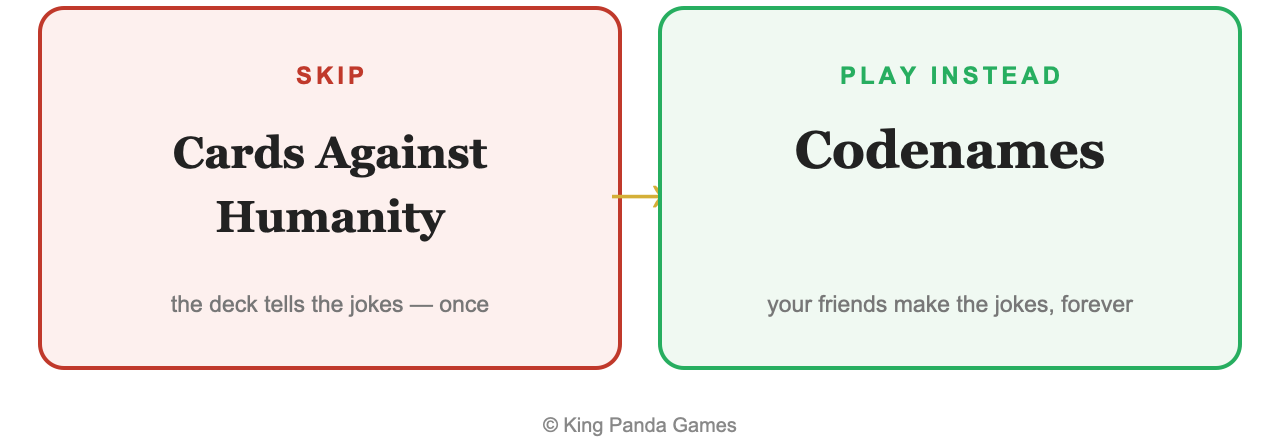
If you want the same night but generative: Codenames — the laughs come from your friends’ one-word clues and the disasters they cause, so it’s different with every crowd, forever. Same teach speed, same party slot, infinite deck.
If you want the edge without the deck dependency: Coup — fifteen minutes of lying to your friends’ faces. The drama is player-made, so it never runs out.
If you want fill-in-the-blank humor that stays fresher: Say Anything or Quiplash — both make players write the answers, which is the exact fix CAH needs.
Frequently Asked Questions
Is Cards Against Humanity worth buying?
Only as a one-time icebreaker for a specific adult party. As a repeat-play purchase it’s weak — the humor lives in the cards, and once your group has seen the deck, the game has spent its best material. For a permanent shelf, Codenames is the better $25.
Why do people stop playing Cards Against Humanity?
Deck fatigue. The jokes are pre-written, so replaying the game means re-hearing the jokes, and by the third or fourth session the laughs drop off sharply. It’s the most-owned, least-replayed game in the party genre for exactly this reason.
Is Cards Against Humanity appropriate for family game night?
No — the standard deck is built on deliberately offensive adult content, and the 17+ label is earned. The separate Family Edition exists and is tamer, but for all-ages fun, games like Codenames or Sushi Go Party! are stronger picks anyway.
How many people do you need for Cards Against Humanity?
Officially 4+, and it’s best at six to eight — enough submissions for variety while rounds stay quick. Past ten players, the reading and judging phases drag badly.
Do the expansions make Cards Against Humanity better?
They make it playable again, not better — expansions exist to refill the joke supply the base game exhausts. If you find yourself budgeting $25 a year to keep a party game funny, that money buys a permanently replayable game instead.
What’s a good alternative to Cards Against Humanity?
Codenames for the same crowd with generative laughs, Coup for short high-drama rounds, and Quiplash or Say Anything if you specifically want the fill-in-the-blank format with player-written answers.
Verdict
Try it, don’t buy it — play someone else’s copy at the party where it belongs. Buy it only as a deliberate one-night icebreaker for a big adult gathering. Skip it for any regular game group; its fun is non-renewable, and the games we’ve linked above run on a fuel source that never empties: the people at your table.
Cards Against Humanity official site: https://www.cardsagainsthumanity.com/
Official rules (PDF): Download it here