


Coup Review: Is It Worth It?
Bottom Line
Coup is the best fifteen minutes in card gaming for groups of four or more — a bluffing knife-fight where you win by lying with a straight face about two hidden cards. Skip it if your group includes anyone who takes accusations personally, or if you mostly play with two players. Its biggest strength is the density: more real decisions and table drama per minute than games five times its length. Its biggest weakness is that eliminated players sit out — briefly, but visibly.
Coup gets a 4/5 Bamboo Plants and 5/5 Pandas from us — buy it, it costs about as much as lunch. Fifteen dollars, fifteen minutes, and the single highest laughs-to-cardboard ratio on our shelf. You get two face-down cards, everyone lies about what they have, and the moment someone finally yells “I don’t believe you” is worth the price of the box alone.
The Pandas score is a full 5 because no game this small has ever produced this much table drama for us. The Bamboo sits at 4 rather than 5 for one honest reason: the rules are simple, but the character grid — who blocks what, who challenges whom — takes new players a full game to absorb. Game one is a tutorial; game two is war.
Some links below are Amazon affiliate links — as an Amazon Associate, King Panda Games earns from qualifying purchases at no extra cost to you. Full disclosure.
| Detail | Info |
|---|---|
| Players | 3–6 |
| Best Player Count | 5 — enough liars for chaos, few enough to track them |
| Age | 10+ |
| Play time | 15 min |
| Complexity | Light |
| Solo Mode | No |
| Designer | Rikki Tahta |
| Publisher | Indie Boards & Cards |
| Popular Upgrades | No (Reformation expansion exists) |
| Bamboo Plants | 4/5 — one game to learn the bluff grid |
| Pandas | 5/5 — pure distilled table drama |
| Official site | indieboardsandcards.com |
| Official rulebook | Download the rules PDF |
How Coup Works
You’re dealt two face-down character cards — your “influence” — and the goal is to be the last player with any left. Each turn you take one action, and here’s the trick: most actions belong to specific characters, and you can claim any character you want, whether you have it or not. It lands at #6 on our best board games of 2026 list.
Claim the Duke and take three coins. Claim the Captain and steal two from a neighbor. Claim the Assassin, pay three, and knock out someone’s card. All of it might be true. None of it has to be.
Sarah claims the Duke for the third turn in a row. Statistically there are only three Dukes in the deck. Marcus squints, points, and challenges — “show me the Duke.” If she has it, Marcus loses a card and Sarah shuffles her Duke back and draws fresh. If she doesn’t, she flips a card face-up, one step from dead. Either way, someone at the table is about to make a noise the neighbors can hear.
Blocks create the second layer: claim the Contessa to block an assassination, the Duke to block foreign aid — and blocks can be bluffs too, and challenged too. Every claim anyone makes is a little dare to the whole table.
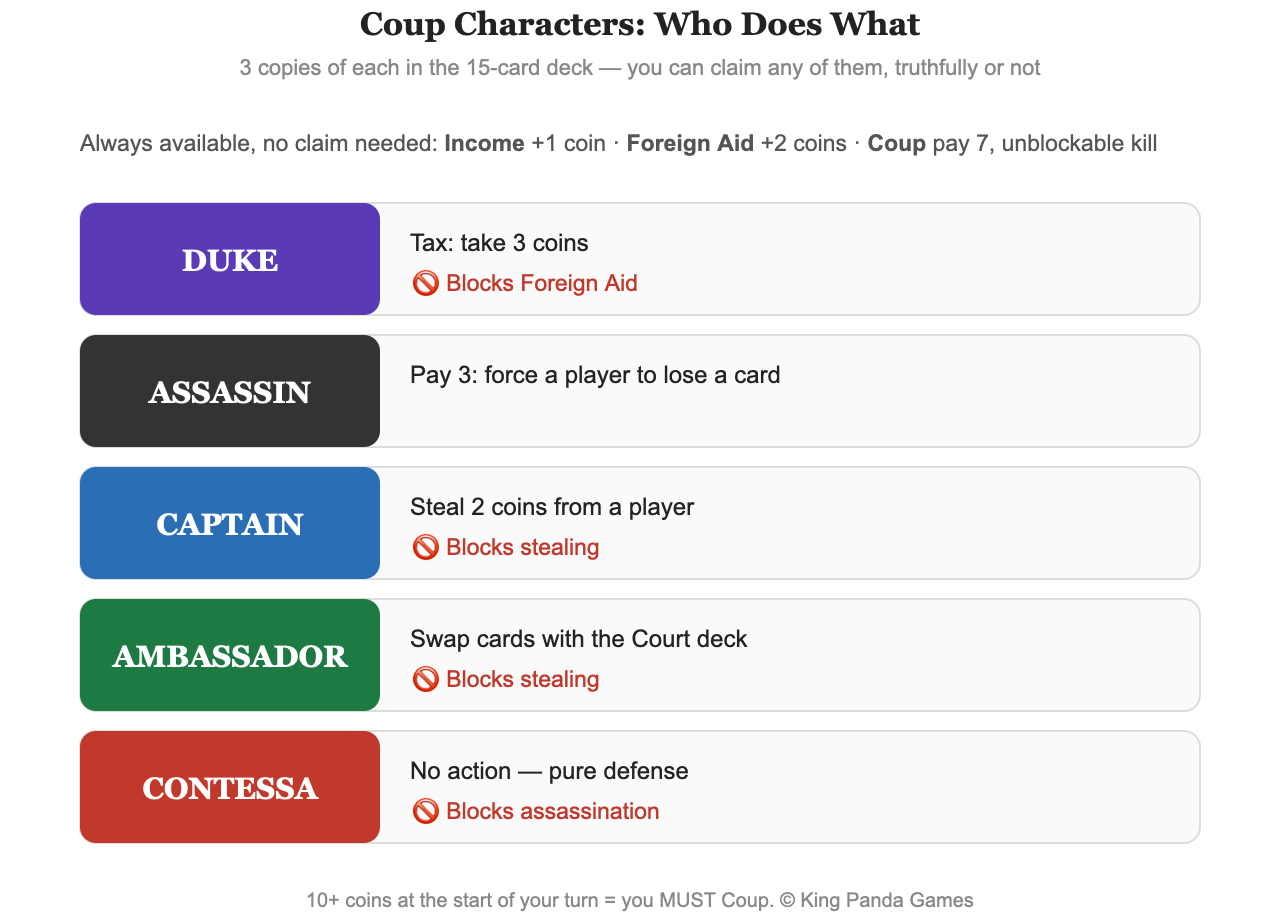
The economy forces the endings: seven coins buys a Coup, an unblockable, unchallengeable kill. Sit on ten or more coins and the rules force you to launch one. Nobody gets to turtle; the knives always come out.
What We Liked
The lying is mechanically load-bearing, not decorative. Plenty of games let you bluff; Coup makes bluffing the entire engine. A player holding two dead cards can win the game on pure nerve, and we’ve watched it happen — the table’s best liar taking it down with nothing but a Contessa claim she never had.
The challenge decision is perfectly weighted. Calling out a liar costs them a card; being wrong costs you one. That symmetry means every accusation has real fear behind it, and the table’s silence while someone decides whether to challenge is the best sound in party gaming.
It fits in the cracks of an evening. Fifteen minutes, a deck the size of your palm, setup measured in seconds. Coup is the game you play while waiting for pizza, and then accidentally play six more times after the pizza’s gone. It anchors a whole category we covered in our BBQ card games roundup.
Losing is fun, which is rare for an elimination game. Getting knocked out usually stings; getting knocked out in Coup comes with a story — you got caught claiming a third Duke, or assassinated by your own spouse. The eliminated players stay at the table heckling, because the show is still on.
What We Disliked
- Player elimination is real, and first eliminations can come fast. In a 6-player game, someone can be out inside five minutes. Games are short enough that it rarely matters, but a bad night can make one player the table’s practice dummy twice in a row.
- It’s flat with 3 players and dead with 2. The bluffing needs a crowd of suspects — at three the deduction gets too easy, and the official 2-player variant is a curiosity, not a game. This is a 4–6 player box, full stop.
- First-timers get eaten. Until you know the character grid cold, you can’t tell a plausible claim from a desperate one, and experienced players will farm you. Expect to lose your first two games as tuition.
Who It’s For
Coup is for any group of four to six people who enjoy each other enough to lie to each other’s faces — game nights, camping trips, office lunches, families with teenagers. It’s the natural next step for groups who loved Codenames but want stakes, or King of Tokyo fans ready to trade dice luck for nerve. Coup is also our #1 pick for the best board games for teens, because it clears the phone-down test in about ninety seconds.
It’s also the best pocket-sized social deduction game ever made — all the paranoia of Werewolf or Mafia with no moderator, no night phase, and no half-hour rounds.
Who should skip this game
Skip Coup if anyone in your group takes accusations personally — the game is literally about calling your friends liars, and players who can’t separate the game from the table will have a bad time. Skip it as a couples’ game entirely; get 7 Wonders Duel instead. And groups that hate player elimination in any form should look at Sea Salt & Paper for their filler slot.
Who Should Buy This?
Buy it without deliberating — Coup costs $12–15, which makes it the cheapest five-star party experience in gaming. There is no “try before you buy” tier for a game priced like a sandwich; if you have a regular group of 4+, the value question answers itself.
It’s a core-collection game for social groups and a situational one for strategy-first tables. The only buyers who should pause are 2–3 player households — at those counts you’re buying a game you’ll only play at gatherings. It sits at #2 on our best board games for adults list, one spot behind Codenames.
Best Player Count
Coup is best at 5 players. The box says 3–6 (with a 2-player variant in newer printings), but five is the sweet spot: enough players that claims are genuinely hard to track, few enough that your turn comes back before the coins pile up and the game turns into forced Coup exchanges.
Six works nearly as well and maximizes chaos — but first eliminations hit faster and the endgame can drag an extra beat. Four is solid, tighter, more readable. Three is playable but transparent: with only two opponents, card counting gets too easy and the bluffs lose their cover. And two players, even with the official variant, strips out the thing the game is actually about — a crowd of suspects.
Replayability
Coup’s replayability comes from the players, not the box, and that’s exactly right for a 15-minute filler. Five characters and their interactions never change; what changes is that your group develops history. Reputations form. The friend who never bluffs, bluffs. Meta-games bloom across weeks — and that evolving psychology is worth more than new cards would be.
The honest ceiling: identical-feeling games can happen back to back, and groups that play Coup as their main event rather than their opener will wear it thin in a few months. It’s a spice, not a main course.
The Reformation expansion adds team allegiances and supports up to 10 players — worth it only for big-group regulars. For most tables the base box is complete.
Awards
Coup was a Golden Geek Best Party Game nominee and has become the modern standard-bearer for micro social deduction — it’s the game that proved fifteen cards can carry a whole genre. It plays in The Resistance universe, its designer Rikki Tahta’s dystopian setting.
Similar Games
If you like The Resistance or Avalon, Coup is the espresso shot — same universe, same lying, but individual survival instead of team deduction, and 15 minutes instead of 45. We break down the full choice in Coup vs. The Resistance.
If you have five or more players, Secret Hitler is the long-form version — hidden teams, elections and a 45-minute arc, where Coup is 15 minutes of every player for themselves. See our Secret Hitler review.
If you like Love Letter, Coup is its mean older sibling — both are micro-deck games of hidden roles, but Love Letter is deduction with gentle luck, while Coup is confrontation with real bluffing teeth.
If you like poker, Coup is the board gamer’s translation — betting nerve against a table, reading faces, and value-bluffing, with characters instead of chips.
If you like Coup but need something the kids can play, Cover Your Assets is the family-table version — same appetite for taking things off your friends, minus the lying and the elimination. The aggression is out in the open, it works from age seven, and nobody gets knocked out and left watching. Full take in our Cover Your Assets review.
Tips & Tricks
Bluff early, when it’s cheap. The first two rounds are the safest time to lie in the entire game — nobody has information yet, so challenges are pure coin flips and most players won’t risk them. An early false Duke claim usually goes unchallenged and funds your whole game.
What most players do: claim whatever character their cards actually show, because lying feels risky.
What actually works: deciding your claims by what the table will believe, not what you hold. Your cards are a safety net, not a script — the player who only claims truthfully is the most readable person at the table.
- Count the characters out loud in your head: three of each in the deck. When two Dukes are face-up dead and a third player claims Duke, that’s when you pounce.
- Don’t challenge assassins unless you can afford to be wrong twice. Losing a challenge against an Assassin costs you the challenge card AND the assassination — a double knockout that ends games. It’s the most punishing mistake in Coup.
- Take Income sometimes. The humble one-coin action requires no claim and gives the table zero information. A quiet Income turn while two rivals feud is often the strongest move available.
And the meta-tip that wins the most games: pick fights with the leader, not the survivor. Coup tables love mauling whoever just made a kill — the player who stays boring until four players remain wins far more than their share.
Want more games where somebody at the table is lying? Coup is first on our best social deduction games list, which sorts twelve by group size and says which ones knock players out.
Frequently Asked Questions
Is Coup worth buying?
Yes — at $12–15 for the most drama-dense fifteen minutes in card gaming, Coup is one of the easiest purchases in the hobby. If you regularly have four or more people around a table, it pays for itself the first night.
How many players do you need for Coup?
Officially 3–6, but the game truly works at 4–6 and peaks at 5. Three players is playable but too easy to read, and the 2-player variant in newer printings loses the crowd of suspects that makes bluffing work.
How long does a game of Coup take?
About 15 minutes, and often less once your group knows the characters. Most sessions turn into three to six consecutive games — it’s built for the “one more round” loop.
Can kids play Coup?
Yes, from around age 10 — the rules are simple and kids often turn out to be terrifying bluffers. The theme is mild dystopian intrigue (assassinations are just card flips), so the real requirement is being old enough to lose a lying contest gracefully.
What’s the difference between Coup and The Resistance?
Coup is individual survival bluffing for 3–6 players in 15 minutes; The Resistance is team-based hidden-traitor deduction for 5–10 players in about 30. Coup is the better small-group filler; The Resistance is the better party centerpiece for big groups.
What happens if you’re caught bluffing in Coup?
If you’re challenged and can’t show the claimed character, you turn one of your two influence cards face-up — permanently. Lose both cards and you’re out of the game. Getting caught once isn’t fatal, but it marks you as a bluffer for the rest of the round.
Do you have to Coup with 10 coins?
Yes — if you start your turn with 10 or more coins, launching a Coup is mandatory. The rule exists to stop players from hoarding coins and turtling, and it guarantees every game accelerates toward eliminations.
Want to go deeper?
- How to Win at Coup: Bluffing Strategy That Actually Works — when to lie, when to challenge, and the character math behind both. Read it here
- Coup vs. The Resistance: Which Bluffing Game Should You Buy? — same universe, very different nights. Read it here
- Coup Player Count Guide: Best at 4, 5, or 6? — how the game changes at every count, plus the truth about the 2-player variant. Read it here
Verdict
Buy it if you have a regular group of four or more — Coup delivers more memorable moments per dollar than anything else in gaming. Skip it if your table is usually two or three players, or if friendly accusations tend to become real ones. There is no try-before-you-buy tier at this price — the box costs less than the pizza you’ll eat while playing it.
Coup official site: https://indieboardsandcards.com/our-games/coup/
Official rulebook (PDF): Download it here