


King of Tokyo Review: Is It Worth It?
Bottom Line
King of Tokyo is the best gateway party game you can buy for a mixed table of kids, adults, and people who claim they “don’t like board games.” Skip it if you want deep strategy or hate player elimination — someone can be knocked out and watching for ten minutes. Its biggest strength is that the whole table cares about every single dice roll, not just their own. Its biggest weakness is that with two players, the push-your-luck standoff loses most of its bite.
King of Tokyo gets a 5/5 Bamboo Plants and 4/5 Pandas from us — buy it. It’s the rare game we can teach in five minutes to an 8-year-old and still watch two 40-year-olds trash-talk each other over. You’re a giant monster rolling dice to smash the other monsters, and the only real decision in the game — do I stay in Tokyo and take the beating, or run? — is somehow tense every single time.
The Bamboo score is a perfect 5 because there is genuinely nothing to teach: roll dice up to three times, do what the dice say. The Pandas sit at 4, not 5, because elimination stings for the first player knocked out, and a bad run of dice can leave you feeling like a passenger.
Some links below are Amazon affiliate links — as an Amazon Associate, King Panda Games earns from qualifying purchases at no extra cost to you. Full disclosure.
| Detail | Info |
|---|---|
| Players | 2–6 |
| Best Player Count | 4–5 — the Tokyo standoff needs a crowd to have teeth |
| Age | 8+ |
| Play time | 30 min |
| Complexity | Light |
| Solo Mode | No |
| Designer | Richard Garfield |
| Publisher | IELLO |
| Popular Upgrades | Yes |
| Bamboo Plants | 5/5 — teaches in one demo turn |
| Pandas | 4/5 — huge fun, minor elimination downtime |
| Official site | iellogames.com/games/king-of-tokyo |
| Official rulebook | Download the rules PDF |
How King of Tokyo Works
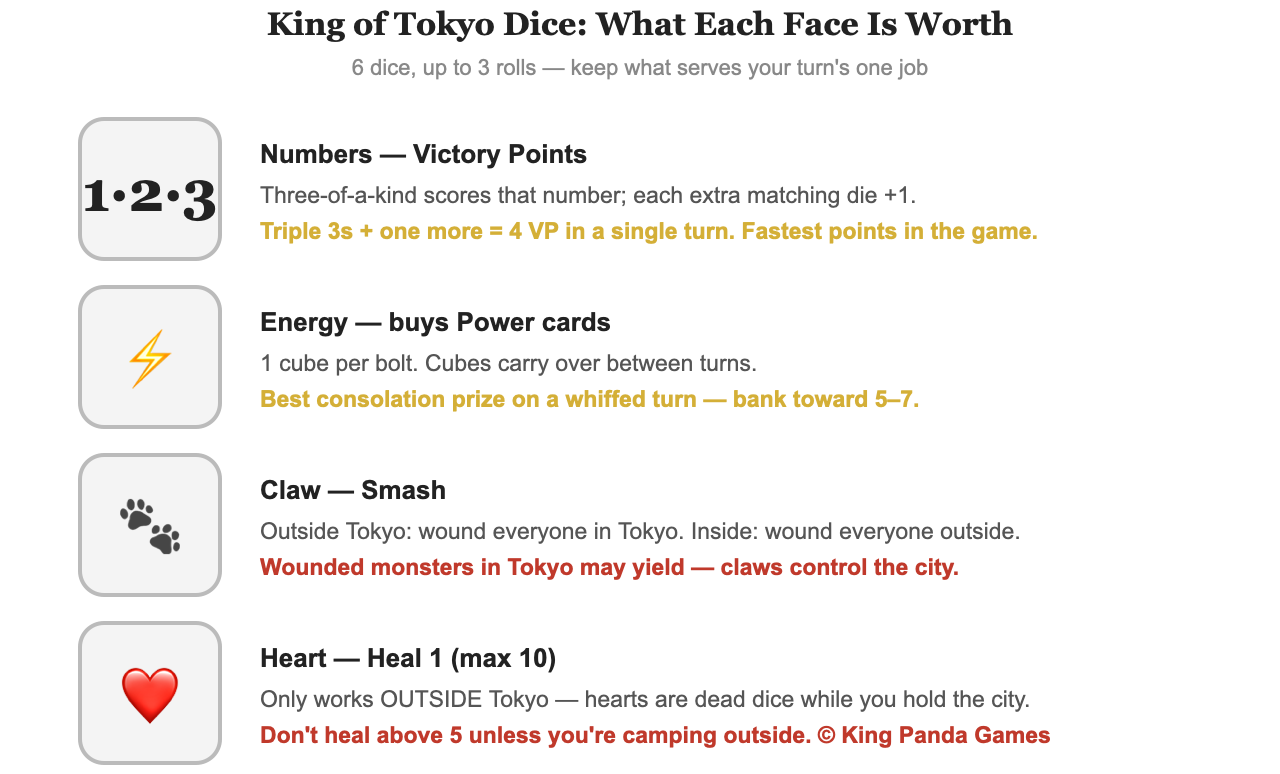
Every turn is Yahtzee with consequences. You roll six chunky black dice up to three times, keeping the faces you like: numbers score Victory Points, hearts heal, lightning bolts earn energy, and claws smash the other monsters. It lands at #14 on our best board games of 2026 list.
It’s your turn. Your buddy’s Gigazaur is sitting in Tokyo with 4 health left. You roll two claws, keep them, and reroll for more. Two more claws. Now the whole table leans in — if you take the last reroll and whiff, you’ve wasted the turn, but if even one more claw lands, Gigazaur has to decide whether to flee Tokyo or risk dying on your next attack. You roll. Claw. The table erupts.
The board is just one thing: Tokyo. Smash someone and you can take their place in the city. Being in Tokyo scores you points every turn — +1 for entering, +2 every turn you start there — but everyone outside is now aiming at you, and you can’t heal while you’re in there. That’s the whole game: greed versus survival.
First monster to 20 Victory Points wins. Or be the last monster alive — both paths are always live, which keeps aggressive players and point-farmers equally dangerous. Energy cubes buy Power cards (extra heads, poison breath, healing rays) that bend the rules in your favor.
That’s it. There’s no setup puzzle, no rules reference card, no “wait, what does this icon mean.” One demo turn and everyone at the table gets it.
A note on the scoring, because it’s cleverer than it looks: rolling three “2” faces scores 2 points, three “3”s score 3, and each extra matching die adds one more. So a fistful of 3s is the fastest point engine in the game — which means the table learns quickly to fear the player quietly keeping number dice while everyone else brawls. King of Tokyo hides a real push-your-luck engine under all the monster art.
At five or six players, a second spot opens: Tokyo Bay. Two monsters share the city, both earning bonus points, both getting hammered by everyone outside. It sounds like a small change, but it keeps big groups moving — there’s always a target, and half the table is always in danger.
What We Liked
Every roll matters to everyone. In most dice games you check out during other people’s turns. In King of Tokyo, every claw rolled by anyone might be aimed at you, so the whole table watches every roll. That’s rare, and it’s the reason this game generates more noise than anything else on our shelf.
The stay-or-yield decision never gets old. When you’re in Tokyo at 3 health and someone rolls claws, you have about five seconds to weigh two extra points per turn against dying — and there’s no correct answer. We’ve watched cautious players suddenly turn kamikaze because they were two points from winning, and it’s glorious.
Worth knowing: the dual win condition is doing more work than it looks like. Because you can win on points OR being last alive, nobody can fully ignore either race — and the leader is always the table’s shared enemy.
Power cards make each game feel different. Buying Extra Head (a seventh die) or It Has a Child (resurrect once) changes how your whole game plays. They’re the only “strategy layer” in the box, and it’s exactly the right amount for this weight of game.
The monsters have personality without needing lore. Cyber Kitty, Gigazaur, Space Penguin — kids pick a favorite instantly, and it matters exactly zero to gameplay, which is the correct design call for a game this light.
It scales down the ceremony of board gaming to nothing. Setup is ninety seconds: hand out monster boards, flip three cards, dump the dice on the table. There’s no board state to rebuild if you stop mid-game, no scores to track on paper — the dials on each monster board handle everything. For a weeknight game with tired kids or a party where people drift in and out, that frictionlessness is worth more than any clever mechanic.
The energy economy is a quiet second game. Watching a new player realize they can spend 2 energy to sweep away three bad Power cards and reveal fresh ones — then chain-buy two cards in one turn — is watching them discover the game has a market layer under the dice. Nobody needs it to have fun, but the players who want a little more always find it.
What We Disliked
- Player elimination is real. In a 5-player game, the first monster knocked out can sit watching for 10–15 minutes. Fine for adults refilling snacks, rough for an 8-year-old who just lost their dinosaur.
- Two-player games are flat. The Tokyo standoff needs a gang of monsters outside the city to feel threatening. Head-to-head, it turns into a slugging match with fewer decisions — even with the official 2-player variant rules.
- Dice can just hate you. It’s a dice game; sometimes you roll three turns of garbage while someone else three-of-a-kinds their way to 20. Anyone who needs to feel in control will get annoyed.
Our First Play (and Why It Sold Us)
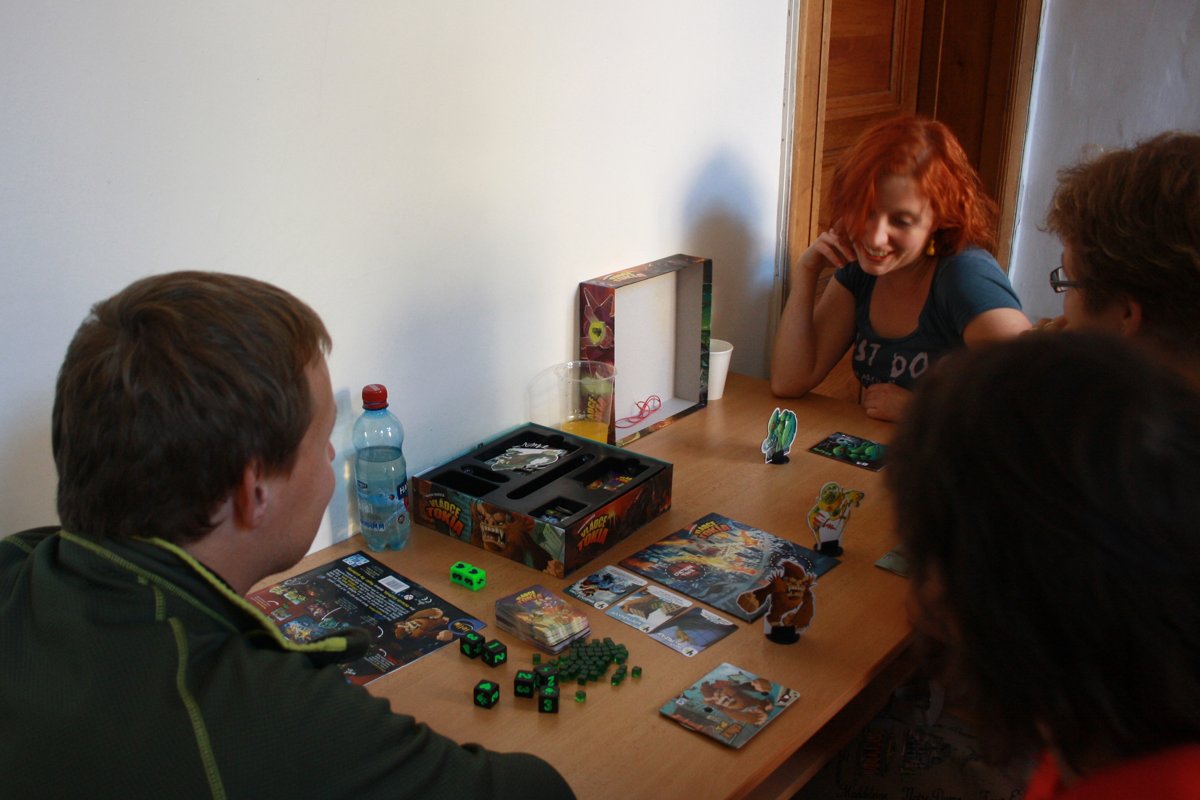
Our first game of King of Tokyo ended with a player winning at exactly 1 health — refusing to leave Tokyo for three straight turns while sitting on 16 points, daring the table to finish the job. Every player had claws. Nobody rolled enough of them. That monster hit 20 points and slammed the table hard enough to knock over the dice tray.
That game taught us what King of Tokyo actually is: a nerve contest wearing a dice game costume. The math says leave Tokyo; the glory says stay. Thirty-plus plays later, that tension hasn’t dulled — someone at our table still makes the “wrong” greedy choice almost every game, and it’s the story everyone retells afterward.
It also taught us the game’s honest limitation. The player eliminated first that night spent twelve minutes as a spectator, and no amount of monster charm fixes that. We now play elimination games back-to-back — lose fast, shuffle up, go again — and recommend every group do the same.
Who It’s For
King of Tokyo is for families with kids 8+, mixed groups of gamers and non-gamers, and anyone who wants a loud 30-minute opener or closer for game night. It’s the game we hand people who bounced off Catan because it felt like homework — there is no homework here.
It’s also a legitimately great “gateway drug” game. We’ve seen it pull teenagers off their phones, which is the highest praise a board game can earn in 2026. That is exactly why it sits at #2 on our best board games for teens list.
If your group already loves Codenames but wants something with dice and direct conflict instead of word puzzles, this is the natural next buy.
Who should skip this game
Skip King of Tokyo if you want meaningful long-term strategy — this is 80% dice luck and 20% nerve, and it never pretends otherwise. Heavy-game fans who need engine building or tight resource math will be bored by the second play. And if anyone in your group genuinely sulks when eliminated from a game, the knockout mechanic will cause problems at exactly the wrong moment.
Who Should Buy This?
Buy it — at around $40 (often $30 on sale), King of Tokyo is one of the best price-to-plays ratios in board gaming. A copy will hit the table hundreds of times over its life because it works with almost any group, any age mix, and any energy level.
This is a core-collection game, not a situational one. If you host game nights, own a copy; don’t wait to try it first. The only people who should borrow before buying are strict two-player households — play a few rounds at a friend’s place first, because the game is noticeably weaker at two.
Check King Of Tokyo price on Amazon →
Best Player Count
King of Tokyo is best at 4 or 5 players. The box says 2–6, but the game is built around one monster in Tokyo getting pounded by everyone outside — that pressure needs at least three attackers to feel dangerous, and four makes the stay-or-yield decision genuinely scary.
At 6 players, Tokyo Bay opens up and two monsters occupy the city, which is fun but adds downtime between your turns. At 3 it’s solid but the king of the hill gets a breather. At 2, even with the official variant (Tokyo grants energy instead of points), the standoff mostly evaporates — if you’re a two-player household, get 7 Wonders Duel instead.
Replayability
King of Tokyo stays fresh for years because the Power card market changes every game. One night you’re stacking attack cards and playing bully; the next, the cards on offer push you toward an energy engine or a healing turtle strategy. The core loop is identical every game, but your monster’s build never is.
The first ten games do blur together more than a deeper game’s would — this is a party game, and its replayability comes from the people at the table, not hidden depth. That’s not a flaw; it’s the job description.
The Power Up! expansion (monster-specific Evolution cards) is the one worth adding once your group hits 20+ plays. It gives each monster an actual identity and is the best $20 upgrade in the series.
Accessories & Upgrades
King of Tokyo has a healthy aftermarket, mostly because the cardboard monster standees beg to be upgraded.
- Monster figure packs / painted minis (Etsy, $15–40) — 3D monster figures instead of cardboard standees. Purely cosmetic, but kids love them.
- Broken Token / laser-cut box organizer ($20–30) — not necessary; the box is fine. Only worth it if you own multiple expansions.
- Power Up! expansion ($20) — the one purchase we actually recommend. Evolution cards give every monster unique powers, and it fixes the “all monsters play the same” flatness.
Check a King of Tokyo organizer price on Amazon →
Awards
King of Tokyo won the 2012 Origins Award for Best Family/Party Game and was a Golden Geek Best Party Game nominee. It’s Richard Garfield’s most successful design after Magic: The Gathering.
Similar Games
If you like Yahtzee, King of Tokyo is the upgrade you didn’t know existed — same roll-and-keep dice engine, but every roll interacts with other players instead of a private scorepad.
If you like Blood Rage, King of Tokyo is its 30-minute little brother — both scratch the “big monsters fighting” itch, but King of Tokyo swaps drafting and area control for pure dice-chucking chaos a third of the length.
If you like Zombie Dice, King of Tokyo is the fuller meal — both are push-your-luck dice games, but King of Tokyo adds the Tokyo standoff and Power cards, turning a filler into a main event.
King of New York is the sequel comparison everyone asks about — we break down which one to buy in our full comparison.
Tips & Tricks
Don’t fight over Tokyo early. The points for holding Tokyo matter most in the mid-game. In the first few rounds, let someone else take the city, chip them with claws, and bank energy — the monster who enters Tokyo first is usually the first one bloodied.
- On your first roll, decide your turn’s job — points, energy, or attack — and keep only dice that serve it. Splitting across all four faces is how you end turns with nothing.
- Buy at least one cheap Keep card before turn four. Even a minor engine (extra energy, +1 damage) compounds over a 30-minute game.
- Yield Tokyo at 4 health or less unless you’re within 5 points of winning. Dead monsters score zero.
What most players do: heal every time they’re hurt, because losing health feels bad.
What actually works: healing only below 5 health. Hearts spent at 8 health are wasted dice — that same roll could have been points or energy, and you can’t heal in Tokyo anyway.
One more from hard experience: track who’s at 15+ points out loud. The table’s job is to stop the leader, and games are lost because everyone kept smashing whoever was in Tokyo while the quiet monster outside farmed three-of-a-kinds to 20.
Frequently Asked Questions
Is King of Tokyo worth buying?
Yes — King of Tokyo is one of the best party board games you can own for a mixed group. It teaches in five minutes, plays in 30, and works with kids, adults, and non-gamers alike. At around $40, it earns its shelf space faster than almost anything else at this weight.
How long does a game of King of Tokyo take?
A typical game runs 30 minutes, and rarely past 45 even with six players. The box time is honest. Teaching adds about five minutes for a brand-new table.
Is King of Tokyo good for 2 players?
It’s playable but noticeably weaker at two, even with the official 2-player variant where Tokyo grants energy instead of points. The game’s tension comes from a crowd of monsters attacking whoever holds Tokyo, and that dynamic mostly disappears head-to-head. Two-player households should look at 7 Wonders Duel or Patchwork instead.
Can kids play King of Tokyo?
Yes — the box says 8+, and that’s accurate; many 6–7 year olds can play with light help reading Power cards. The one thing to manage is player elimination: a knocked-out kid may have to wait 10+ minutes for the game to end.
Why can’t I heal in Tokyo?
Heart dice do nothing while your monster is in Tokyo — that’s the core rule, not a house rule. It’s the cost of earning bonus points there, and it’s what forces the stay-or-yield decision. You can only heal in Tokyo through specific Power card effects.
When can you leave Tokyo?
You can only Yield Tokyo immediately after another monster wounds you with claw dice — you can’t just walk out on your own turn. Damage from Power cards doesn’t trigger a Yield either. This is the most commonly misplayed rule in the game.
Which King of Tokyo expansion should I get first?
Power Up! is the clear first pick. It adds monster-specific Evolution cards that give each monster unique powers, fixing the base game’s one soft spot — every monster playing identically. Halloween and the Monster Packs are fine but optional.
Is King of Tokyo or King of New York better?
King of Tokyo for most groups — it’s faster, simpler, and better with kids and non-gamers. King of New York adds buildings, military units, and more decisions, which suits groups who found Tokyo too simple. If you’re choosing your first one, choose Tokyo.
Want to go deeper?
- King of Tokyo Strategy: When to Stay in Tokyo (and When to Run) — the one decision that decides every game, broken down by health, points, and player count. Read it here
- The Best Power Cards in King of Tokyo, Ranked — the cards worth saving energy for and the traps that look better than they are. Read it here
- Is King of Tokyo Good for Kids and Families? — real ages, elimination workarounds, and how it compares to other family night picks. Read it here
- King of Tokyo vs. King of New York: Which Should You Buy? — the head-to-head, with a clear pick for every type of group. Read it here
Verdict
Buy it if you host game nights with any mix of ages or experience levels — King of Tokyo is a permanent-collection game that earns its spot in the first play. Skip it if your group only enjoys deep strategy or can’t handle player elimination. Try before you buy only if you’re a strict two-player household — the game’s best trick doesn’t work without a crowd.
King of Tokyo official site: https://iellogames.com/games/king-of-tokyo/
Official rulebook (PDF): Download it here