The short version: In For Sale, everyone bids coins on property cards numbered 1 to 30. Passing gets you the cheapest card on the table and half your bid back, rounded down. Then everyone sells their properties for checks in sealed reveals. Most money wins.
Lost the rulebook? Here are the official For Sale rules from IELLO, or browse official rulebooks for 49 games.
The rules below come from the Eagle-Gryphon rulebook in our own box, the 2017 English edition of Eagle-Gryphon’s For Sale. If you’re still deciding whether to buy it, our For Sale review covers who it’s for.
Some links below are Amazon affiliate links — as an Amazon Associate, King Panda Games earns from qualifying purchases at no extra cost to you. Full disclosure.
Setup by Player Count
| Players | Starting coins each | Cards removed (unseen) | Rounds per half |
|---|---|---|---|
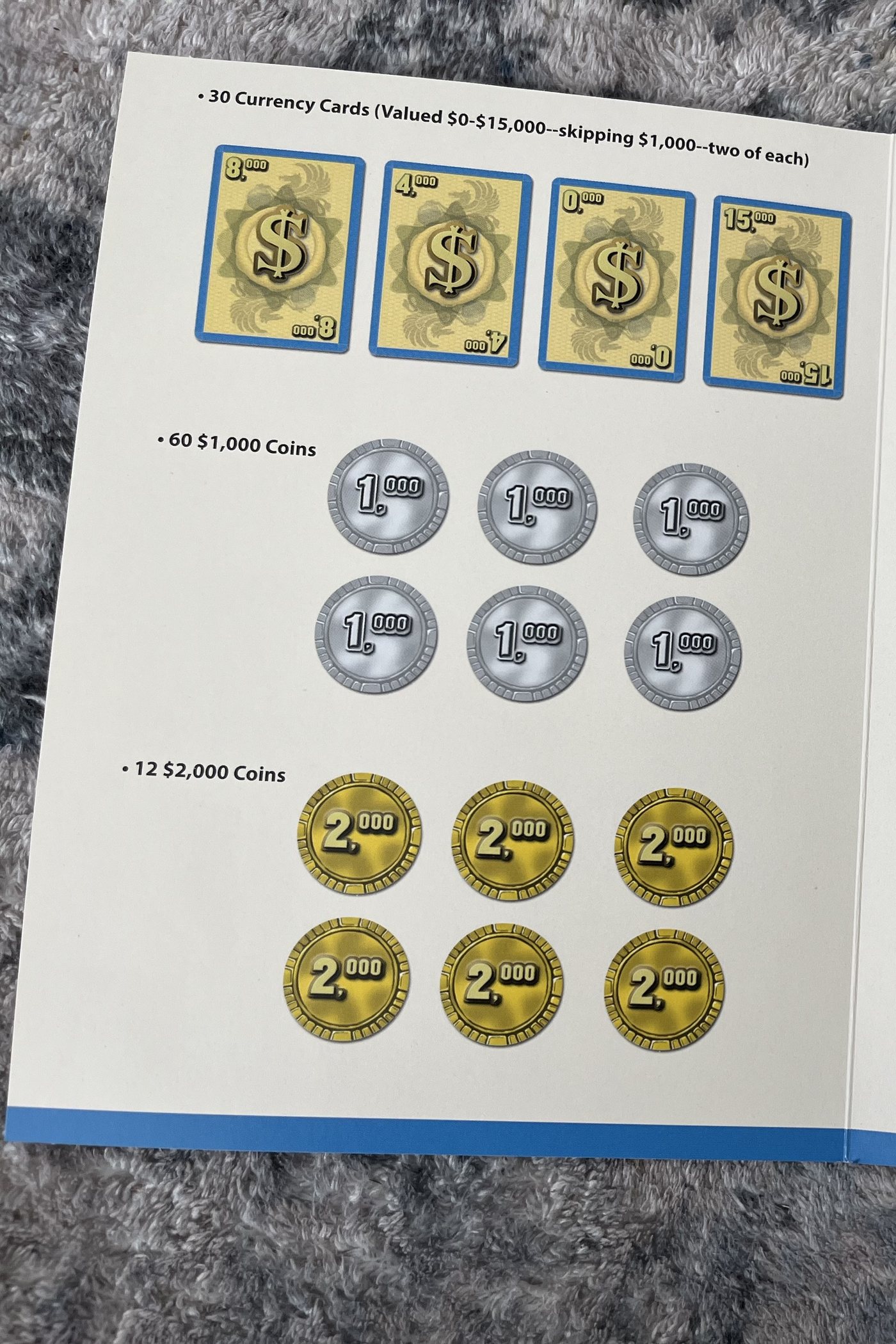
| 3 | $18,000 (two $2,000 + fourteen $1,000) | 6 property + 6 currency | 8 |
| 4 | $18,000 (two $2,000 + fourteen $1,000) | 2 property + 2 currency | 7 |
| 5 | $14,000 (two $2,000 + ten $1,000) | none | 6 |
| 6 | $14,000 (two $2,000 + ten $1,000) | none | 5 |
The starting money and the cards to remove are printed in the rulebook. We worked out the round counts from them: the remaining property cards divided by the number of players.
- Split the cards into the two decks: 30 property cards and 30 currency cards. Shuffle each.
- Remove cards for 3 or 4 players as the table shows, face down, and put them back in the box without looking.
- Set the currency deck aside. You won’t need it until the second half.
- Give each player their coins. Keep your money hidden, as the rulebook recommends.
What’s in the Box
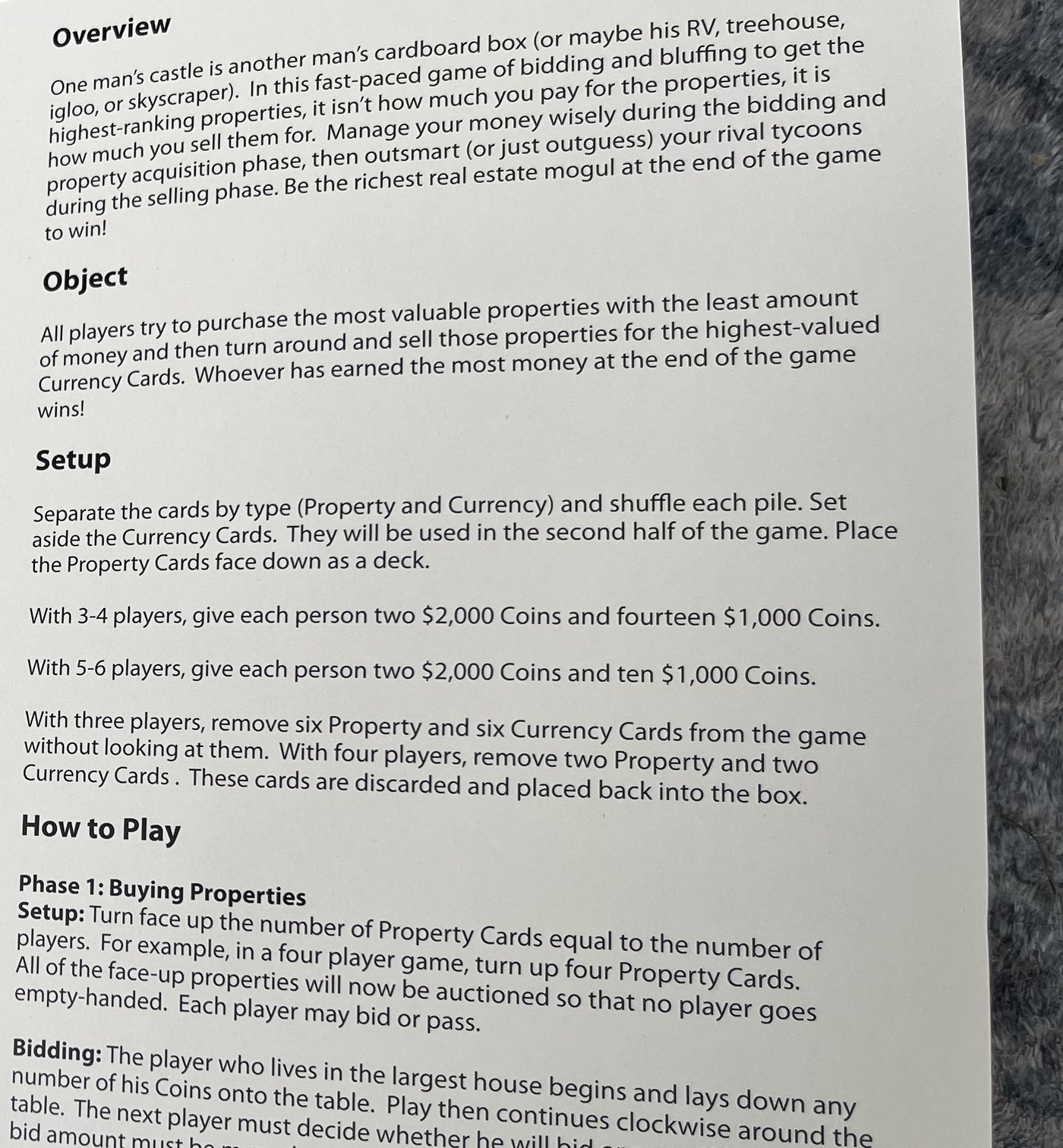
The box holds 30 property cards numbered 1 to 30, from a cardboard box at 1 up to a space station at 30. It also has 30 currency cards and 72 coins: 60 worth $1,000 and 12 worth $2,000.
The currency cards run from $0 to $15,000, two of each value, with no $1,000 check. That makes the full deck worth $238,000 in checks.
Phase 1 (Buying Properties)
Each round, turn up as many property cards as there are players. At four players, that’s four cards. Every card on the table will go to someone, so nobody leaves a round empty-handed.
The rulebook says the player who lives in the biggest house starts. That player bids any number of coins, putting them on the table. Going clockwise, each player either raises the bid or passes, and it keeps going around until everyone but one has passed.
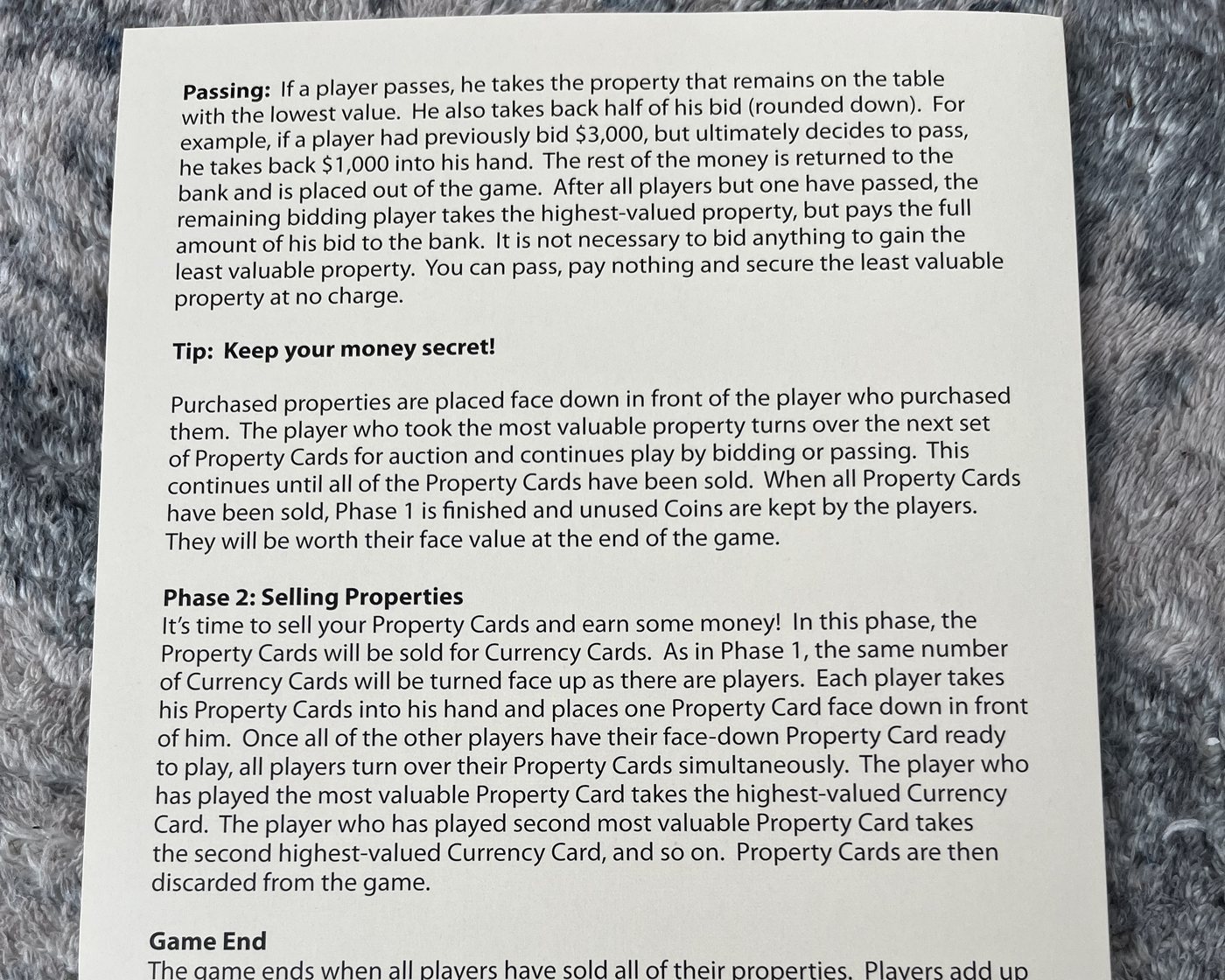
When you pass:
- you take the lowest property still on the table,
- you get back half your bid, rounded down, and
- the rest of your bid goes out of the game.
The last player still bidding takes the highest property and pays their full bid. They also turn up the next round’s cards and start the bidding.
You bid $3,000, then decide to pass. Half of $3,000 is $1,500, which rounds down to $1,000. You take $1,000 back, lose $2,000, and pick up the lowest card left on the table.
You never have to bid. Passing on your first turn costs nothing and gets you the cheapest property on the table for free.
Put the properties you buy face down in front of you. When every property has been bought, the first half is over. Keep your leftover coins, because they count toward your score at the end.
Phase 2 (Selling Properties)
Pick up all your property cards. Each round, turn up as many currency cards as there are players.
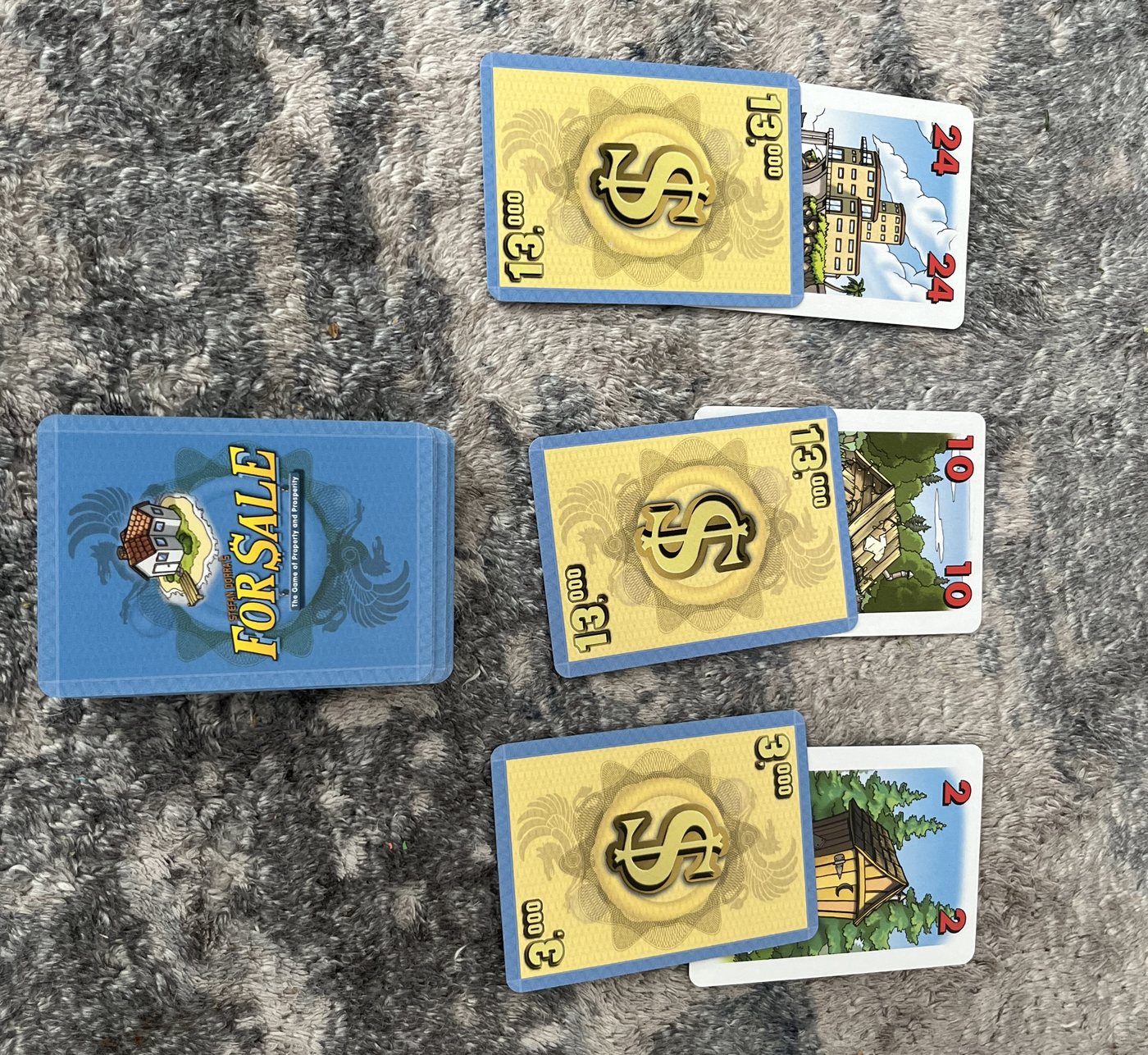
Every player chooses one property from their hand and puts it face down. When everyone is ready, reveal them together. The highest property takes the highest check, the second-highest takes the second check, and so on down to the lowest property, which takes the lowest check.
The sold properties go out of the game. Keep going until everyone has sold every property. There are never ties in this half, because every property card has a different number.
Scoring and Ties
Add up your checks and your leftover coins. The richest player wins.
If two players tie, the one with more coins left wins. That’s the only tie-breaker in the rulebook, and it’s one reason not to spend every coin in the first half.
Rules People Get Wrong
The common mix-up: rounding the refund up, so a $3,000 bid returns $2,000. Some older printings worded the rule differently, according to [For Sale’s BoardGameGeek page](https://boardgamegeek.com/boardgame/172/for-sale), so you’ll find both versions online.
What our rulebook says: Round down. A $3,000 bid returns $1,000. BoardGameGeek notes that rounding down is the rule designer Stefan Dorra prefers.
Two more rules worth checking at your table:
- The cards you remove at 3 or 4 players stay secret. Nobody looks at them, so nobody knows which properties or checks are missing.
- Every new bid has to be higher than the last one. You can’t match the current bid. You either beat it or pass.
For a bigger table, it’s one of our best games for groups, and it sits alongside other quick picks in our best card games. Buying a copy for your group? Get the standard For Sale card game from Eagle-Gryphon. Want to play better rather than just correctly? Our For Sale strategy guide works through the passing math and when to play your best property. To play online first, Board Game Arena has For Sale.
Check For Sale price on Amazon →
Frequently Asked Questions
How much money do you start with in For Sale?
With 3 or 4 players, each player starts with $18,000: two $2,000 coins and fourteen $1,000 coins. With 5 or 6 players, it’s $14,000: two $2,000 coins and ten $1,000 coins.
How many cards do you remove in For Sale with 3 players?
Remove six property cards and six currency cards without looking at them. That leaves 24 of each, which works out to eight rounds in each half.
What happens when you pass in For Sale?
You take the lowest property still on the table and get back half your bid, rounded down. The rest of your bid leaves the game. If you pass before bidding anything, you get the cheapest property for free.
Who goes first in For Sale?
The rulebook says the player who lives in the biggest house starts the first round. After that, whoever won the highest property turns up the next set of cards and starts the bidding.
Can you have negative money in For Sale?
No. You can only bid coins you have, so you can’t go below zero. Two of the currency cards are worth $0, so a property can sell for nothing, but you never lose money in the selling half.
Do coins count at the end of For Sale?
Yes. Leftover coins count at face value along with your checks. If two players tie, the one with more coins left wins.