Bottom Line
For Sale is best for groups of 3 to 6 who want a real decision every turn in a game that’s over in 20 minutes. Skip it if you play mostly as a couple, because it needs at least three. Its biggest strength is the two-phase design: you buy houses with coins, then sell them for checks, and the second half rewards what you did in the first. Its biggest weakness is that the theme is thin, so it plays like a clever card game with pictures of houses on it.
For Sale gets 4/5 Bamboo Plants and 4/5 Pandas from us. It’s one of the easiest bidding games to teach, and For Sale is the auction game we’d hand a family that has never played one.
The Bamboo is a 4 because the whole game is two short rules, one for each phase, and the only fiddly part is the refund you get when you pass. The Pandas are a 4 because the auctions create real tension in a small box, but the game stays light enough that nobody will still be talking about the plays the next day.
Some links below are Amazon affiliate links — as an Amazon Associate, King Panda Games earns from qualifying purchases at no extra cost to you. Full disclosure.
Check For Sale price on Amazon →
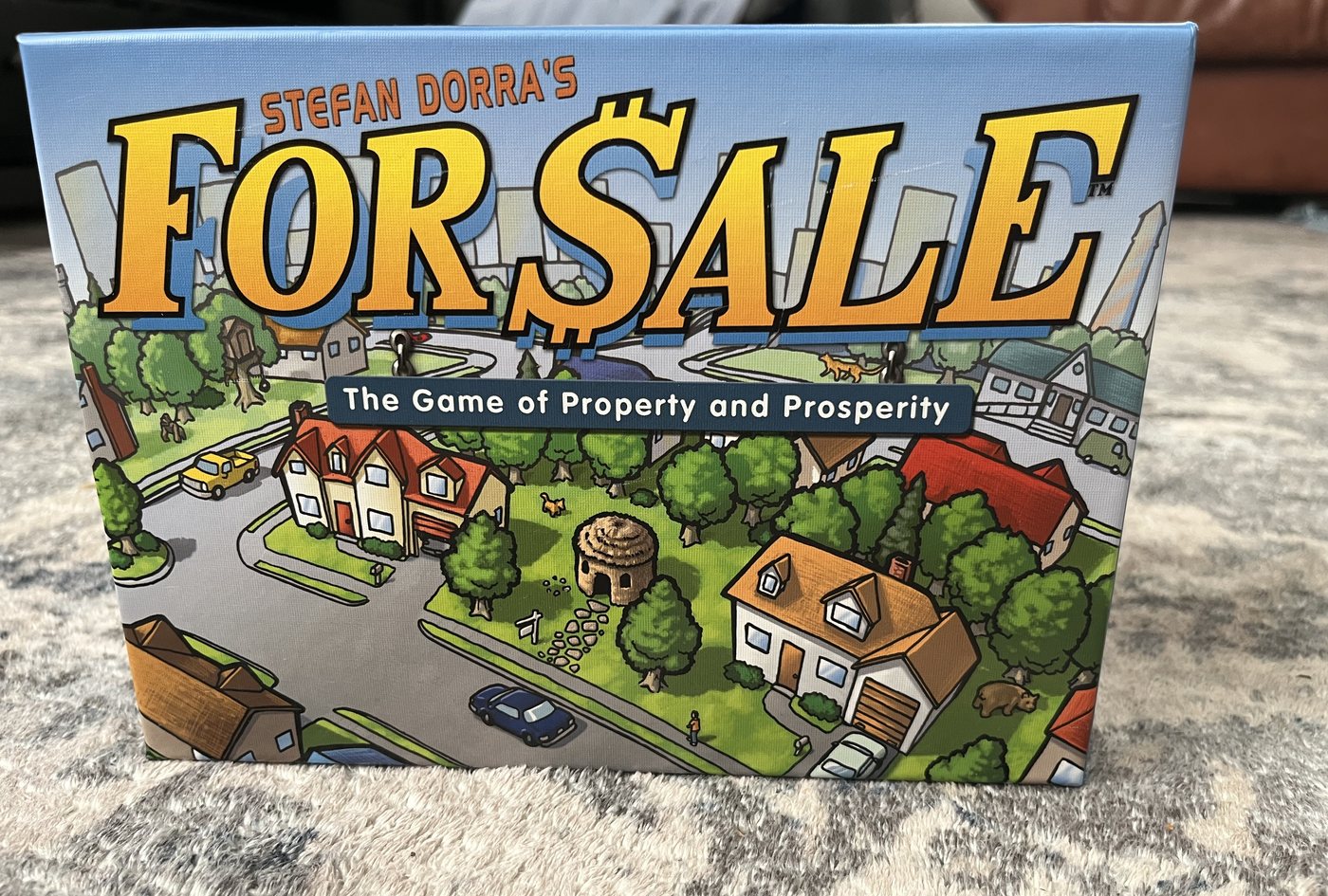
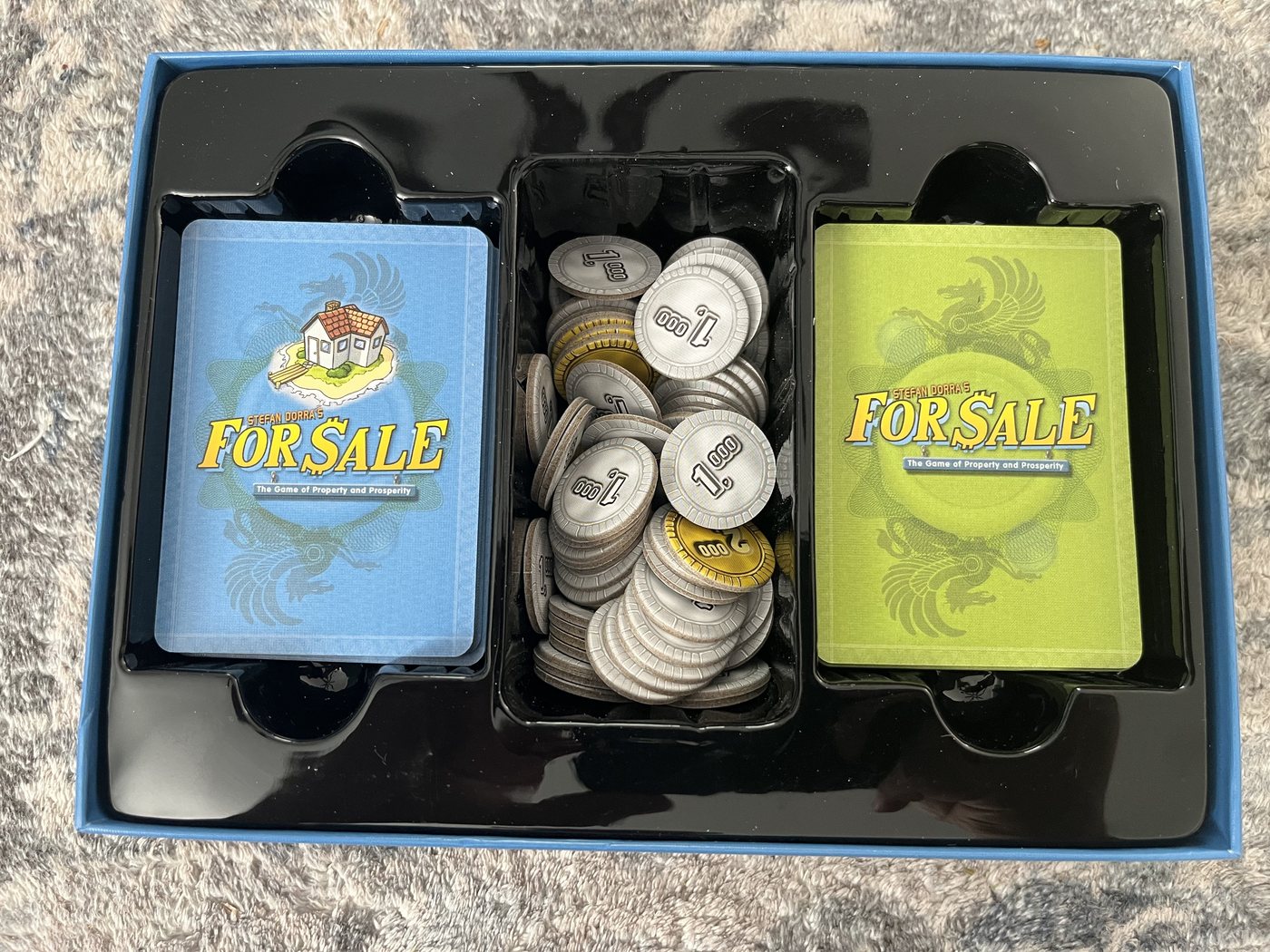
We own For Sale. Our copy is the Eagle-Gryphon English edition from 2017, second printing. The ratings are ours, and the rules, card counts and math in this review come from the rulebook in our box and our own arithmetic. We haven’t kept a play count, so we don’t quote one.
| Detail | Info |
|---|---|
| Players | 3–6 |
| Best Player Count | 5 — the full deck, no cards removed |
| Age | 8+ (our box) |
| Play time | 20–30 min |
| Complexity | Light |
| Solo Mode | No |
| Designer | Stefan Dorra |
| Publisher | Eagle-Gryphon Games |
| Popular Upgrades | No |
| Bamboo Plants | 4/5 — two phases, five-minute teach |
| Pandas | 4/5 — tense bids in a 20-minute box |
| Official site | Eagle-Gryphon’s For Sale page |
How For Sale Works
For Sale is a bidding card game in two halves. In the first half you spend coins to buy property cards numbered 1 to 30, from a cardboard box at 1 up to a space station at 30. In the second half you sell those properties for currency cards worth $0 to $15,000, and whoever ends with the most money wins.
Everyone starts with coins. At 3 or 4 players that’s $18,000 each, and at 5 or 6 it’s $14,000. Each round of the first half, you turn up one property card per player and auction them all at once. Players go around the table raising the bid or passing.
Passing is the clever part. When you drop out, you take the lowest property still on the table and get half your bid back, rounded down. The last player left takes the best property and pays the full bid. So nobody leaves a round empty-handed, and the question every turn is how much you’ll pay to stay in for the better card.
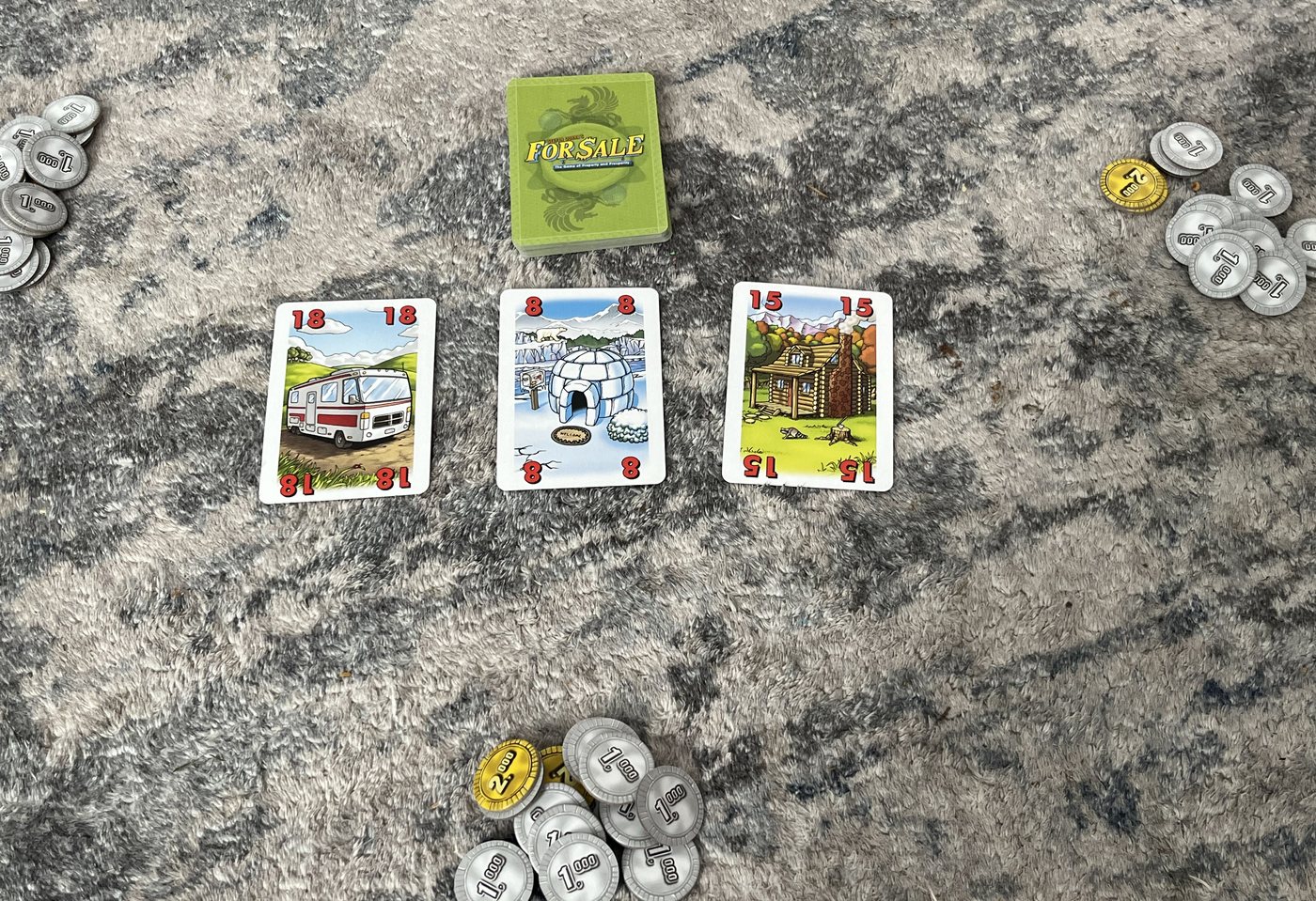
It’s a three-player round and the cards on the table are the 18, the 15 and the 8. You bid $2,000 to signal interest. The next player goes to $3,000, and you have to decide: chase the 18, or pass now, keep $1,000 of your bid and take the 8. Passing is cheap, but the 8 will lose almost every sale in the second half.
Once every property is sold, the second half starts. Currency cards go face up, one per player. Everyone picks a property from their hand and plays it face down, then all reveal at once. The highest property takes the highest check, the second-highest takes the second check, and so on down.
That reveal is where For Sale earns its reputation. Only the order of the properties matters, not the gap between them. A 10 that beats a 2 can take the same check as a 24.
What We Liked
The passing rule makes every bid a real decision. Most auction games have one painful choice per round: bid or don’t. For Sale adds a second one, because quitting early costs you half your bid and hands you the worst card. A $1,000 bid that you later abandon costs you the full $1,000, since half of it rounds down to zero.
The two halves feed each other. Your coins from the first half are worth their face value at the end, and a tie goes to the player with more coins left, so cheap properties are a real strategy rather than a consolation prize.
It fits more people than most small games. Plenty of quick card games top out at 4 or 5 players, and For Sale goes to 6, with everything for a table that size in the box: 30 property cards, 30 currency cards and 72 coins.
What We Disliked
- It needs three. There is no two-player mode in the rulebook, so couples should look elsewhere.
- The theme is thin. The houses, igloos and treehouses are fun to look at, but nothing about real estate changes how you play. It’s a numbers game.
- The second half has a luck spike. The currency deck has two $0 checks. If one turns up in a round where you play your weakest property, that card earns nothing at all, and you can’t do anything about it.
Who It’s For
For Sale fits families with kids around 8 and up, and friend groups who want a quick game between longer ones. The rules fit on two pages and the arithmetic stays in whole thousands, so younger players can keep up.
It’s also a good first auction game for anyone who has never played one. Passing always hands you a card and some of your bid back, so a new player can’t bid themselves into a hole the way they can in bigger bidding games.
It works as a warm-up or closer on a game night where something heavier is the main event. Twenty minutes is short enough to play twice.
Who should skip this game
Skip For Sale if you mostly play with two people, or if your group wants theme and story more than clean decisions. Players who dislike bluffing and reading the table will find the second half a guessing game.
Who Should Buy This?
Buy it if you have a regular group of three or more. Eagle-Gryphon lists the standard edition at $24.99, which is fair for a game this replayable. If you want it smaller still, there’s a travel edition.
It’s a core collection game for families and casual groups, and a situational one for heavier gamers, who will still pull it out as a filler. You don’t need to try it first, because the rules are simple enough that you’ll know within one game whether your group likes bidding.
If you want the original rather than a remake, get the standard For Sale card game from Eagle-Gryphon.
Check For Sale price on Amazon →
Best Player Count
Five is the best count for For Sale. At 5 and 6 players, nothing is removed from either deck, so all 30 properties and all 30 checks are in the game and you can track exactly which cards are left.
Five gets the edge over six because of the money. At 5 you play six rounds on $14,000, and at 6 you play only five rounds on the same $14,000, so six-player games end sooner and the coins matter less. BoardGameGeek’s community poll also picks 5 as the best count on For Sale’s BGG page.
Three is the weakest count. The rulebook has you remove six property and six currency cards without looking, so you never know whether the 30 or the $15,000 checks are in the game. Four removes only two of each, which is a small enough gap to plan around.
Replayability
For Sale has high replayability for a game this small. The order the properties come out changes every game, and so do the combinations each auction offers. One round might have the 28, 29 and 30 together, so somebody gets a top card cheaply.
The decisions also change with the table. A table of cautious bidders makes cheap properties scarce, and a table of aggressive bidders lets you collect checks with mid-value cards.
What doesn’t change is the shape of the game. Every game is the same two halves, so it rewards knowing the deck more than it surprises you. For more variety there’s the For Sale Advisors expansion and a standalone remake, For Sale Autorama, both from Eagle-Gryphon. We cover both in our edition guide.
Awards
For Sale was a finalist for the Lys Grand Public in 2016, and BoardGameGeek inducted it into its Hall of Fame in 2026, according to its BGG listing. The Dice Tower’s review covers it as a family game, and you can try it first on Board Game Arena.
Playing For Sale after Thanksgiving dinner? Our Thanksgiving Table Games pack has dinner bingo and 48 table-talk cards for the meal before it.
See it · $5
Want a game for every night of December, not just For Sale nights? The Advent Game Night Calendar has 24 five-minute games that use things you already own.
See it · $6
Bringing For Sale to Christmas? The Christmas Game Night Pack has 10 more party games that need no box.
See it · $7
Playing For Sale on New Year’s Eve? Our New Year’s Eve pack plans the rest of the night to midnight.
See it · $5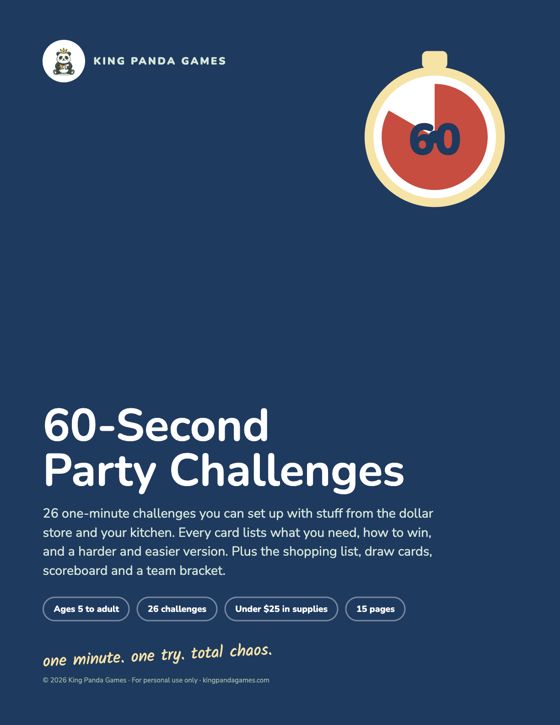
Hosting a For Sale night? 60-Second Party Challenges are 26 one-minute games to play between rounds.
See it · $6Similar Games
If you like 6 nimmt!, try For Sale. Both have everyone reveal a card at the same moment, but For Sale adds a buying half first, so you choose your own hand instead of being dealt it.
If you like Monopoly Deal, try For Sale. Both are quick property card games, but Monopoly Deal is about stealing from each other, and For Sale is about bidding and timing. Nobody can take a card you’ve bought.
If you like Coup, try For Sale for a bluffing game where nobody gets knocked out. In Coup you bluff about your cards. In For Sale you bluff with your bids, and everyone plays until the end.
For more quick picks for a bigger table, see our best games for groups and best card games.
Tips & Tricks
- Bid in even numbers if you might pass. The refund is half your bid rounded down, so bidding $2,000 and passing costs you $1,000, but bidding $3,000 and passing costs $2,000. An odd bid you abandon is the most expensive kind.
- Remember every property that goes up. All properties are auctioned face up, so by the second half you can know which numbers each player holds. That tells you when your 14 will beat everything else on the table.
- Buy the 1 to 5 cards for free when you can. Passing at once costs nothing and still gets you a property. You need low cards in the second half too, for the rounds where the checks are $0 and $2,000.
What most players do: Play their best property into the round with the biggest check, because it feels safe.
What actually works: Look at the gap between the checks. If the top two checks are $15,000 and $14,000, your second-best property can win almost as much, so save your best card for a round where the top check is far ahead of the rest.
Our For Sale strategy guide works through the math behind each of these.
Frequently Asked Questions
Is For Sale worth buying?
Yes, for any group of three or more. It teaches in five minutes, plays in about 20, and every round asks a real question about how much to pay. At a $24.99 list price it’s one of the best-value small games for families and casual groups.
Can you play For Sale with 2 players?
No. The rulebook covers 3 to 6 players and has no two-player mode. The auctions need at least three bidders, because passing early hands you the worst of the remaining cards.
How long does a game of For Sale take?
The box says 20 to 30 minutes. Larger groups play fewer rounds, five at six players against eight at three, so the length stays about the same at every player count.
What age is For Sale for?
Our Eagle-Gryphon box says 8 and up, and BoardGameGeek lists 10 and up. All the money is in whole thousands, so a child who can compare numbers to 30 can play the selling half.
Do you round up or down when you pass in For Sale?
Down. When you pass, you get back half your bid rounded down, so a $3,000 bid returns $1,000. Our Eagle-Gryphon rulebook says this, and BoardGameGeek notes it’s the rule designer Stefan Dorra prefers. Some older printings worded it differently.
What happens if there’s a tie in For Sale?
The player with the most coins left wins. Ties can’t happen in the second half, because every property card has a different number from 1 to 30.
Is For Sale like Monopoly?
Only in theme. For Sale has no board, no dice and no rent. It’s a bidding game where you buy property cards and then sell them, and a game takes about 20 minutes.
Want to go deeper?
- How to Play For Sale (Setup for 3 to 6 Players) — the rules in order, with the starting money and cards to remove at every player count. Read it here
- For Sale Strategy (How to Win Both Phases) — the passing math, what your coins are really worth, and how to time your best property. Read it here
- For Sale Editions Ranked (Which One to Buy) — the standard edition, the travel box, Autorama and the Advisors expansion, and which to buy. Read it here
Verdict
Buy it if you have three or more players and want a 20-minute game that still asks real questions. Skip it if you play mostly as a couple or want a game with a strong theme. Try before you buy only if your group has never enjoyed a bidding game, because For Sale won’t change their minds.
For Sale official site: Eagle-Gryphon Games