

Phase 10 is the better game for most families. We rate it 4/5 Pandas against 2/5 for Uno, because Phase 10 gives you a hand to build and choices to make. Buy Uno if you need to seat seven to ten players or want rounds that end in a few minutes.
Some links below are Amazon affiliate links — as an Amazon Associate, King Panda Games earns from qualifying purchases at no extra cost to you. Full disclosure.
Both games are made by Mattel, both use a deck of colored number cards, and both list at $6.49. That’s where the similarity ends.
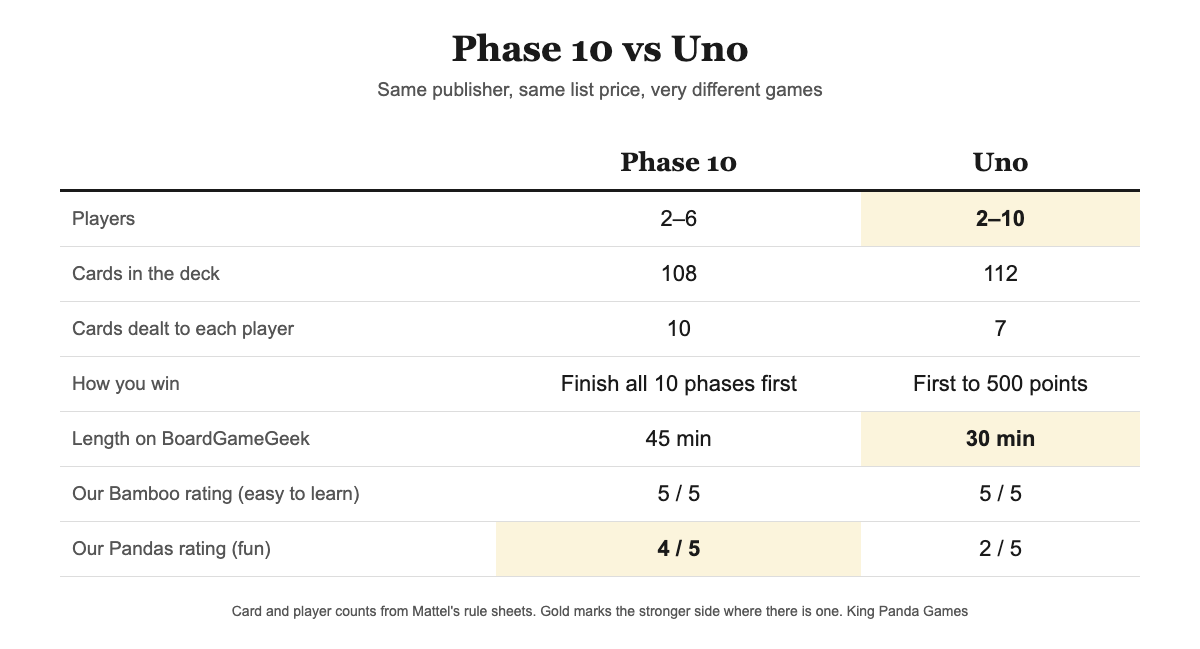
| Phase 10 | Uno | |
|---|---|---|
| Created | 1982, Kenneth Johnson | 1971, Merle Robbins |
| Cards | 108 | 112 |
| Players | 2–6 | 2–10 |
| Age | 7+ | 7+ |
| Goal | Complete 10 phases in order | Empty your hand; first to 500 points |
| Hand size | 10 cards | 7 cards |
| Scoring | Low is good, and points only break ties | High is good: the winner scores what’s left in other hands |
| Play time on BoardGameGeek | 45 min | 30 min |
| Mattel list price | $6.49 | $6.49 |
| Our Bamboo rating (easy to learn) | 5/5 | 5/5 |
| Our Pandas rating (fun) | 4/5 | 2/5 |
Card counts and player counts come from Mattel’s rule sheets for Phase 10 and Uno.
How the Two Games Actually Differ
In Uno you get rid of cards. In Phase 10 you collect them. That one difference changes everything about how a turn feels.
An Uno turn is a match: play a card that shares a color or number with the top of the pile, or draw. If you have one playable card, there’s no decision to make.
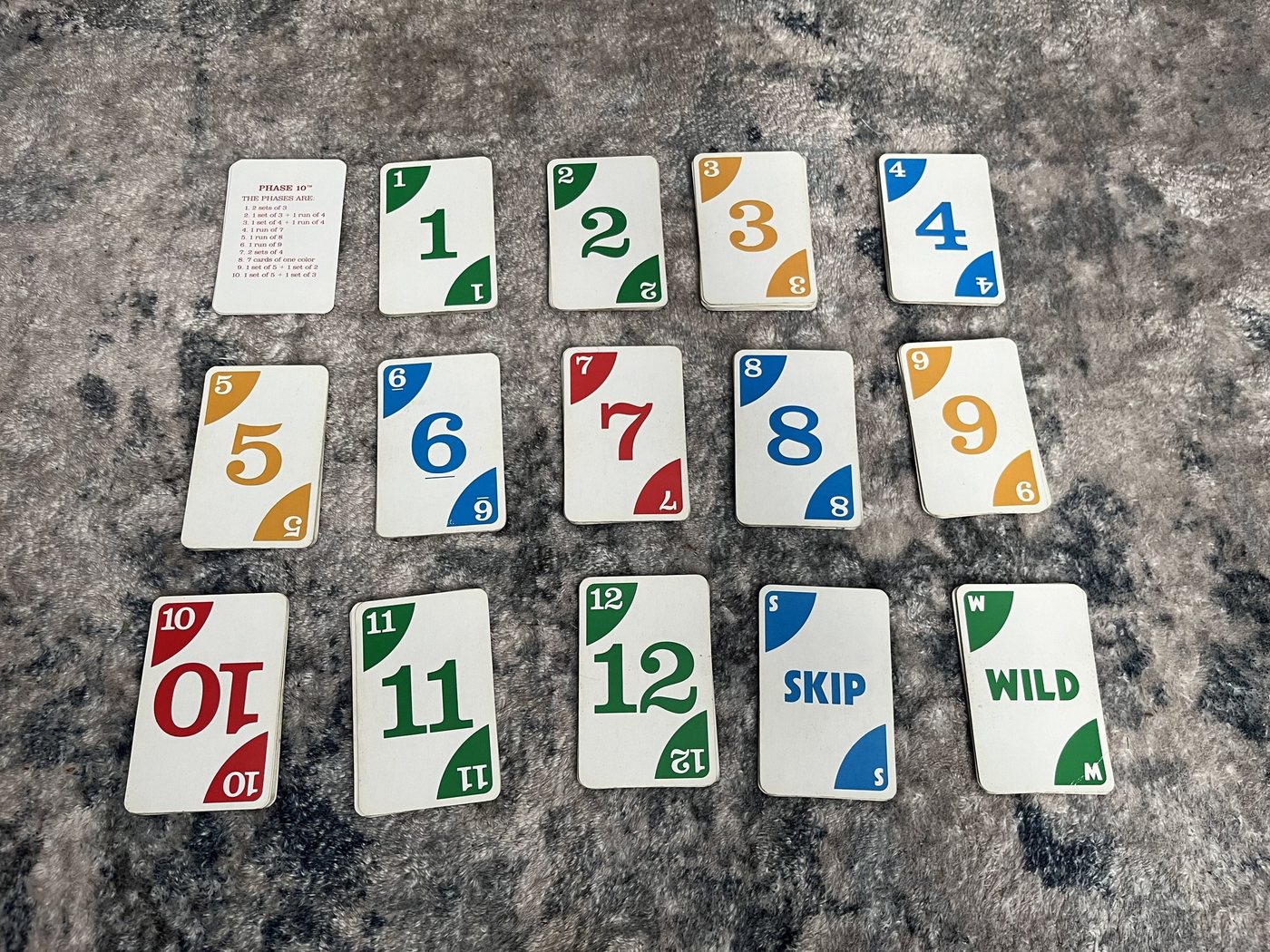
A Phase 10 turn has more to it. You draw from either the deck or the discard pile, and then you choose what to throw away. You’re holding ten cards and working toward a specific goal, like a run of seven or two sets of four.
Phase 10 is a rummy game wearing Uno’s colors. Mattel’s own product page calls it “a rummy-type card game.”
Check Phase 10 price on Amazon →
Which Is Easier to Learn?
“Is Phase 10 harder than Uno?” Slightly, and not enough to matter. We give both 5/5 Bamboo.
Uno is the easier of the two. Match a color or a number, and say “Uno” at one card. Most people already know it.
Phase 10 adds two ideas: sets (same number) and runs (numbers in order). The ten phases are printed on a reference card, so you only ever need to read one line. Both boxes say ages 7 and up.
Which Is Better for Big Groups?
Uno wins on player count, and it isn’t close. Uno seats 2 to 10. Phase 10 stops at 6.
The common assumption: any deck of cards can stretch to fit however many people show up.
What the boxes say: Phase 10 deals 10 cards each from a 108-card deck, so six players already use 60 cards before the first turn. Uno deals 7 each from 112, so ten players use 70.
For a party of eight, Uno is the only one of the two that works. If you regularly host that many, our best games for groups list has stronger options than either.
Which Takes Longer?
Phase 10 is the longer game. A full game is at least ten rounds, because someone has to complete all ten phases, and players repeat any phase they miss.
A single Uno round is short. Uno’s official rules play to 500 points across many rounds, but each round stands alone, so you can stop after any of them. Our Uno house rules guide covers how people actually play it.
Worth knowing: Phase 10’s rules include two shorter variants. You can play exactly ten rounds with everyone moving up a phase each time, or agree to stop after five or seven phases.
So if you have 15 minutes, play Uno. If you have an evening, play Phase 10.
Which Is More Fun?
Phase 10, and it’s the reason we’d tell most families to buy it first.
We’ve played Phase 10 more than 100 times, and it’s a staple when we go camping. Every round has a target, and you can see your own progress up the ladder.
Our Uno review gives Uno 2/5 Pandas. The short version: your turns are mostly decided by what you draw. Phase 10 has plenty of luck too, but choosing what to keep and what to discard is a real choice every turn.
Phase 10 has one weakness Uno doesn’t. A player who misses a phase falls behind and can stay there. In Uno, every round is a fresh start.
So Which Should You Buy?
- Most families of 2 to 6: Phase 10.
- Groups of 7 to 10: Uno.
- Kids who are just learning colors and numbers: Uno first, Phase 10 a little later.
- You want a short filler game: Uno.
- You already own Uno and want a step up: Phase 10.
At $6.49 each, owning both is reasonable. They don’t replace each other.
If you want a third option, Five Crowns sits between them: rummy-style like Phase 10, with no fixed phases to get stuck on. See Five Crowns vs Phase 10, or read our full Phase 10 review. If you mostly play with two, Skip-Bo vs Phase 10 vs Uno adds Mattel’s third card game to the comparison.
Frequently Asked Questions
Is Phase 10 better than Uno?
For most families, yes. We rate Phase 10 4/5 Pandas and Uno 2/5, because Phase 10 gives players more choices each turn. Uno is better for groups of seven to ten and for very short games.
Are Phase 10 and Uno made by the same company?
Yes. Mattel publishes both. Uno was created by Merle Robbins in 1971 and Phase 10 by Kenneth Johnson in 1982, and Mattel acquired each of them later.
Can you play Phase 10 with Uno cards?
Not properly. Phase 10 needs numbers 1 to 12 with two of each number in every color, plus eight Wilds. An Uno deck only runs 0 to 9, with no 10s, 11s or 12s, so you’d have to change the phases.
Which game is easier for young kids, Phase 10 or Uno?
Uno. Matching a color or a number is simpler than building sets and runs. Both boxes are rated 7 and up.
How many players can play Phase 10 and Uno?
Phase 10 plays 2 to 6. Uno plays 2 to 10. For seven or more players, Uno is the only one of the two that works out of the box.
Which is the best-selling card game, Phase 10 or Uno?
Uno. The Strong National Museum of Play describes Phase 10 as one of the world’s bestselling card games, second only to Uno.