

Best Sushi Go Party! Menus (And How to Build Your Own)
Party Sampler is the best menu in the box, Master Menu is the one to graduate to, and the fastest way to ruin a game of Sushi Go Party! is to build a custom menu full of dishes that don’t fight each other. The menu system is what makes this game worth twice the price of the original tin — here’s how to use it properly. Playing it at a friend’s and want your own? Sushi Go Party! is the box every menu on this page comes from.
Some links below are Amazon affiliate links — as an Amazon Associate, King Panda Games earns from qualifying purchases at no extra cost to you. Full disclosure.
How Menus Actually Work
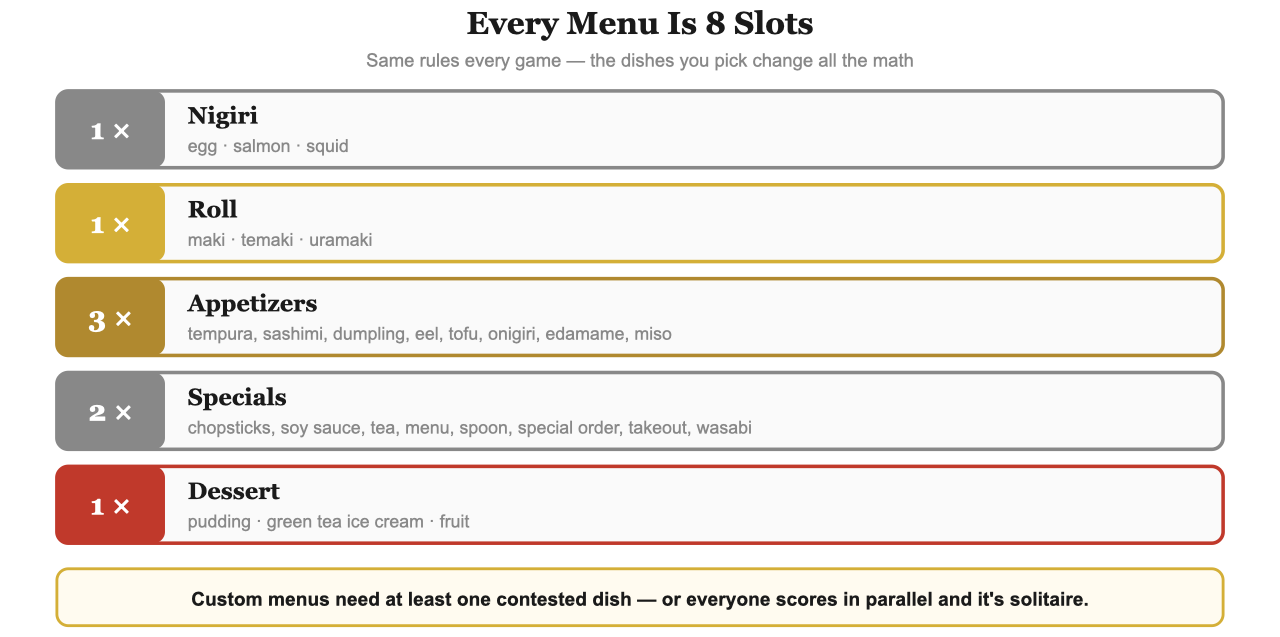
Every game uses exactly eight slots: one nigiri type, one roll type, three appetizers, two specials, and one dessert. You pick which dishes fill them, place the matching menu tiles on the board so everyone can see what’s in play, and shuffle those card sets into the deck.
The rules never change. The decisions completely do — a menu with temaki and uramaki produces constant racing and blocking, while one built on tempura and dumplings is a quiet collection game. What wins moves with the menu, which is why our Sushi Go Party! strategy guide adjusts its advice dish by dish.
The Four Preset Menus, Ranked
1. Party Sampler — the best default. It showcases the dishes that don’t exist in the original game, and the mix has enough interaction that every card matters without overwhelming anyone. If you’re playing with people who’ve seen the game once, start here.
2. Master Menu — the thinking version, and the one experienced groups should live in. More conditional scoring, more ways to punish greedy drafting, and the tightest games we’ve played.
3. Sushi Go! — the original lineup, faithfully reproduced. It’s a fine menu and it’s nostalgic, but if this is the menu you always choose, you bought the deluxe box for nothing. That is the whole argument in Sushi Go vs Sushi Go Party! — if the tin’s dish list is all you want, the tin is cheaper and fits in a pocket.
4. My First Meal — deliberately gentle, and correct for exactly its stated purpose: teaching kids or total beginners. Everything scores simply, nothing punishes, and games are low-drama. Graduate away from it after two plays.
Worth knowing: the presets exist because the designers balanced them. A group that free-builds on night one will usually produce a worse game than any of these four — earn your way to custom menus.
Building a Custom Menu That Doesn’t Fall Flat
The failure mode is a menu where everyone can score in parallel without ever competing. Avoid it by making sure your eight slots include tension:
- Pick at least one contested dish — maki, temaki, or uramaki. These create direct competition because only the leaders score.
- Pick at least one escalating set — dumplings, sashimi, or tempura — so players have something to commit to.
- Pick at most one “wasted if unused” special — chopsticks, spoon, and menu all score zero if unplayed, and a menu stacked with them feels punishing.
- Consider your dessert last, and know it shapes the endgame: pudding creates a game-long side battle, green tea ice cream rewards heavy collection, fruit punishes spreading thin.
A menu of salmon nigiri, maki, tempura, dumplings, edamame, chopsticks, wasabi, and pudding plays beautifully: maki forces competition, dumplings and tempura reward commitment, edamame rewards the crowd, wasabi creates timing decisions, and pudding hangs over the whole game. Swap maki for a second appetizer and the same menu becomes solitaire.
Menus for Specific Groups
What should you play with eight people at a party?
Keep it simple and contested. With eight players, hands cycle far and planning gives way to grabbing, so choose dishes that score on quantity rather than precise combinations — maki, dumplings, edamame, pudding. Save the conditional specials for smaller tables. (Remember to flip the maki tile to its 6–8 player side, which scores 6/4/2 instead of 6/3.)
For two players, lean into the specials. Special order and spoon add decisions the thin draft can’t provide on its own — and note that special order is only legal in 2–6 player games.
For kids, My First Meal exists for a reason, but the better long-term move is a custom menu with dumplings (which reward every single card), nigiri, and green tea ice cream. Nothing scores negative, so nobody goes backward.
For cutthroat groups, stack the punishing dishes: temaki (fewest loses 4), eel (one is −3), tofu (three or more is 0), pudding (fewest loses 6). It’s a mean, excellent game.
The Setup Tax, and How to Beat It
Building a menu means pulling specific card sets from the box and finding eight matching tiles — a few minutes before a twenty-minute game. The fix used by every group we know: once you find a menu you love, band those card sets together with the tiles and keep them as a unit. Setup drops to under a minute.
That’s also the honest downside of the menu system, and it’s covered in our full Sushi Go Party! review. For exactly what each dish pays, see our complete scoring reference, and the official rulebook lists every menu tile if you want to plan before your next game night.
Frequently Asked Questions
What is the best menu in Sushi Go Party!?
Party Sampler for most groups — it showcases the new dishes with good interaction and balanced scoring. Master Menu is the best choice once your group knows the cards, and My First Meal is right for kids or absolute beginners.
How many cards go into a Sushi Go Party! menu?
Eight slots: one nigiri type, one roll type, three appetizers, two specials, and one dessert. You place the matching menu tiles on the board so everyone can see what’s in play and how each dish scores.
Can you make your own menu in Sushi Go Party!?
Yes, and it’s the main appeal of the deluxe edition. Just make sure to include at least one contested dish like maki or temaki, or players score in parallel and the game becomes solitaire.
What’s the best Sushi Go Party! menu for kids?
My First Meal is the built-in answer, or build a custom menu around dumplings, nigiri, and green tea ice cream — dishes that reward every card collected and never score negative points.
What’s the best menu for a big group?
Choose quantity-based dishes like maki, dumplings, edamame, and pudding, and skip conditional specials. With seven or eight players hands cycle too far for precise combination planning, and remember to flip the maki tile to its 6–8 player side.
Should beginners build a custom menu?
No — start with the presets. The four included menus are balanced by design, while a first custom build usually ends up with too little competition between players and a flat game.
Try this next game night: play Party Sampler once, then rebuild it swapping only the dessert. It’s the clearest way to feel how much one slot changes the whole table.