

Scythe Strategy: Economy Wins, Combat Finishes
Count the coins at the end of any Scythe game and the story is almost always the same: the winner made their money on production and popularity, and used combat — if at all — only to control when the game ended. That’s the whole strategic frame. Economy wins, combat finishes. Everything below is that one idea applied to each phase of the game. If you are still learning the rules, read our take on Scythe for beginners first and come back after a game or two.
Some links below are Amazon affiliate links — as an Amazon Associate, King Panda Games earns from qualifying purchases at no extra cost to you. Full disclosure.
The Opening: Workers Before Everything
Your first four turns should be about getting workers on villages and resources flowing, even though it feels passive. Production scales with workers, workers come from producing on villages, and that compounding loop is the only exponential curve in the game — mechs and buildings are one-time purchases, workers are an engine.
The catch that keeps this honest: each batch of new workers makes your Produce action permanently more expensive — first power, then popularity, then coins. So the real opening question is when to stop. Six workers by mid-game is comfortable; the eighth worker is usually a late pickup you time for its star, not its labor.
The rule: if you haven’t produced twice by turn four, you’re behind — and no amount of clever combat later will out-earn the worker you didn’t make on turn two.
The Midgame: Buy Your Discounts First
Upgrades outperform every other bottom-row action per coin spent, because they pay twice: each one improves a top-row action and cheapens a future bottom-row purchase. An upgrade bought on turn six discounts everything after it; the same upgrade on turn sixteen discounts nothing.
It’s mid-game. You have three oil and a choice: Upgrade now, or save toward the mech you want in two turns. Upgrade first — if it’s the one that drops your Deploy cost, the mech you wanted just got cheaper, and every action between now and the end of the game runs on the improved rate. Sequencing beats saving in Scythe, every time.
Meanwhile, watch your popularity tier like a second scoreboard. The jumps that matter are 6→7 and 13→14 — each one moves every star, territory, and resource pair you own up a payout bracket ($3/$2/$1 → $4/$3/$2 → $5/$4/$3). A single Trade action that crosses a tier boundary is routinely worth $8–12 at scoring, which makes it the most profitable “boring” move in the game.
Combat: Win By One, Lose On Purpose
How much should you commit to a fight you’ve decided to take?
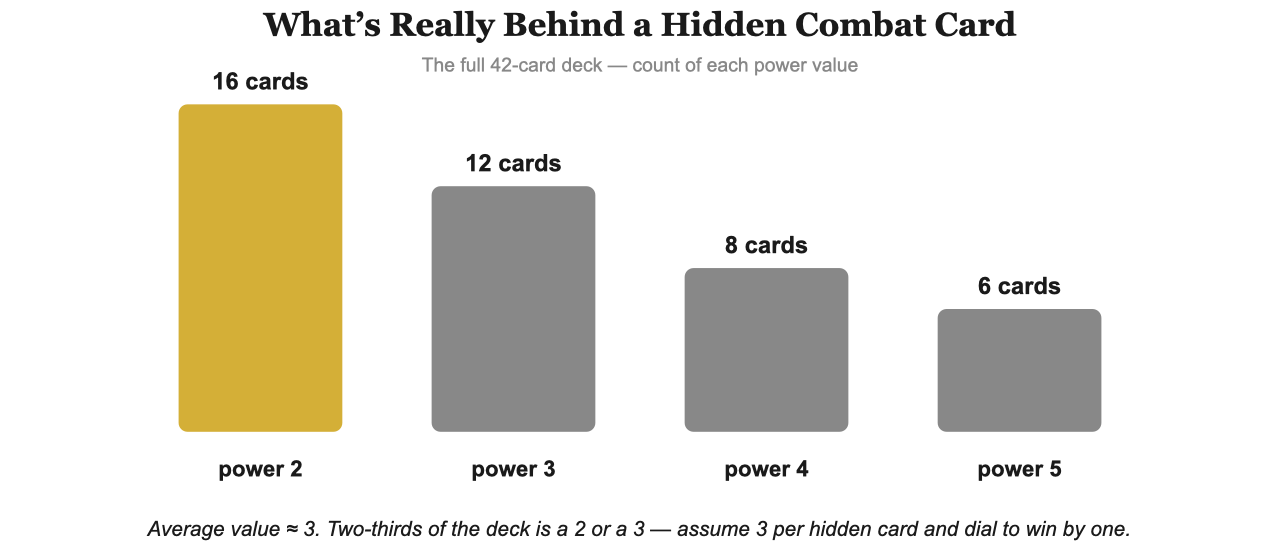
Exactly enough to win by one, and the combat deck’s math tells you what that means. The deck is 42 cards: sixteen 2s, twelve 3s, eight 4s, six 5s. Average card value is barely over 3 — so a defender with two units and two unknown cards is threatening about 6 extra power on average, not the 10 your imagination suggests. Dial accordingly; overkill is money you set on fire, because spent power is gone whether you needed it or not.
The other half of combat strategy is losing well. The loser of a fight draws a combat card, keeps their spent power off the table for the next fight’s math, and retreats — which sometimes just repositions them for free. Feeding a fight you can’t win with a 0-power dial while banking cards is a real line of play, and it’s how experienced players treat aggressive neighbors: expensive to chase, cheap to survive.
One exception to combat minimalism deserves its own sentence: combat wins are stars, capped at two, and they’re the fastest stars in the game for a player whose economy already peaked — Saxony especially, since their cap is removed.
The Endgame: Play the Clock, Not the Board
From the moment anyone has four stars, Scythe stops being an economy game and becomes a timing game. The sixth star ends everything instantly — there is no final round, no last turn for the table. The winner is very often the player who ended the game, not the player with the best board.
So run this checklist every turn from four stars onward:
- If the game ended right now, do I win? If yes, sprint to star six by the shortest path — even an “inefficient” one.
- If no, what’s my coin gap, and does one popularity tier jump close it?
- Who else can reach six stars, and in how many turns? Their clock is your deadline, not your engine’s schedule.
- Is there a fight I can decline by moving now? The cheapest combat is the one that never happens.
That fourth question is where territory finally matters: the Factory hex counts as three territories at scoring, so ending the game while sitting on it is a quiet $6–9 bonus that never shows up until the count.
Match the Strategy to Your Mat
All of the above bends around one thing: your player mat’s pairings, which decide what’s cheap for you this game. Industrial and Innovative mats want the upgrade-first engine line hard; an Agricultural mat’s cheap Enlist wants recruits earlier than this guide suggests. Read the mat, find your discounted bottom action, and treat its top-row partner as your default turn. The deeper pairing math is a rabbit hole the BGG strategy forums have mapped exhaustively — and the official rules and reference PDFs are worth a skim before you trust any guide, including this one.
Don’t own Scythe yet? This guide assumes the base game.
Check Scythe price on Amazon →
Frequently Asked Questions
What is the best strategy in Scythe?
Build economy first: expand workers early, buy upgrades before mechs, and climb popularity tiers before the game ends. Combat should control timing — who ends the game and when — rather than being a goal in itself.
Should you fight early in Scythe?
Almost never. Early fights spend power and popularity you need for your engine, and the winner often loses popularity for chasing off workers. Fights become worthwhile in the last third of the game, when stars and territory control convert directly to points.
How much power should I use in Scythe combat?
Enough to win by one, based on the visible information. The combat deck averages just over 3 per card, so estimate an opponent’s hidden strength at about 3 per card they can play, add their dial maximum only if they can afford it, and don’t pay for overkill.
Is popularity important in Scythe?
It’s the most important number on the board at game end. Popularity sets the payout bracket for every star, territory, and resource pair you own — crossing from 6 to 7 or 13 to 14 popularity frequently swings final scores by $10 or more.
When should you end the game in Scythe?
The moment you’re ahead on coins, even if your engine has more to give. The sixth star ends the game instantly with no final round, so a “premature” ending that locks in your lead beats a perfect engine that hands someone else two more turns.
What’s the biggest strategy mistake new Scythe players make?
Playing it like a war game — building an army instead of an economy. The players who spend their early turns producing and upgrading consistently finish $20–30 ahead of the players who spent those turns posturing with mechs.
Still deciding if the game rewards all this thinking? Our full Scythe review is the short answer — and if you’re choosing who to pilot first, start with the faction rankings. First move at your next game: read your mat, find the discounted bottom action, and build your first four turns around its top-row partner.