

How to play Azul: on your turn, take every tile of one color from a factory display or from the center, and place them on one of your five pattern lines. Completed lines move one tile to your wall and score points. Extra tiles fall to your floor line and cost points. The game ends after someone completes a horizontal row on their wall.
This page follows the official Azul rulebook from Plan B Games and Next Move Games.
Some links below are Amazon affiliate links — as an Amazon Associate, King Panda Games earns from qualifying purchases at no extra cost to you. Full disclosure.
Don’t own it yet? These rules cover the original Azul, which has 100 tiles (20 in each of five colors), four player boards and nine factory displays.
Setup by Player Count
| Players | Factory displays | Tiles per factory |
|---|---|---|
| 2 | 5 | 4 |
| 3 | 7 | 4 |
| 4 | 9 | 4 |
- Give each player a board, colored-wall side up. Everyone must use the same side.
- Put each player’s scoring marker on 0.
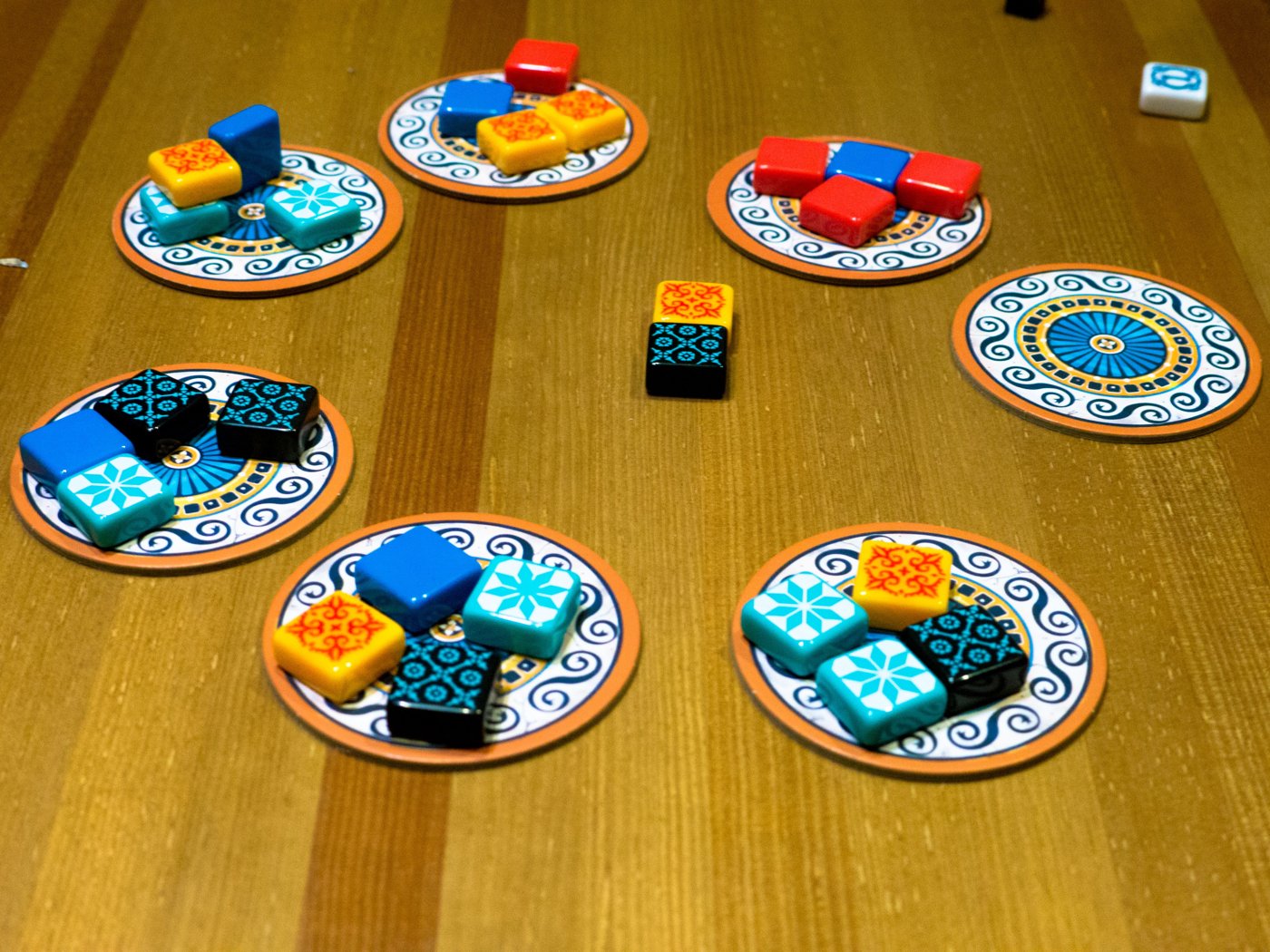
- Arrange the factory displays in a circle and fill each one with 4 tiles drawn from the bag.
- Give the first-player marker to the starting player. At the start of each round, they put it in the center of the table and take the first turn.
Taking Tiles (Phase 1)
On your turn, do one of these:
- Take from a factory. Take every tile of one color from one factory display. Push the rest of that factory’s tiles into the center of the table.
- Take from the center. Take every tile of one color from the center. If you’re the first player this round to take from the center, also take the first-player marker and put it on your floor line.
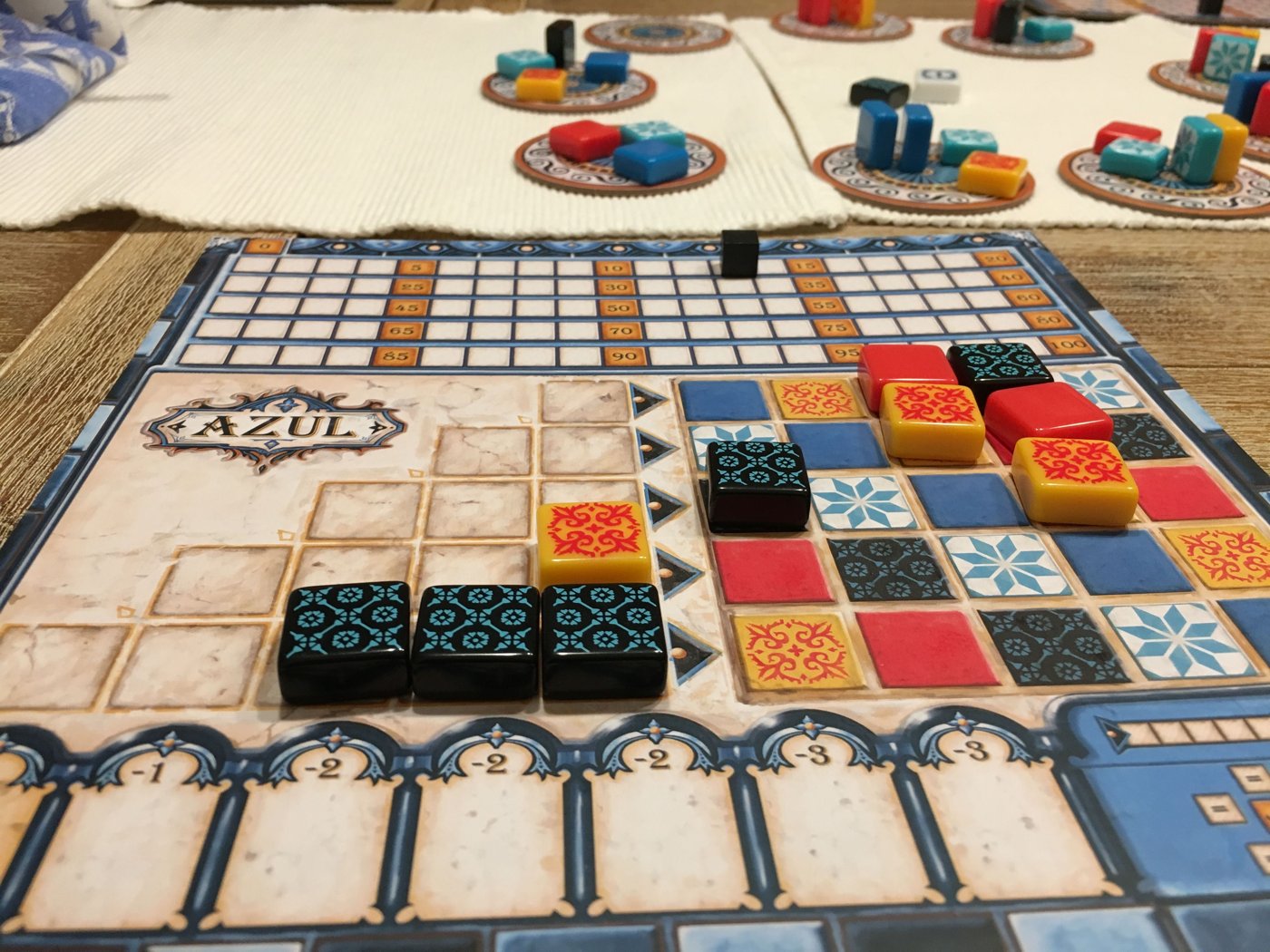
Then place all the tiles you took on one of your five pattern lines. Line 1 holds one tile and line 5 holds five. Each line can hold only one color, and you can’t add a color to a line if that row of your wall already has that color. Any tiles that don’t fit go to your floor line.
The phase ends when every factory and the center are empty.
Wall Tiling and Scoring (Phase 2)
All players do this at the same time. Going from top to bottom, move one tile from each complete pattern line to the matching color space in the same row of your wall. Then clear the leftover tiles from that line. Incomplete lines stay for next round.
Each tile scores as soon as it lands on the wall:
- Nothing next to it: 1 point.
- Touching other tiles: count the tiles in the connected horizontal line, including the new one, and score that many. Then do the same for the connected vertical line and add it.
A tile that connects to a row of three and a column of two scores 3 + 2 = 5 points.
The Floor Line
Every tile on your floor line costs points at the end of the round. The seven spaces cost −1, −1, −2, −2, −2, −3, −3, so a full floor line costs 14 points. The first-player marker counts as a floor tile. If your floor line is full, extra tiles go back to the box lid without further penalty. Your score can never drop below 0.
Preparing the Next Round
If nobody has completed a horizontal row, the player holding the first-player marker refills every factory display with 4 tiles from the bag. If the bag runs out, refill it with the tiles stored in the box lid and keep going. In the rare case that both run out, start the round anyway with some factories short.
Ending the Game
The game ends after the wall-tiling phase in which anyone completes a horizontal row of five tiles. Then everyone scores bonuses:
| Bonus | Points |
|---|---|
| Each complete horizontal row | +2 |
| Each complete vertical column | +7 |
| Each color with all 5 tiles on your wall | +10 |
Highest score wins. On a tie, the player with more complete horizontal rows wins. If that’s also tied, the players share the win.
The Gray-Side Variant
The back of each player board has a plain gray wall. With that side up, you choose where each tile goes in its row, but no color can repeat in any row or any column. If a completed pattern line has no legal space left, all its tiles go to the floor line.
Still deciding whether to buy it? Read our full Azul review. For winning tactics, our Azul strategy guide explains why columns are worth more than rows.
Frequently Asked Questions
How many factory displays do you use in a 2-player game of Azul?
Five. Use 7 factory displays with 3 players and 9 with 4, and fill each one with 4 tiles at the start of every round.
Do you have to take all the tiles of one color in Azul?
Yes. When you take from a factory or the center, you take every tile of the chosen color there. Tiles that don’t fit on your chosen pattern line go to your floor line.
Can your score go below zero in Azul?
No. Floor line penalties can reduce your score, but never below 0.
Does the first-player marker cost points in Azul?
Yes. Whoever takes from the center first in a round puts the first-player marker on their floor line, where it counts as one floor tile. They start the next round.
When does Azul end?
After the wall-tiling phase of the round in which at least one player completes a horizontal row of five tiles. Then everyone adds end-of-game bonuses.
How do you break a tie in Azul?
The tied player with more complete horizontal rows wins. If that’s also tied, the victory is shared.