


This article contains affiliate links — if you buy through them, we may earn a small commission at no extra cost to you. Full disclosure.
Uno Review: The World’s Favorite Game That Isn’t Very Good
Bottom Line
Uno is in more homes than any card game on Earth, and it endures on nostalgia and availability rather than design — the game plays you, not the other way around. It’s fine as a lowest-common-denominator deck for camping trips and eight-year-olds, and there’s real value in a game literally everyone already knows. But your turns are almost entirely dictated by your draws, games drag randomly past their welcome, and the fact that nearly every family invents house rules is the tell: people have been quietly patching Uno for fifty years.
Some links below are Amazon affiliate links — as an Amazon Associate, King Panda Games earns from qualifying purchases at no extra cost to you. Full disclosure.
Uno gets a 5/5 Bamboo Plants and a 2/5 Pandas from us. We know — it’s Uno. Your grandmother plays it, your kids play it, we played it for hundreds of hours before we knew better. This review isn’t about whether Uno is beloved; it’s about whether it’s good, and honestly: match the color or number, hope the deck is kind, sit back down when someone Draw-Fours you. That’s not a game you play so much as a game that happens to you.
The Bamboo 5 is untouchable — Uno may be the most teachable game ever printed, and its universality is a genuine feature. The Pandas 2 reflects the play experience once the nostalgia wears off: long stretches where no one is making a decision that matters.
| Detail | Info |
|---|---|
| Players | 2–10 |
| Best Player Count | 4 — the take-that cards circulate without chaos |
| Age | 7+ |
| Play time | “30 minutes” that can be 12 or 50 |
| Complexity | Light |
| Solo Mode | No |
| Designer | Merle Robbins (1971) |
| Publisher | Mattel |
| Bamboo Plants | 5/5 — everyone on Earth already knows it |
| Pandas | 2/5 — nostalgia doing the game’s job |
| Official site | mattel.com/uno |
| Official rules | Download the rules PDF |
How Uno Works
The 112-card deck is four colors of 0–9 plus the famous action cards: Skip, Reverse, Draw Two, Wild, and Wild Draw Four. Match the top discard by color or number, or play a Wild; can’t play, draw. First to empty their hand wins the round — after shouting “UNO!” on their second-to-last card — and (in the official rules almost nobody uses) scores points off everyone else’s leftovers toward 500.
That scoring system is the first sign of the gap between official Uno and lived Uno. Nobody plays to 500. Nobody stacks Draw Twos officially either — Mattel has repeatedly confirmed stacking is illegal, to national outcry — because the actual rules produce a flatter game than the one everyone remembers playing.
What We Liked
Universality is a real feature, and Uno owns it. No teach, no language barrier, no generational gap — you can deal Uno to any six humans on the planet and be playing in thirty seconds. As lowest-common-denominator infrastructure for camp cabins and hospital waiting rooms, nothing else comes close.
The last-card tension still works. The “UNO!” call, the table scrambling to Skip the leader, the final-card reveal — the endgame of a round has genuine juice, and it’s the memory everyone’s nostalgia is actually built on.
It’s a fine first game for small kids. Color and number matching is real cognitive work at age 6, and turn-taking with mild take-that is a gentle introduction to losing gracefully.
What We Disliked
What playing Uno feels like from memory: tense duels, dramatic Draw Four betrayals, comebacks.
What playing Uno actually is: checking whether your hand contains a legal card. It usually contains zero or one — meaning most turns involve no choice at all. The drama is real but randomly distributed, like weather.
- Decision-free turns dominate. With one legal play (or none), your “turn” is an act of administration. Compare any modern card game, where every turn asks a real question — Uno asks one a few times per game.
- Game length is a slot machine. A round ends when the deck decides. A player one card from winning can be dragged back for ten more minutes by chained draws — which sounds exciting and plays as exhausting, especially with kids near bedtime.
- The house-rule epidemic is the design’s confession. Stacking, 7-0 swaps, jump-in play — every table modifies Uno, and Mattel now prints official variants of the fan fixes. When fifty years of players independently conclude the base game needs patching, the base game needed patching.
- The take-that is mean without being interesting. A Wild Draw Four isn’t a decision anyone made under pressure; it’s a card someone happened to hold, played at the only moment it can be played. Its target’s counterplay is: nothing.
Who It’s For
Uno is for the glovebox, the beach bag, and the cabin shelf — contexts where “everyone already knows it” outweighs everything else, and where a game surviving sand and spilled juice matters more than depth. It’s also a legitimately good first card game for children learning colors, numbers, and taking turns.
And if your family’s Uno-with-house-rules nights are genuinely beloved — keep them. Traditions don’t need our rating to justify themselves.
Who should skip this game
Skip buying it if you’re choosing a game rather than inheriting one — at the same $10, strictly better options exist for every job Uno does. Skip it for adult game nights, where its decision-free turns show immediately. And if your family plays constantly with a thick stack of house rules, consider that you’ve already outgrown it — you’re playing a game you designed, on Mattel’s cardstock.
Who Should Buy This?
Almost nobody needs to — a copy will find you. If you’re actively shopping the $10–15 shelf: Sea Salt & Paper gives real decisions in the same footprint, Love Letter gives deduction in five-minute rounds, and 6 Nimmt! gives the big-group chaos Uno promises but delivers only sometimes.
The one purchase we endorse: replacing a destroyed family copy. Some cardboard is tradition, and tradition is allowed.
Best Player Count
Four. The Skips and Draw Twos circulate meaningfully without the table descending into pure chaos, and downtime stays short. At 6+, you’ll wait ages between turns to play your one legal card; at 2, Reverse and Skip become the same card, and the duel exposes just how few decisions the deck offers.
Replayability
Uno’s replayability is a paradox: infinite in one sense — no setup, no wear on the design, always the same — and shallow in another, because game five hundred is identical to game five. It never gets worse, which is more than Cards Against Humanity can say. It also never once gets better, deeper, or different. It is the flat line of card games.
The endless licensed editions (Uno Flip being the one genuinely improved variant — the double-sided deck adds real texture) are Mattel’s own admission that the base experience needs freshening.
Play This Instead
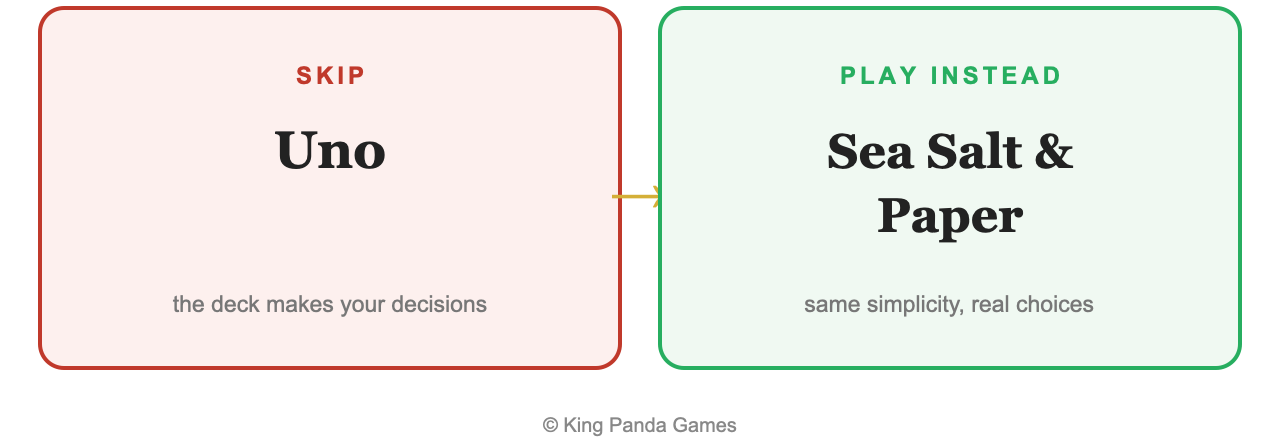
If you want the same simplicity with actual decisions: Sea Salt & Paper — teaches nearly as fast, plays as portably, and every turn asks a real question. The single best Uno upgrade in card gaming.
If it’s for the kids: Love Letter — five-minute rounds, gentle deduction, and a velvet pouch that survives backpacks. Kids feel clever winning it, not just lucky.
If you love the big-group take-that chaos: 6 Nimmt! — simultaneous play (no downtime), real risk decisions, and up to ten players. Everything Uno’s fans think Uno is.
Card games like Uno
Ready for the next step up from Uno?
- Same company, more planning: Skip-Bo or Phase 10
- Wild cards with real choices: Five Crowns
- Eight or more of you: 6 Nimmt or Sushi Go Party
Only have a regular deck? Crazy Eights, the game Uno is based on, is on our list of 25 card games you can play with a standard deck, with quick rules and the common other names each game goes by.
Frequently Asked Questions
Is Uno actually a good game?
It’s a great cultural artifact and a weak game — most turns offer zero or one legal play, so the deck effectively makes your decisions. Its real strengths are universality and simplicity, which make it useful without making it good.
Why does everyone play Uno with house rules?
Because the official game is flatter than people want — stacking Draw Twos, 7-0 swaps, and jump-ins all add the decisions and drama the base rules lack. Fifty years of universal house-ruling is the clearest verdict players have ever delivered on a design.
Can you stack Draw 2 cards in Uno?
Not officially — Mattel has confirmed repeatedly that stacking Draw Twos or Draw Fours is against the rules; you draw and lose your turn. Most tables ignore this, which says more about the base game than about the players.
What is the official way to win Uno?
Officially you play rounds, score points for cards left in opponents’ hands, and play to 500 points. Almost nobody does — the universal “first to empty their hand wins” is itself a house rule, and a sensible one.
Is Uno good for adults?
As nostalgia with drinks, occasionally; as a chosen game night title, no. Adults notice the decision-free turns quickly. Games like Sea Salt & Paper or 6 Nimmt! deliver Uno’s simplicity with genuine choices.
What’s better than Uno for family game night?
Sea Salt & Paper for the same weight with real decisions, Love Letter for quick deduction, King of Tokyo for dice-chucking fun from age 6, and 6 Nimmt! for big family gatherings. All cost about the same as a licensed Uno deck.
Verdict
Keep it if it’s already in the drawer — Uno’s universality has real utility, and family traditions outrank reviews. Skip buying it when you’re actually choosing: every job Uno does, a better $12 deck does with actual decisions. And if your house rules stack six cards deep — congratulations, you’ve been telling this review’s verdict yourselves for years.
Uno official site: https://www.mattel.com/uno
Official rules (PDF): Download it here