


The Best Kingdom Cards in Dominion’s Base Set, Ranked
Chapel costs 2 coins and it’s the strongest card in the box. New players skip it for an entire year. That gap — between what looks good and what wins — is exactly what this ranking is for. Played it at a friend’s and want your own? Dominion is the base set these kingdom cards live in.
Here’s every important base-set (Second Edition) kingdom card sorted into tiers, based on how often it decides the game when it’s on the table.
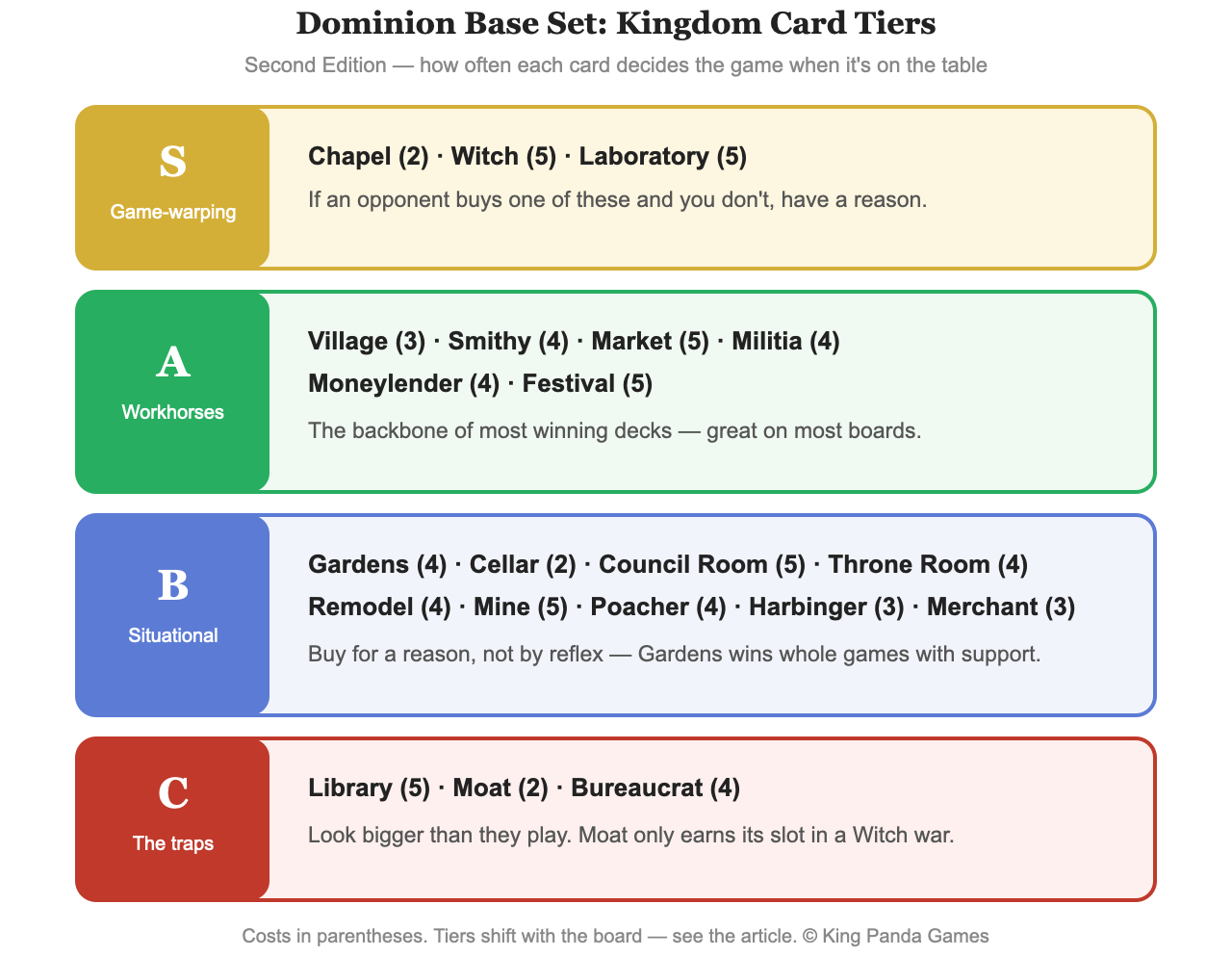
When you’re ready to add to the base game, see the best Dominion expansions.
S-Tier: These Cards Warp the Game
Chapel (2) — trash up to 4 cards from your hand. The best card in base Dominion, full stop. Two early Chapel turns convert your sludgy starting deck into a lean machine that draws its good cards every single hand. When Chapel is in the kingdom, the game is about who uses it better.
Witch (5) — +2 Cards and every opponent gains a Curse. The strongest attack in the set. Each Curse is minus one point and a dead draw forever, and the ten-Curse pile means an uncontested Witch hands out ten of them. If Witch is on the board, buying one isn’t optional.
Laboratory (5) — +2 Cards, +1 Action. The cleanest engine piece in the box: pure acceleration with no cost and no coordination needed. There’s no board where Laboratory is bad, which is exactly what S-tier means.
A-Tier: The Workhorses
These cards are the backbone of most winning decks — great on most boards, essential on some.
- Village (3) — +1 Card, +2 Actions. The enabler that makes engines legal. Worthless alone, priceless with draw cards.
- Smithy (4) — +3 Cards. The classic draw engine and the partner in the famous “Big Money + Smithy” benchmark deck.
- Market (5) — +1 of everything. Never spectacular, never dead. The most forgiving buy in the game.
- Militia (4) — +2 coins, opponents discard to 3 cards. The attack that quietly ruins engine plans, and the reason Moat sometimes matters.
- Moneylender (4) — trash a Copper for +3 coins. Thins your deck and pays you for it; a poor player’s Chapel that’s still very good.
- Festival (5) — +2 Actions, +1 Buy, +2 coins. Village for grown-ups; the +Buy matters more than new players think.
B-Tier: Situational, Sometimes Brilliant
Worth knowing: “situational” doesn’t mean weak — it means you have to check the situation. Gardens is a C-tier card on most boards and the outright win condition on boards with Workshop and extra Buys.
Gardens (4) deserves its own paragraph. It scores 1 point per 10 cards in your deck, which inverts everything this game normally teaches — suddenly Coppers are points and deck bloat is a plan. On boards with Workshop (gain a card up to 4) and +Buy cards, a dedicated Gardens rush can empty three piles and end the game before engines even warm up. It’s the base set’s best trap for rigid thinkers.
The rest of the tier: Cellar (2) cycles dead cards into fresh ones and shines in Curse-heavy games. Council Room (5) draws four but gifts your opponent a card — great when you’re racing, questionable when they’re the engine. Throne Room (4) doubles an Action and is either magic or a dead card depending entirely on what it copies. Remodel (4) is slow trashing that becomes an endgame star, turning Golds into Provinces. Mine (5), Poacher (4), Harbinger (3), Merchant (3), and Vassal (3) are all fine role players you buy for a reason, not by reflex.
C-Tier: The Traps
What most players do: buy Library and Adventurer-style cards because “draw until you have 7 cards” sounds enormous, and buy Moat the moment anyone shows an attack.
What actually works: counting what those cards actually do. Library’s draw shrinks as your engine improves — the better your deck, the worse it gets. And a reactive Moat (2) spends a buy and a card slot to sometimes cancel one Militia; usually you’re better off just building a deck that doesn’t care.
The full trap list: Library (5) — anti-synergy with every engine you’d want to build. Moat (2) — buy it only against a dedicated Witch war. Bureaucrat (4) — a Silver-gainer whose attack barely stings; there’s almost always a better 4. Chancellor’s replacement Vassal escaped this tier, but Workshop (3) lives on its edge — gaining 4-cost cards is only a plan on Gardens boards, where it jumps two tiers.
Artisan (6) and Bandit (5) sit between tiers: Artisan is a strong finisher for engines that can spare 6 coins mid-build, and Bandit’s Gold-gaining is real while its attack is mostly theater.
How to Use the Tiers at the Table
Tiers are the starting bid, not the answer — the ten-pile combination re-prices everything. Chapel drops a tier when there’s nothing worth drawing after you thin. Witch drops when everyone can afford her (a four-way Curse war just slows the game evenly). Village is unplayable with no draw to chain into.
So use the tiers as your opening scan: find the S-cards first, ask what stops them, then build. The deeper archetype logic — when the whole board says engine versus when it says money — is covered in our Dominion strategy guide, and if you’re still on the fence about the game itself, the full review is the place to start.
Everything ranked above is in the base game of Dominion. Some links below are Amazon affiliate links — as an Amazon Associate, King Panda Games earns from qualifying purchases at no extra cost to you. Full disclosure.
Check Dominion price on Amazon →
Frequently Asked Questions
What is the best card in Dominion’s base set?
Chapel — trashing up to four cards per play turns your starting deck into a lean engine faster than anything else in the box. Witch and Laboratory round out the top three, but Chapel shapes more games than either.
Is Witch worth buying in Dominion?
Almost always, when it’s in the kingdom. Every Curse it deals is both minus one point and a permanently dead card in an opponent’s deck, and skipping Witch while an opponent buys one puts you at a structural disadvantage for the whole game.
Why is Chapel so good in Dominion?
Because deck quality beats deck size. A 10-card deck of good cards draws its combo every hand, while a 20-card deck of good and bad cards draws a mix. Chapel removes the bad half for a one-time cost of 2 coins — the best exchange rate in the game.
Is Gardens a good card in Dominion?
Only with support, but then it’s game-winning. Gardens wants extra Buys and cheap gainers like Workshop so you can bloat your deck to 40+ cards and empty piles fast. Without that support, it’s a weak 4-cost that clogs a normal deck.
What cards should beginners buy in Dominion?
Silver over Copper always, one Smithy for draw, and Village only if you have Actions worth chaining. The recommended first-game kingdom in the rulebook — Cellar, Market, Merchant, Militia, Mine, Moat, Remodel, Smithy, Village, Workshop — is genuinely well-chosen for learning these instincts.
Is Moat worth buying to block attacks?
Usually not. Moat only helps when it’s in your hand at the right moment, and its +2 Cards is the weakest draw in the set. Buy it in heavy Witch games where blocking even half the Curses matters; otherwise spend the 2 coins on Cellar or save for better.
Print-worthy version of this whole article: S-tier is Chapel, Witch, Laboratory — if one is on the table and your opponent buys it and you don’t, you’d better have a reason.