


How to Win at Coup: Bluffing Strategy That Actually Works
The player who wins at Coup is almost never the best liar. It’s the player who knows when lying is cheap, when challenging is profitable, and when doing absolutely nothing interesting is the strongest move at the table.
Some links below are Amazon affiliate links — as an Amazon Associate, King Panda Games earns from qualifying purchases at no extra cost to you. Full disclosure.
Here’s the strategy layer hiding inside those fifteen cards.
Bluff Early, When Lies Are Cheap
The first two rounds are the safest bluffing window in the game. Nobody has seen any cards, nobody has a read on anybody, and a challenge is a pure coin flip that most players won’t risk on turn one. A false Duke claim in round one gets you three coins and — more valuable — a reputation as a Duke-holder that shapes how the table treats you for the rest of the game.
The math tightens every round after that. As face-up cards accumulate, claims become checkable, and by mid-game a lie has to survive players who’ve been counting. Front-load your dishonesty.
The rule: your claims should be decided by what the table will believe, not by what you’re holding. The player who only claims what they have is the most readable player in the game.
The Character Math Everyone Ignores
There are exactly three copies of each character in the deck. That single fact is the whole deduction engine, and most casual players never use it.
Two Contessas are lying face-up dead on the table. You pay three coins and announce an assassination against Priya. She claims the Contessa block. There is exactly one Contessa left in a fifteen-card deck — and you’re holding cards, the other players are holding cards, and the odds her two cards include that specific last copy are terrible. This is the challenge you take every single time.
Keep a running count of just two things: dead characters (face-up on the table) and claimed characters (what each player has implied they hold). When claims outrun the deck — a fourth “Duke” appears, or someone blocks a steal after two Captains and an Ambassador are dead — the table is being lied to, and profit is available.
When to Challenge (and When to Swallow It)
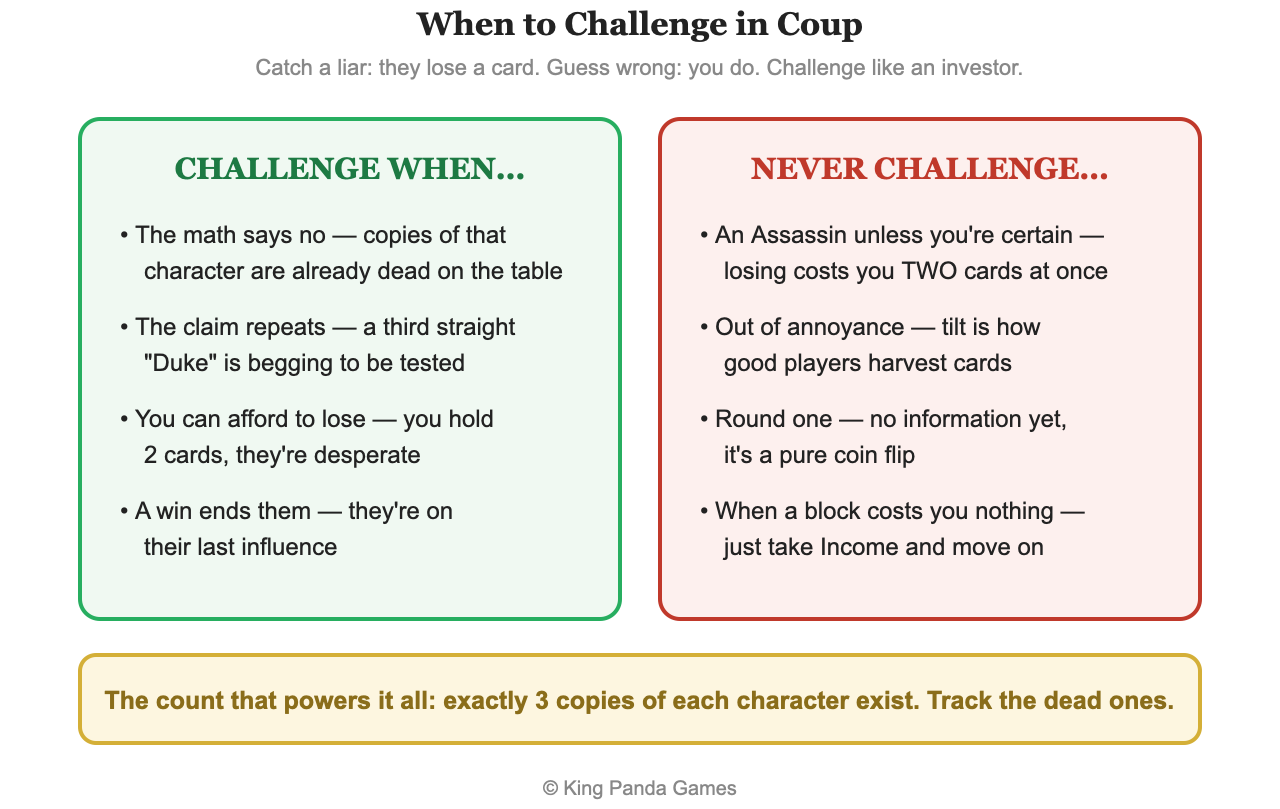
Challenging is priced beautifully: catch a liar and they lose a card; guess wrong and you do. That symmetry means challenges should be investments, not outbursts.
Challenge when the math is on your side (see above), when the claim is repeated (a third consecutive Tax claim is begging to be tested), or when you’re safe — you hold two cards and the accused is desperate. Never challenge just because you’re annoyed, and be extremely careful challenging one specific claim:
What most players do: challenge the Assassin claim, because assassination is scary and they want it to be a lie.
What actually works: respecting the double-loss rule. If you challenge an Assassin and they show it, you lose one card for the failed challenge and a second to the assassination that now resolves. That’s both your cards — the single most punishing mistake in Coup. Challenge Dukes and Captains; respect Assassins.
The same trap applies in reverse: bluffing a Contessa block against an assassination risks two cards if challenged. Only the table’s best liars should block assassins with air.
The Power of Boring Turns
Income — one coin, no claim, no challenge possible — looks like the weakest action in Coup. In the mid-game, it’s often the best one. Every claim you make hands the table information and a target; a quiet Income turn while two rivals feud makes you the least interesting person at the table, and the least interesting person is the last one anybody Coups.
That’s the deeper positioning game: Coup tables reflexively punish whoever just made a kill or claimed powerful cards, and the player who stays visibly harmless until four players become three wins far beyond their share. Aggression spends attention; attention gets you killed. Save your violence for when the survivors are too weak to answer it.
One warning about overdoing it: the 10-coin forced Coup exists precisely to stop infinite turtling, and a player who takes Income eight turns straight telegraphs weakness — an easy, guilt-free elimination. Boring is a phase, not an identity.
Play the Players, Not Just the Cards
All of the above is table stakes; the winrate lives in reads. Watch how each opponent claims when you know they’re telling the truth — speed, eye contact, phrasing — because that’s the baseline their lies will deviate from. New players announce bluffs with hesitation; experienced players announce truths with theatrical hesitation to bait challenges. Your group’s meta will evolve weekly, which is exactly why this game stays in rotation — and if you’re reading strategy before you even own it, our full Coup review will tell you whether your table is the right table.
Don’t own Coup yet? This guide assumes the base game.
Frequently Asked Questions
What is the best strategy in Coup?
Bluff early when challenges are risky for everyone, track the three-copies-per-character math to catch impossible claims, and stay unthreatening in the mid-game so the table’s aggression lands on louder players. Coup rewards positioning more than lying skill.
When should you challenge in Coup?
Challenge when the math says a claim is unlikely — repeated claims of the same character, or claims after most copies are visibly dead. Avoid challenging Assassin claims unless you’re nearly certain: losing that challenge costs two cards at once.
Is it better to bluff or tell the truth in Coup?
Mix both, weighted by timing — truth when the claim will be tested, bluffs when challenges are expensive or the table is distracted. A player who never bluffs is predictable and exploitable; a player who always bluffs gets counted out by turn five.
What is the strongest character in Coup?
The Duke — three coins per turn with no cost and a useful block makes it the claim that funds everything else. That’s also why Duke claims draw the most challenges; the strongest card to actually hold is often the Contessa in an assassin-heavy game.
Should you Coup the leader or the weakest player?
The leader — eliminating weak players just accelerates a strong player’s win. When you’re forced to Coup (10+ coins) or choose to, hit whoever has the most coins and influence, and let the weak players survive as future targets for everyone else.
How do you win Coup with bad cards?
Cards barely matter; claims do. Two dead characters in your hand can still claim Duke, block steals, and threaten assassinations — the game only checks your cards when someone challenges. Keep your claims plausible against the visible math and play the same confident game.
Next game, try one deliberate experiment: make your very first claim a lie, and note how nobody challenges it. That’s the free money the whole strategy is built on.