


The Best Power Cards in King of Tokyo, Ranked
Extra Head costs 7 energy. Most players never save that much. The players who do win a lot more games.
Power cards are the only shopping decision in King of Tokyo, and the gap between the best and worst cards is enormous. Here’s our ranking after dozens of plays — what to buy on sight, what to buy situationally, and what to leave on the table.
Tier 1: Buy on Sight
Three cards are worth almost any price and any detour to afford them.
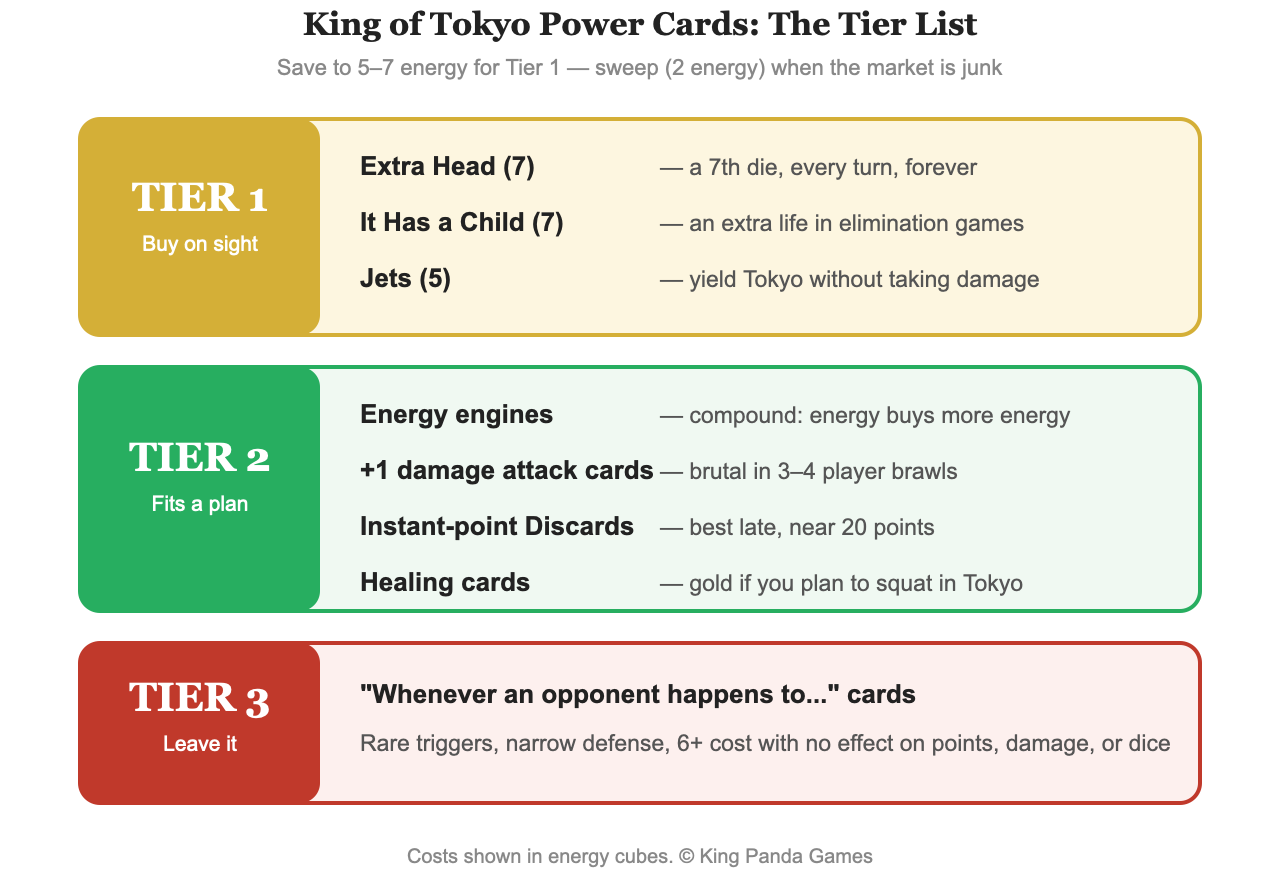
Extra Head (7 energy) is the best card in the game, full stop. A seventh die is roughly 17% more of everything — points, claws, energy, hearts — every single turn for the rest of the game. Bought before mid-game, it pays for itself three times over.
It Has a Child (7 energy) is an extra life. When you’d be eliminated, you discard everything and come back fresh — and yes, the reset stings, but surviving is literally half the win condition. In a bloody 5–6 player game where eliminations are flying, this card wins outright.
Jets (5 energy) removes the game’s hardest decision: you take no damage when yielding Tokyo. Suddenly you can occupy the city greedily, milk the entry and turn bonuses, and bail out for free the moment anyone breathes on you. It turns the stay-or-yield math permanently in your favor.
Tier 2: Strong, Situational
Worth knowing: a card’s value depends on your game plan. Attack cards are gold in a 3-player brawl and mediocre in a 6-player points race — read the table before you spend.
- Energize (worth it whenever energy engines are online) — energy-generating Keep cards like Friend of Children or Solar Powered compound: more energy buys more cards buys more energy. Two energy cards early is a genuine engine.
- Acid Attack / extra-damage cards — +1 claw damage every attack turn adds up brutally in small games where the same monsters keep trading hits.
- Complete Destruction and other big Discard bombs — instant points are underrated. Discard cards that hand you 3–5 points on the spot are often better than a mediocre Keep you’ll forget to use.
- Healing Ray / Regeneration — healing cards jump a full tier if you plan to squat in Tokyo, since hearts are dead dice while you’re in the city.
Tier 3: The Overrated Traps
What most players do: buy whatever they can afford the moment they can afford it, because spending energy feels like progress.
What actually works: saving to 5–7 energy for a Tier 1 card, and spending 2 to sweep the market when the face-up cards are junk. An empty hand of energy is a threat; three bad cards are a museum.
The traps share one trait: they look scary but trigger rarely. Cards that punish opponents for specific dice results, defensive cards that only matter if you’re attacked in a specific way, and expensive cards costing 6+ that don’t affect points, damage, or dice count. If a card needs a sentence starting with “whenever an opponent happens to…” — pass.
The 2-energy sweep is the most underused move in King of Tokyo. Players treat the three face-up cards as the whole store; they’re just the shelf. Sweeping into a fresh row when you’re holding 8 energy finds you a Tier 1 card shockingly often.
How to Shop: Three Rules
- Bank energy before you browse. Decide your target price (5–7 for game-changers) and don’t leak energy on 3-cost snacks along the way.
- Buy engines early, bombs late. A Keep card bought turn three works for ten more turns; the same card bought at 15 points does almost nothing. Flip it for Discard point-bombs — those get better as you near 20.
- Deny when the price is right. If the leader is one card away from a runaway (Extra Head on the market while they hold 7 energy), buying it yourself — even suboptimally — can be the correct play.
Buying nothing is a strategy too. In short, brutal games with lots of eliminations, monsters who spent turns farming energy sometimes just die rich. If the table is bloodthirsty, convert dice to claws and points, not cubes — if you’re still deciding whether this game’s card layer is deep enough for your group, our full King of Tokyo review has the verdict.
Everything ranked above is in the base game of King of Tokyo. Some links below are Amazon affiliate links — as an Amazon Associate, King Panda Games earns from qualifying purchases at no extra cost to you. Full disclosure.
Check King of Tokyo price on Amazon →
Frequently Asked Questions
What is the best card in King of Tokyo?
Extra Head. A permanent seventh die improves every roll for the rest of the game, no matter your strategy. At 7 energy it’s expensive, but it’s the card every experienced player saves for.
How do you get more energy in King of Tokyo?
Keep lightning bolt dice when you roll them — each one is worth 1 energy cube. Energy-generating Keep cards accelerate this, and dedicating one otherwise-wasted turn to bolts often funds a game-changing purchase.
Should you buy cheap cards or save for expensive ones in King of Tokyo?
Save for the 5–7 energy game-changers unless a cheap card directly fits your plan. Most 2–3 cost cards have small, situational effects, while Extra Head, Jets, and It Has a Child visibly swing games.
What does sweeping cards do in King of Tokyo?
Spending 2 energy discards all three face-up Power cards and reveals three new ones, which you can buy immediately. It’s the best move in the game when the market is full of junk and you’re holding a big energy reserve.
Can you buy more than one Power card per turn?
Yes — you can buy as many face-up cards as you can afford during your buy step, and purchased cards are replaced immediately, so you can even buy the replacement. Big energy turns can chain two or three purchases.
Are Discard cards or Keep cards better in King of Tokyo?
Keep cards are better early because their effects repeat every turn; Discard cards are better late because instant points matter most near 20. A good rule: engines before turn five, bombs after.
Next game, try this: don’t buy a single card until you have 6 energy, then shop. You’ll feel the difference immediately.