
This article contains affiliate links — if you buy through them, we may earn a small commission at no extra cost to you. Full disclosure.
The first time you lose a Sequence game to someone who just learned the rules, it stings in a specific way — because you know the board was yours to control. The rules are simple. The deck is shared. So why did they beat you?
Some links below are Amazon affiliate links — as an Amazon Associate, King Panda Games earns from qualifying purchases at no extra cost to you. Full disclosure.
Usually, it’s because they played their jacks at the right moment and you didn’t.
Sequence has a shallow decision surface — but within that shallowness, a handful of choices separate players who win consistently from players who react to the board. Here’s what those choices actually are. Cheap family card games hide their skill this way. Cover Your Assets is the other big offender — it plays like pure stealing luck until you learn to hold a matching card back as a defender.
Control the Center First, Not the Edges
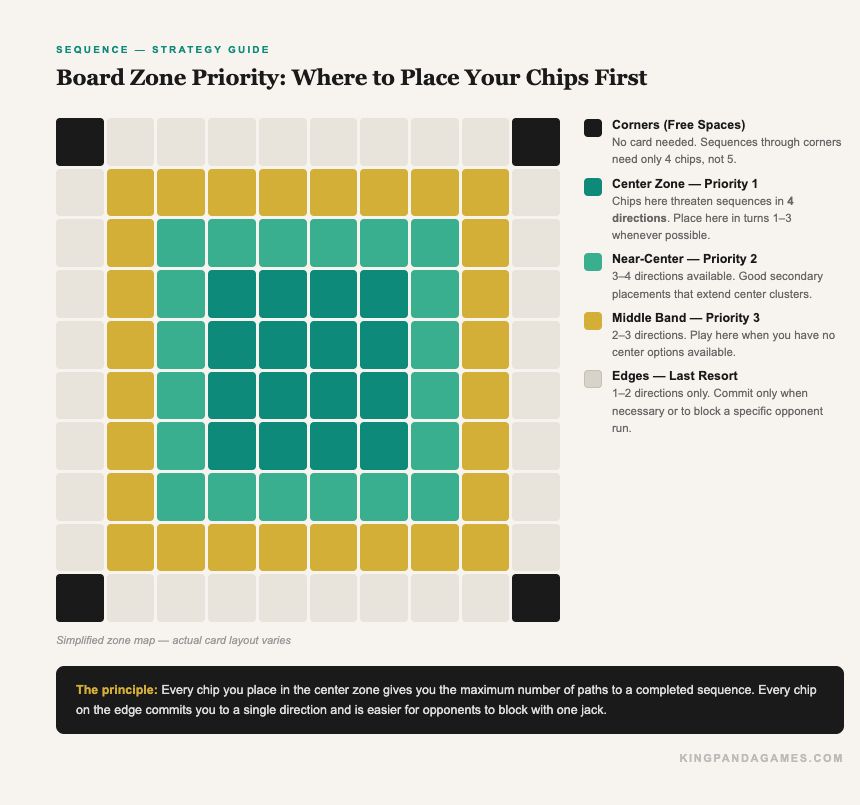
The most valuable real estate on the Sequence board isn’t where your hand sends you — it’s the center cluster. A chip placed in the center of the board can contribute to sequences running in four directions: horizontal, vertical, and both diagonals. An edge chip locks you into one or two directions at most.
In the first three turns, the temptation is to play whatever card you’re holding and place wherever it lands. Resist this. Scan the board before playing. If two cards in your hand have one placement near the center and one near the edge, almost always go center — even if the edge chip would extend an existing two-chip run.
The center also has a compounding effect. Opponents who place their early chips in the center force everyone else to contest those spaces with jacks, burning their tactical resources early. Being the team that occupies center forces your opponents to react to you.
The rule: prioritize board zones with four-direction flexibility over placements that extend existing runs of two chips or fewer.
Jack Cards: Stop Saving Them
Most Sequence players treat jacks like emergency tools — held in reserve until an opponent is about to win, then deployed in a panic. This is backwards. (Full breakdown of exactly what each jack does: our Sequence jack card rules guide.)
One-eyed jacks (the ones that remove chips) are most valuable when played early or mid-game, not late. The chip you want to remove isn’t the fourth in a near-complete sequence — it’s the chip that’s anchoring two separate sequence paths simultaneously. That chip, removed in round three, collapses your opponent’s multi-directional threat before it forces you to choose which direction to block.
What most players do: Hold one-eyed jacks until an opponent has four chips in a row, then use the jack to remove one chip and feel like a hero.
What actually works: Use the jack to remove the chip that’s simultaneously contributing to two potential sequences. The threat you’re dismantling looks smaller, but removing it earlier costs the opponent more than saving one turn before a completion.
Two-eyed jacks (the wild placement jacks) follow the same principle in reverse. Don’t save them for the winning chip. The most powerful use of a two-eyed jack is filling a gap mid-game — a space in the middle of a potential sequence that your current hand can’t reach with a matching card. If you hold the two-eyed jack waiting for a dramatic finish, your opponent sees the gap, contests it, and your plan collapses.
Play your jacks earlier than feels right. You’ll win more games for it.
Threading Two Sequences at Once
Sequence rewards players who build toward two completions simultaneously. This is the single most important strategic principle in the game, and most casual players never practice it.
Here’s why it works: your opponents have a limited number of one-eyed jacks. If you’re clearly building toward one sequence, they can block one space to derail the whole path. If you’re building chips that threaten two sequences at once — two paths that both extend from the same cluster — they can only use one jack to block one path. Your second route stays open.
The practical approach: look for board positions where a single chip placement extends two runs simultaneously. A chip at the intersection of a horizontal and a diagonal cluster contributes to both without requiring additional placements in either direction. Building from intersections, rather than building a single line, forces your opponents to spend two defensive resources to stop you.
This works in team play too. If you and your teammate each start separate clusters, an opponent only needs to disrupt one to slow both of you. If your clusters intersect and share chips, a single disruption hurts both paths — but so does a single build.
Using the Corners
Each corner of the board is a free space — no card required, every team benefits, and multiple teams can route through the same corner simultaneously. A sequence through a corner only needs four chips to complete, not five.
That one-chip reduction matters more than it looks. In a 20-minute game, one fewer chip in a sequence is roughly one turn of advantage. Teams who consistently route sequences through corners when their card draws allow it are building that advantage into every game.
Worth knowing: Corners can’t be exclusively claimed — multiple teams can use the same corner space simultaneously. Don’t overinvest in protecting a corner as if it’s yours. Instead, route through it opportunistically when the cards line up.
“When should I build toward a corner versus through the center?” Build toward whichever one your current hand cards can fill faster. The center is more flexible (more adjacency, more sequence directions), but the corner path is shorter. If you have three cards in hand that land near a corner line and only one that goes toward center, take the corner route.
Coordinating in Team Play Without Saying Anything
The communication ban in Sequence isn’t just a rule — it’s the game’s actual design. The silent coordination between teammates is where Sequence earns its replay value. Learning to read your partner, and to place chips they can read, is a real skill.
The fundamental rule: extend your teammate’s existing work before starting something new. A chip that connects to something your partner already placed sends a clear signal — they’ll see it, understand it, and build toward the same sequence. A chip placed in an unrelated corner of the board creates ambiguity and forces them to guess.
- Before placing your chip, scan for your teammate’s most developed cluster — their longest existing run.
- Check whether any card in your hand places near that cluster.
- If yes, play toward it, even if a different card would give you a stronger personal placement.
- If your whole hand is unrelated to their work, start a new cluster near the center and make the placement obvious — not tucked near the edge where it could be mistaken for a defensive move.
Team play punishes selfish sequences. The pair that wins is usually the one that built half a joint sequence each, not the one where each partner built their own.
Dead Cards: Don’t Broadcast Too Early
When you hold a dead card — both board spaces for that card are already covered — you can turn it in on your turn and draw a replacement before still playing normally. You must announce it to the table.
That announcement is information. The moment you declare a dead card, opponents know both spaces on the board for that card are filled — and by extension, they now know more about the current board state and potentially about your hand composition. In mid-game, that information can help them plan defensive moves.
Before announcing a dead card, consider: does anyone benefit from knowing those spaces are covered? If revealing that the two queen-of-spades spaces are both taken gives your opponent useful intelligence about an uncontested zone, hold the dead card one more turn if you can afford to. One turn of delayed information can be worth more than one marginally better card draw.
Don’t own Sequence yet? This guide assumes the base game.
Check Sequence price on Amazon →
Frequently Asked Questions
What is the best opening strategy in Sequence?
Prioritize center placements over edge placements in your first two or three turns. The center of the board has adjacency to sequences running in four directions — horizontal, vertical, and both diagonals — while edge spaces commit you to one or two directions at most. If two cards in your hand give you options, almost always go center.
When should you use a one-eyed jack in Sequence?
Use one-eyed jacks proactively in the mid-game rather than holding them for emergencies. The most effective use is removing a chip that simultaneously anchors two of your opponent’s potential sequence paths — not reacting to a near-complete sequence after it’s already threatening a win.
When should you use a two-eyed jack in Sequence?
Use two-eyed jacks to fill gaps mid-game that your current hand cards can’t reach — not as the final chip in a nearly-complete sequence. Holding them too long gives opponents time to see the gap and contest it. A mid-game two-eyed jack that closes a three-chip run into a four-chip run is usually more valuable than a dramatic final placement.
How do you win consistently at Sequence?
Three habits separate consistent winners: placing early chips near the center (maximum directional flexibility), building toward two sequence paths simultaneously (forces opponents to use two jacks to block you), and playing jacks proactively instead of defensively. Players who do all three win most games they play.
How do you coordinate with your teammate in Sequence without talking?
Extend your teammate’s existing chip clusters before starting something new. A chip placed adjacent to your partner’s run signals your intent clearly — they’ll see it and build toward the same sequence. If your entire hand is unrelated to their work, start a new center cluster and make the placement deliberate rather than tucked in an ambiguous edge position.
Does the corner free space really make a difference in Sequence strategy?
Yes — sequences through a corner require only four chips instead of five, which is roughly one turn of advantage per completion. Teams that consistently route sequences through corners when cards allow it build that advantage across every game. Corners can’t be exclusively claimed, so use them opportunistically rather than trying to “own” them.
Put it together: the first three turns are board positioning, the middle game is jack management, and the late game is finishing the sequence your team has been threading. Sequence rewards players who see the board two moves ahead, not one. If you’re making decisions one chip at a time, you’re already a step behind the player who’s building toward two completions simultaneously.
If you’re still deciding whether Sequence belongs in your collection, check out our full Sequence review first — it covers who the game is best for and where it falls short. Sequence earns its spot on our best Christmas board games list for the same reason — two-versus-two teams get a six-year-old and her grandpa plotting against the other side.