

If you’re choosing between Codenames and Codenames Duet, the answer is simpler than most comparison articles make it: buy Codenames if you play with groups, buy Duet if you play primarily with one other person. They’re not two difficulty levels of the same game — they’re different games built on the same word-card concept.
Some links below are Amazon affiliate links — as an Amazon Associate, King Panda Games earns from qualifying purchases at no extra cost to you. Full disclosure.
Here’s what actually separates them.
The Core Difference: Competitive vs. Cooperative
Codenames is a competitive team game. Two teams of two or more race to identify all their agents before the other side does. One team wins, one loses. The Spymaster knows everything; the operatives know nothing. The tension comes from that gap and from the assassin card that ends the game if anyone touches it.
Codenames Duet is a fully cooperative game for exactly two players (though it technically works with more, built for two). Both players are Spymasters simultaneously. Each player has a key card showing which words belong to their side — and the key cards overlap intentionally. Some words are agents for both players, some are agents for only one, and the assassins multiply (three assassins vs. Codenames’ one). You win together or lose together.
The vibe is completely different. Codenames feels like a competition with a word game inside it. Duet feels like a puzzle you’re both trying to crack before the timer runs out.
When Codenames Is the Right Buy
Codenames is right for you if you regularly play with groups of four or more.
The game runs best with two teams of at least two people each. The social layer — team deliberation, reading your teammates, watching the Spymaster for any involuntary signal — requires more than one person per team to function. With two people total, that entire dynamic disappears. You’re left with two people taking turns giving each other clues, which is a much thinner experience.
The rule: if your default game night has four or more people, buy Codenames. If you’re primarily buying it for two-player sessions, buy Duet.
Codenames also works better as a party game and a gateway game. The rules explain in five minutes, the rounds run 15–30 minutes, and it pulls in non-gamers without requiring them to care about strategy. For hosting situations — family gatherings, coworker game nights, large friend groups — Codenames is the more versatile tool.
Check Codenames price on Amazon →
When Codenames Duet Is the Right Buy
Codenames Duet is right for couples or pairs who want a cooperative puzzle game they can play regularly. It is one of only two cooperative picks on our best board games for couples list, and the other one asks for a cleared Saturday.
The two-player cooperative format changes everything. Instead of competing, you’re working together to identify 15 shared agents in nine turns each — a tight constraint that makes every clue count. With three assassins on the board instead of one, the stakes for bad clues are higher. You can also lose by running out of turns, which Codenames doesn’t have.
In Duet, you give a clue for three of your agent words. Your partner guesses correctly twice, then touches the third card — which happens to be one of your partner’s assassins. You didn’t know. They didn’t know. The game is over. This is the specific failure mode Duet introduces that the base game doesn’t have: hidden information that works against both of you, not just one team.
Duet also has a campaign mode — a series of scenarios set in different cities with specific win conditions — that the base game doesn’t. If you want Codenames to have more structure over multiple sessions, Duet’s campaign gives you a reason to keep coming back to it.
Check Codenames Duet price on Amazon →
The Components Are Mostly Compatible
Both games use word cards of the same dimensions. The word sets are different — Duet has its own 400 codenames, separate from the base game’s 400 — but you can mix them if you want more variety. You can also pull Duet’s word cards into a standard Codenames game and vice versa, effectively doubling your word pool.
The key cards and agent tiles are not interchangeable. Duet’s key cards show the cooperative setup with both players’ agent assignments and assassin placement. Base Codenames key cards show the competitive red/blue split. They’re designed for different games.
Do You Need Both?
If you own Codenames and play regularly with a consistent partner, adding Duet is worth it — the cooperative format is a genuinely different experience, and having a two-player option means you’re not stuck with a lesser version of the base game when it’s just two of you.
If you own Duet first (maybe you play mostly in pairs), the base game is still worth adding when your group expands. The competitive format hits differently than the cooperative one, and you’ll get use out of both.
If you can only buy one: decide based on who you play with most. Groups → base Codenames. Pairs → Duet.
Quick Comparison
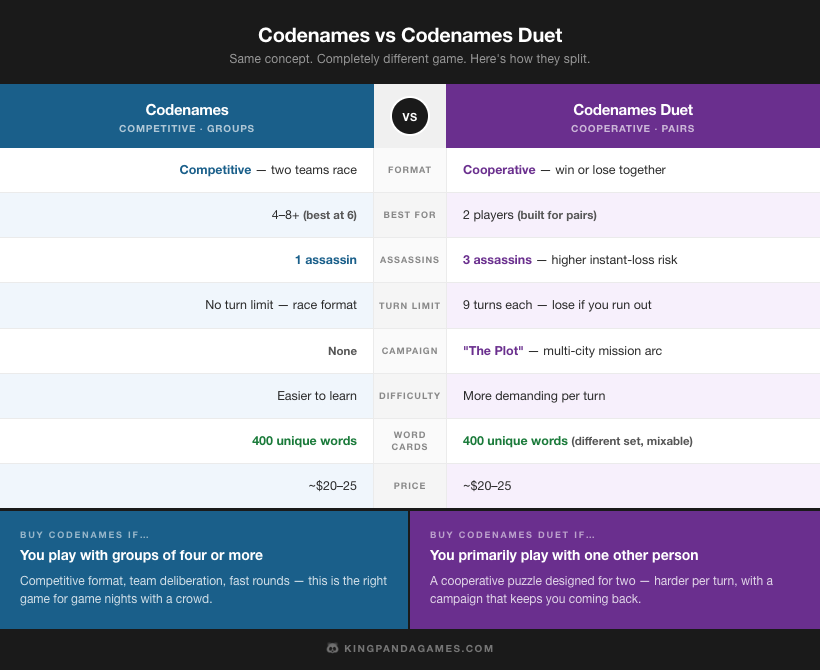
| Codenames | Codenames Duet | |
|---|---|---|
| Players | 4–8+ best | 2 (designed for) |
| Format | Competitive | Cooperative |
| Assassins | 1 | 3 |
| Turn limit | No | Yes (9 turns each) |
| Campaign mode | No | Yes |
| Word cards | 400 unique | 400 unique |
| Price | ~$20–25 | ~$20–25 |
Both games are priced identically. Neither is a budget version of the other — they’re parallel products for different use cases.
For the full breakdown of what makes the base game work (and who it’s actually for), read our complete Codenames review.
Frequently Asked Questions
Can you play Codenames Duet with more than 2 players?
Yes. Duet technically supports more than two players by having players share a Spymaster role or rotate who gives clues. In practice, it works best with two — the cooperative dynamic is designed around two players with separate key cards. With three or four, one person ends up passive most of the time.
Is Codenames Duet harder than regular Codenames?
For most groups, yes. The three assassins (vs. one in the base game) create more ways to lose instantly, and the turn limit means you can also lose by running out of time. The cooperative format removes the competitive pressure but adds a tighter mechanical constraint. Most players find Duet more mentally demanding per turn.
Can you mix Codenames and Codenames Duet word cards?
Yes. The word cards are the same dimensions and can be freely combined to expand your word pool. Mixing them is a common recommendation after 30+ games when the original word sets start feeling familiar. The key cards and agent tiles are not compatible across versions.
Does Codenames Duet have a campaign mode?
Yes. Duet includes a campaign called “The Plot” with a series of missions across different cities. Each mission has specific win conditions and modifies the standard rules slightly. It’s a meaningful addition that gives the game structure across multiple sessions — something the base Codenames doesn’t offer.
Which version is better for beginners?
The base Codenames is the better starting point. The competitive format is easier to explain, the single assassin creates less confusion, and the team structure naturally distributes pressure — beginners can participate as operatives without needing to give clues right away. Duet’s additional complexity (three assassins, turn limit, mutual key cards) is harder to absorb in a first game.
Going with the original? here’s the honest breakdown of how it plays at every player count, and once you’re ready to give clues yourself, our Spymaster tips will sharpen your first game fast.