

Most people who’ve played Codenames a dozen times still give bad Spymaster clues. Not because they don’t understand the rules — because the Spymaster role looks simple from the outside and is genuinely difficult once you’re holding the key card.
Some links below are Amazon affiliate links — as an Amazon Associate, King Panda Games earns from qualifying purchases at no extra cost to you. Full disclosure.
Here’s the gap: operatives see 25 words and try to find connections. Spymasters see 25 words and need to find connections that include exactly the right cards and exclude every other card that could plausibly fit. Those are two completely different cognitive tasks. The first is brainstorming. The second is precision engineering under time pressure with nine people staring at you.
These tips are for players who already know how to play and want to stop costing their team the game.
The Assassin Is Your Real Puzzle
Every Spymaster’s first instinct is to look at their agent cards and ask: what do these have in common? That’s backwards.
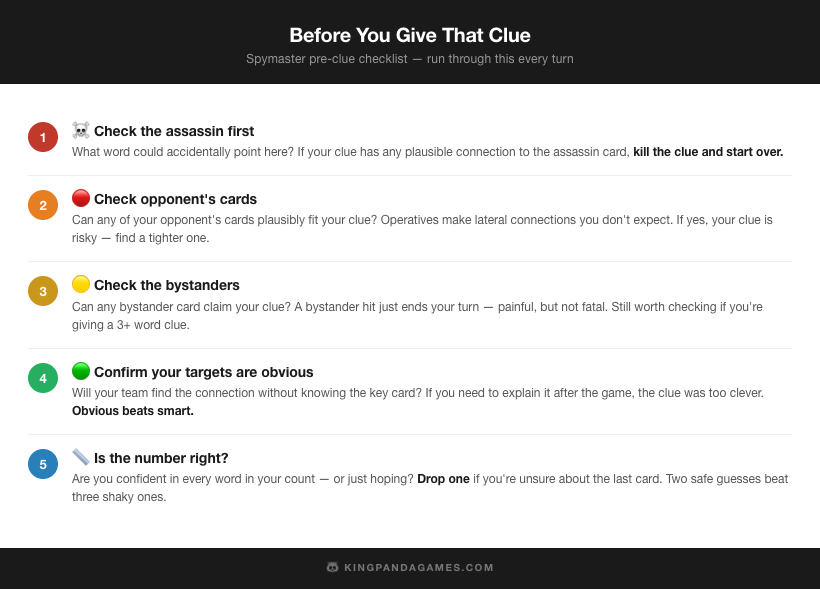
Start with the assassin. Before you build a single clue, study that card and ask: what word could I give that my team would plausibly connect to the assassin? What category, theme, or sound does it share with my agents? Then remove every clue that touches it.
The assassin kills you in one touch. Your opponent’s cards only cost you a turn. Bystanders only cost you a turn. The assassin ends the game. It deserves the most attention before you say anything.
The rule: build every clue backward from the assassin — what can’t you say? — then forward from your agents.
A common version of this mistake: your agents include ROCK and STAR, and your assassin is FISH. “ROCK, 2” feels clean until your team debates whether rock fish is a thing. “STAR, 2” feels safe until someone argues STARFISH. Check both directions before you commit.
Why 2-Word Clues Win More Games Than 4-Word Clues
“When should you go for a big clue vs. a safe one?”
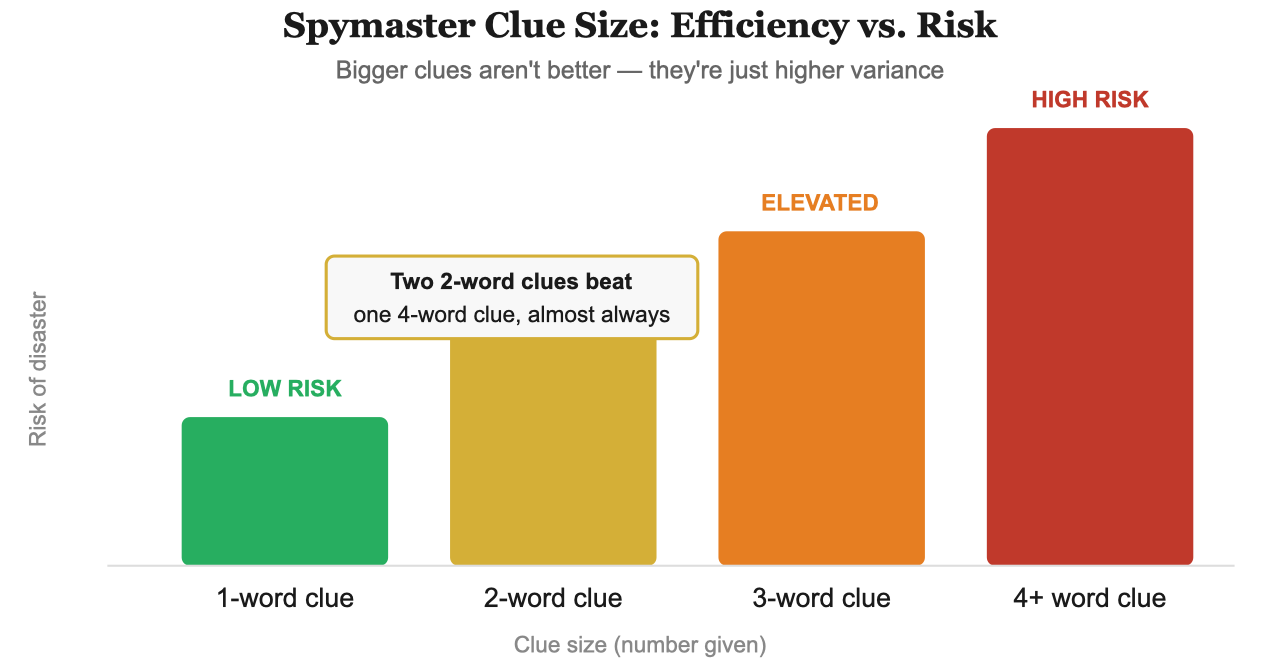
Almost always the safe one. Here’s the math: a 4-word clue requires your team to correctly identify four cards in sequence without touching a bystander, opponent agent, or the assassin. Each additional word multiplies the ways the turn can go wrong.
New Spymasters love 4-word clues because they feel efficient — one great clue for four cards sounds faster than two clues for two cards each. In practice, two clean 2-word clues are more reliable than one ambitious 4-word clue with one dangerous fringe connection your team might reasonably make.
What most Spymasters do: Try to link the maximum number of their agents in a single clue. “OCEAN, 4” — connecting WAVE, BLUE, FISH, and DEEP — feels impressive. It also creates four chances for your team to drift to the opponent’s BOAT card or the bystander WATER or, worst case, the assassin NET.
What actually works: Give 2-word clues for your cleanest pairs first. Bank the wins. Use your +1 bonus guess to chip away at a third card when the board gets safer in later rounds. The game is won on consistency, not on the one spectacular clue that works once in ten tries.
There’s a time for ambitious clues: when the board thins out in the final two or three rounds. By then, many dangerous cards are already revealed, fringe connections disappear, and a clue that would have been reckless in round two is clean in round five. Save the big swings for when the board gives you permission.
How to Handle a Word That Doesn’t Fit Anywhere
Every Spymaster eventually stares at one of their agent cards and cannot connect it to anything — it’s too isolated, too risky, or too easily confused with the assassin or an opponent’s card. This is the most uncomfortable position in Codenames, and most Spymasters handle it wrong.
You have seven agents left. Six of them connect cleanly across three good clues. The seventh is WALL. Your assassin is FLOWER. Your opponent owns GARDEN and BRICK. WALL connects to every dangerous card on the board. You cannot use it as a target without risking a catastrophe. What do you do?
Leave it. Win with your other six cards. A clue of 0 (“WALL, 0”) is legal and tells your team that none of the remaining words connect to your clue — you get one free guess. But the cleaner move is to win before you need it. Identify early which of your agents is most isolated and plan your clues so it’s the last one your team touches — when the board is emptier and the dangerous cards are gone.
If the isolated card is blocking you completely, the “0” clue buys you a turn without the disaster risk. Use it sparingly and only when you have a specific card in mind for the one free guess it gives.
Reading Your Team Before the Game Starts
The best Spymasters adapt their clue style to their team, not to the key card.
If you’re playing with people who think literally, stick to direct category clues — ANIMAL, COLOR, COUNTRY. Abstract or creative clues will get misread every time. If you’re playing with a team that loves lateral connections, you can push further — wordplay, double meanings, cultural references — because they’ll find those links.
This is worth knowing before the game starts: spend the first round watching how your operatives discuss clues when you’re on the other side. How they guess tells you how they think. A team that argues from category will guess differently than a team that argues from vibes. Your job is to give them clues they can decode, not clues that impress you.
Worth knowing: The clue number can be 0 (one free guess for your team, no connection implied) or “unlimited” (no guess limit — almost never the right call). Both are legal and both are occasionally correct. Know they exist before you need them.
Common Clue Mistakes, Ranked by How Often They Lose Games
Worth knowing: we tracked which clue-giving habits actually cost games across dozens of plays. Here’s the honest ranking, worst first.
| Mistake | Why it loses games | The fix |
|---|---|---|
| Ignoring the assassin until last | You build a great clue, then realize it also points to the assassin — too late to un-say it | Check the assassin connection before finalizing any clue, every time |
| Reaching for a 2-card connection when only 1 is safe | The extra card is almost always the riskiest part of the clue | When in doubt, clue for one fewer card than you think you can get |
| Repeating a category you already used | Your team starts assuming every clue relates to the last one, and mismatches the new clue to old logic | Vary your clue style — category, then sound, then pop culture — so your team resets each turn |
| Giving a clue that’s technically legal but obscure | A clue only you would make the connection to isn’t a good clue, even if it’s not against the rules | If you can’t picture your specific teammates making the leap, don’t give it |
| Panicking into an “unlimited” clue late-game | Teams guess wildly under time pressure and walk straight into the assassin | Stick to numbered clues even when the clock is tight — losing slowly beats losing instantly |
Staying Stone-Faced
This is the part most written Spymaster guides skip because it feels obvious: you cannot react. No nodding when your team gets close. No visible relief when they pick correctly. No slight tension when they’re debating near the assassin. Any signal — intentional or not — is cheating, and experienced players will notice.
The harder version: you cannot react to wrong guesses either. If your team picks a bystander on a clue that was clean, you cannot show frustration. You cannot validate or invalidate their reasoning by your expression. You sit there and you take it.
This gets easier with practice, but it’s a real skill. Some people are naturally stone-faced; others telegraph everything involuntarily. If you’re in the second group, focus on keeping your eyes on the key card rather than on the board. Watching individual cards your team is considering is where most involuntary reactions happen.
Don’t own Codenames yet? This guide assumes the base game.
Check Codenames price on Amazon →
Frequently Asked Questions
What makes a good Codenames Spymaster clue?
A good clue connects at least two of your agent cards while excluding the assassin, every opponent card, and ideally the bystanders too. The clue word should have an obvious connection your team will find, not a clever one only you can see. If you have to explain the connection after the game, the clue wasn’t good enough.
Can the Spymaster give a clue that’s a proper noun?
Yes, as long as the clue word isn’t any word currently visible on the board. Proper nouns — names, places, brands — are legal. Some groups house-rule differently, so it’s worth confirming before the game starts. The official Czech Games Edition rules allow them.
What is the “0” clue in Codenames?
A clue of “0” means none of the remaining word cards on the board connect to your clue word. Your team still gets one guess. This is useful when you want your team to avoid a specific card — the one free guess lets them act on a previous unfinished clue — without pointing them toward anything dangerous.
Can you give a clue for just one card?
Yes. “OCEAN, 1” is a perfectly legal clue. Sometimes the board is dangerous enough that the safest play is to guide your team to exactly one card and stop there. Don’t give a 2-word clue when you’re not confident about the second word — one correct guess is better than a correct guess followed by hitting the assassin.
How do you give a clue when all your remaining cards are risky?
Look at the board from your team’s perspective, not yours. Which of your remaining agent cards has the fewest dangerous neighbors — fewest connections to the assassin, opponent cards, or bystanders? Start there. If every remaining card is genuinely risky, a “0” clue to buy a safe free guess is better than a clue that ends the game.
Is it illegal to give a clue that sounds like a word on the board?
Yes. You cannot give a clue that sounds like, rhymes with, or is a homophone of any word currently visible on the board. The rule exists to prevent clues like “KNIGHT” when NIGHT is a codename. If your opponents catch it, they get to cover one of your agent cards.
When should you use an “unlimited” clue?
Almost never. An “unlimited” clue tells your team they can guess as many cards as they want — which usually means they’ll guess until they hit something bad. The only legitimate use is when you’re certain your team has correctly identified multiple cards from previous clues and just needs to clear them. Even then, it’s a risk. Most experienced Spymasters avoid it entirely.
If you’re still deciding whether Codenames belongs in your collection, read our full Codenames review first — it covers everything from setup to who the game is actually for.