

Some links below are Amazon affiliate links — as an Amazon Associate, King Panda Games earns from qualifying purchases at no extra cost to you. Full disclosure.
Scientific supremacy ends the game immediately — no Age III required, no scoring, no tiebreakers. If you collect 6 of the 7 different scientific symbols, you win the moment the sixth one enters your city. It’s the most dramatic win condition in 7 Wonders Duel, and it’s underutilized by beginners who don’t know how close they can get before their opponent realizes what’s happening.
The Seven Symbols and How They Enter Play
There are 7 scientific symbols distributed across green (Scientific Building) cards and one Progress token:
- Compass (Globe) — multiple green cards across Ages
- Wheel (Gear) — multiple green cards across Ages
- Inkwell (Quill) — multiple green cards across Ages
- Mortar (Pestle) — multiple green cards across Ages
- Scales (Balance) — multiple green cards across Ages
- Pyramid/Triangle — multiple green cards across Ages
- Feather — multiple green cards across Ages
The Law Progress token also counts as one scientific symbol — specifically, it adds a symbol of its own that can satisfy the sixth-symbol requirement.
Law is the strongest Progress token for exactly this reason — see how it ranks against the other nine.
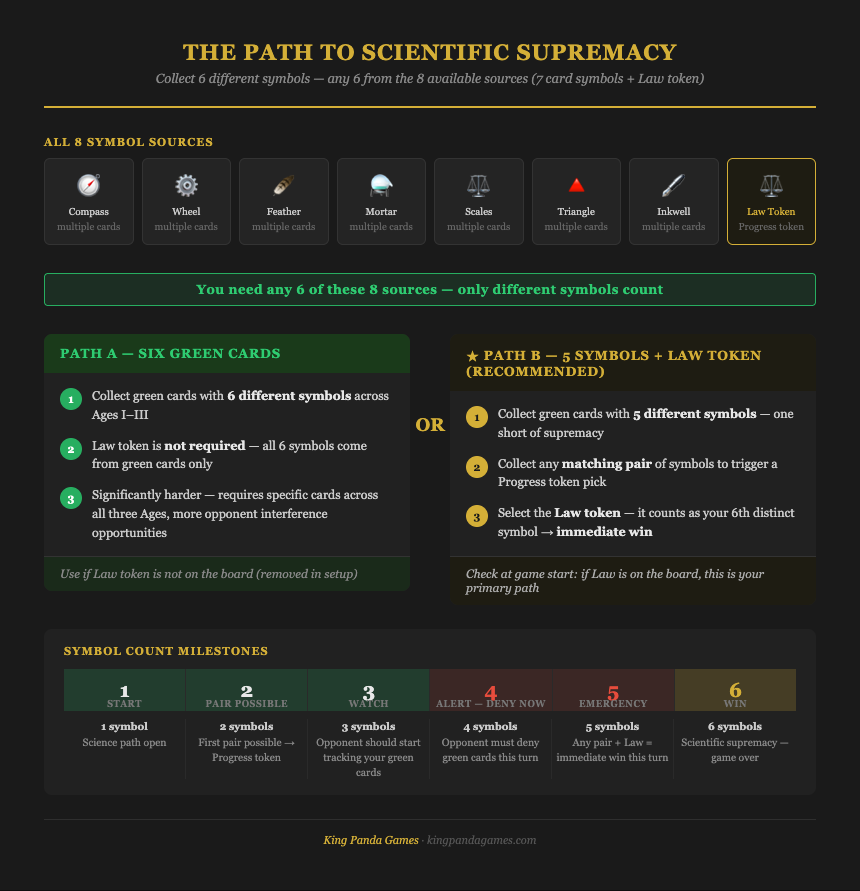
Worth knowing: Collecting 6 different symbols wins. Collecting a pair of any identical symbol earns you a Progress token pick — these are different goals that interact but don’t require each other.
The Pair Mechanic Is the Engine, Not the Destination
Most scientific supremacy victories don’t come from systematically collecting six distinct symbols. They come from the Progress tokens unlocked by pairs.
Every time you collect a matching pair of any symbol, you immediately choose one of the five face-up Progress tokens. Some tokens are worth triggering for their direct effects — Agriculture (6 coins + 4 VP), Philosophy (7 VP), Mathematics (3 VP per token). But two tokens transform the science path into a win condition accelerator:
Law counts as a scientific symbol. If you’ve collected five different symbols and grab the Law token through a pair trigger, you hit six and win immediately. This is the most common scientific supremacy path — get to five symbols through green cards, pair any symbol to grab Law, and win.
Strategy adds 1 shield to every new red card you build. If you’re threatening science and your opponent is forced to go shields to stop it, Strategy lets you match their military pressure while maintaining your science position. It creates a two-front threat that’s extremely difficult to stop.
How to Build the Science Path Without Announcing It
The biggest mistake science-path players make is taking every green card that appears, in order, as fast as possible. This tells your opponent exactly what you’re doing before you’re close enough to win.
- Take your first two or three green cards normally — they look like incidental science, not a strategy.
- Build one or two red cards in between. This serves double duty: it keeps the Conflict pawn from drifting dangerously toward your capital, and it obscures your science count.
- When you have four distinct symbols, start tracking what’s left in the deck structure. How many green cards are still face-down? Are both Science-symbol cards for your fifth symbol still available, or has one been removed in the pre-game setup?
- At five symbols, take the most direct path to six — either the next green card with a different symbol, or a pair that enables the Law Progress token.
You have four different science symbols. Your opponent has been focused on blue and yellow cards. The Dispensary appears face-up — it adds a Mortar symbol, your fifth unique symbol. You take it. Now you have five different symbols. Your opponent still hasn’t built any counter. The Law Progress token is on the board. You need one more pair trigger to grab it. The Pharmacist and the Scriptorium both have symbols you already have — one will pair. Two turns away. Your opponent has one turn to react. They have no green cards in hand. The game is over.
When Your Opponent Realizes It
Once your opponent sees you at four or five distinct symbols, they will start denying green cards. This is where the science path either closes fast or collapses.
At five distinct symbols, your opponent’s denial window is very narrow — you only need one more card or one pair trigger. The calculation flips: can they spend their turns exclusively denying green cards while still building enough to win on points? Usually not.
At four symbols, you’re vulnerable. Your opponent can slow-play denial across multiple turns while maintaining their own development. This is the danger zone — you’re committed enough that switching paths costs you, but not close enough to force an immediate win.
The correct response to four-symbol stalling: watch the board structure. If the cards covering key green cards have been taken (exposing your target cards for next turn), press forward. If the green cards you need are buried under three layers, consider whether pivoting to a civilian points game is more viable than waiting.
When to Abandon the Science Path
Abandon science supremacy when:
- Your fifth symbol requires a card that was removed in setup (unknown until the structure depletes)
- The Law Progress token has been taken by your opponent
- You’re in Age III with only one green card remaining in the structure and you don’t have five symbols yet
In each case, the path is blocked and pivoting to civilian points is the right move. The science cards you’ve built still contribute to scoring — green buildings often have VP values in addition to their symbols. You haven’t wasted your turns; you just need a different way to finish.
What feels like failure: You pursued science, couldn’t reach six symbols, and lost on points to a civilian-heavy opponent.
What actually happened: Your science threat forced your opponent to spend turns denying green cards instead of building high-value blue cards. Your total VP from green buildings was comparable to what they built while panicking. The game was closer than you think — and next time, you close it earlier.
The Law Token Is the Keystone
Everything above reduces to one practical directive: track the Law Progress token’s availability from game start.
If Law is on the board, a five-symbol position wins the game via any pair trigger. If Law is off the board (in the five tokens returned to box during setup), scientific supremacy requires six distinct green card symbols, which is significantly harder to achieve because it means collecting specific cards across all three Ages.
Check at setup. If Law is visible, you have a viable supremacy path via five symbols plus one pair. If it isn’t, plan for the harder path or pivot to civilian points from the start.
If you’re still learning whether 7 Wonders Duel is the right game for you, check out our full 7 Wonders Duel review.
Don’t own 7 Wonders Duel yet? This guide assumes the base game.
Check 7 Wonders Duel price on Amazon →
Frequently Asked Questions
How many science symbols do you need for scientific supremacy?
Six different scientific symbols — but only different ones count. Having four Compass cards doesn’t help; you need one each of six distinct symbol types. There are 7 different symbols total across the game, plus the Law Progress token which counts as an additional symbol. You need any 6 of the 8 possible sources (7 card symbols + Law).
Does the Law Progress token count as a scientific symbol?
Yes. The Law token counts as one scientific symbol for the purpose of both Progress token triggering (you can form a “pair” between Law and a matching green card symbol) and scientific supremacy (it counts as one of the six distinct symbols needed to win). If you have five card symbols and grab Law via a pair trigger, you win immediately.
Can you win by scientific supremacy in Age I or Age II?
Theoretically possible in Age II, extremely rare in practice. The green card distribution across ages makes it very difficult to collect six distinct symbols before Age III begins. Most scientific supremacy wins happen mid-to-late Age III, or late Age II in games where a player gets extremely favorable green card access and their opponent doesn’t contest it early enough.
What’s the best way to prevent scientific supremacy?
Take green cards your opponent needs before they become accessible to them, even if the green cards have no value for your own city. The key threshold to defend is four symbols — once your opponent has four different symbols, the game enters a critical phase. At five symbols, your ability to stop them is very limited. Intervene before they reach five.
Should you always pursue scientific supremacy if you can?
No. Scientific supremacy requires most of your green card picks to align across three ages — if the card structure doesn’t cooperate or your opponent contests aggressively, you may end Age II with four symbols and a long way to go. At that point, pivoting to civilian points using your existing green buildings (which all have VP values) is often more viable than forcing an unreachable supremacy.