

Most players lose Ticket to Ride for one of two reasons: they wait too long to claim routes they need, or they draw Destination Tickets they can’t complete. Neither of these is bad luck. Both are decisions — and both are fixable.
Some links below are Amazon affiliate links — as an Amazon Associate, King Panda Games earns from qualifying purchases at no extra cost to you. Full disclosure.
Ticket to Ride won the Spiel des Jahres in 2004, the award that turned it into a gateway staple. See the jury’s entry.
This guide covers the plays that separate experienced players from beginners. None of it requires memorizing the map. It requires understanding how the game’s pressure system works and making better decisions inside it.
The seven rules, up front — the rest of this guide explains each one:
- Claim your longest routes first; short routes can be improvised later, long ones can’t.
- Draw toward exact card sets, and claim the moment you have enough — not more than enough.
- Keep Destination Tickets that overlap; return the outlier.
- Never draw new tickets with fewer than 25 trains left.
- Take face-up Locomotives only when you need them this turn or next.
- Claim contested routes on your path early — passive blocking beats pure denial.
- Start counting everyone’s trains the moment anyone drops below 15.
The math behind rule one, straight from the scoring table:
| Route length | Points | Points per train |
|---|---|---|
| 1 | 1 | 1.0 |
| 2 | 2 | 1.0 |
| 3 | 4 | 1.3 |
| 4 | 7 | 1.75 |
| 5 | 10 | 2.0 |
| 6 | 15 | 2.5 |
A six-train route earns two and a half times the points per train of a two-space hop. That one column explains most of what separates winners from mid-table finishers.
Still picking a box to play in? We ranked every Ticket to Ride version, and if table size is the question, see how many players each version handles.
Prioritize Long Routes First — Always
The route scoring table is the most important thing to internalize in Ticket to Ride. A six-space route scores 15 points. A five-space route scores 10. Three two-space routes score 6 points total. The math is stark: one long route is worth more than three short ones, uses fewer turns to claim (just one turn vs. three), and usually requires cards you’re collecting anyway.
The first rule of Ticket to Ride strategy falls directly from this:
Claim your longest routes first. Short routes can be filled in with leftover cards at the end; long routes cannot be improvised.
In practice this means scanning your Destination Tickets at the start and identifying which long routes lie along your paths. If you’re connecting Los Angeles to Chicago, you want the longest segments you can find between those cities — not a chain of 1- and 2-space hops.
Hand Management: Collect Before You Commit
“When do I stop drawing and start claiming?”
This is the question new players get wrong most often. The temptation is to draw cards until you have more than you need for a route, then claim it comfortably. Experienced players flip this: they identify the routes they need, calculate the exact card sets required, and draw with purpose.
The face-up card display is your primary tool. Five cards are visible at all times. If the color you need is face-up, take it. If it isn’t, decide whether to blind-draw (top of deck) or take something adjacent to your plan. Locomotives are worth more than their face value suggests — 14 in a 110-card deck is a tight supply — but remember that taking a Locomotive from the face-up display costs you your second draw for that turn. The tempo cost is real.
What most players do: Take whichever face-up cards look useful, accumulate a large hand, then figure out where to spend them.
What works: Identify the exact card sets needed for your next two routes, draw specifically toward those, and claim as soon as you have enough — not as soon as you have more than enough.
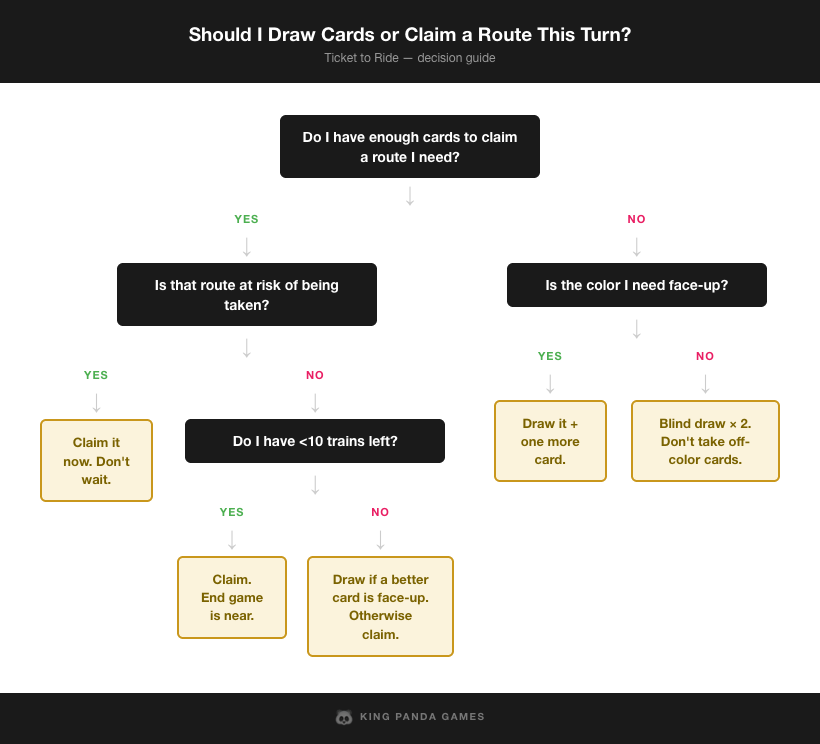
Holding excess cards is a liability, not a safety net. Cards in hand aren’t scoring points. Every turn you spend drawing instead of claiming is a turn someone else might take a route you need.
Reading the Board: Passive Blocking
You don’t need to aggressively block opponents to play good Ticket to Ride. But you should understand when a route you’re building also blocks someone else — and factor that into your timing.
Watch the face-up card display. If the same player takes two or three cards of the same color across consecutive turns, they’re accumulating toward a specific route. If that route is on your path, move it up your priority list. You don’t need to confront them — just claim it before they do.
It’s mid-game. You need the orange route from Denver to Oklahoma City (4 spaces) at some point in your plan. The player to your right has drawn orange cards twice in three turns. You have two orange cards and two Locomotives in hand — enough to claim it now. Your alternative is drawing for a blue route you need more urgently elsewhere. Do you claim Denver-OKC preemptively, or let it go and risk losing it? The right answer: claim it if you have the cards and the route is on your Destination Ticket path. Don’t hold routes hostage to a hypothetical future hand.
In games with four or five players, the board fills up faster than beginners expect. Routes that seem available in round two may be gone by round four. When in doubt, claim earlier.
When to Draw New Destination Tickets
New players draw Destination Tickets whenever they can. Experienced players treat the Destination Ticket deck like a loan: it gives you potential points upfront but charges interest if you can’t complete the connection.
Only draw new Destination Tickets when you’re already on track to complete the ones you’re holding and have trains left to execute a new plan.
The specific trigger to watch: if you have fewer than 25 trains remaining and you’re still working on a cross-country connection, don’t draw more tickets. You don’t have enough track left to take on new obligations. If you have 35+ trains remaining and your current tickets form a compact network, drawing one more ticket to fill adjacent space is a reasonable play.
Tickets that connect organically to your existing network are worth keeping. Tickets that pull you in a new direction — especially late in the game — are worth returning.
Managing the End-Game Clock
The game ends when any player reaches 0, 1, or 2 remaining trains at the end of their turn. Everyone including that player gets one final turn. This means the end-game clock is triggered by train count, not by turns elapsed — and it can arrive faster than it looks.
Start counting trains when any player drops below 15. At 8–10 trains, watch carefully. If another player is claiming long routes quickly, the game might end before you finish your planned network.
Two adjustments for end-game pressure:
- Prioritize claims over draws. When the clock is ticking, every drawing turn is a turn where you’re not placing trains. Spend cards rather than accumulate them.
- Reassess incomplete tickets. If a Destination Ticket would require five more turns to complete and the game might end in three, cut your losses mentally. You can’t return tickets mid-game, but you can stop devoting turns to a lost cause and claim shorter routes that still score points.
Reading Opponent Trains
One piece of information is always public: how many trains each player has remaining. Count them. A player who’s already placed 30 trains in round 5 is moving faster than you think. A player sitting at 38 trains isn’t a threat yet.
Track this, especially in the final third of the game. The player who triggers the end turn is almost always the one who took the most 5- and 6-space routes early — not the one who was hoarding cards.
Can You Actually Win Every Time?
No — and anyone promising a guaranteed Ticket to Ride win is selling something. The ticket draw and card flow guarantee real variance. What the seven rules change is your floor: they eliminate the self-inflicted losses (dead tickets, hoarded hands, missed clocks) that decide most casual games. Played consistently, they make you the favorite at almost any family table — which is as close to “every time” as an honest strategy gets. Heat: Pedal to the Metal rewards the same discipline: it looks like a racing game and it’s really about not spending resources you can’t get back, which our Heat strategy guide lays out as a budget.
Quick Tips & Tricks Worth Taping to the Box
- The 4-train routes are the value sweet spot most players skip — 7 points, modest card cost, rarely contested.
- Gray routes accept any single color: save your biggest same-color stacks for them when your named-color routes are gone.
- In 2–3 player games, blocking barely matters — race instead. In 4–5 player games, claim contested paths a full round earlier than feels necessary.
- Count the 12-of-each-color deck: if eight greens are visible in discards and hands, stop waiting on greens.
- The Longest Path bonus (10 points) most often goes to whoever claimed the most 5- and 6-train routes, not whoever planned for it — pursue it only when it lies along your ticket network anyway.
What the critics said about Ticket to Ride
We play these games ourselves, but it’s worth knowing where the rest of the hobby lands.
-
“I’ve always thought this game was amazing, so why not invest in a very nice version of it?”
— The Dice Tower. From the Dice Tower’s 10th Anniversary edition review — the base game’s standing is not in question.
-
Shut Up & Sit Down — SU&SD’s review covers the base game alongside Rails & Sails, and is the best single argument for why the route-claiming loop still holds up.
Going straight to the source: Read the official Ticket to Ride rules, plus the background and history.
📕 Grabbing the rules? Grab this too.
The KPG Budget Board Games Guide — 9 games under $30, each with player counts, play time, and who it’s actually for. Free PDF, no email gymnastics.
Don’t own Ticket to Ride yet? This guide assumes the base game.
Check Ticket to Ride price on Amazon →
Frequently Asked Questions
What’s the best opening strategy in Ticket to Ride?
Look at your initial three Destination Tickets and identify whether they overlap geographically. If two or three tickets share cities or run through the same region, keep all three — you can build an efficient network. If they pull you in completely different directions, return the one that requires the most independent infrastructure. Then identify the longest route on your combined path and collect toward that first.
Should you block other players in Ticket to Ride?
Deliberate blocking — claiming a route purely to deny an opponent — is usually a waste of a turn unless it directly protects a critical connection on your own Destination Ticket path. The more profitable play is passive: if a route is on your path AND blocks someone else, claim it as soon as you have the cards. Don’t burn turns on pure denial that doesn’t advance your own network.
Are Locomotives worth taking from the face-up display?
Only when you genuinely need a wildcard to complete a route that turn or the next. Taking a Locomotive from the face-up display costs you your second card draw — it counts as both cards for the turn. In tight board states where tempo matters, that’s an expensive trade. If you can get Locomotives from blind draws (top of deck), you get them without the tempo penalty.
How many Destination Tickets should you hold at once?
Two to four is the practical range. Starting with two connected tickets and completing them is a reliable strategy. Adding a third ticket mid-game makes sense if it connects naturally to your existing network. Holding more than four tickets simultaneously risks point penalties if the game ends before you can complete them.
What’s the biggest mistake beginners make?
Waiting too long to claim routes. New players often draw cards well past the point where they have enough to claim a route they need, hoping to “have extra just in case.” By the time they act, the route is gone. The moment you have the cards for a route on your Destination Ticket path, claiming it is almost always correct — especially in four or five-player games where competition for routes is high.
Does the Longest Continuous Path bonus change late-game strategy?
Yes, especially in close games. Ten points is the equivalent of claiming a five-space route — significant. If you’re within striking distance of the longest path and it doesn’t require building routes far from your Destination Ticket network, it’s worth pursuing. But building two disconnected networks to accumulate trains doesn’t earn the bonus — it has to be one continuous path.
The clearest path to winning Ticket to Ride: claim your longest routes early, draw cards with purpose rather than abundance, and keep one eye on opponent train counts as the end approaches. The rest follows from those three habits.
If you’re still deciding whether Ticket to Ride is the right game for your group, check out our full Ticket to Ride review first. Strategy also shifts with table size — our player count guide covers what changes from two players up to five.