


Bottom Line
Play Nine is best for golf fans and for families who already like the card game Golf and want a boxed version with bonuses. Skip it if you want the simplest card game on the shelf or the cheapest one. Its biggest strength is the scoring: matching pairs cancel to zero, so a 12 can turn from your worst card into a bonus. Its biggest weakness is that the same scoring takes the longest to explain and to add up.
Play Nine gets 3/5 Bamboo Plants and 3/5 Pandas from us. It’s a decent game, and Play Nine is worth buying for the right table, but it isn’t the first card game we’d tell most families to get.
The Bamboo is a 3 because the turn is easy and the scoring isn’t. You have to check every column for pairs, then for bonuses, then for the Hole-in-One exception, before you can total a hole. The Pandas are a 3 because the game sits in the middle for us: fun enough to play, not one we’d put ahead of the card games we rate higher.
Some links below are Amazon affiliate links — as an Amazon Associate, King Panda Games earns from qualifying purchases at no extra cost to you. Full disclosure.
Check Play Nine price on Amazon →
We own Play Nine. The ratings are ours, and the rules, card counts and odds in this review come from the publisher’s instruction sheet and our own arithmetic. We haven’t kept a play count, so we don’t quote one.
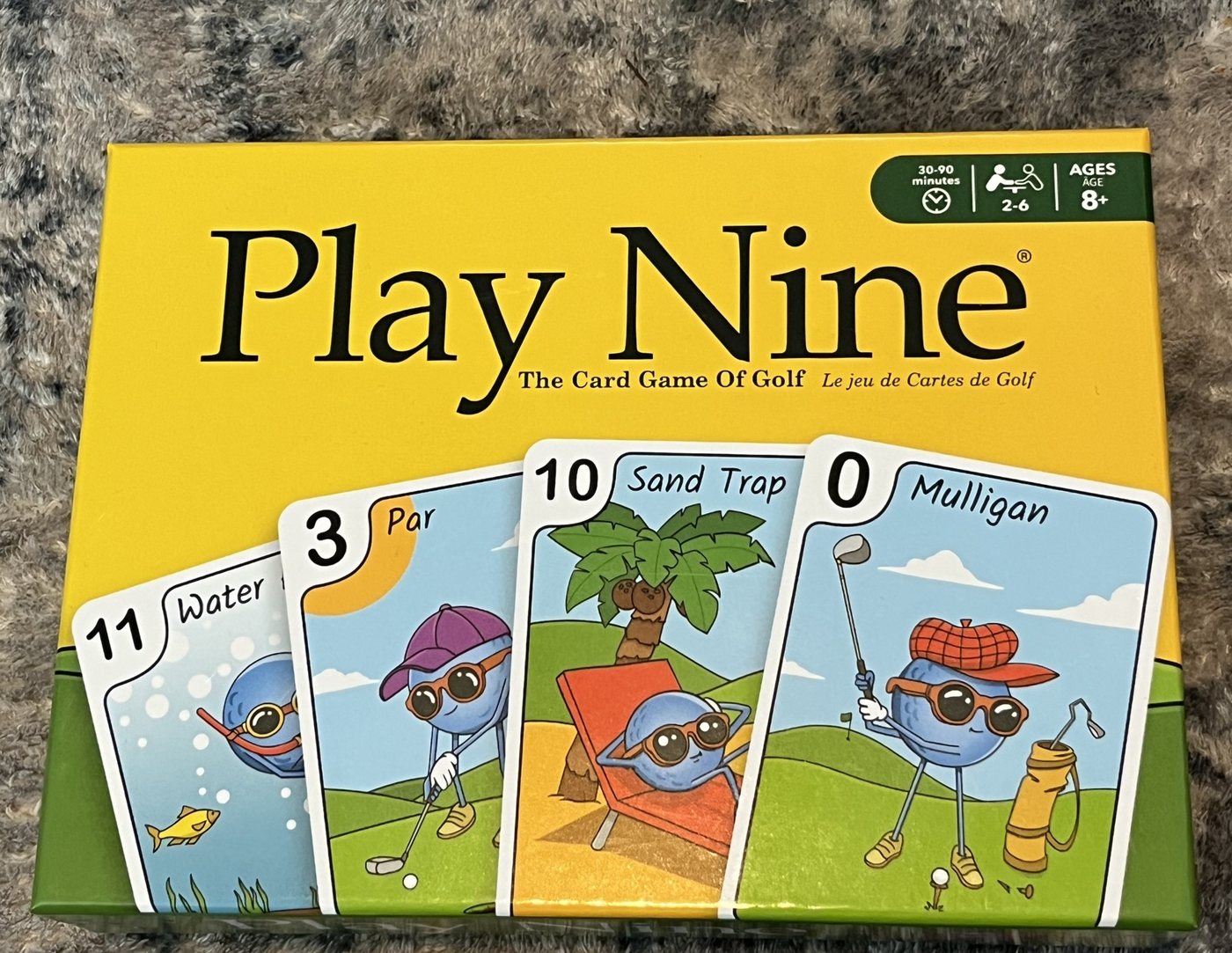
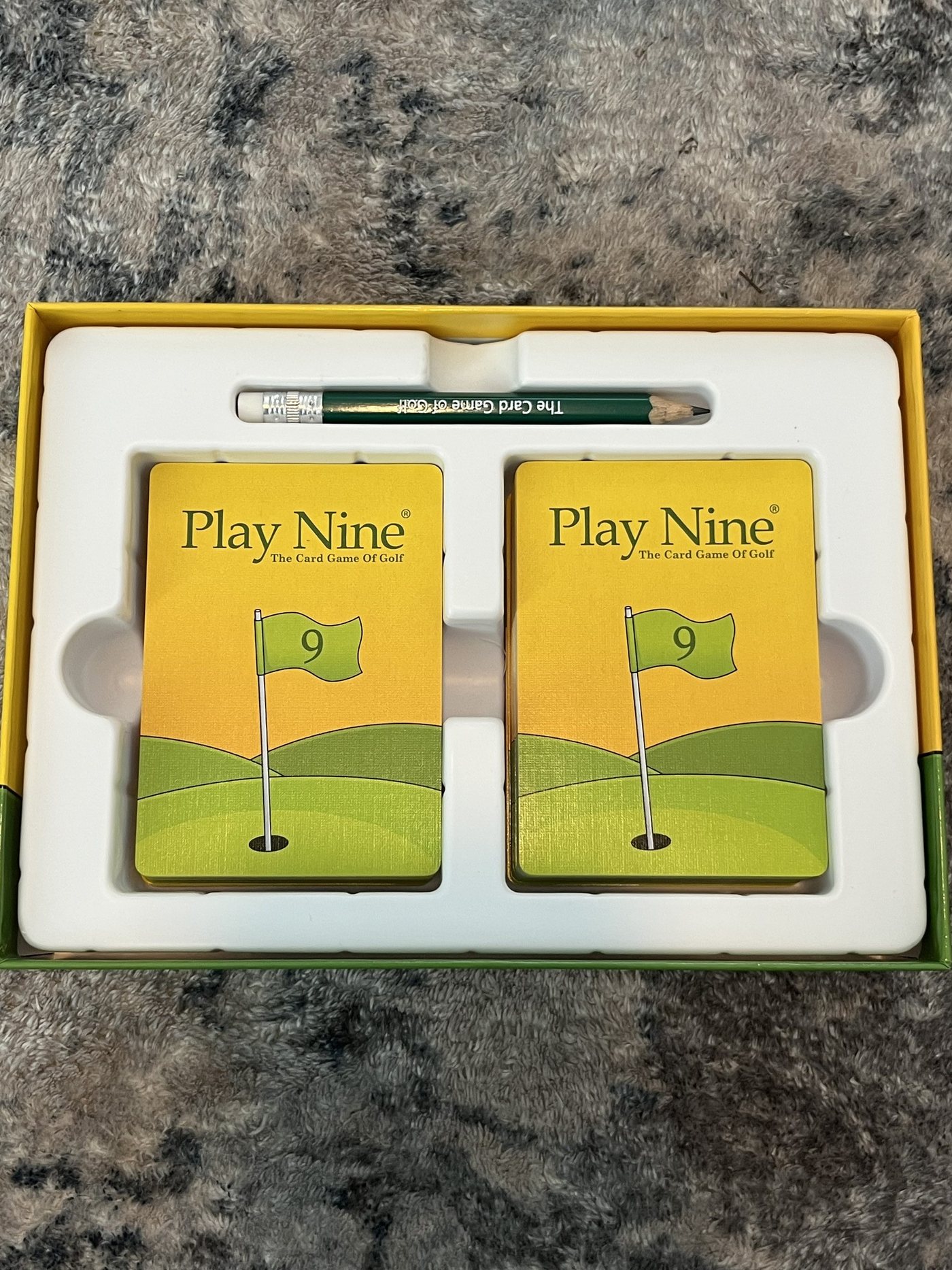
Play Nine is a golf-themed card game where each player tries to finish nine “holes” with the lowest total score by swapping out a grid of eight cards.
| Detail | Info |
|---|---|
| Players | 2–6 |
| Best Player Count | 3 or 4 — enough discards to watch, short waits between turns |
| Age | 8+ |
| Play time | 30–90 min on the box; 45 min on BoardGameGeek |
| Complexity | Light |
| Solo Mode | No |
| Designer | Ceil Anderson and Kathy Assell |
| Publisher | Double A Productions, distributed by Bonfit America |
| Popular Upgrades | No |
| Bamboo Plants | 3/5 — easy turns, fiddly scoring |
| Pandas | 3/5 — solid, not a first pick |
| Official site | The publisher’s Play Nine page |
How Play Nine Works
You’re trying to make your eight cards add up to as little as possible. Card values are strokes, and like golf, low wins.
The deck has 108 cards: eight each of 0 through 12, plus four Hole-in-One cards worth −5, according to the official instruction sheet. Everyone gets eight cards face down in two rows of four and turns any two face up.
A turn is one decision:
- Draw the top card of the deck or the top card of the discard pile.
- Swap it for one of your cards, face up or face down, and discard the old one.
- Or, if it came from the deck, discard it and flip one of your face-down cards.
When one player has all eight cards face up, everyone else gets one more turn and the hole is scored.
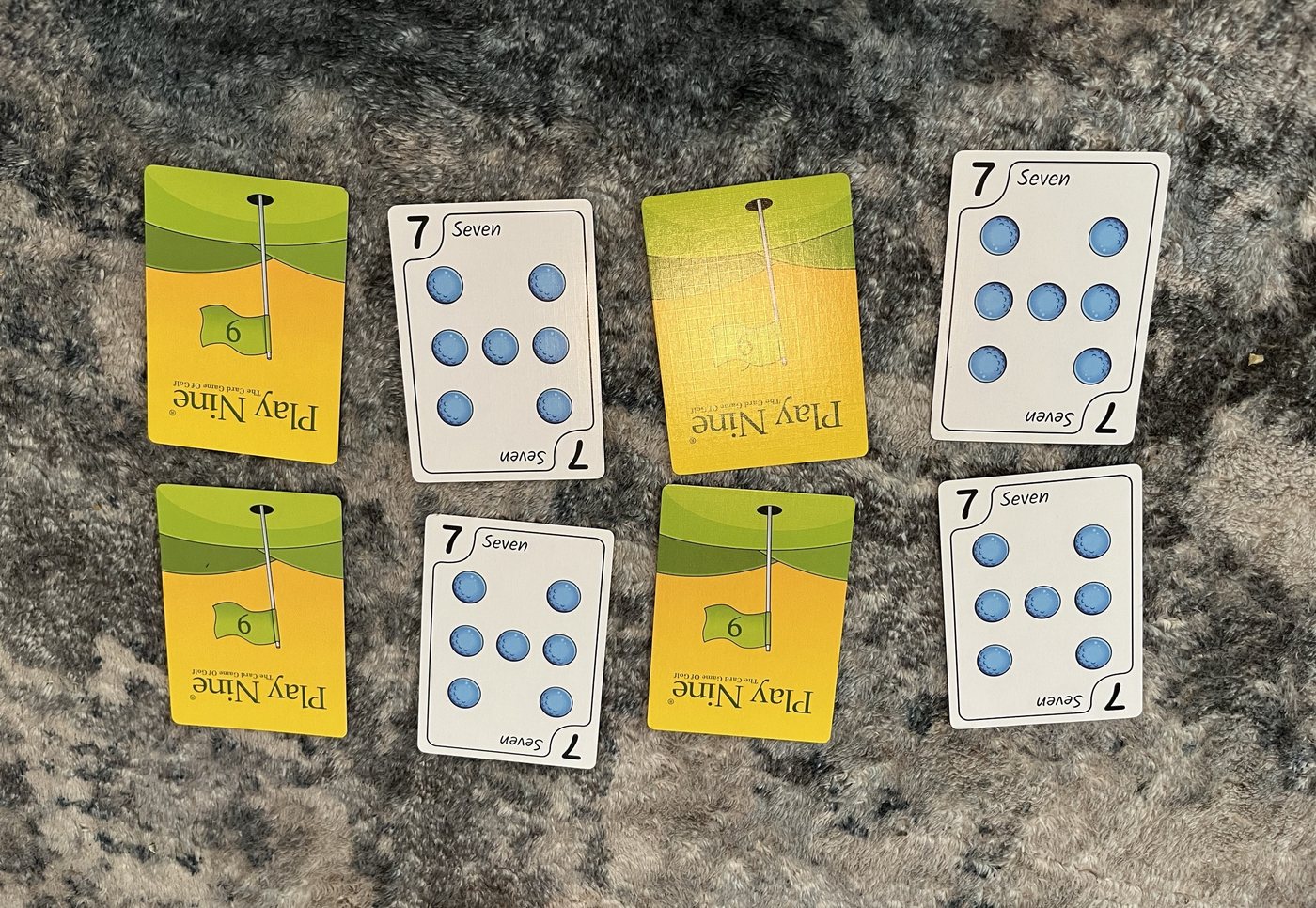
You have a 12 face up in your first column, with a face-down card under it. The player before you discards a 12. Take it and put it under your own 12. Two matching cards in a column cancel out, so 24 strokes just became zero.
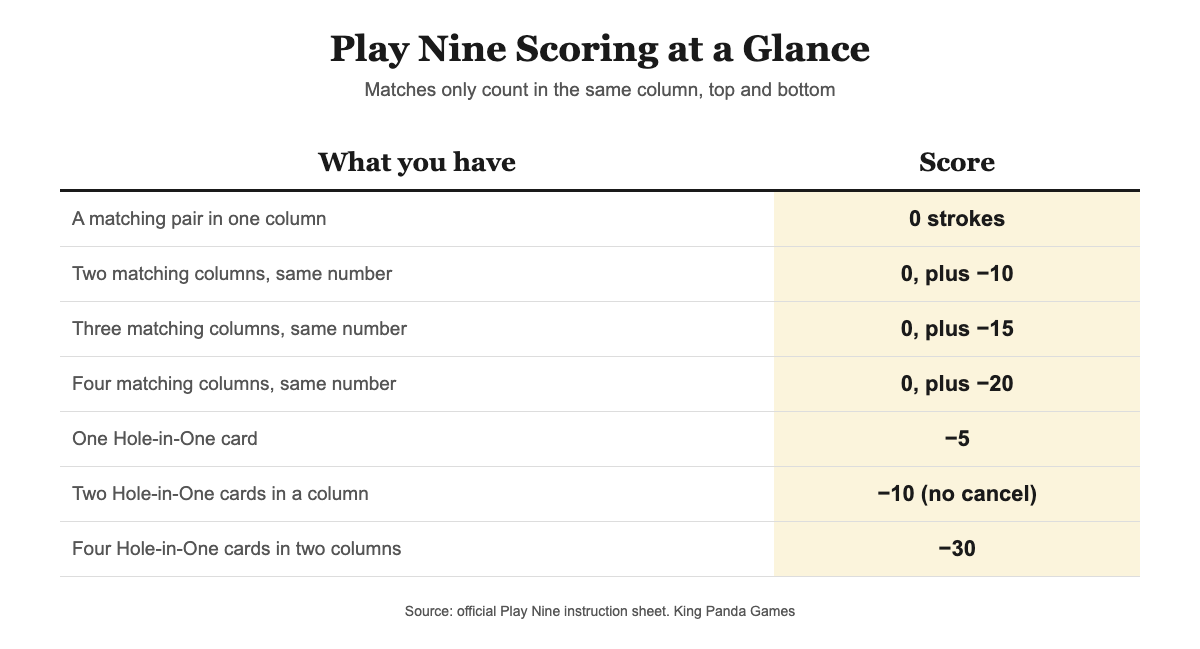
That pair rule is the heart of the game. Two matching columns of the same number earn a −10 bonus, three earn −15 and four earn −20. Our Play Nine rules guide has the full scoring table, and the publisher’s how to play page has a video.
What We Liked
Pairs make high cards interesting. In most low-score card games, a 12 is just bad. Here a 12 is half of a pair worth zero, and a second pair of 12s is a −10 bonus. That gives you a reason to keep a card you’d normally dump.
You control when the hole ends. With one face-down card left, the rules let you skip turns: draw, discard, and leave that last card alone until you like what you see. Ending the hole gives everyone else exactly one more turn.
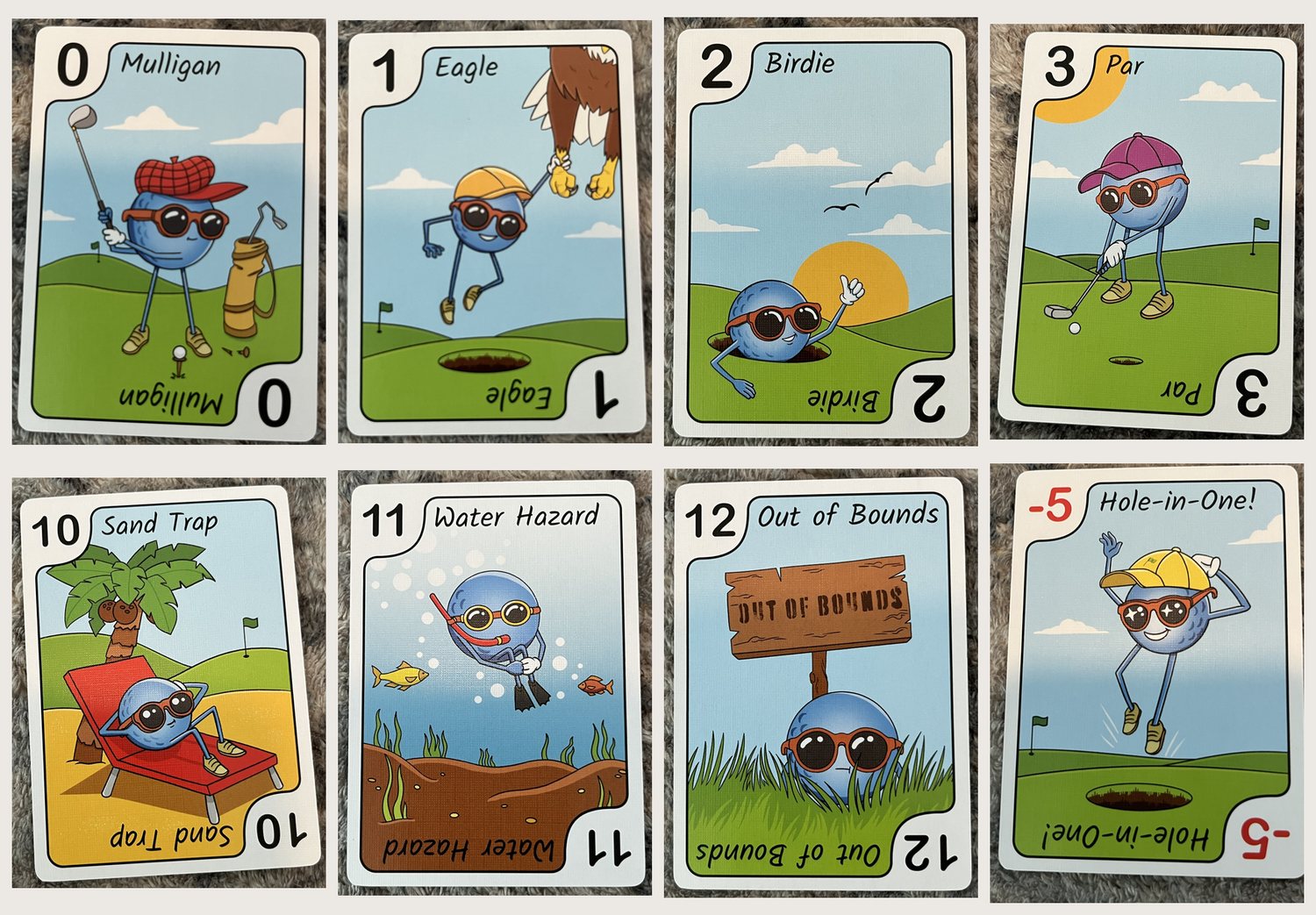
The theme holds together. The 0 is a Mulligan, the 12 is Out of Bounds, the −5 is a Hole-in-One, and rounds are holes. For a golfer, that’s a real part of the appeal.
The game has a fixed length. It’s always nine holes. Nobody has to argue about when to stop.
What We Disliked
Scoring is the slow part. Every hole ends with the same checklist: pairs, then bonuses, then the Hole-in-One exception, then the total, then the score pad. It’s why we stop at 3/5 Bamboo.
It costs more than its rivals. The publisher lists Play Nine at $19.99. Mattel lists Skip-Bo at $8.49 and Phase 10 at $6.49, and we rate both of those higher for fun.
- The deal decides a lot. The average card is worth about 5.6 strokes, so eight unseen cards average about 45. Some holes you’re dealt a mess and can’t fix it in time.
- Nine holes is nine shuffles and nine deals. That’s a lot of handling for one game.
Who It’s For
Play Nine is for golfers, for families who already play Golf with regular cards, and for groups who like chasing bonuses more than playing it safe. The box says ages 8 and up.
It also suits mixed-age tables where a nine-round structure helps: everyone knows how much game is left.
Who should skip this game:
– Anyone who wants the lightest possible rules. The scoring has too many cases for that.
– Budget shoppers. Cheaper card games do a similar job.
– Players who dislike luck. The deal and the draws matter more than the decisions.
Who Should Buy This?
Buy Play Nine if the golf theme means something to the person you’re buying for, or if your family already loves this style of game and wants the boxed version with bonuses. The publisher’s list price was $19.99 when we checked on October 4, 2026.
If you just want a good, cheap card game for the family, we’d send you to our Skip-Bo review or our Phase 10 review first. Play Nine is a situational buy, not a core one.
For a golf gift, the standard Play Nine card game is the one to get.
Check Play Nine price on Amazon →
Best Player Count
Play Nine is best with 3 or 4 players. The box says 2 to 6.
With three or four, there are enough discards going by to give you real choices, and your turn still comes around quickly. The small BoardGameGeek community poll lands in the same place, though only a handful of people have voted in it.
At two, you see fewer discards between your turns, so more of your draws are blind. At six, 48 of the 108 cards are dealt out before anyone moves, and the wait between turns is longer.
Replayability
Play Nine holds up as long as the pair-and-bonus chase stays fun for your group. The rules and the deck never change, and there’s nothing to add.
Each hole is a fresh deal, so no two play out the same. The limit is that the decisions repeat: replace a high card, chase a pair, decide when to end. Our Play Nine strategy guide covers those in detail.
Awards
Play Nine has no major game awards that we could verify. BoardGameGeek lists it as first published in 2004, designed by Ceil Anderson and Kathy Assell.
Similar Games
If you like the card game Golf, try Play Nine — it’s the same idea in a box. Pagat’s Golf page describes an eight-card version with two decks and four jokers, which is the same 108 cards and the same two rows of four.
If you like Skyjo, Play Nine will feel familiar — both are Golf variants. Skyjo uses twelve cards and removes matching columns of three. Play Nine uses eight cards and pays bonuses for matching columns. Our Play Nine vs Skyjo comparison lays out the differences.
If you want an easier family card game, try Skip-Bo — it’s a race to empty a pile, with no adding up at the end. We rate it 5/5 Pandas in our Skip-Bo review.
Tips & Tricks
Treat every face-down card as a 5.6. That’s the average value of a card in the deck. If you draw a 4 or lower, it’s better than an unseen card. If you draw an 8, it isn’t.
Pair your high cards. Matching two 2s saves four strokes. Matching two 11s saves twenty-two.
The tempting play: flip your last card as soon as you can, to end the hole.
The better play: check the table first. If your score is low and the others still have cards face down, end it. If not, use the skip rule and wait for a better card.
Stack your Hole-in-One cards without worry. Two of them in one column still score −10. They’re the one pair that doesn’t cancel to zero, so putting them together costs you nothing.
Watch what the next player needs. If they have a 10 showing above a face-down card, don’t discard a 10.
Frequently Asked Questions
Is Play Nine worth buying?
For golf fans and families who already like the card game Golf, yes. We rate it 3/5 Bamboo and 3/5 Pandas. For a general family card game, we rate Skip-Bo and Phase 10 higher, and both cost less.
How long does a game of Play Nine take?
The box says 30 to 90 minutes, and BoardGameGeek lists 45. The rules set the game at nine holes, and each hole is a fresh shuffle and deal.
Is Play Nine hard to learn?
The turn is easy: draw a card, then swap it or flip one. The scoring takes longer to learn, because pairs cancel, matching columns earn bonuses, and Hole-in-One cards follow their own rule.
How many people can play Play Nine?
Play Nine is for 2 to 6 players. We think it’s best with 3 or 4.
Do you need to like golf to enjoy Play Nine?
No. The golf theme is in the names and the nine-hole structure. The game itself is about swapping cards for a low score, and you don’t need to know anything about golf.
Is Play Nine the same as the card game Golf?
It’s a boxed version of eight-card Golf. Play Nine adds its own card values, a −5 Hole-in-One card and bonuses of −10, −15 and −20 for matching columns.
Is Play Nine good for kids?
The box says ages 8 and up. A child needs to be comfortable adding and subtracting, including negative numbers, to score their own holes.
Want to go deeper?
- How to Play Play Nine — setup, turns and the full scoring table. Read it here
- Play Nine Strategy — what to keep, when to chase pairs, and the odds behind it. Read it here
- Play Nine vs Skyjo — the two golf card games compared. Read it here
Verdict
Buy it if you’re shopping for a golfer, or your family already loves Golf with regular cards and wants bonuses. Skip it if you want the easiest or cheapest card game on the shelf. Try before you buy if you’re not sure: deal a hand of eight-card Golf with two regular decks and see if the idea lands.
Play Nine official site: the publisher’s Play Nine page