

7 Wonders is played over three Ages. Each Age, every player is dealt 7 cards, picks one, and passes the rest. You build the card, bury it under your Wonder, or sell it for 3 coins. After six turns you fight your two neighbors. The highest score after Age III wins.
Some links below are Amazon affiliate links — as an Amazon Associate, King Panda Games earns from qualifying purchases at no extra cost to you. Full disclosure.
These rules are for the Second Edition of 7 Wonders, for 3 to 7 players. Everything here follows the official rulebook, which is 8 pages long.
Setup
- Sort the cards. Split the 148 Age cards into Age I, Age II and Age III. Each card shows a minimum player count such as 3+ or 5+. Keep only the cards at or below your number of players.
- Add the guilds. Take the purple cards out of Age III. Shuffle them and put back as many as the number of players plus 2. Five players means 7 guilds.
- Hand out Wonders. Each player takes a Wonder board at random and picks a side. The rulebook suggests the Day side for your first few games.
- Take 3 coins each. The rest of the coins and the military tokens go in the middle.
Your “neighbors” are the players directly to your left and right. They’re the only people you trade with and the only people you fight.
What You Do on a Turn
Every turn has three steps, and everyone does them at the same time.
- Choose a card. Pick one card from your hand and place it face down.
- Play it. When everyone has chosen, reveal together and each do one of the three actions below.
- Pass your hand. Give the cards you didn’t choose to your neighbor. Pass left in Ages I and III, and right in Age II.
| Action | What you pay | What you get |
|---|---|---|
| Build the card | The cost printed on the card | The building joins your city for the rest of the game |
| Build a Wonder stage | The cost printed on that stage | Tuck the card face down under your board and gain the stage’s effect |
| Sell the card | Nothing | Discard it and take 3 coins |
Two limits apply. You can never build two cards with the same name. And Wonder stages must be built left to right, though you can build them in any Age and you don’t have to build them at all.
An Age lasts six turns. On the sixth, you’ll have two cards: play one and discard the other. That discarded card earns no coins.
Check 7 Wonders price on Amazon →
The Seven Card Colors
| Color | Type | What it does |
|---|---|---|
| Brown | Basic materials | Makes clay, stone, ore or wood |
| Grey | Manufactured goods | Makes glass, cloth or papyrus |
| Blue | Civic buildings | Straight victory points |
| Yellow | Commercial buildings | Coins, cheaper trading, some points |
| Red | Military buildings | Shields for the fight at the end of each Age |
| Green | Science buildings | One of three science symbols |
| Purple | Guilds (Age III only) | Points based on what you or your neighbors built |
How to Pay for a Card
A card costs nothing, 1 coin, or a set of resources. Resources are not used up. If your city makes one wood, you have one wood on every turn of the game.
Your city’s resources come from your Wonder’s starting resource, your brown and grey cards, and some yellow cards and Wonder stages. Each symbol can be used once per turn.
What if you’re short? Buy from a neighbor. Pay them 2 coins for each resource you need. They keep their card and can still use it themselves.
A few details matter here:
- You can only buy a neighbor’s starting resource and their brown and grey cards. Their yellow cards and Wonder stages are off limits.
- You must have the coins at the start of the turn. Coins another player pays you this turn can’t be spent until the next one.
- You can’t buy from a building your neighbor built this same turn.
- A neighbor can’t refuse to sell.
Worth knowing: from Age II on, some cards can be built for free through a chain. If you already built a card showing the matching chain symbol, you skip the cost. The rulebook’s example: build the Theater in Age I and the Gardens are free in Age III.
Military Conflicts
At the end of each Age, count the shields on your red cards and your Wonder. Compare your total with each neighbor separately.
| Result against a neighbor | Age I | Age II | Age III |
|---|---|---|---|
| You have more shields | +1 | +3 | +5 |
| You have fewer shields | −1 | −1 | −1 |
| Tie | 0 | 0 | 0 |
That’s two comparisons per Age and six in the whole game. The best possible military score is 18, and the worst is minus 6.
How Scoring Works
The game ends after the Age III military fight. Add up seven categories on the score pad.
| Category | How it scores |
|---|---|
| Wonder | Points shown on the stages you built |
| Coins | 1 point for every 3 coins |
| Military | Add your victory tokens, subtract your defeat tokens |
| Blue cards | Points printed on each card |
| Yellow cards | Points described on the card, if any |
| Green cards | Each symbol scores its count squared, plus 7 for each set of three different symbols |
| Purple cards | Points described on each guild |
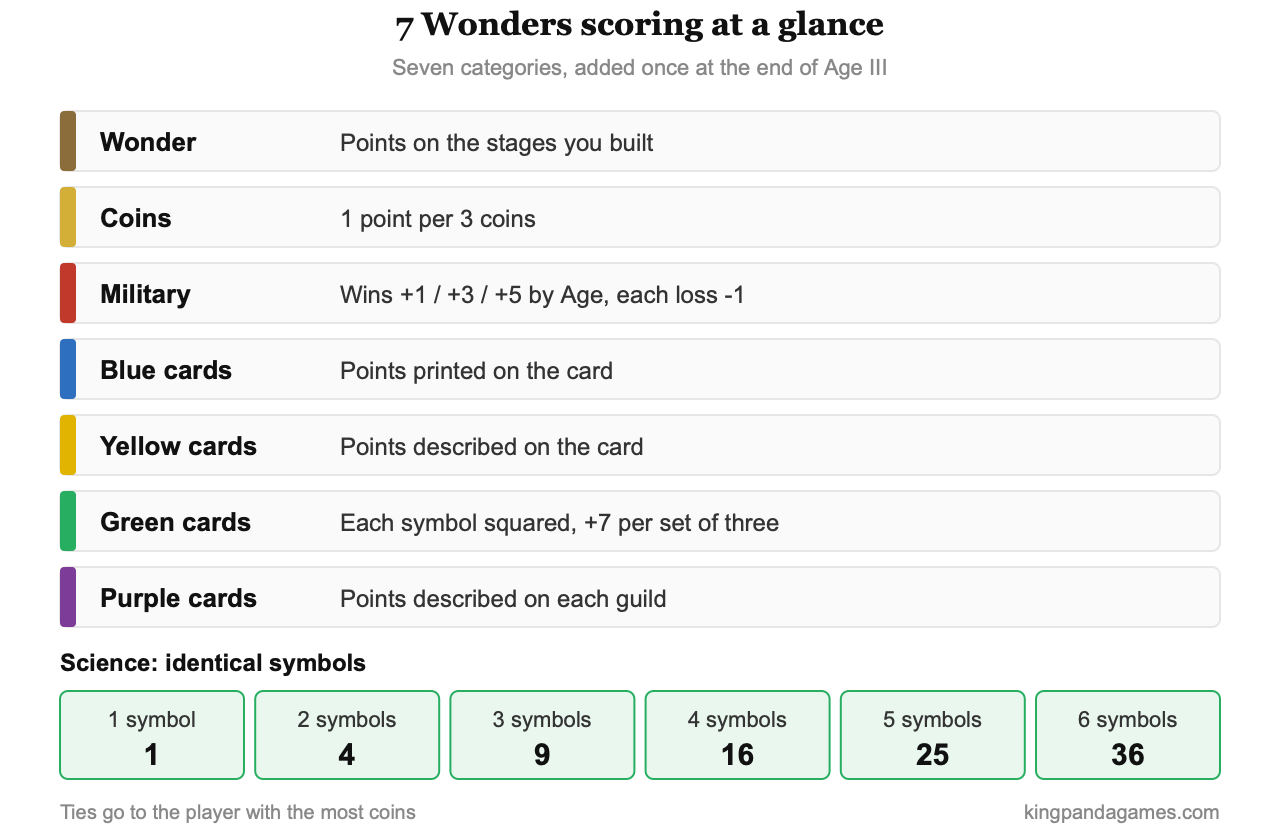
Science is the one that needs an example. Say you have three compasses, two gears and one tablet. The compasses score 9, the gears 4 and the tablet 1. You also have one full set of three different symbols, worth 7. That’s 21 points.
| Identical symbols | 1 | 2 | 3 | 4 | 5 | 6 |
|---|---|---|---|---|---|---|
| Points | 1 | 4 | 9 | 16 | 25 | 36 |
Highest total wins. If there’s a tie, the tied player with the most coins wins. If that’s tied too, they share the win.
Rules That Are Easy to Miss
The last card of each Age is discarded, not sold. You get no coins for it.
Coins you receive can’t be spent the same turn. If a neighbor buys from you, that money is for next turn.
You can’t build duplicates. Higher player counts add second copies of many cards, but your city can only hold one of each name.
Ties in military give no tokens to anyone. You need at least one more shield than a neighbor to score.
Wonder stages are optional. Nothing in the rules makes you finish your Wonder, and the card you tuck under it does nothing else.
Once the turn structure makes sense, our 7 Wonders strategy guide explains what to actually pick. If you’re reading the rules to decide whether to buy the game, the verdict and both scores are in our 7 Wonders review.
Frequently Asked Questions
How many cards do you get in 7 Wonders?
Each player is dealt 7 cards at the start of each of the three Ages. You play six of them and discard the seventh, so you play 18 cards in a full game.
Which way do you pass cards in 7 Wonders?
Pass to the left in Age I and Age III, and to the right in Age II. The direction is printed on the back of each Age’s cards.
How does buying resources work in 7 Wonders?
Pay 2 coins to a neighbor for each resource you need that turn. You can buy their Wonder’s starting resource and anything on their brown and grey cards. The neighbor keeps the card, can still use it, and cannot refuse.
How is science scored in 7 Wonders?
Each of the three science symbols scores the number you have multiplied by itself, so three of a kind is 9 points. Every complete set of three different symbols adds another 7 points. Both are added together.
Can you build the same card twice in 7 Wonders?
No. You can never have two buildings with the same name in your city. If you’re passed a second copy, your options are to bury it under a Wonder stage or sell it for 3 coins.
What happens in a tie in 7 Wonders?
The tied player with the most coins wins. If they have the same coins as well, they share the victory.
How many players can play 7 Wonders?
The Second Edition plays 3 to 7. There are no two-player rules in its rulebook. For two players, 7 Wonders Duel is a separate game.
Check 7 Wonders price on Amazon →
Looking for the official files? Repos Production hosts the rulebook in ten languages on its 7 Wonders page.