

Catan vs Carcassonne: Which Board Game Should You Learn First?
Someone on Reddit recently asked: “Is Carcassonne easier than Catan?” The thread got 139 comments. That’s how genuinely this question divides people — because the answer isn’t obvious and both games have passionate defenders.
Some links below are Amazon affiliate links — as an Amazon Associate, King Panda Games earns from qualifying purchases at no extra cost to you. Full disclosure.
Here’s the short answer: Carcassonne is easier to learn. Catan is more social. Which one you should buy depends entirely on what your group wants from a game night.
If you already know you want Catan, read our full Catan review. This guide is for people choosing between the two.
How They’re Different at a Glance
| Catan | Carcassonne | |
|---|---|---|
| Learning time | ~20 min | ~10 min |
| Play time | 60–120 min | 30–60 min |
| Players | 3–4 (base) | 2–5 |
| Conflict level | High (trading, robber) | Low (tile placement) |
| Luck factor | High (dice) | Medium (tile draws) |
| Social energy | Very high | Moderate |
Learning Curve
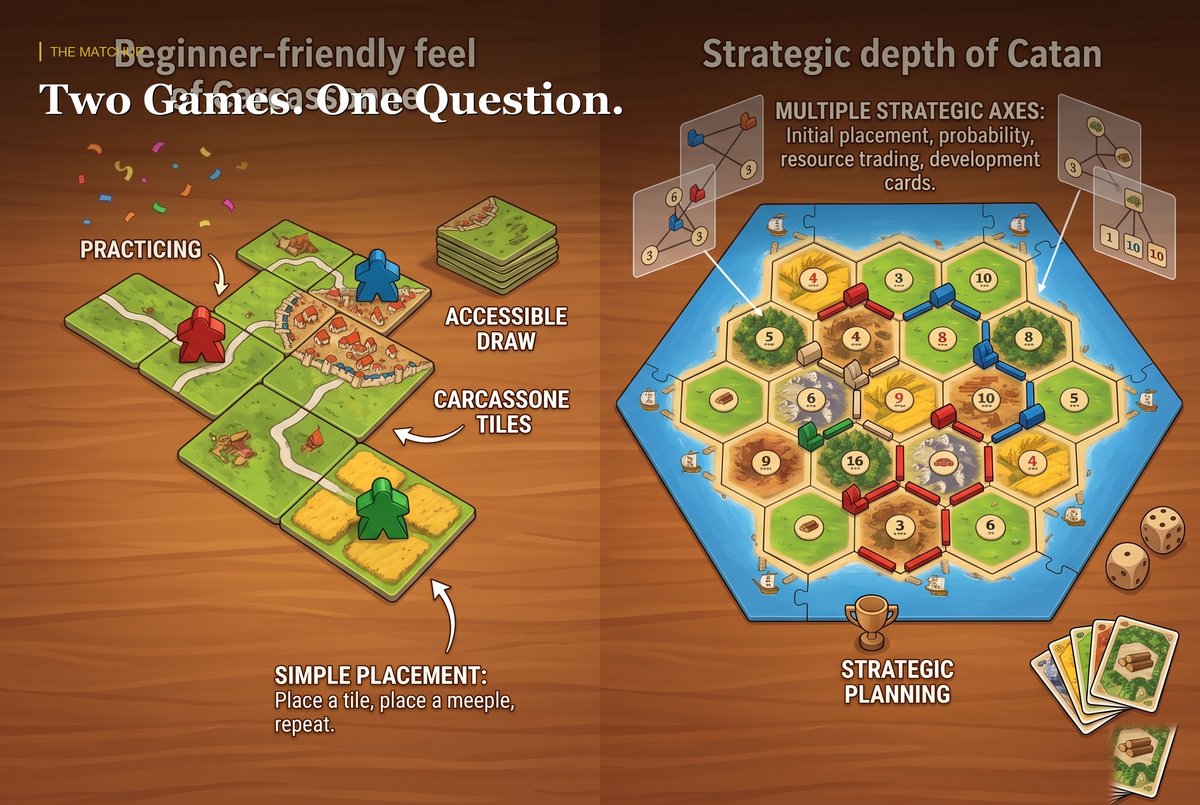
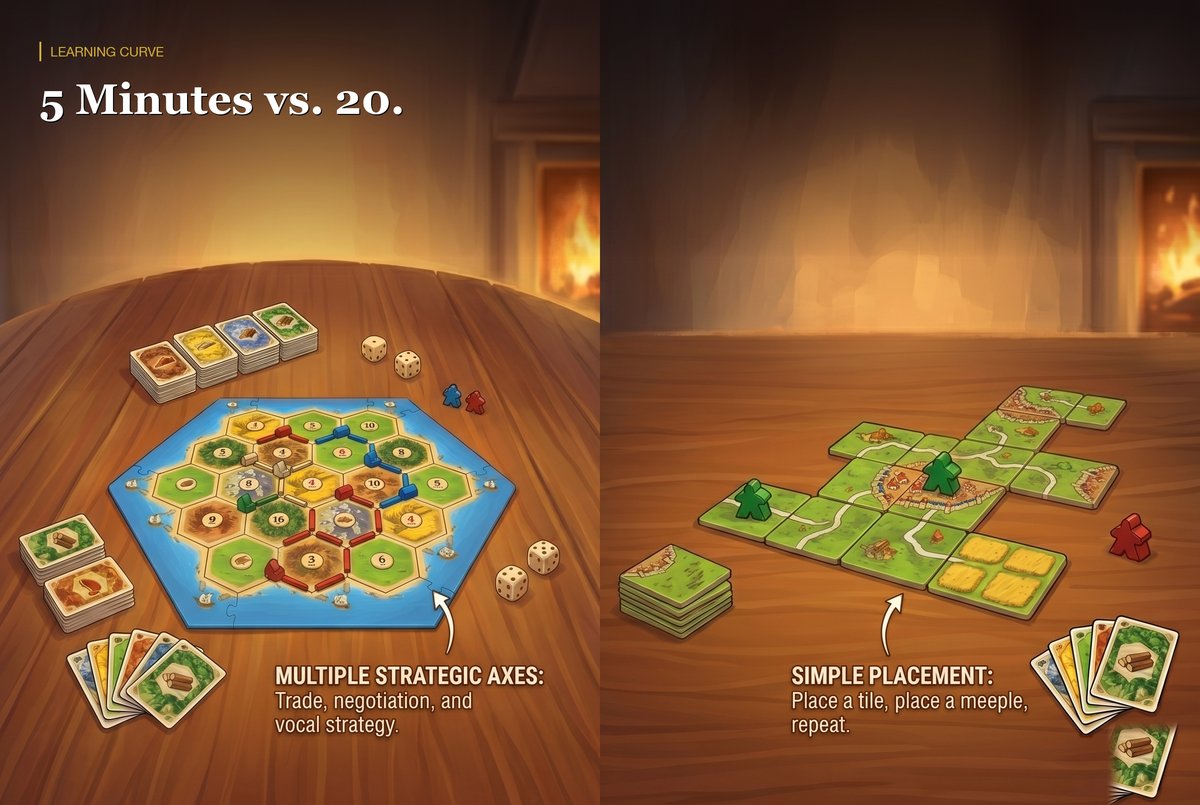
Carcassonne is simpler. You draw a tile, place it so it connects to existing tiles, and optionally place a follower (a small wooden figure called a meeple) to claim a feature. Roads, cities, monasteries, and fields score points. That’s most of the game. You can teach someone Carcassonne in five minutes and they’ll be playing comfortably within their first two turns.
Catan takes longer. The core resource loop clicks quickly, but new players consistently stumble on the same things: what you can build and for what cost, how the robber works, when to trade vs. when to spend. Most new players feel comfortable by turn 5 or 6 — that’s not slow for a 90-minute game, but it’s noticeably more than Carcassonne’s immediate accessibility.
Verdict on learning curve: Carcassonne wins decisively. If you have kids under 10 or someone who’s genuinely new to board games and might get frustrated by a rulebook, start with Carcassonne.
How Much They Conflict
This is where the games diverge most sharply.
Catan is built on conflict. The robber directly steals from players. Trading involves negotiation and leverage. Players block each other’s expansion with roads. Someone is always benefiting from someone else’s misfortune. This generates enormous social energy — laughter, arguments, alliances, grudges. Some groups love this. Some groups hate it. Most of the heat comes from one piece, and the robber rules are narrower than most tables play them.
Carcassonne conflicts passively. You can place your meeple on a city that someone else started building, which steals points if you complete it — but that’s as aggressive as it gets. There’s no direct stealing, no dice that punish specific players, no negotiation. The conflict is subtle enough that many players don’t even experience it as conflict until they’re several games in.
Verdict on conflict: If your group includes anyone who gets stressed by direct competition or confrontation, Carcassonne is the safer choice. If your group loves social chaos and interpersonal drama, Catan is what you want.
Luck Factor
Catan is more luck-dependent. Two dice determine your resource production every turn. If your numbers don’t roll, you produce nothing and fall behind. Good placement reduces variance — putting settlements on 6s and 8s produces reliably — but the dice still have enormous influence, especially in shorter games.
Carcassonne has luck, but less punishment. You draw tiles randomly, and you can’t always place a tile optimally. But you can almost always place every tile somewhere useful, and bad tile draws are less catastrophic than Catan’s cold dice streaks. Experienced players adapt to their tiles rather than being punished by them.
Verdict on luck: Players who get frustrated with bad luck will have a better time with Carcassonne. The variance is lower and the game feels more controllable.
Social Energy and Replayability
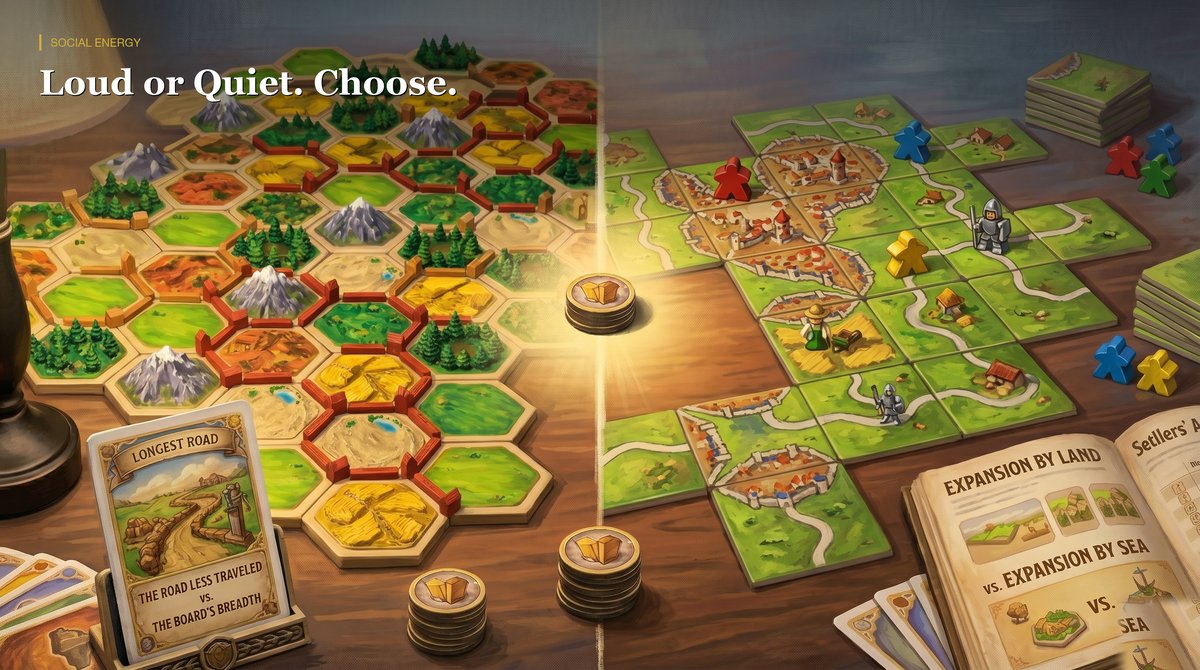
Catan generates more table talk. Every trade is a conversation. Every robber placement is a declaration. Players form alliances, break them, accuse each other of bad deals. A Catan session creates stories — “remember when you robbed me with that 7 right before I could build my city?” Carcassonne sessions are quieter. More thoughtful, less loud.
Carcassonne plays better at two. The base Catan game doesn’t work at two players. Carcassonne plays remarkably well as a two-player game — some argue it’s at its best with just two. If you’re buying a game primarily for a partner or a single friend, Carcassonne is the better choice.
Both have excellent replayability. Catan’s modular board creates a different island every game. Carcassonne’s tile deck creates a different landscape every game. Neither gets stale quickly.
The Honest Recommendation
Buy Carcassonne first if:
- You have younger players or complete newcomers
- Your group prefers lighter, less confrontational games
- You often play with two players
- You want something that plays in under an hour
Buy Catan first if:
- Your group enjoys social negotiation and mild conflict
- You want a game that becomes a group tradition
- You have 3–4 players consistently
- You want something with more depth that scales as players get better
Buy both eventually. They’re different enough to coexist in any collection. Carcassonne is the game you play when you want something approachable and calm. Catan is the game you play when you want the table talking.
One note: if you play Carcassonne and love it but want more depth, your natural next step is Catan. If you play Catan and love it but want something you can play faster or with less conflict, Carcassonne is your next step. They’re natural complements.
Check Carcassonne price on Amazon →
Frequently Asked Questions
Is Carcassonne easier to learn than Catan?
Yes, Carcassonne is definitively easier to learn. You can teach someone the core rules in five minutes, and they'll be comfortable playing within their first two turns, making it perfect for absolute beginners or younger players. Catan, while not overly complex, has more rules new players consistently stumble on.
Which game is better for new board game players, Catan or Carcassonne?
For genuinely new board game players, Carcassonne is the superior choice. Its simple "draw, place, claim" mechanics are incredibly accessible, ensuring a smooth first experience without the frustration of complex rulebooks or direct player confrontation. Catan's higher conflict and learning curve can be a bit much for total newbies.
How much conflict is in Catan compared to Carcassonne?
Catan is built on high, direct conflict, featuring the robber stealing resources, aggressive trading negotiations, and players actively blocking expansion. This generates intense social energy and drama. Carcassonne, by contrast, has very low, passive conflict, where the most aggressive move is sharing a city for points, making it much calmer.
Is Catan too complex for kids or new players?
Catan isn't necessarily too complex, but its higher learning curve and direct conflict can be frustrating for younger kids, especially those under 10, or for people genuinely new to board games. Carcassonne offers a much smoother, less confrontational experience that's better suited for introducing children or total newbies without overwhelming them.
Which game has more player interaction, Catan or Carcassonne?
Catan offers significantly more player interaction and social energy due to its core mechanics of trading, negotiation, and direct conflict like the robber. This often leads to lively discussions, alliances, and even grudges. Carcassonne's interaction is much more subtle and passive, focusing on shared tile placement rather than direct negotiation.
Does luck play a big role in Catan?
Yes, luck plays a significant role in Catan, primarily through the two dice rolls that determine resource production each turn. If your numbers don't come up, you can quickly fall behind, which can be frustrating. Carcassonne has a medium luck factor, mostly tied to the random tile draws.
Which game should I buy if my group dislikes direct competition?
If your group gets stressed by direct competition or confrontation, Carcassonne is absolutely the safer and better choice. Its conflict is so subtle that many players don't even perceive it as such, offering a much more relaxed and friendly gaming experience compared to Catan's aggressive player interactions.