

How to Win at Carcassonne: Strategy Guide for Beginners
You’ve played Carcassonne a few times. You understand how tiles connect, you know how scoring works — and you keep losing. Someone at the table finishes the game with 80 points while you’re sitting on 45 and you can’t figure out where the gap came from.
Here’s where it came from: farms. And meeple timing. And the fact that you’re probably completing features for your opponents as often as you’re completing them for yourself.
This guide covers the five principles that actually explain why experienced Carcassonne players win consistently — not just once, but game after game.
If you haven’t read our full Carcassonne review yet, start there for the basics.
Some links below are Amazon affiliate links — as an Amazon Associate, King Panda Games earns from qualifying purchases at no extra cost to you. Full disclosure.
Principle 1: Farms Win Games
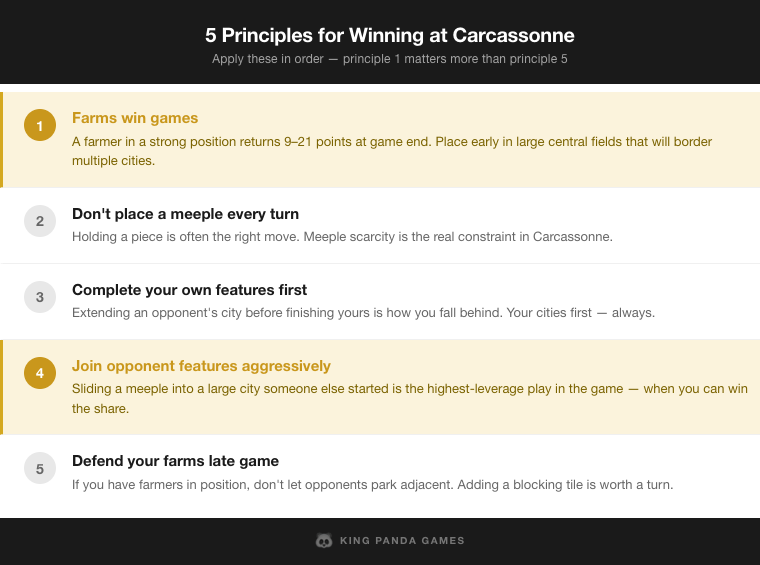
This is the single most important thing to understand about Carcassonne, and the single thing most beginners don’t act on until their third or fourth game.
Farms score 3 points per completed city they border at the end of the game. A farmer meeple (placed face-down on a field) never scores mid-game and never returns to your hand until the final tally. This makes farms feel wasteful to new players — you’re tying up a meeple indefinitely with no immediate return.
That’s exactly why experienced players use them. While you’re getting 2 or 3 points from small road completions, a well-placed farmer quietly accumulates 12, 15, sometimes 20+ points waiting at end-game. In a typical game, the player who farms best wins.
The rule: get one farmer down early — ideally in a field that borders at least one city already under construction. Then protect it by placing tiles that keep opponents from connecting their own fields to yours (which would force you to share the points).
The earlier you place a farmer, the more cities they’ll touch before the game ends. A farmer placed on turn 3 in a large central field is worth far more than a farmer placed on turn 15 in a small corner.
Principle 2: Don’t Place a Meeple on Every Turn
New players default to placing a meeple on every tile they draw. This feels productive — you’re claiming features, you’re on the board, you’re in the game. It’s actually one of the most common losing habits in Carcassonne.
You only have seven meeples — eight if you own Inns & Cathedrals, which hands every player one large meeple that counts as two in a contested feature. When you run out, you can’t claim new features until existing ones complete and return your pieces. An opponent who has three meeples in hand while you’re running dry can claim every high-value feature that comes up for the next four turns.
Good meeple management means:
- Skipping turns where the available feature isn’t worth the investment
- Prioritizing high-scoring features (large cities, farms) over small ones (short roads, isolated monasteries)
- Watching your supply and deliberately freeing up meeples before you need them
A turn where you place a tile in a strategically useful position and put no meeple down is often a better turn than one where you wastefully complete a 2-point road. You preserved a meeple. That meeple will score more points later.
Principle 3: Complete Your Own Features Before Extending
One of the most common mistakes in Carcassonne is building massive features that never close. A 12-tile city that never completes scores 6 points at game end (1 per tile instead of 2). The same city completed scores 24.
When you have a meeple in a city, your primary goal is completing that city — not extending it endlessly. Extending a city adds more tiles before completion, which means more turns of vulnerable, half-scored points. Every tile you add is another opportunity for the city to get blocked or left unfinished.
The rule: before extending a feature, estimate how many turns it will take to complete it if you start now. If the answer is “probably never,” don’t extend. Complete small and bank the points. The meeple returns to your hand ready for the next high-value placement.
The exception: if you’re joining a city an opponent already has a meeple in, extending is often worth it because you’re building toward a majority that earns you shared or full points on their investment.
Principle 4: Join Opponent Features Aggressively — When You Can Win
Carcassonne allows two players to share a feature. If you place a tile that connects your city section to your opponent’s city section, you’re both now staking claim to the same city. When it completes, whoever has more meeples gets all the points. If tied, both players get full points.
This mechanic — the join — is one of the highest-skill plays in the game. Used correctly, it lets you:
- Ride your opponent’s development work for free
- Force a tie on a city your opponent was going to win outright
- Sneak majority control into a feature someone else built
The rule: join opponent features when you can tie or take majority. Never join when you’ll be the minority — you’ll help them complete a city and score nothing.
Before joining, count meeples. If they have two meeples in a city and you’re placing one, you’re giving them a bigger, better-completed city. That’s the opposite of what you want.
Principle 5: Defend Your Farms
Once you have a farmer in a large field, your opponents will try to connect their own fields to yours. A connected field is a shared field — if they tie you in meeple count within that field, you split the final score. If they get more meeples into the field, they take your points.
Most new players don’t defend their farms because they don’t understand farms are under attack. But an experienced opponent watching your farmer will deliberately place tiles to open gaps in your field boundary, then slot their own farmer through.
Defend by:
- Placing tiles that close the gaps between your farm and adjacent fields
- Building road segments that act as natural field dividers (roads separate fields by design)
- Avoiding tiles that would create the opening your opponent needs
A farm you successfully defend for the whole game is your largest single scoring source. A farm that gets invaded and contested at game end is a near-total loss — especially if the opponent ends up with more meeples in the merged field than you.
Putting It Together
The framework looks like this: one early farmer in a strong field (protected throughout the game), conservative meeple usage that keeps two or three pieces in hand at all times, small feature completions that return meeples quickly, and opportunistic joins on opponent cities when you can force a tie.
The players who lose at Carcassonne are almost always the ones who used all seven meeples by mid-game, built large cities that never completed, missed the farm entirely, and then watched an opponent reveal a 15-point farmer at the final tally.
Fix Principle 1 first. Get a farmer down early and protect it. Everything else in this guide becomes more impactful once you stop giving away the end-game.
Check Carcassonne: Inns & Cathedrals price on Amazon →
Frequently Asked Questions
Why do I keep losing at Carcassonne?
You're likely overlooking the immense end-game points from farms and mismanaging your meeples. Beginners often waste meeples on low-value features, leaving them unable to claim crucial opportunities, while experienced players quietly accumulate huge scores with well-placed farmers.
Are farms important in Carcassonne?
Absolutely, farms are the single most important factor for consistent wins in Carcassonne. While they don't score until the end of the game and tie up a meeple indefinitely, a well-placed farmer can easily net 15-20+ points, often more than all your other features combined.
When should I place a farmer in Carcassonne?
Place a farmer as early as possible, ideally by turn 3-5, in a large central field that already borders at least one city under construction. The earlier a farmer is placed, the more completed cities it will likely border by game's end, maximizing its point potential.
How do I protect my farmers in Carcassonne?
To protect your farmer's points, strategically place tiles that prevent opponents from connecting their own fields to yours. This ensures your farmer retains sole ownership of the bordering cities' points, rather than having to share them.
Should I place a meeple on every turn in Carcassonne?
No, placing a meeple on every turn is a common beginner mistake that will cost you games. You only have seven meeples, and tying them up on small roads or isolated monasteries leaves you unable to claim high-value features like large cities or prime farm spots later on.
What is good meeple management in Carcassonne?
Good meeple management means being selective: only place a meeple on high-scoring features like large cities or strategic farms. Don't be afraid to place a tile without a meeple if the available feature isn't worth the investment, preserving your meeples for better opportunities.
Why do experienced Carcassonne players win so often?
Experienced players consistently win because they master end-game scoring, primarily through strategic farm placement, and efficient meeple management. They prioritize high-value features and understand when to hold back meeples, rather than spreading them thin on low-scoring features.