

Sushi Go Party! Scoring Explained: Every Card, Every Point
With more than twenty dishes across five categories, Sushi Go Party! has more scoring rules than any other twenty-minute game we know. Here’s every one of them, straight from the official Gamewright rulebook — plus the four rules that get misplayed at nearly every table.
Some links below are Amazon affiliate links — as an Amazon Associate, King Panda Games earns from qualifying purchases at no extra cost to you. Full disclosure.
When Scoring Actually Happens
Most cards score at the end of each round, and there are three rounds. Two important exceptions:
Pudding scores once, at the end of the whole game. Cards accumulate across all three rounds.
Uramaki can score mid-round, the instant you cross ten icons — it’s a race, not a tally.
Everything else gets counted when hands run out and the round closes.
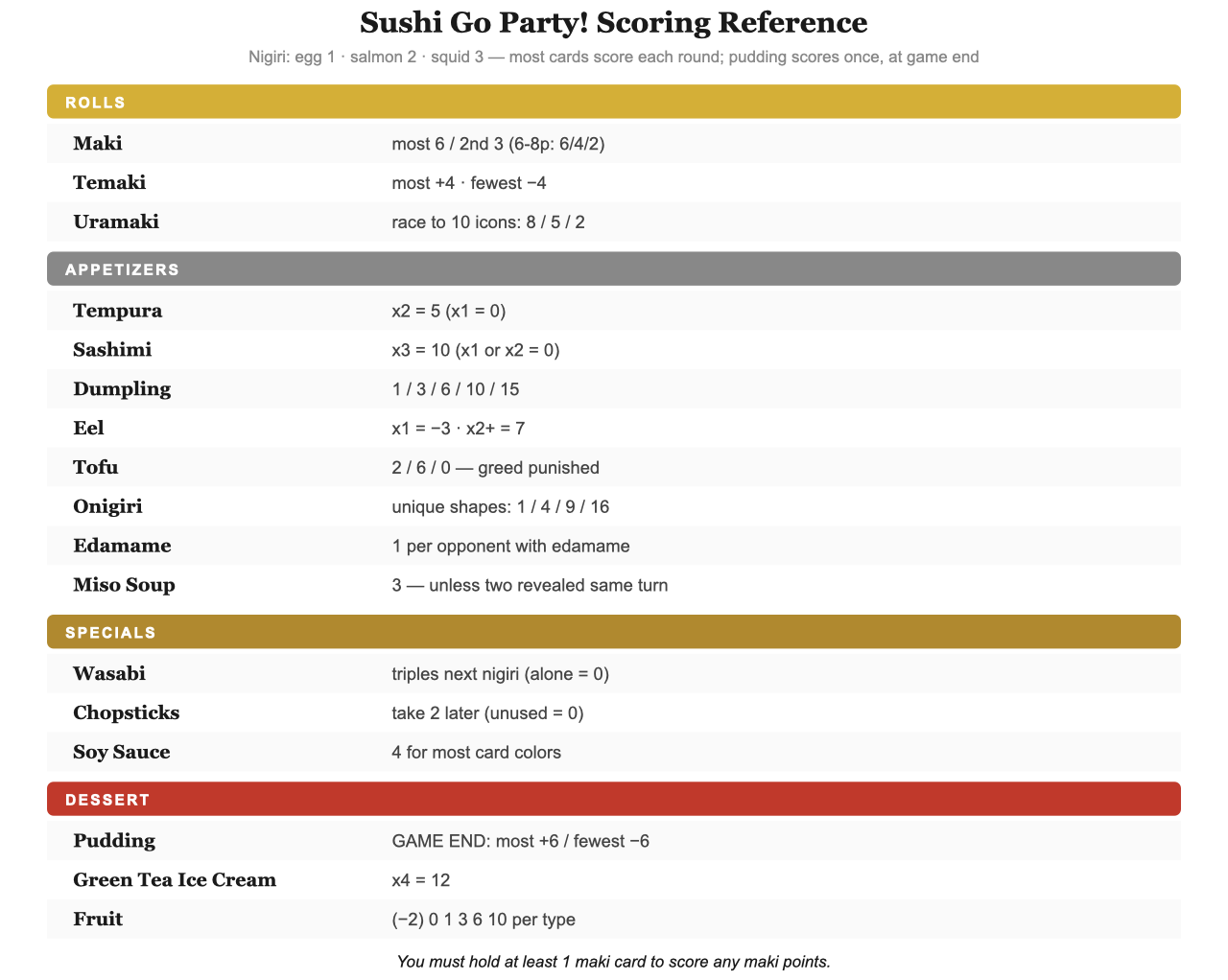
Nigiri and Rolls
Nigiri is the simplest scoring in the game: egg is 1 point, salmon is 2, squid is 3. No sets, no conditions.
Maki rolls reward whoever collects the most icons at the end of a round. In 2–5 player games the most scores 6 and second scores 3; in 6–8 player games it’s 6 / 4 / 2 for the top three. Ties split the points, rounded down, and you must hold at least one maki card to score anything.
Temaki is the opposite — it punishes. Most temaki scores +4, fewest scores −4. In a two-player game, the player with fewest simply loses nothing.
Uramaki is the race. The first player to reach 10 icons immediately scores 8 points, the second gets 5, the third gets 2. At the end of the round, whoever has the most uramaki still in front of them takes the next unclaimed place.
Worth knowing: if two players cross ten icons on the same turn, ties break by total icon count — and second place is then skipped entirely, so the next player to reach ten only gets the third-place points.
Appetizers
This is where the interesting math lives:
- Tempura — 2 cards = 5 points. One alone scores 0. Multiple sets score.
- Sashimi — 3 cards = 10 points. One or two score 0.
- Dumplings — escalating: 1/3/6/10/15 for one through five.
- Eel — one is −3, two or more is 7.
- Tofu — one is 2, two is 6, three or more is 0. Greed is punished.
- Onigiri — scores by unique shapes: 1/4/9/16 for one through four different shapes.
- Edamame — 1 point per opponent who also played edamame. Zero if you’re the only one.
- Miso soup — 3 points, unless two or more are revealed on the same turn, in which case all of them are discarded and score nothing.
Specials
Wasabi triples the value of the next nigiri you place on it. A wasabi with no nigiri scores 0, and you may only stack one nigiri per wasabi.
Chopsticks let you take two cards from a hand on a later turn — swap the chopsticks back into the hand you pass. Unused, it’s worth 0.
Soy sauce scores 4 if you have the most different card background colors among your played cards.
Menu lets you take a card from the deck; Spoon lets you name a card and take it from an opponent’s hand. Both are worth 0 if unused.
Special order (2–6 player games only) copies any card you’ve already played. Takeout box flips played cards face down for 2 points each.
Desserts
Pudding — at game end, most scores +6 and fewest scores −6. In a two-player game, fewest loses nothing.
Green tea ice cream — every set of four scores 12.
Fruit — scores by matched type: (−2) / 0 / 1 / 3 / 6 / 10 depending on how many of each fruit you collect.
Note that a fixed number of dessert cards is shuffled in per round — more in later rounds — so pudding contention naturally escalates.
The Four Rules People Misplay
What tables commonly get wrong: scoring maki for a player with zero maki cards, letting one wasabi triple several nigiri, forgetting miso soup cancels, and counting pudding at the end of each round.
The actual rules: you need at least one maki card to place at all; one nigiri per wasabi; simultaneous miso soups are all discarded; pudding is scored exactly once, at the end of the game.
Get those four right and you’re playing the game as designed. For which dishes to actually chase, our strategy guide covers the drafting side, and our full review explains why this is the best light drafting game on the market.
Don’t own Sushi Go Party! yet? It’s the deluxe version with every dish on this page.
Check Sushi Go Party! price on Amazon →
Frequently Asked Questions
How does scoring work in Sushi Go Party!?
Most cards score at the end of each of the three rounds. Pudding is the exception — it accumulates across the whole game and scores once at the end, +6 for most and −6 for fewest. Uramaki can also score mid-round when a player crosses ten icons.
How many points is sashimi worth in Sushi Go Party!?
Ten points for a set of three, and zero for one or two. You can score multiple sets in a round, but a partial set is worth nothing at all — which makes it the highest-variance dish in the game.
How do maki rolls score in Sushi Go Party!?
The player with the most maki icons scores 6 and second place scores 3 in a 2–5 player game. In 6–8 player games it’s 6, 4, and 2 for the top three. You must hold at least one maki card to score any maki points.
What happens if two players play miso soup on the same turn?
Both cards are immediately discarded and score nothing. Miso soup is worth 3 points only if you’re the sole player revealing one that turn, which makes it a genuine gamble in bigger games.
How does wasabi work in Sushi Go Party!?
Wasabi triples the value of the next nigiri you place on top of it — so a squid nigiri worth 3 becomes 9. You may only place one nigiri per wasabi, and a wasabi with no nigiri at the end of the round scores zero.
When is pudding scored in Sushi Go Party!?
Only at the very end of the game, after all three rounds. The player with the most pudding scores +6 and the player with the fewest scores −6, making it a twelve-point swing that many players ignore until it’s too late.
How does uramaki scoring work?
It’s a race to ten icons. The first player to reach ten immediately scores 8 points, the second scores 5, and the third scores 2. At the end of the round, whoever has the most uramaki remaining takes the next unclaimed placement.