

Sushi Go Party! Review: Is It Worth It?
Bottom Line
Sushi Go Party! is best for groups who want a light drafting game that seats up to eight and never plays the same way twice. Skip it only if you already own the original Sushi Go! and never play above five players — otherwise this replaces it outright. Its biggest strength is the build-your-own menu, which turns one box into dozens of genuinely different games. Its biggest weakness is that the box is mostly air, and you’ll pay deluxe price for a game that fits in a lunchbox.
Sushi Go Party! gets 5/5 Bamboo Plants and 5/5 Pandas from us — our first double-five since Wingspan, and the easiest recommendation on this site. The Bamboo is perfect because drafting is the most intuitive mechanic in gaming: take a card, pass the rest. The Pandas are perfect because after fifty plays we’re still discovering menu combinations that feel new.
Some links below are Amazon affiliate links — as an Amazon Associate, King Panda Games earns from qualifying purchases at no extra cost to you. Full disclosure.
Here’s what separates it from every other filler: you choose the menu before you play. Twenty-plus dishes, five categories, and you assemble which ones are in the deck this game. The rules never change — the math completely does. It lands at #2 on our best board games of 2026 list.
| Detail | Info |
|---|---|
| Players | 2–8 |
| Best Player Count | 5 — big enough that hate-drafting matters, small enough to track the pass |
| Age | 8+ |
| Play time | 20–30 min |
| Complexity | Light |
| Solo Mode | No |
| Designer | Phil Walker-Harding |
| Publisher | Gamewright |
| Popular Upgrades | No — the box already includes a score board and pawns |
| Bamboo Plants | 5/5 — drafting explains itself in one sentence |
| Pandas | 5/5 — the menu system is genuine, lasting variety |
| Official site | gamewright.com |
How Sushi Go Party! Works
Before the first card is dealt, the table builds a menu: one nigiri type, one roll type, three appetizers, two specials, and one dessert. The box includes four ready-made menus — Sushi Go! (the original lineup), Party Sampler, Master Menu, and My First Meal — or you assemble your own from the 22 menu tiles.
Then it’s classic drafting. Everyone gets a hand, simultaneously picks one card to keep face up, and passes the rest to the left. Repeat until the hands are gone. Three rounds, then the highest score wins.
Round two, five players. Your hand has a sashimi — worth 10 points if you collect three, and 0 if you collect two. You already have one. Taking it commits you to chasing a third through the pass, while the player to your left is visibly hoarding maki and the pudding count is running against you. This is the whole game: every card is a bet on what comes back around.
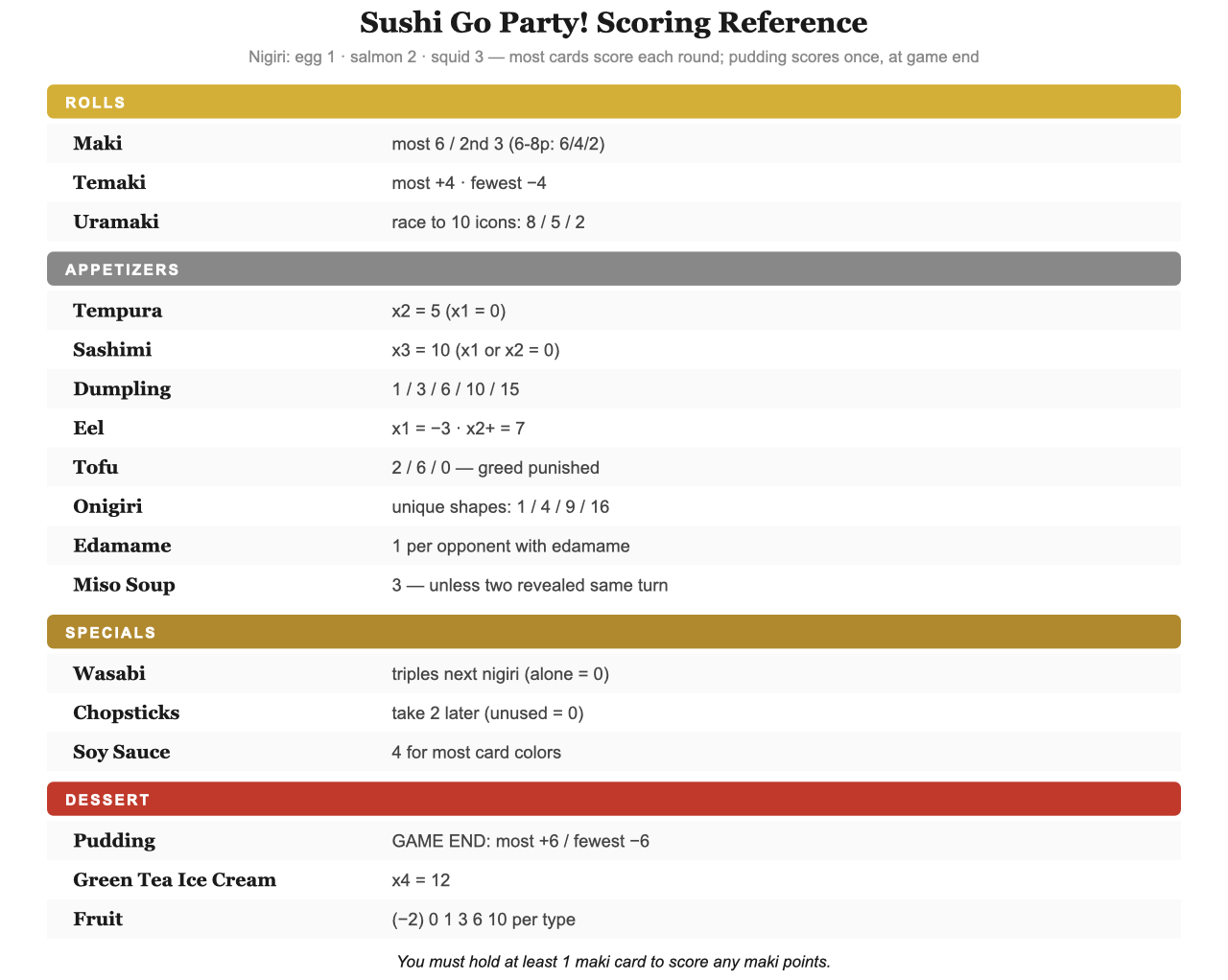
Scoring is where the personality lives, and the numbers are worth knowing: tempura pays 5 for a pair and 0 for a single. Sashimi pays 10 for three, 0 for one or two. Dumplings escalate 1/3/6/10/15. Eel is −3 for one but 7 for two. Uramaki is a race — first player to 10 icons scores 8, then 5, then 2. And pudding is scored only at the end of the whole game: most gets +6, fewest gets −6.
That last one is why people lose games they thought they’d won.
A few dishes carry rules worth knowing before your first game. Wasabi triples the next nigiri you stack on it — but a wasabi with no nigiri scores zero. Chopsticks let you take two cards on a later turn, swapping the chopsticks back into the hand you pass. And miso soup is the trap: if two players reveal miso soup on the same turn, both are discarded and score nothing at all.
What We Liked
The menu system is the best “replayability” feature we’ve seen in a filler. Most light card games get variety from luck; this one gets it from configuration. A Master Menu game with uramaki and special orders plays like a different, meaner game than My First Meal — same rules, completely different decisions.
Eight players, twenty-five minutes. Almost nothing handles eight without either dragging or turning into a party game with no decisions. Because everyone drafts simultaneously, the count barely affects length — which is why it sits alongside 6 Nimmt! on our best BBQ card games list.
The pudding rule is quietly brilliant design. It’s the only card scored across the entire game rather than per round, so it hangs over all three rounds and forces a running side-negotiation nobody ever fully wins. We’ve had two games decided by a single pudding on the final pass.
It teaches in about two minutes and kids genuinely compete. Take a card, pass the rest, collect sets. An eight-year-old can hold their own against adults on night one, and that’s rarer than it sounds.
The included score board is a small thing that matters more than it should. Most fillers make you tally on scrap paper between rounds; here you nudge a pawn along a track and keep playing. It’s the difference between a game that flows and one that pauses three times.
What We Disliked
The box is enormous for what’s inside. You’re getting 181 cards, a small board, and eight pawns in a package sized like a mid-weight strategy game. It’s a shelf-space tax on a game that’s fundamentally a deck of cards.
Some menu combinations are duds. Building your own menu is the headline feature and it’s genuinely fun, but a table that picks four low-interaction dishes will produce a flat, solitaire-ish game. The four preset menus exist because free-building can go wrong, and new groups should stick to them for a while.
Two-player is fine, not great. Drafting games want a table. At two, the pass is predictable and the hate-drafting that gives the game its bite mostly evaporates.
Setup is longer than the game deserves. Choosing a menu, pulling the right card sets from the box, and placing the matching menu tiles takes a few minutes before anyone plays — real friction for a game that lasts twenty. Groups that keep a favorite menu bundled together in a rubber band skip most of it.
Who It’s For
Sushi Go Party! is for the household that hosts mixed groups — kids and adults, gamers and non-gamers, four people or eight. It’s the most flexible light game we own, and the one we’d keep if forced to choose a single filler. It seats eight without slowing down, which is why it lands at #4 on our best board games for teens list.
It’s also the right pick for anyone curious about drafting as a mechanic. Card drafting drives some of the best games ever made — 7 Wonders most famously — and this is the friendliest possible introduction to it.
Who should skip this game: couples who play exclusively two-player, where drafting loses its tension. And anyone who already owns and loves the original Sushi Go! tin but only ever plays with three or four people — the upgrade is real but not urgent at that size. Our full comparison breaks down exactly when it’s worth replacing.
Who Should Buy This?
Buy Sushi Go Party! instead of the original Sushi Go!, at around $25. The deluxe version costs roughly twice the tin and gives you triple the game: more dishes, the menu system, a score board, and support up to eight players instead of five.
The only reason to buy the small tin instead is portability — it genuinely fits in a pocket, and this box does not. If you want a game for camping and airplane trays, buy the tin. For a house that hosts, buy this one and don’t look back.
Best Player Count
Sushi Go Party! is best at 5. The box says 2–8, and the honest ranking is 5, then 6, then 4, then 7, then 8, then 3, then 2.
Five is where you can still roughly track what’s circulating while facing real competition for every card type. Hate-drafting — taking a card you don’t want purely so the player to your left can’t have it — becomes a live consideration, and that’s the skill ceiling of the whole game.
At seven or eight, hands cycle so far that planning gives way to grabbing; still fun, less skillful. At two the pass is nearly deterministic, and at three there’s not enough contest for maki and temaki to matter.
Replayability
This is the best-replaying filler we own, and the reason is structural rather than lucky. With 20+ dishes and a menu of eight slots per game, the combination space is enormous — and unlike random setup variability, you control it, so a group can deliberately escalate from gentle menus to cutthroat ones as they improve.
The four presets carry a group for a dozen-plus plays on their own. After that, custom menus are where the game reopens: pairing uramaki’s race mechanic with special orders creates a completely different tempo than the classic tempura-sashimi-dumpling lineup.
There are no expansions, and it doesn’t need any. The base box is the complete game.
Awards
Sushi Go! and its deluxe successor have been Mensa Select and Golden Geek nominees, and designer Phil Walker-Harding went on to design Bärenpark and the Spiel des Jahres-nominated Imhotep.
Similar Games
If you like 7 Wonders, Sushi Go Party! is the 20-minute version — same simultaneous card drafting, same “what will come back around” tension, but with eight cards instead of a civilization to manage.
If you like 6 Nimmt!, this is the more strategic cousin. Both handle big groups fast, but 6 Nimmt! is about dodging penalties with no control over placement, while Sushi Go Party! gives you a real decision every single turn.
If you want the same feel in your pocket, buy the original Sushi Go! tin instead — fewer dishes, five players max, no menu system, but a third the size and half the price.
Tips & Tricks
Count the pudding, every round. It’s the only card scored at game end, and the swing between most (+6) and fewest (−6) is twelve points in a game often decided by five. Nobody drafts pudding in round one; everyone panics about it in round three.
What most new players do: chase sashimi because 10 points is the biggest number on the table.
What actually works: take sashimi only if you can see a realistic path to three. One sashimi is 0 points and a wasted draft; two is 0 points and two wasted drafts. Meanwhile dumplings pay 1/3/6/10/15 and reward you at every step of the way.
Hate-draft maki when you’re not competing for it. Maki pays 6 to the leader and 3 to second place (6/4/2 in bigger games), which means denying the runaway maki player a single card can swing six points without costing you anything you wanted.
Worth knowing: wasabi triples the next nigiri you play on it, and a wasabi with no nigiri is worth zero. Taking wasabi early is a bet that a squid nigiri (3 points → 9) comes back around. Taking it late is usually a wasted card.
Watch the hand sizes shrink. Late in a round, hands are small and every remaining card is known to someone — that’s when a targeted denial is cheapest, because you’re giving up almost nothing to take it.
Play chopsticks earlier than feels comfortable. An unused chopsticks card is worth exactly zero, and the two-card turn it enables only pays off if there are still good pairs circulating. Holding it “for the perfect moment” is how most players score nothing with it.
If your menu includes uramaki, treat it as a race and not a collection. First to ten icons scores 8 points, second gets 5, third gets 2 — so a slow uramaki hoarder who arrives fourth has spent an entire round’s drafts on nothing.
Frequently Asked Questions
Is Sushi Go Party! worth buying?
Yes — we rate it 5/5 Bamboo and 5/5 Pandas, our highest combined score. For around $25 you get a game that teaches in two minutes, plays up to eight people in under half an hour, and offers real variety through its build-your-own menu system.
Is Sushi Go Party! better than the original Sushi Go!?
Yes, for almost everyone. Party has more than twenty dishes versus the original’s eight, adds the menu system, includes a score board, and supports 8 players instead of 5. The original tin only wins on portability and price.
How many players is Sushi Go Party! best with?
Five. You can still track roughly what’s circulating while facing real competition for maki and temaki, and hate-drafting becomes a genuine consideration. It works from 2 to 8, but two and three are noticeably weaker.
How does scoring work in Sushi Go Party!?
Most cards score at the end of each round: tempura pays 5 for a pair, sashimi 10 for three, dumplings escalate 1/3/6/10/15. Maki rewards whoever collects the most, and pudding is the exception — it’s scored only at the end of the whole game, +6 for most and −6 for fewest.
What’s the best menu in Sushi Go Party!?
Start with My First Meal for new players and Party Sampler for everyone else, since both are balanced by design. Master Menu is the most strategic preset and the right choice once your group knows the dishes.
Is sashimi worth taking in Sushi Go Party!?
Only with a realistic path to three cards. Sashimi scores 10 for a set of three but zero for one or two, making it the highest-variance dish in the game. Dumplings are the safer scaling pick because they pay at every quantity.
Does Sushi Go Party! work with 2 players?
It works but it’s the weakest count. With only two hands passing back and forth the draft becomes predictable and hate-drafting loses its punch — drafting games want a bigger table.
Are there expansions for Sushi Go Party!?
No, and it doesn’t need them. The base box contains 181 cards and 22 menu tiles covering more than twenty dishes, which is already more configurations than most groups will exhaust.
Want to go deeper?
- Sushi Go Party! Strategy: How to Win — Why sashimi is a trap, when to hate-draft maki, and reading the pass. Read it here
- Sushi Go Party! Scoring Explained — Every dish and exactly what it pays, in one reference. Read it here
- Best Sushi Go Party! Menus — All four presets ranked, plus how to build your own without breaking the game. Read it here
- Sushi Go vs. Sushi Go Party! — Which version to buy, and when the tin is actually the right call. Read it here
Verdict
Buy it if you host groups of any size — this is the most flexible light game in our collection and the one we’d save from a fire. Skip it only if you play exclusively two-player, or if you own the original tin and never exceed five players. Try before you buy doesn’t really apply; at $25 for a game this teachable, buying is trying.
Sushi Go Party! is the rare deluxe edition that actually deserves the word deluxe. It took a great $12 filler and turned it into the best light drafting game on the market.
Sushi Go Party! official site: gamewright.com — the full rules PDF is free to download there.