

6 Nimmt! Review: Is It Worth It?
Bottom Line
6 Nimmt! is best for groups of five to ten people who need one game that handles everybody and teaches in three minutes. Skip it if your table wants control — you will lose a round to a card you had no way to play safely, and some people never forgive that. Its biggest strength is that everyone plays simultaneously, so ten players is as fast as four. Its biggest weakness is that the same trait making it great for big groups makes it merely fine for two.
6 Nimmt! gets 5/5 Bamboo Plants and 4/5 Pandas from us, and at around $12 it’s the best value in our entire collection. The Bamboo score is perfect because you can teach this game in the time it takes to deal it — pick a card, play it, lowest number resolves first, don’t be the sixth card in a row. The 4 Pandas reflects the one honest limitation: it’s a filler, and fillers don’t carry a whole game night.
Here’s what makes it work after thirty years: you never choose where your card goes. The rules place it for you. All your decision-making happens before that, in guessing what everyone else is about to do — and that’s why a game with no meaningful choices on the board produces so much shouting at the table.
Some links below are Amazon affiliate links — as an Amazon Associate, King Panda Games earns from qualifying purchases at no extra cost to you. Full disclosure.
| Detail | Info |
|---|---|
| Players | 2–10 |
| Best Player Count | 6 — enough chaos that predicting the table is genuinely hard |
| Age | 8+ |
| Play time | 30–45 min |
| Complexity | Light |
| Solo Mode | Yes — the “Beat the Buffalo” co-op variant in the 30th anniversary edition |
| Designer | Wolfgang Kramer |
| Publisher | Amigo Spiele |
| Popular Upgrades | No — it’s a $12 deck of cards, and it should stay that way |
| Bamboo Plants | 5/5 — the entire rules explanation fits in one breath |
| Pandas | 4/5 — riotous with a crowd, quiet with two |
| Official site | amigo-spiele.de |
How 6 Nimmt! Works
Everyone gets ten cards from a deck numbered 1 to 104, and four cards start four rows on the table. Every turn, all players simultaneously choose one card and lay it face down. Then everyone flips.
Now the clever part: cards resolve in ascending numerical order, lowest first. Your card goes into the row whose last card is the closest number below yours — you don’t get to pick. And if yours is the sixth card in that row, you take the first five into your scoring pile.
Rows end in 12, 34, 51, and 88. You play the 52 thinking it’s safe — it slots after the 51, and that row only has three cards. But two other players played 53 and 55, which resolve after yours and pile onto the same row. Neither of them takes it. The player who played 58 does. You were right that the row was safe; you were wrong about how many people had the same idea.
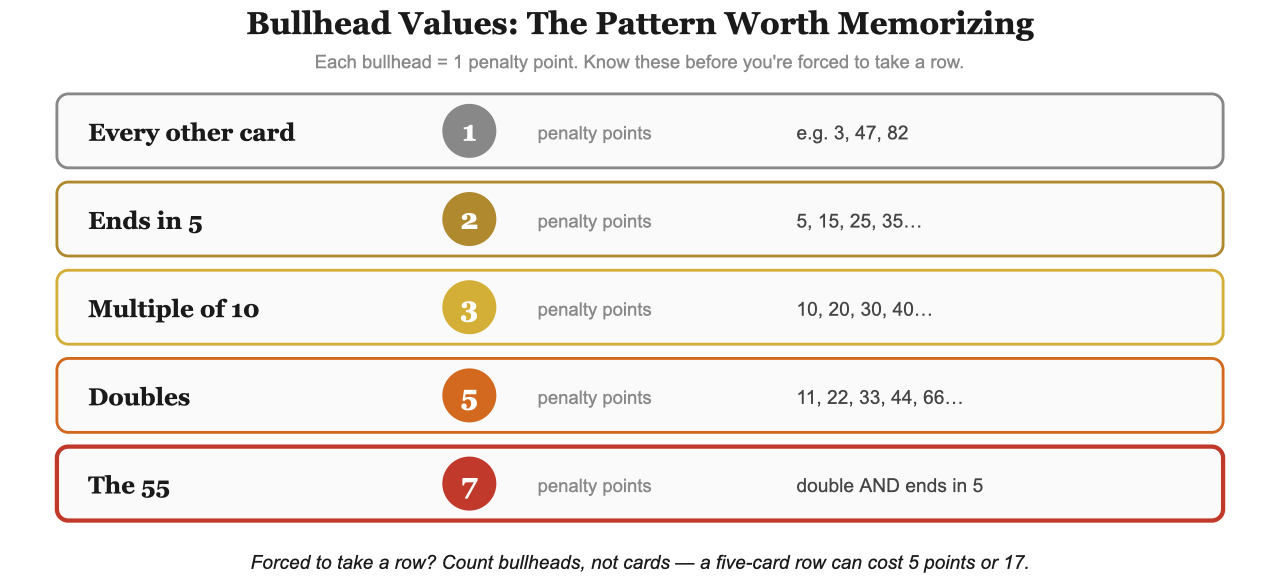
The cards you collect are pure penalty. Every card shows one to seven bullheads, and each bullhead is a negative point. The values follow a pattern worth memorizing: cards ending in 5 are worth 2, multiples of 10 are worth 3, doubles like 33 and 77 are worth 5 — and 55 is both, making it the single worst card in the deck at 7 bullheads.
One more rule that decides more rounds than any other: if your card is too low to fit any row, you take a row of your choice and your card starts that row fresh. Low cards aren’t safe. Low cards are landmines.
Play continues until someone crosses 66 points, and the player with the fewest wins.
A round is exactly ten turns — you play your whole hand, then everyone counts their bullheads and the cards get reshuffled. Most games run three or four rounds before somebody crosses 66, which is why a session lands around 45 minutes even with a full table of ten.
What We Liked
Ten players, same length as four. Because everyone chooses simultaneously, adding people doesn’t add turn time — it only adds chaos. This is the rarest property in board gaming, and it’s why 6 Nimmt! is our automatic answer for a crowd. We rank it first on our best card games for a BBQ list for exactly this reason.
The teach genuinely takes three minutes. Ascending order, lowest resolves first, don’t play the sixth card. That’s it. We’ve taught this to a table of eight people who’d been drinking, and it worked.
The simultaneous reveal produces the best kind of table noise. Everyone flips at once, and the groans arrive in ascending order as people watch the rows fill toward them. It’s a spectator sport where you’re also the one getting hit.
Losing feels funny rather than frustrating — most of the time. Because nobody chose to give you those cards, there’s no target for resentment. The deck did it. That distinction keeps mixed groups friendly in a way that direct take-that games don’t.
It’s about $12. There is no other game in our collection with a better fun-to-price ratio.
What We Disliked
Two-player 6 Nimmt! is a different, worse game. With only two cards hitting the table per turn, rows fill slowly and predictably, and the guessing that makes the game sing mostly evaporates. It’s playable. It’s not why you own this.
You will occasionally lose to an unplayable hand. Draw a fistful of low cards and you’ll be forced to take rows regardless of skill. Skilled players absolutely win more over a full game to 66, but a single round can be decided by the deal, and control-oriented players find that maddening.
It’s a filler, and it knows it. Forty-five minutes is the ceiling, and after two consecutive rounds most groups want something with more meat. Buy it to open or close a game night, not to headline one. That still makes it the best-value pick on our best board games for adults list — nothing else we own does this much with a deck of cards.
The scoring is pen-and-paper, and it shows its age. You tally bullheads by hand between rounds, on the little notepad in the box, while everyone waits. It takes ninety seconds and it’s the one moment the game’s energy drops — a modern design would have solved this with a score track.
Who It’s For
6 Nimmt! is for anyone who regularly hosts more than four people. That’s the whole pitch, and it’s a strong one — most games break down past five players, and this one gets better.
It’s also the best game we know for mixed-skill tables. A newcomer can beat a veteran on any given night, the rules don’t need re-teaching, and nobody has to feel bad about a bad round because nobody engineered it.
Card game fans who like Love Letter or Coup for their portability will find this scratches a similar itch with triple the player capacity.
It travels better than almost anything. A deck of cards and a notepad fits in a jacket pocket, needs about a foot of table, and survives being played on a picnic blanket — which is why it opens our best card games for a BBQ roundup. Families with kids around 8–10 should also take a serious look: the math is simple ordering, and children beat adults at this game regularly enough to keep them invested.
Who should skip this game: couples looking for a two-player staple — the game is genuinely diminished at that count. Also skip it if your group hates any outcome they couldn’t control; 6 Nimmt! hands you unplayable hands sometimes, and no amount of skill fixes a round where every card you hold is a 3.
Who Should Buy This?
Buy it. At around $12 for a game that seats ten and lasts decades, this is close to a no-brainer purchase for anyone who hosts.
The only genuine hesitation is if you exclusively play with one other person, in which case your money is better spent on something from our best 2-player games list. Everyone else: this belongs in the bag you bring to every game night, and it costs less than the snacks.
If you’re buying today, the 30th anniversary edition is the one to get — same base game, plus special fan cards and a full cooperative variant for no meaningful price difference.
Best Player Count
6 Nimmt! is best at 6. The box says 2–10, and the honest ranking is 6, then 7–8, then 5, then 9–10, then 4, then 3, then 2.
Six is the point where predicting the table becomes genuinely impossible without becoming random. Rows fill fast enough that every card feels risky, but you can still roughly track what’s been played. Below five, the rows fill too slowly and the guessing gets easy; above eight, it tips into pure chaos — fun chaos, but the skill component thins out.
At two players the game is a shadow of itself, and the box’s own Pro Variant (2–6 players) exists partly to address that. Our full player count breakdown covers every option including the variants.
Replayability
6 Nimmt! has no variability to speak of — same 104 cards, same four rows, every single game. And it doesn’t matter, because the variability is the people. What changes between plays is who’s at the table and how they think, which is why the same deck has stayed in print for thirty years.
What does get old is playing it repeatedly with the same two people. The 30th anniversary edition addresses this with special fan cards (Even/Odd, Mountain Climbing, The Jumping Cow, Flippin’ Digits) that bend the placement rules, plus the “Beat the Buffalo” cooperative variant where 1–6 players team up against a bot opponent. Those additions are genuinely good and they’re in the box.
Realistically: this is a game you’ll play twenty times a year for a decade, in small doses, and never get sick of because it’s never the main event.
Awards
6 Nimmt! was nominated for the Spiel des Jahres in 1994 and has remained continuously in print since — a thirty-year run that almost no card game manages.
Similar Games
If you like No Thanks!, try 6 Nimmt! — both are cheap number-card fillers about avoiding penalty points, but No Thanks! is a quiet bidding game of taking turns, while 6 Nimmt! is simultaneous and loud. No Thanks! is better at 3–5; 6 Nimmt! is better at 6–10. Full comparison here.
If you like Sushi Go, 6 Nimmt! is the bigger-group version of that feeling — both are light, fast card games where you’re reading the table, but Sushi Go is drafting for points while 6 Nimmt! is dodging penalties.
If you want the same crowd capacity with more laughing, play Codenames instead — it also handles big groups, but it’s a team word game rather than a solo scramble.
Tips & Tricks
Memorize the bullhead pattern before your second game. Cards ending in 5 are worth 2, multiples of 10 are worth 3, doubles are worth 5, and 55 is worth 7. When you’re forced to take a row, that knowledge is the difference between eating 3 points and eating 11.
What most new players do: hold onto low cards, assuming small numbers are safe.
What actually works: dump low cards early, while rows are still short. A low card that fits nowhere forces you to take an entire row — and late in a round, every row is five cards deep. The 3 in your hand is a bomb with a timer on it.
Count the row that’s at four cards, then play into it deliberately when your card is the clear lowest. Taking a four-card row of cheap cards on your terms is often better than getting stuck with a five-card row of expensive ones later. Eating 4 bullheads on purpose beats eating 15 by accident.
Worth knowing: the number you play matters less than where it sits relative to everyone else’s. If you play 60 and three people play 61–65, they’re all resolving after you, stacking the row you just made safer for yourself. Playing just below a crowd is the closest thing this game has to a defensive move.
Watch what’s already on the table late in a round. With 104 cards and ten in your hand, you can often deduce that a whole range is exhausted — and a card that would’ve been suicide on turn two is perfectly safe on turn nine.
Play the high cards when the spread is wide. A 98 or a 101 is only dangerous if the row it lands on is nearly full, and early in a round nothing is. The players who hoard their big numbers “for safety” end up holding them on turn nine, when every row is four deep and there’s nowhere left to hide.
One habit changes more outcomes than any tactic: before you commit, look at how many cards each row already holds, not just what number ends it. A row ending in 40 with two cards is a completely different risk from a row ending in 40 with five — and new players read only the number.
Frequently Asked Questions
Is 6 Nimmt! worth buying?
Yes — at around $12 for a game that handles up to 10 players and teaches in three minutes, it’s one of the best-value purchases in board gaming. The only groups who should pass are couples who play exclusively two-player, where the game is noticeably weaker.
How do you play 6 Nimmt!?
Everyone simultaneously plays one card from their hand, then cards resolve lowest-number first into four rows. Your card goes into the row whose last card is closest below it, and if you place the sixth card in a row, you take the first five as penalty points. Fewest points when someone hits 66 wins.
How many players is 6 Nimmt! best with?
Six. That’s where predicting the table is genuinely hard without becoming random. It’s excellent from 5 to 8, works up to 10, and is significantly weaker at 2–3 where rows fill too slowly and the guessing becomes easy.
Is 6 Nimmt! the same as Take 5?
Yes — Take 5! is the English-language retitling of the same Wolfgang Kramer design, and Beat the Heat is another edition name. The rules are identical; you’re buying the same game whichever box you find.
Why are low cards dangerous in 6 Nimmt!?
Because a card too low to fit any row forces you to take an entire row of your choice. Since cards resolve in ascending order, low cards resolve first — when rows are at their most crowded from the previous turn. Dump low cards early while rows are still short.
What is the worst card in 6 Nimmt!?
The 55, at seven bullheads. It’s both a double (worth 5) and a card ending in five (worth 2), and those stack. Multiples of ten are worth 3, other doubles are worth 5, and every other card is worth 1.
Does 6 Nimmt! work with 2 players?
It works but it’s the weakest count — with only two cards hitting the table per turn, rows fill slowly and predictably, and the guessing that drives the game mostly disappears. The Pro Variant included in the box improves it somewhat.
Is there a solo or cooperative mode for 6 Nimmt!?
Yes, in the 30th anniversary edition. The “Beat the Buffalo” variant lets 1–6 players cooperate against a bot opponent using 16 special cards, and it’s a genuine mode rather than a token addition.
Want to go deeper?
- 6 Nimmt! Strategy: How to Take Fewer Bullheads — Why low cards are traps and when to eat a row on purpose. Read it here
- 6 Nimmt! Rules Explained — The full rules in five minutes, including the resolution order everyone gets wrong. Read it here
- 6 Nimmt! Player Count — Every count from 2 to 10 honestly ranked, plus the Pro and co-op variants. Read it here
- 6 Nimmt! vs. No Thanks! — Two cheap fillers, two different kinds of pain. Read it here
Verdict
Buy it if you ever host more than four people — this is the most reliable crowd game you can own for $12, and it’s been earning that reputation since 1994. Skip it if you play almost exclusively two-player, where the tension thins out badly. Try before you buy basically never applies here; at this price, buying it is trying it.
Thirty years in, 6 Nimmt! remains the answer to the hardest question in board gaming: “there are eight of us, what can we all play?” That it costs less than a pizza is almost unfair.
6 Nimmt! is published by Amigo Spiele — the full English rulebook PDF is free to download, and designer Wolfgang Kramer’s catalog is worth a browse if you like this one.