

Heat Strategy Guide: How to Win More Races
The player who spends the most time in 4th gear almost never wins. That sentence sounds wrong in a racing game, and it’s the single biggest thing separating people who’ve played Heat five times from people who’ve played it fifty. Speed in Heat isn’t something you choose — it’s something you can afford, and this guide is about managing what you can afford. That is the opposite of how Formula D handles speed, where the gear you pick is a die you roll and you find out afterward.
Some links below are Amazon affiliate links — as an Amazon Associate, King Panda Games earns from qualifying purchases at no extra cost to you. Full disclosure.
The Heat Economy Is the Entire Game
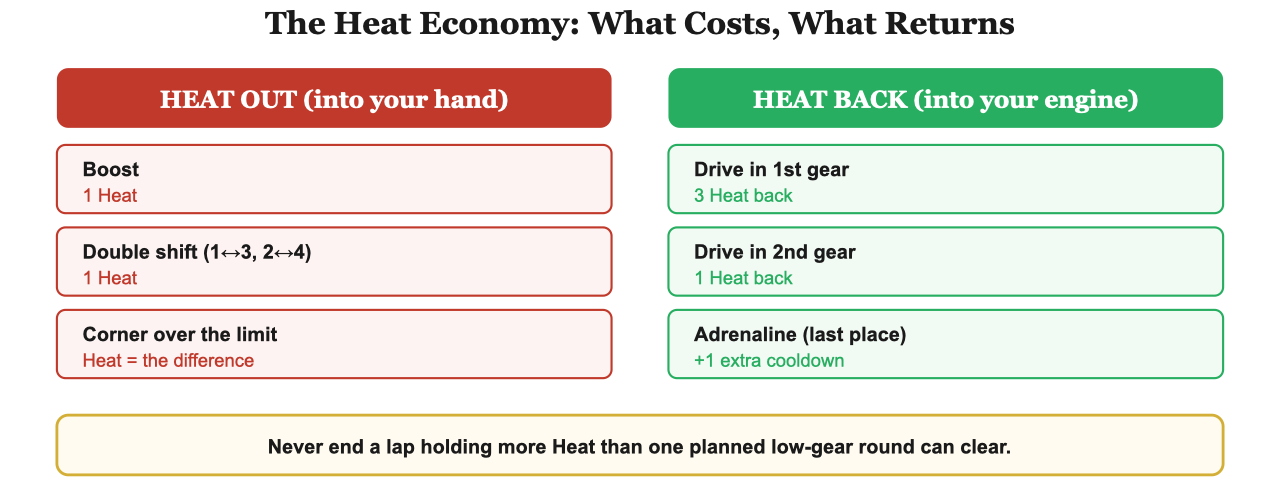
Every Heat card in your hand is a card that isn’t speed. You take them for boosting, for double-shifting, and for exceeding corner speed limits — and the only way to send them back to your engine is cooling down: 3 cards in 1st gear, 1 in 2nd.
That creates a simple budget nobody explains to you on the first play. If you take 4 Heat over the first lap and never spend a round in a low gear, that Heat sits in your hand forever, and your effective hand shrinks from seven cards to three. You’re now driving a worse car than everyone else for the rest of the race.
The rule: never end a lap with more Heat in hand than you can cool off in a single planned low-gear round. Two is fine. Five means you’ve already lost and haven’t noticed.
Slipstream Is the Only Free Speed — Use It Constantly
When should you deliberately stay behind a car instead of passing it?
Almost any time a corner is coming. Slipstream gives you 2 extra spaces when you end your move beside or behind another car, and — this is the part new players miss — those 2 spaces don’t count toward your corner speed check. Every other way to go faster in Heat adds to that total. Boost adds to it. Playing bigger cards adds to it. Slipstream doesn’t.
So the ideal approach to a tight corner is to arrive with a modest card total, tuck in behind a rival, take the free 2 spaces, and slide through under the limit while the car ahead pays Heat for the same corner. You gain position without paying anything.
Final lap, you’re one space behind the leader, corner with a Speed Limit of 4 coming up. You play cards totaling 4 — right at the limit, zero Heat owed. You end beside their car, slipstream 2 more, and cross the corner line ahead of them while they’re paying 2 Heat for a total of 6. You just passed the leader for free and they spent resources doing it.
Gear Discipline: When to Actually Use 4th
Fourth gear is a tool for straights, not a default setting. The board prints the number of spaces to the next corner on every track — read it, then pick the gear that gets you there without overshooting.
The practical pattern most winners follow:
- Open in 2nd or 3rd, not 4th — the pack is bunched at the start and you can’t use the speed anyway.
- Hit 4th on the longest straight of each lap, once you can see the next corner is far enough away.
- Drop to 1st or 2nd for one round per lap, deliberately, to cool down while everyone else panics later.
- Save your Heat for the final lap, where corner penalties can’t be repaid and spinning out is unrecoverable.
That third step is the one people skip. A planned slow round costs you a few spaces; an unplanned one costs you the race.
Boost Is a Trap Nine Times Out of Ten
Boost costs 1 Heat, flips cards off your deck until a Speed card appears, and adds that value to your move. It feels great. It also counts toward your corner check and burns cards off the top of your deck — including any Heat cards, which get discarded rather than returned to your engine.
What most players do: boost whenever they have Heat available, because free speed feels like free speed.
What actually works: boost only on a straight where you’re certain no corner check follows, or on the final dash to the line where Heat has no future value. Mid-lap boosts into a corner are how good positions evaporate.
The exception is the last straight of the last lap. At that point Heat is worthless currency — spend everything.
Play the Adrenaline Position on Purpose
Last place each round (or last two, in a race of five or more) gets Adrenaline: a free extra space and an extra cooldown. It can’t be saved, and it exists so nobody gets dropped from the race.
Experienced players occasionally choose to sit last through a technical section. You cool down every round for free, keep your Heat budget clean, and let the leaders burn theirs fighting each other into corners. Then you arrive at the final lap with a full hand while they’re driving three-card cars.
This isn’t a strategy for the whole race — Adrenaline won’t out-earn genuine track position over four laps. But for one or two rounds through a corner-heavy stretch, being last is quietly the best place on the board.
Putting It Together
Heat rewards the driver who plans two corners ahead rather than one. Count the spaces, pick the gear that fits, cool down before you’re forced to, and treat slipstream as your primary passing tool rather than raw speed. If you want the exact corner mechanics behind all this, our corner rules explainer breaks them down, and our full Heat review covers whether the game belongs on your shelf in the first place. The official rulebook is free if you want to check a specific interaction, and BGG’s Heat forums are where the deeper track-by-track theory lives.
Don’t own Heat: Pedal to the Metal yet? This guide assumes the base game.
Check Heat: Pedal to the Metal price on Amazon →
Frequently Asked Questions
What’s the best gear to drive in Heat?
Third gear is the most efficient default — enough speed to stay with the pack without the Heat costs that 4th gear generates at corners. Use 4th on long straights only, and plan one round per lap in 1st or 2nd to cool down.
How do you avoid spinning out in Heat?
Count the spaces to the next corner before choosing your gear, and keep at least 2 Heat in reserve at all times. Spinning out only happens when you exceed a corner’s speed limit and can’t pay the Heat difference — so the failure is almost always a budgeting mistake made a lap earlier.
Is slipstreaming always worth it in Heat?
Nearly always, because the 2 free spaces don’t count toward your corner speed check. The only time to decline is when those 2 spaces would push you past a corner line you weren’t planning to cross this round.
When should you boost in Heat?
On straights with no corner check ahead, and on the final dash to the finish line where leftover Heat has no value. Boosting into a corner is the most common way experienced-seeming players lose races, because boost counts toward the speed limit check.
Should you stay in last place for Adrenaline in Heat?
For a round or two through a corner-heavy section, yes — the free space and extra cooldown let you rebuild your Heat budget while leaders burn theirs. As a full-race plan it fails, because track position matters more than the bonus over four laps.
What’s the biggest mistake new Heat players make?
Treating 4th gear as the default because it’s a racing game. The winner of most races spends more rounds in 2nd and 3rd than anyone expects, arriving at the final lap with Heat left while everyone else is driving a clogged hand.
Before your next race: read the space count to the first corner, pick a gear that lands you just under the limit, and bank a cooldown round on lap one. That single habit wins more races than any clever passing move.