


Werewolf Review: The Party Classic With Three Broken Legs
Bottom Line
Werewolf (or Mafia — same game, different fur) invented the social deduction genre and still produces some of the biggest moments in party gaming: the perfect lie, the wrong lynch, the reveal that makes twelve people scream. It’s also carrying three structural injuries its descendants fixed years ago: one player must sit out as moderator, eliminated players — often killed before doing anything — watch from the couch, and the loudest voice at the table wins far more than the smartest. Play it at camp with twenty people; buy its successors for your shelf.
Werewolf gets a 4/5 Bamboo Plants and a 3/5 Pandas from us — a score about the design, not the memories. We love the memories. Everyone who’s played a great Werewolf night at a retreat or a sleepover carries it around like a campfire story, and that’s exactly why it’s worth saying plainly: the game producing those stories fails a third of the people who play it, every single round, by design.
The Bamboo 4 reflects an easy teach with one asterisk — the moderator has real work to do. The Pandas 3 is an honest average between the all-timer moments and the structural failures the modern genre exists to repair.
Some links below are Amazon affiliate links — as an Amazon Associate, King Panda Games earns from qualifying purchases at no extra cost to you. Full disclosure.
| Detail | Info |
|---|---|
| Players | 8–20+ (plus one non-playing moderator) |
| Best Player Count | 11–14 — enough cover for wolves, manageable debates |
| Age | 10+ |
| Play time | 30–60 min |
| Complexity | Light (players) / Medium (moderator) |
| Solo Mode | No (ironically, one person is always solo) |
| Designer | Dimitry Davidoff (as Mafia, 1986) |
| Publisher | Public domain; many editions (Bézier, Looney Labs) |
| Bamboo Plants | 4/5 — players learn in a minute; someone has to run it |
| Pandas | 3/5 — legendary peaks, structural valleys |
| Rules reference | Bézier Games’ Ultimate Werewolf (our recommended edition) |
How Werewolf Works
Everyone secretly draws a role: mostly Villagers, a few Werewolves, and a Seer who can investigate one player per night. The game alternates two phases. At night, everyone closes their eyes; the moderator wakes the wolves, who silently choose a victim, then the Seer, who checks a suspect. At day, the victim is revealed dead, and the survivors argue about who did it — ending in a vote to eliminate (“lynch”) one player, who flips their card.
Villagers win by eliminating all wolves; wolves win by eating their way to parity. The engine is pure accusation: no cards to play, no resources — just faces, alibis, and the vote.
When it hits, nothing hits harder. A wolf steering the mob toward an innocent friend for three straight days is a performance people describe years later.
What We Liked
The highs are the genre’s highest, still. Hidden-role paranoia at fifteen players produces a scale of drama no small-box game touches — full-table gasps, standing ovations for caught liars, betrayed screams. Werewolf at a retreat or camp remains one of gaming’s great communal experiences.
It costs nothing and scales past every box on our shelf. A standard deck of cards (aces are wolves) runs it for twenty people. As infrastructure for huge groups — youth camps, offsites, weddings gone right — Werewolf is unmatched and effectively free.
It invented everything. Coup, The Resistance, Avalon, Blood on the Clocktower — the entire social deduction genre is Werewolf’s descendants filing patches. That pedigree is real.
What We Disliked
The memory everyone keeps: the legendary night the quiet kid turned out to be the wolf.
The night as most people actually experienced it: Sarah was eaten before her first turn and watched from the kitchen for forty minutes; the moderator ran the show but never got to play; and the vote went wherever the two loudest players pushed it — as it does nearly every game.
- The moderator problem. One person must sit out entirely to run the night phases — usually the most experienced player, i.e., exactly the person who’d most enjoy playing. Every modern successor’s first fix was deleting this job.
- First-night kills are a design insult. Werewolf routinely eliminates players before their first meaningful action, then asks them to spectate for up to an hour. No amount of nostalgia makes “you’re dead, sit quietly” acceptable design in 2026.
- Volume beats deduction. With no mechanical information beyond the Seer, day debates run on charisma. Confident, loud players dominate the vote regardless of team; quiet players get lynched for being quiet. The game’s “social deduction” is mostly social dominance, and everyone who’s played with a big personality knows it.
- It needs a great moderator and a big crowd to work at all — under ten players the wolves have no cover, and a flat moderator makes the whole night sag. The game’s best self has significant staffing requirements.
Who It’s For
Werewolf is for big gatherings — 12 to 20 people at camps, retreats, youth groups, and reunion weekends — with a charismatic volunteer who enjoys moderating (they exist, and they’re treasures). At that scale, with that host, it delivers a communal experience no boxed game matches, for the price of a deck of cards.
It’s also secretly a team-bonding tool: nothing surfaces a group’s talkers, readers, and dark horses faster.
Who should skip this game
Skip it for ordinary game nights of 5–8 — the wolves have no cover and the eliminations bite too deep in a small group; Coup is flatly better there. Skip it if your group contains one dominant personality (the game will simply hand them every vote), or players who take accusations personally — Werewolf’s arguments get real faster than any game we cover. And nobody should buy a fancy edition before reading the next section.
Who Should Buy This?
Here’s the twist: you may not need to buy anything — Werewolf is public domain and runs on any deck of cards plus a free moderator app. If you want a real edition for the role variety, One Night Ultimate Werewolf ($25) is the actual purchase to make: it’s Werewolf with all three broken legs healed — no moderator (an app runs the night), no elimination (one ten-minute round), no spectating. It’s what this game became when someone finally fixed it. Running it at a Halloween party? Our Halloween games for adults covers when to play the free version and when the one-night box is the better call.
The classic long-form experience is worth having at camp. It is not worth $30 of specialty cards.
Check Werewolf price on Amazon →
Best Player Count
Eleven to fourteen, plus the moderator. Enough bodies that two or three wolves have real cover and a wrong lynch doesn’t end things, few enough that day debates stay one conversation instead of five. Below ten, wolves get sniffed out mechanically; above sixteen, add a role or two and expect the day phase to need chairing like a town hall — because it is one.
Replayability
Genuinely strong at the right scale — the roles never change but the people do, and Werewolf’s content is entirely the people. A camp that plays every summer builds legends, reputations, and revenge arcs that no boxed game’s expansion can print. This is the same “player-generated fun” test that Cards Against Humanity fails and Werewolf passes completely.
The catch is opportunity: the game needs a crowd, a host, and an hour, so most people replay it twice a year at best. Its successors compressed the same magic into shapes that fit an ordinary Tuesday — which is why they, not it, live on shelves.
Play This Instead
For game nights of 4–6: Coup — Werewolf’s bluffing compressed to fifteen minutes, no moderator, eliminations that barely sting. The direct descendant for small tables.
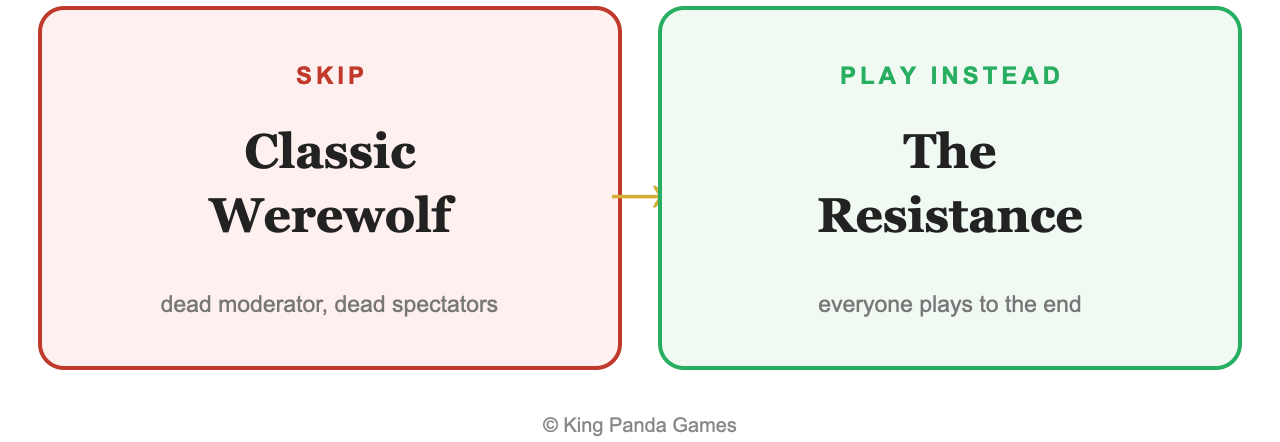
For groups of 5–10: The Resistance or Avalon — hidden traitors with no elimination and no moderator; every player argues to the very end. The complete repair kit, covered in our Coup vs. The Resistance breakdown.
For the same size group with more structure: Secret Hitler — hidden roles with no moderator, elections every round, and a policy deck that gives every liar an excuse. It does eliminate players late in the game. Our Secret Hitler review has the verdict, and Secret Hitler vs Avalon covers which to buy.
For Werewolf itself, fixed: One Night Ultimate Werewolf — the whole experience in ten minutes with an app as moderator. If this review stung and you love the wolf, this is your box.
Want more games where somebody at the table is lying? Werewolf is on our best social deduction games list, which sorts twelve by group size and says which ones knock players out.
Frequently Asked Questions
Is Werewolf a good party game?
At 12+ players with an enthusiastic moderator, it’s one of the great communal party experiences. At typical game-night sizes of 5–8, its flaws — dead spectators, no moderator to spare, charisma-driven votes — outweigh the magic, and modern successors like Coup or The Resistance are simply better.
What’s the difference between Werewolf and Mafia?
Theme only — Mafia (1986, Dimitry Davidoff) is the original with mobsters; Werewolf is the 1997 re-theme that stuck. Roles, phases, and rules are functionally identical, and the names are used interchangeably.
How many players do you need for Werewolf?
Eight is the practical minimum and 11–14 is the sweet spot, plus one person as moderator. Below eight the werewolves have nowhere to hide and games collapse in a round or two.
Do you need to buy Werewolf to play it?
No — the game is public domain and runs on a standard deck of cards (aces as wolves) plus a free moderator app or script. Paid editions add role variety and nice cards, not the game itself.
What fixes Werewolf’s problems?
Its own descendants. One Night Ultimate Werewolf removes the moderator and elimination entirely; The Resistance and Avalon keep every player alive and arguing to the end; Coup shrinks the bluffing to 15 minutes for small groups. Each was designed specifically to repair a leg Werewolf limps on.
Is Werewolf okay for kids?
From about age 10, yes, with an adult moderating the tone — the “werewolf kills” are just card flips, but the accusation dynamics can get intense, and younger kids handle being mobbed by the vote poorly. The Resistance is gentler for mixed ages since nobody is ever eliminated.
Verdict
Play it at every camp, retreat, and twenty-person gathering you ever attend — with a great moderator, it’s still magic at scale. Buy One Night Ultimate Werewolf or The Resistance instead of a classic edition; they’re this game with the broken legs healed. Skip classic Werewolf for standard game nights entirely — the genre it invented has spent thirty years improving on it, and the improvements worked.
Recommended edition: Ultimate Werewolf (Bézier Games) — or any deck of cards and a free app.