
How to Win at Sea Salt & Paper: Strategy Guide
Most people learn Sea Salt & Paper in five minutes and feel like they understand it. Then they play against someone who seems to always call the right move at the right time — stopping when everyone else expected them to keep going, calling Last Chance when the table thought they’d fold — and they realize the game has more texture than the small box suggests.
Some links below are Amazon affiliate links — as an Amazon Associate, King Panda Games earns from qualifying purchases at no extra cost to you. Full disclosure.
This guide covers the specific decisions that separate winning players from players who know the rules. If you’re still deciding whether to buy the game, check out our full Sea Salt & Paper review first.
The Stop vs Last Chance Decision Is the Whole Game
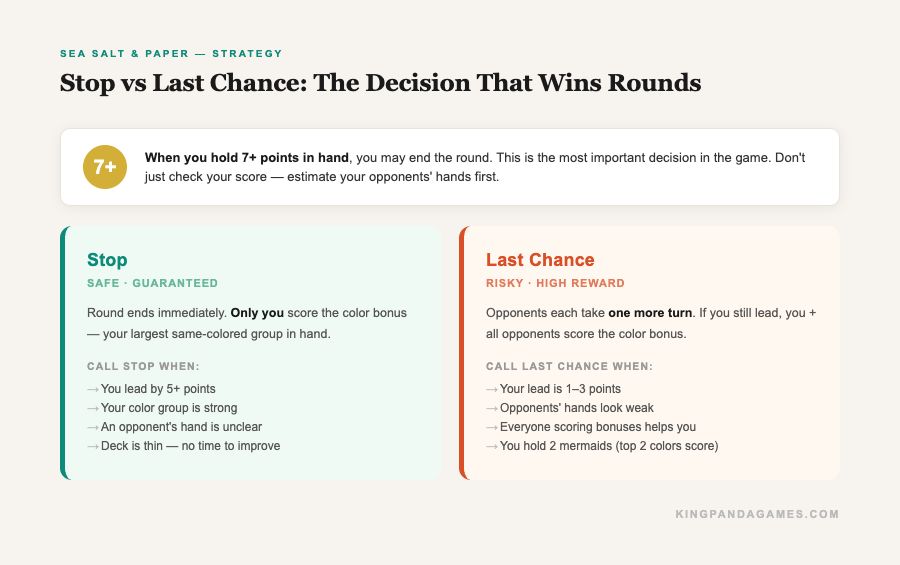
Every strategic decision in Sea Salt & Paper is working toward one moment: when you have 7+ points in hand, what do you call?
Stop gives you the color bonus immediately and ends the round. Last Chance gives everyone one more turn — but if you’re still ahead when it ends, you get the color bonus and everyone else scores their color bonus too. If someone beats you, you’ve handed them the advantage.
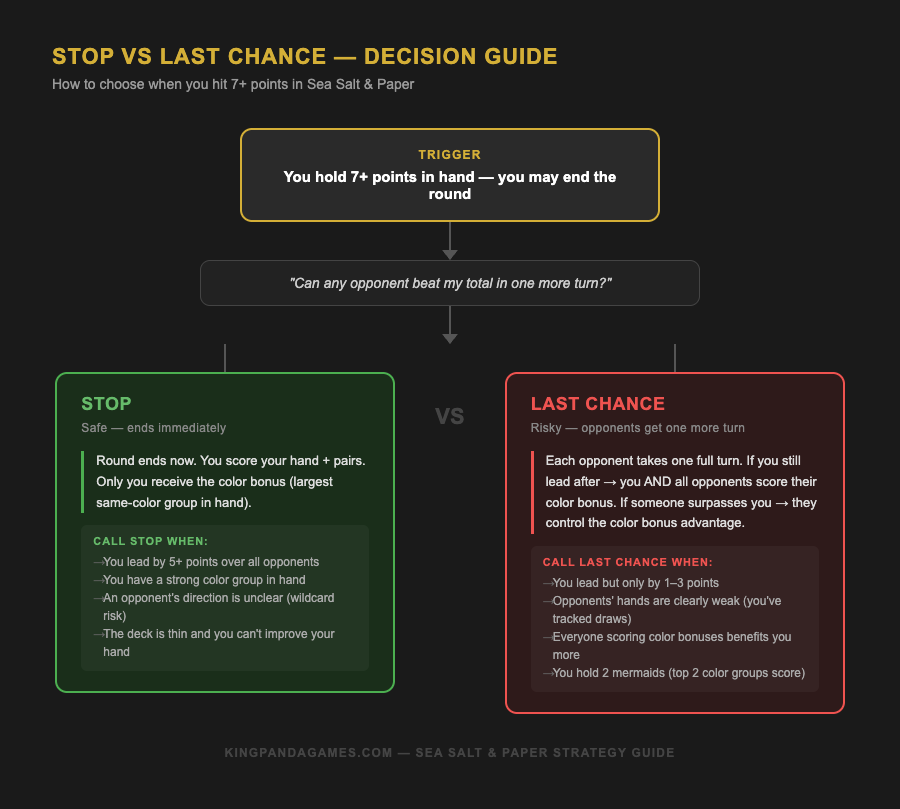
Here’s the framework:
- Count your current point total (hand cards + played pairs).
- Estimate each opponent’s total from what you’ve seen: their played pairs are face-up and known; their hand requires inference from what they’ve been drawing.
- Check your color bonus — your largest same-colored group in hand.
- Ask: can any opponent surpass me in one more turn?
If the answer is no — call Last Chance. You collect your bonus, everyone else scores their color groups, and the round total swings heavily in your favor.
If the answer is maybe — call Stop. The guaranteed color bonus is yours. You give up the extra points everyone else would have scored from their color groups, but you lock the win.
If the answer is yes — keep drawing. The threshold is a floor, not a ceiling.
The rule: never call Stop just because you can. Call Stop because you’ve done the math and you don’t need to risk Last Chance. Calling Stop at 7 points with a weak color group is often worse than taking two more turns and building properly.
The Color Bonus Is a Scoring Category, Not a Bonus
Players who think of the color bonus as extra points treat it as an afterthought. Players who win treat it as a primary scoring category that they’re actively managing every turn.
Your color bonus is the points from your largest single-color group in hand. At end of round, that’s typically worth 4–10 points depending on how many same-colored cards you’ve accumulated. Over three or four rounds, that’s 15–30 points — comparable to your entire collector scoring.
What most players do: Draw cards toward their collector sets (shells, octopi, penguins), then count the color bonus as whatever they happen to end up with. They’re optimizing for the set scoring they can see and ignoring the color bonus they could be building.
What actually works: Track the color of every card entering your hand. When two collection paths look equally good — say, you could take a blue octopus or a blue shell and you already have three blue cards — take whichever deepens your color group. The color bonus from a 5-card blue group is worth more than the marginal difference between two comparable collectors.
Two mermaids change this calculation entirely. With two mermaids in hand, your color bonus counts your top two color groups, not just one. If you’re holding three blue cards and three yellow cards, two mermaids means you score both — potentially 8–12 additional points that opponents didn’t budget for. Mermaids are a secondary win condition, but even as a color bonus multiplier they’re among the most valuable cards in the game.
Collection Priority: Which Sets to Build
Not all collectors score equally. Here’s the honest assessment:
Octopi have the highest single-collection ceiling — four octopi score 12 points. The problem is availability: there are only four octopus cards in the deck, and every player knows their value. Expect competition. Build toward octopi when you draw the first one; abandon the plan if opponents are clearly racing you for the same cards.
Shells are the most consistent. They score based on color diversity — you need 5 different colored shells for the maximum 10 points. This means you’re drawing toward breadth rather than depth, which gives you flexibility: any shell helps regardless of duplicates. If shells appear frequently in your early draws, this is almost always the right direction.
Penguins score 1, 3, or 5 points for one, two, or three penguins. The scaling looks modest but penguins are frequently available and easy to accumulate alongside other sets. Don’t build around penguins, but don’t discard them either — two penguins sitting in your hand while you build shells is a free 3 points.
Sailors score 0 points with one type and 5 points with both. One sailor alone is worth zero — if you’re holding a single sailor late in the round and another player is about to call Stop, it’s dead weight. Commit to both types or discard the first one if the second hasn’t appeared.
Denial Is an Active Strategy
The boat pair is the most underused power in the game.
New players use boat steals to take cards they want. Experienced players use boat steals to break up what opponents are building. The distinction matters enormously.
Round 3. You’re watching the player to your right take every red card that surfaces. They have four played pairs in front of them and a full hand. You draw a pair of boats. Option A: steal a card you actually need — say, a yellow shell to complete your set. Option B: steal one of the red cards they’re clearly building toward, then discard it on your next turn if it’s useless to you. Option B costs them 4–6 points and costs you nothing if red is worthless to your hand. That’s often the better steal even when the card itself has no value to you.
The fish pair (draw two from discard, keep one) is a different kind of denial. Taking a card off the top of the discard removes it from opponent access. If someone just discarded a card that would complete your color group, take it — don’t wait and hope it’s still there next turn.
Timing Pairs for Maximum Impact
Play pairs on the turns they help you most, not just the turns you have them.
Crab pairs (draw two, keep one) are best played early — you have more drawing time ahead of you, so the extra cards have more value. A crab pair in round 4 when the deck is thin is less useful than the same pair in round 2 when many relevant cards are still available.
Boat pairs (steal) are most valuable at two points: early, to deny someone building a strong base; or late, when you have a clear picture of what opponents are holding and can target the card that breaks their best collection.
Swimmer + Shark lets you look at an opponent’s hand and take one card. This is an intelligence tool as much as an acquisition tool. Even if you don’t take anything devastating, you now know their hand — which changes how you evaluate whether to call Stop or Last Chance.
Worth knowing: The discard pile is public information, and what opponents take from it tells you as much as what you’ve seen them play. If someone consistently takes from the discard instead of drawing blind from the deck, they’re either chasing a specific card or protecting their hand size. Watch the pattern — it usually reveals their direction before they commit to it.
Don’t own Sea Salt & Paper yet? This guide assumes the base game.
Check Sea Salt & Paper price on Amazon →
Frequently Asked Questions
When should you call Stop in Sea Salt & Paper?
Call Stop when you have a clear point lead and at least one strong color group in hand. If you’ve estimated opponents’ scores and you’re ahead by 5 or more points, Stop is usually correct — the color bonus is yours and you’ve locked the round. Don’t call Stop if an opponent has a large unscored color group that will close the gap once everyone reveals.
When should you call Last Chance in Sea Salt & Paper?
Call Last Chance when you have the most points but your lead is narrow — 3 or fewer points — and you need everyone scoring their color bonuses to maximize your round total. Last Chance is also the right call when you’re confident opponents have weak hands, so the extra turn they receive won’t threaten your lead.
What is the best collection to build in Sea Salt & Paper?
Shells are the most consistent — they score from color diversity, so any shell helps regardless of color, giving you flexibility. Octopi have the highest ceiling at 12 points (four octopi) but are rare and heavily contested. Prioritize whichever collection type appears most frequently in your early draws, then deny opponents the cards they need once your direction is set.
Are boat steals worth using in Sea Salt & Paper?
Yes — boat steals are most valuable as denial tools, not just acquisition tools. Stealing a card that breaks an opponent’s collection is usually more impactful than taking a card you want. One steal that prevents a 10-point shell set costs your opponent 6–8 points and potentially wins you the round.
How important is the color bonus in Sea Salt & Paper?
The color bonus is decisive — treat it as a primary scoring category, not an afterthought. A 5-card color group scores 10 points. Controlling who gets the color bonus through the Stop/Last Chance decision is often the difference between winning and losing a round. Experienced players are actively building their color group alongside their collectors from turn one.